The Bond Market Deals a Blow to the AI Bull Market

marsbit2026-05-19 tarihinde yayınlandı2026-05-19 tarihinde güncellendi

Özet

The article "Bond Market Deals a Blow to the AI Bull Market" discusses how a recent global bond sell-off is threatening to end the AI-driven stock market rally that had been ongoing for about a month and a half. A sharp sell-off in global equity markets began last Friday, with significant declines in indices like South Korea's KOSPI and Japan's Nikkei 225. The primary suspect, according to Morgan Stanley, is the bond market. Key long-term bond yields, such as the U.S. 30-year Treasury and Japan's 10-year government bond, have surged to multi-decade highs. This breach of critical yield levels (like 5% for the 30-year U.S. Treasury) is seen as a dangerous signal that historically precedes risk asset corrections. The root cause is identified as resurgent inflation, fueled by rising oil prices due to renewed Middle East geopolitical tensions, specifically the breakdown of U.S.-Iran talks and the blockade of the Strait of Hormuz. This has led markets to drastically revise expectations for U.S. Federal Reserve policy, now pricing in a significant chance of future rate hikes instead of cuts. Higher bond yields negatively impact stocks, especially high-growth tech/AI stocks, through two main channels: 1. **Valuation Pressure:** Higher yields increase the discount rate used to value future earnings, making the present value of distant AI-related cash flows less attractive. 2. **Relative Attraction:** Safer government bonds offering ~5% yields reduce the appeal of riskier equity i...

Author: Ba Xiao Ling, Wu Xiaobo Channel

The AI bull market, which had been rebounding for a month and a half, appears to be nearing its end.

From last Friday to yesterday, global capital markets were hit by a wave of selling.

Last Friday was the most brutal. Global stock markets saw widespread declines. South Korea's KOSPI plummeted 6.12%, triggering a trading halt at one point. Japan's Nikkei 225 index plunged 6.22%. The three major US stock indices performed poorly, with the Nasdaq Composite falling 1.54%. China's Shanghai Composite Index lost 2.5% over two days, with two consecutive negative sessions shaking market confidence.

This Monday, the A-share and Hong Kong markets continued to show weakness. The Nikkei 225 fell 0.97%. In the evening, the three major US indices also opened and trended weaker.

Who pulled the market's bull back?

According to Morgan Stanley, the main suspect is the bond market.

On Monday (May 18th), during the Tokyo morning session, the Japanese bond market saw a significant adjustment. The yield on the 10-year government bond briefly touched 2.797%, setting a new market record in nearly three decades, reaching its highest point since October 1996. Previously, the US 30-year Treasury yield had also breached the 5% level, touching 5.12% in actual trading, a new high since 2007.

The trouble isn't limited to the US and Japan.

The yield on French 30-year government bonds is as high as 4.675%; Germany's 30-year yield is at 3.704%; and the UK's 30-year yield is even higher at 5.86%.

By Monday, although bond market volatility had eased compared to the sell-off that swept through markets on Friday, yields remained near multi-year highs.

This wave of selling in global bond markets is now threatening global stock markets. Morgan Stanley warns that if bond market volatility intensifies further, US stocks could see their first meaningful correction, which could lead to the end of the entire AI bull market.
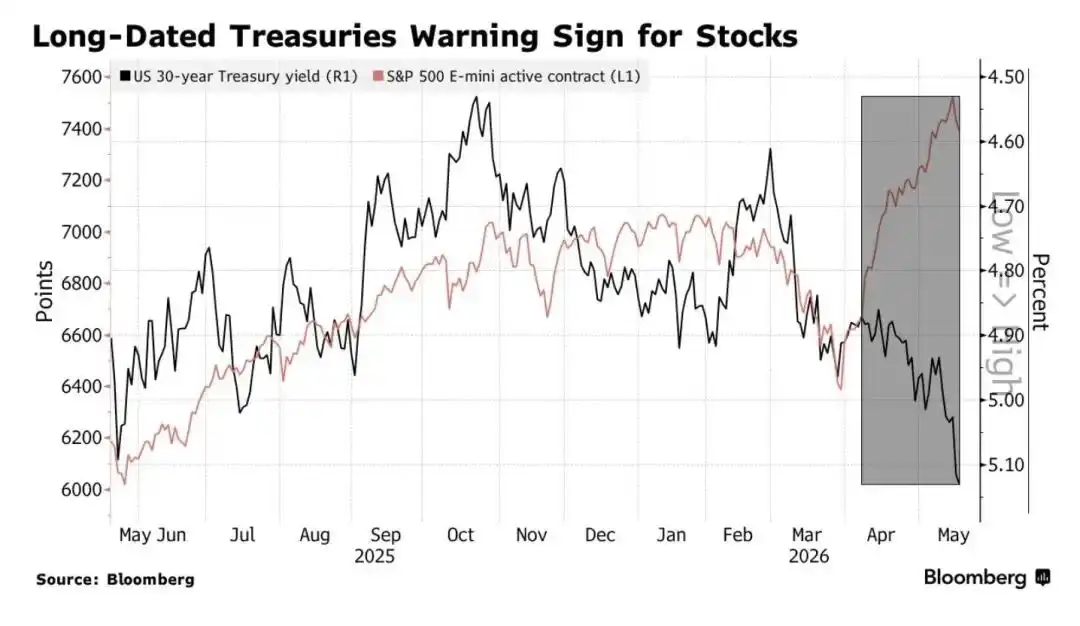
High Bond Yields Weigh on Stocks

The Bond Market's "Maginot Line" Breached

In the bond market, bond yields and prices are inversely correlated. The more bonds investors sell, the higher the bond yields rise.

Michael Hartnett, chief strategist at Bank of America, believes that when the 30-year US Treasury yield crosses 5% and the 10-year yield breaks through 4.5%, it is a dangerous signal. Citing historical experience from the past century, he argues that once inflation crosses this threshold, capital markets may trigger large-scale deleveraging shocks, and risk assets often enter a correction phase. The S&P 500 index tends to fall by an average of 4% in the following three months and 7% within six months.

Thus, these two levels became the "Maginot Line" for the bond market.

Now, this line has been breached.
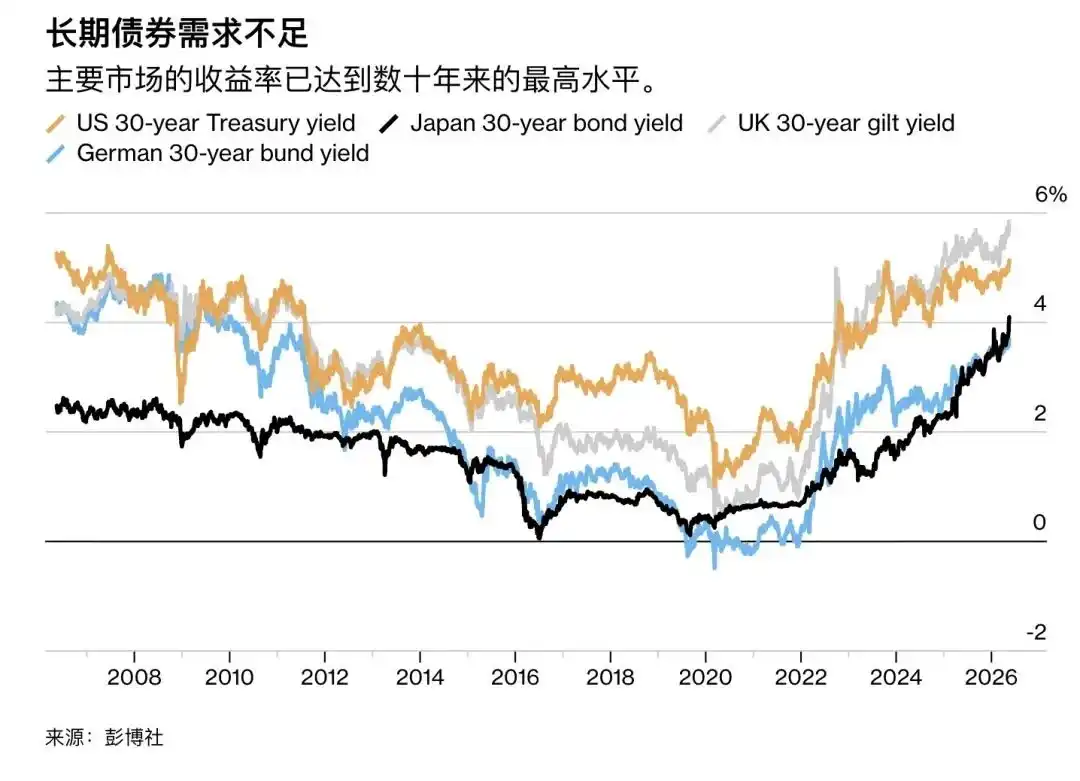
So, who is the culprit that broke through the bond market's defense line?

The answer is not difficult: it's the energy prices that the market has gradually become desensitized to over the past month or more.

Due to the substantive breakdown of US-Iran negotiations and the continued blockade of the Strait of Hormuz, international oil prices have risen sharply. As of the early hours of May 19th, Brent crude oil had returned above $110.
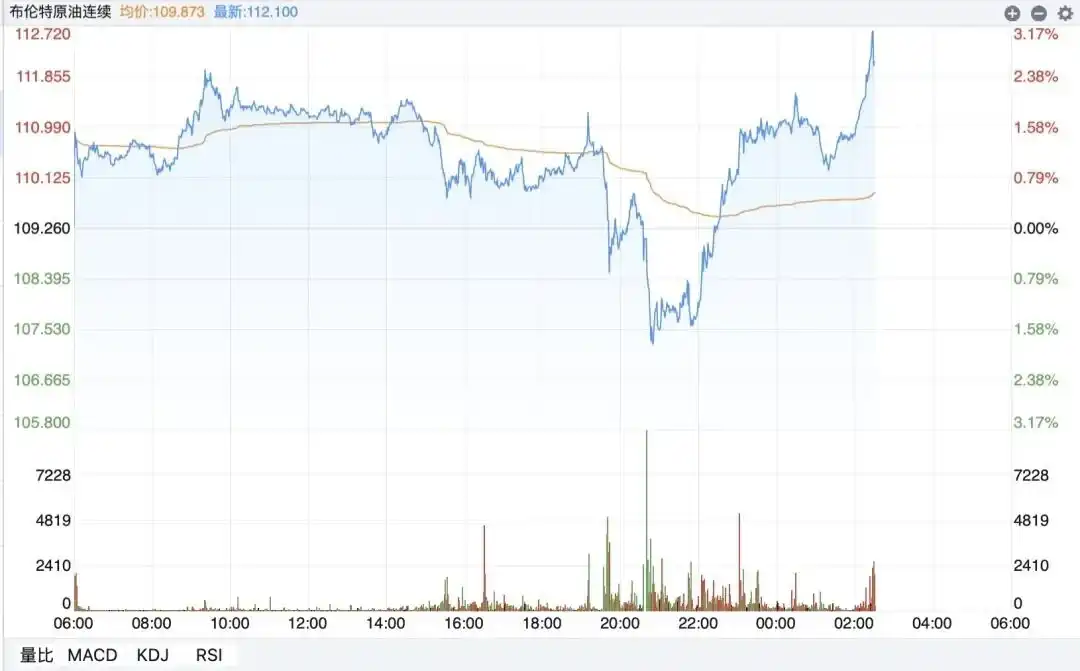
Brent Crude Breaks $110 Again

This has initiated a familiar transmission chain: Middle East geopolitical crisis → Global inflation reignites → Fed reversal expectations → Bond market sell-off.

On one hand, inflation is flaring up again in Europe and the US. Taking the US as an example, Labor Department data shows: The US Consumer Price Index (CPI) rose 3.8% year-on-year in April, higher than 3.3% in March, the highest level since June 2023. The US Producer Price Index (PPI) rose 6% year-on-year in April, reaching its highest level since December 2022.

Furthermore, according to data from prediction platform Kalshi, the probability of the US economy being hit by stagflation before the end of this year has risen from 11% to 40%.

On the other hand, the high inflation data has completely reversed market judgments about the Fed's policy path.

Under the threat of stagflation, the Fed may not only refrain from further rate cuts but might even plan rate hikes. Market forecasts now put the probability of a hike by July 2027 at 60%, meaning the market will quickly follow the Fed's lead in selling bonds, further pushing up Treasury yields.
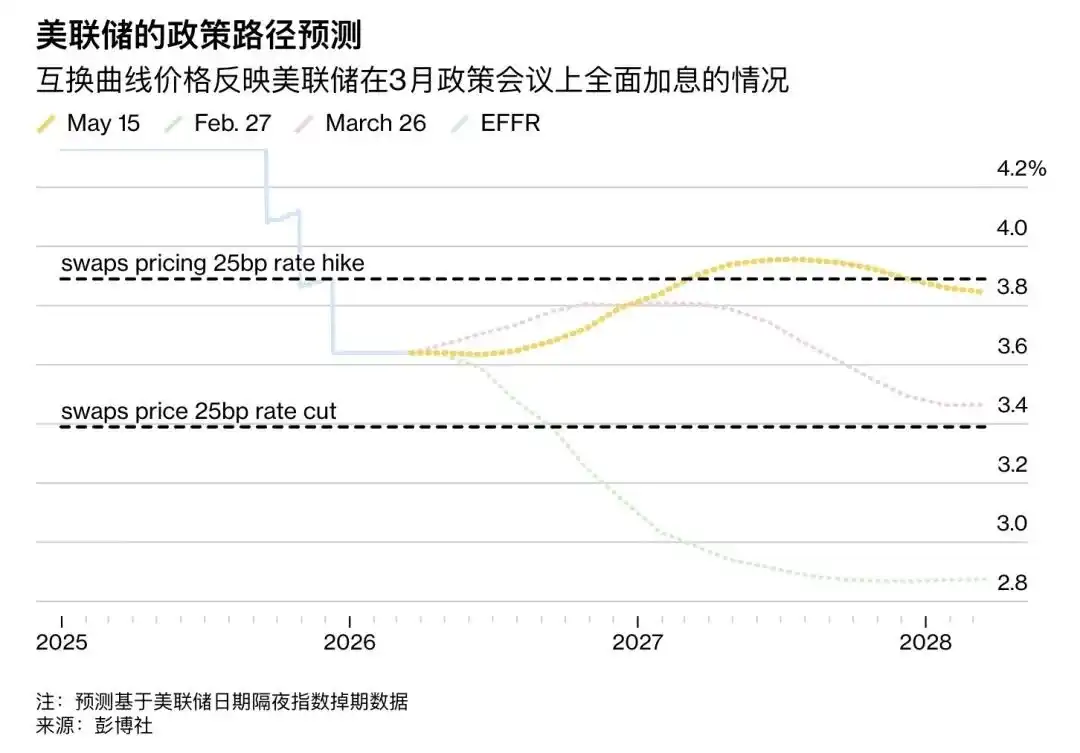
This coincides with the critical juncture of the Federal Reserve chair transition. The first task for the new chair, Kevin Warsh, upon taking office might be to closely monitor the bond market and strictly guard against inflation.

Dongwu Securities believes that the direction of the US-Iran conflict determines the short-term trend of US Treasury rates. Signals of a turning point in the US-Iran conflict and oil prices, as well as late-May PCE data, are worth watching. In the long term, when Fed rate hike expectations strengthen, attention should shift to AI industry drivers and the resilience of US economic growth.

High Rates "Discount" Tech Stocks

So why does significant volatility in the bond market pull down stock markets?

Rising US Treasury market rates mean higher market risk-free rates. Consequently, the discount rate for tech stocks also rises, leading to a collapse in the valuations of US tech stocks.

The "discount rate" refers to the interest rate used to convert future cash flows into present value. It equals the risk-free rate plus a risk premium. For the same amount of money, the higher the discount rate, the lower its present value. For AI tech stocks, most of their value lies far in the future.

Therefore, when US Treasury yields rise, the discount rate increases, applying a harsher discount to future money. This is a heavy blow to tech stocks that rely heavily on future cash flows.

This is why, in the past, whenever the Fed hinted strongly at rate hikes or long-term bond yields jumped, the Nasdaq often led the decline.

Similarly, changes in bond yields also exert valuation pressure on tech stocks in the A-share market.

Calculated using the 10-year Treasury yield: On May 18th, the US 10-year yield was 4.63%, while China's 10-year yield was 1.76%, resulting in a negative spread of 2.87%. When this spread widens, it means the relative attractiveness of risk assets in emerging markets like China declines.

As an investor, when buying US Treasuries can yield 5%, why chase uncertain returns in emerging markets, taking on currency and investment risks?

China Securities Journal cited industry expert views, pointing out that rising government bond yields in multiple countries have put significant pressure on the tech sector, represented by artificial intelligence. Rising bond yields weaken investors' motivation to hold stocks. Additionally, rising international oil prices further reinforce rate hike expectations and suppress market risk appetite for tech stocks.
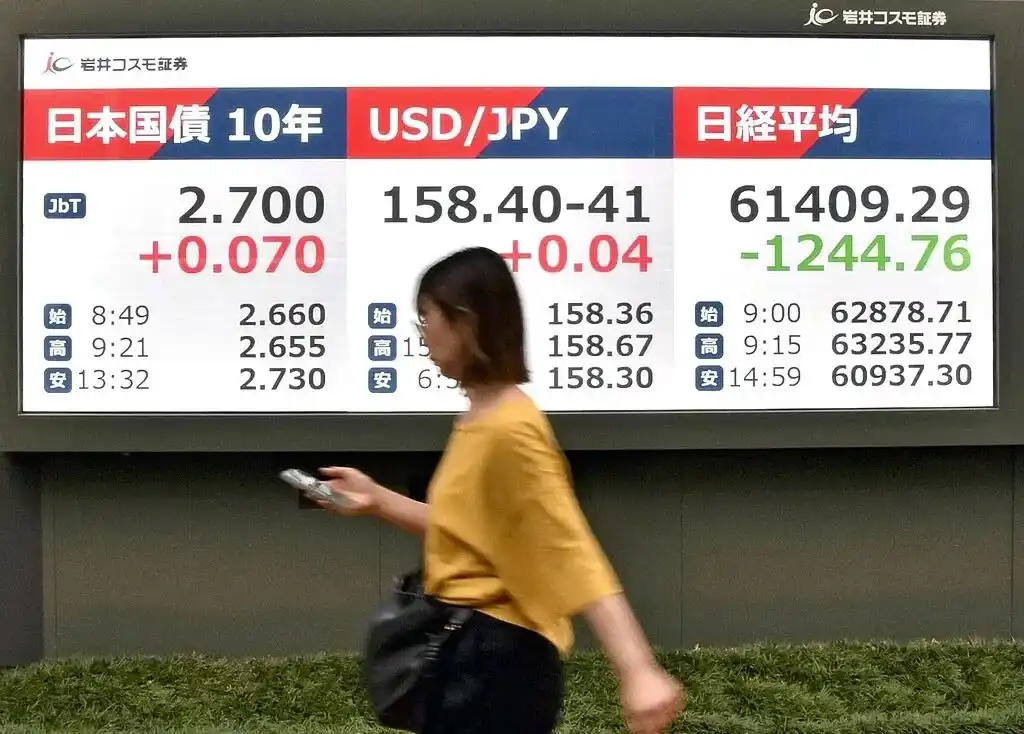
May 16th, Tokyo Stock Exchange, Nikkei Index Close

However, the outcome is not yet determined. Rich Privorozhskiy, a strategist at Goldman Sachs, believes the core market contradiction currently lies in the direct confrontation between the bond market and the AI boom, like an ongoing tug-of-war.

On the AI side, strong industry demand has given related tech stocks performance exceeding expectations, providing sustained and stable support for the foreseeable future. According to a China International Capital Corporation (CICC) research report: S&P 500 first-quarter earnings growth reached 28%, the highest since Q4 2021, with the semiconductor and equipment sector seeing growth as high as 99%. The situation in the A-share market is similar. Data shows that in Q1 2026, the revenue of the semiconductor equipment sector was 25.498 billion yuan, a year-on-year increase of 25.78%, with net profit attributable to shareholders reaching 4.446 billion yuan, a significant year-on-year jump of 60.42%.

Simultaneously, the AI boom itself has also accumulated considerable risks, which is the underlying reason why bond market movements can trigger volatility.

Earlier, UBS had already issued a clear warning that AI-related stocks and large-cap tech stocks were already severely overpriced, with growth expectations far exceeding reality. The bank's research showed that major tech stocks, including the "Magnificent Seven," exhibited excessive bullishness. Legendary investor Jim Rogers and Michael Burry, who predicted the 2008 subprime crisis, have both urged investors to reduce tech holdings and issued warnings about the AI frenzy.

How Should Ordinary Investors Respond to the New Changes?

Ray Dalio, founder of Bridgewater Associates, stated in April that the world is entering a new era dominated by "jungle rules," and investors must re-evaluate their wealth protection strategies.

In the face of these new developments, we have distilled some of the latest institutional opinions for reference:

Xinyuan Fund believes: Regarding the future trend of the A-share market, the liquidity environment has not undergone a trend change. Last week's market movements were more about high-volatility disturbances and emotional shocks, not the starting point of a systemic risk. They advise investors to increase flexibility, retain more liquid positions to cope with the high-volatility environment brought by rising US Treasury yields. In terms of sectors, they suggest continuing to focus on the AI industry chain, including domestic computing power, optical modules, and semiconductor equipment, as well as supporting directions like mechanical equipment and new chemical materials for the AI supply chain.

Huatai Securities believes: The A-share sentiment index has been running in the overheated zone for two weeks, with the valuation differentiation coefficient approaching the highs of 2021. Rebalancing pressure between sectors is rising, and the adjustment is likely to involve trading time for space. For allocation, they suggest continuing to hold core positions in tech themes like communication equipment and memory. Within the tech sector, switches could be considered towards semiconductor (core stocks) equipment, discrete devices, and other directions.

Bewildering geopolitical crises and the massive AI revolution are placing global markets in an awkward position. Whether to cash in or charge ahead, investors may need to do their homework carefully in the coming period.

As "the father of global investing," Sir John Templeton, said: "Bull markets are born on pessimism, grow on skepticism, mature on optimism, and die on euphoria."


İlgili Sorular

QAccording to the article, what triggered the global sell-off in equity markets and threatened the AI bull market?

AThe global sell-off in bond markets, where yields on major government bonds (like U.S. and Japanese 30-year bonds) surged to multi-year or multi-decade highs, triggered equity market declines and threatened the AI bull market. This bond sell-off was partly driven by resurgent inflation fears due to rising oil prices from renewed Middle East tensions.

QWhat specific threshold levels for bond yields did Bank of America's chief strategist identify as a 'danger signal' for risk assets?

ABank of America's chief strategist, Michael Hartnett, identified the 5% level for the U.S. 30-year Treasury yield and the 4.5% level for the 10-year U.S. Treasury yield as critical 'danger signals' or 'Maginot Line' thresholds. Historically, breaching these levels has often led to corrections in risk assets.

QHow does an increase in bond yields (like U.S. Treasury yields) negatively impact the valuation of technology/AI stocks?

AHigher bond yields increase the discount rate used to value future cash flows. Since technology/AI stocks derive much of their value from expected profits far in the future, a higher discount rate significantly reduces their present valuation, making them less attractive compared to safer assets offering higher yields.

QWhat are the two main opposing forces, according to Goldman Sachs, that are creating a 'tug of war' in the current market?

AGoldman Sachs strategist Rich Privorotsky described the current market as a 'tug of war' between two opposing forces: 1) The strong fundamentals and earnings growth driven by the AI boom, and 2) The pressure from rising bond yields and market volatility.

QWhat investment strategy suggestions does the article mention for ordinary investors facing the current market volatility?

AThe article mentions suggestions from institutions like鑫元基金 and华泰证券: increase portfolio flexibility and maintain机动仓位 (maneuverable positions) to handle volatility; focus on AI industry chain sectors (e.g., domestic computing power, optical modules, semiconductor equipment) and supporting industries; within tech, consider rotating to segments like core semiconductor equipment and分立器件 (discrete devices).

İlgili Okumalar

STAR 50 Soars 10.73%, Why Did A-Shares Stage a "V-Shaped Reversal"?

After a prolonged decline, the Chinese A-share market staged a strong rally on July 21. The STAR 50 index surged 10.73%, its largest single-day gain in nearly a year, leading a broad-based "V-shaped" reversal. The Shanghai Composite Index rose 1.79%, the Shenzhen Component Index gained 4.81%, and the ChiNext Index jumped 7.05%. Total market turnover reached 2.97 trillion yuan, an increase of 256.1 billion yuan from the previous session, with over 3,100 stocks advancing. The semiconductor sector spearheaded the rebound, with related ETFs posting significant gains. Analysts attribute the surge to three converging factors. First, coordinated capital inflows from "national team" institutions, insurance funds, listed company buybacks, and fund house self-purchases have bolstered market liquidity and confidence. Second, supportive policy signals, including commitments from regulators to ensure stable market operations, provided a favorable backdrop. Third, a stabilization and recovery in overseas markets, notably South Korea, created a positive external environment. Institutions suggest the most severe panic selling phase for the tech sector has likely passed, following a significant digestion of crowded positions and leveraged funds. While short-term volatility may persist, the medium to long-term outlook remains underpinned by enduring trends like AI computing demand expansion and semiconductor localization. The market's focus now shifts to the sustainability of supportive fund flows, earnings reports, and upcoming catalysts from the global AI industry chain.

marsbit29 dk önce

STAR 50 Soars 10.73%, Why Did A-Shares Stage a "V-Shaped Reversal"?

marsbit29 dk önce

U.S. Tech Momentum Stocks Post Largest Single-Day Gain Ever, But Is the Plunge Over?

US tech momentum stocks staged a sharp rebound on Tuesday (July 21st). Morgan Stanley's TMT Momentum Factor surged over 12%, marking its largest single-day gain on record, exceeding even peaks from the 2000 dot-com bubble. Key momentum indices from Goldman Sachs also posted their strongest daily performances in years. The rally was led by semiconductors, with the Philadelphia Semiconductor Index jumping 4.6%. This rebound followed three consecutive down days and a cumulative 33% plunge in momentum stocks, one of the steepest drawdowns since the dot-com era. Analysts attribute the surge largely to a short squeeze. Heavy selling had pushed high-beta momentum stocks into deeply oversold territory, forcing many short sellers, particularly in Asia, to cover their positions, creating a self-reinforcing buying spiral. However, the rebound's internals appear weak. Trading volume was notably low, and advancing stocks still lagged decliners on the S&P 500, indicating a narrow, concentrated rally rather than broad market participation. Diverging views emerge on the outlook. BTIG warns the bounce has hit key resistance and recommends selling into strength, citing extreme volatility and historical parallels to past market tops. Conversely, Goldman Sachs and UBS believe the momentum unwind is nearing its end, suggesting it may be time to gradually add exposure, as positioning has been significantly reduced. They caution, however, that high volatility warrants a measured approach, potentially using defined-risk strategies. The upcoming earnings season, particularly reports from major tech firms like Alphabet, is seen as a critical test for the rally's sustainability. Simultaneously, bond markets flashed a warning, with yields rising partly due to spiking oil prices. Analysts note that if long-term Treasury yields break decisively higher, it could pose a significant headwind for equities, especially growth stocks.

marsbit36 dk önce

U.S. Tech Momentum Stocks Post Largest Single-Day Gain Ever, But Is the Plunge Over?

marsbit36 dk önce

U.S. Tech Momentum Stocks Record Largest Single-Day Gain Ever, but Has the Rout Ended?

U.S. tech momentum stocks staged a dramatic rebound on Tuesday, July 21st. Key momentum indices like the Morgan Stanley TMT Momentum Factor and Goldman Sachs' High Beta Momentum Long Index posted historic or near-historic single-day gains, fueled largely by semiconductor stocks. This sharp rally followed a severe three-day sell-off that saw momentum stocks plunge 33%, marking one of the steepest pullbacks since the dot-com bubble. Analysts attribute the bounce primarily to a short squeeze, as forced covering from over-leveraged traders, particularly in Asia, created a buying spiral. However, the rally's health is questioned due to weak market breadth—overall trading volume was low, and decliners outnumbered advancers in the S&P 500 despite the index's gain—suggesting a narrow, concentrated surge rather than broad recovery. Opinions on the sustainability diverge. BTIG strategists warn the rebound has hit key resistance levels, citing extreme volatility and historic stock dispersion as signs of an ongoing broader correction, and recommend selling into strength. Conversely, Goldman Sachs and UBS view the aggressive momentum unwinding as nearing its end, noting reduced positioning and a lack of new fundamental catalysts. They suggest the sell-off presents a selective opportunity to add exposure, albeit cautiously and gradually using defined-risk strategies. The immediate trajectory hinges on the ongoing earnings season, with market focus on Alphabet's capital expenditure guidance for AI investment clarity. Meanwhile, bond markets present a risk, with rising Treasury yields—potentially heading toward 5.5%—and widening credit spreads for mega-cap tech companies posing a threat to equity valuations. The combination of technical factors, earnings results, and macro conditions leaves the durability of the rebound in doubt.

链捕手38 dk önce

U.S. Tech Momentum Stocks Record Largest Single-Day Gain Ever, but Has the Rout Ended?

链捕手38 dk önce

Long-Divided Must Unite, Long-United Must Divide: When L1 Becomes Its Own Rollup, What Is Ethereum's Endgame?

"The Inevitable Cycle: When L1 Becomes Its Own Rollup – What is Ethereum's Endgame?" For years, the Ethereum community grappled with concerns that L2s were fragmenting the ecosystem and eroding L1's value. While L2s provided cheaper execution, they also splintered liquidity and the unified user experience of a single chain. This has prompted a fundamental reassessment of the relationship between L1 and L2. Ethereum's roadmap is evolving. The "Scale" initiative merges L1 and L2 expansion into a holistic framework. L1 itself is advancing with higher gas limits, statelessness, and zkEVM verification, no longer content to be just a low-throughput settlement layer. Consequently, the primary value proposition of L2s is shifting from merely providing cheap blockspace to offering L1 cannot easily provide: application-specific optimizations, privacy features, and flexible governance models. L2s are becoming a spectrum of execution environments with varying degrees of security inheritance from Ethereum. A critical challenge in this multi-chain future is interoperability. The vision is to make Ethereum "feel like one chain again." This relies on advancements in native account abstraction (like EIP-7702) and intent-based architectures (Open Intents Framework), where users declare desired outcomes, and solvers handle the complex cross-chain execution. Furthermore, shortening Ethereum's finality time from minutes to seconds is crucial, as it underpins trust between chains for bridges, stablecoins, and cross-chain applications. Perhaps the most provocative idea is that Ethereum L1 itself could become a form of "its own Rollup." As zkEVM and proof systems mature, high-performance nodes could execute transactions and generate validity proofs. Regular validators would then verify these proofs instead of re-executing all transactions. This blurs the traditional L1/L2 hierarchy, making "Rollup" more of a general execution-verification architecture. Native Rollup aims to integrate L2 validation more directly into the Ethereum protocol, allowing L2s to inherit L1's security more fully and move away from reliance on security councils. In the end, L2s are not destined to replace L1 or be made obsolete by it. The likely future is a unified system where diverse execution environments—each optimized for specific use cases like DeFi, gaming, or privacy—coexist. They will share a common foundation of security, liquidity, and verifiable state, seamlessly connected to restore a cohesive user experience. The next phase for Ethereum is not just about scaling through separation, but about intelligently reintegrating what was separated back into a coherent whole.

链捕手55 dk önce

Long-Divided Must Unite, Long-United Must Divide: When L1 Becomes Its Own Rollup, What Is Ethereum's Endgame?

链捕手55 dk önce

İşlemler

Spot
活动图片