Nation State To Buy Bitcoin Worth ‘Billions Of Dollars’ Soon, Insider Predicts

bitcoinist2024-11-04 tarihinde yayınlandı2024-11-04 tarihinde güncellendi

Özet

David Bailey, CEO of Bitcoin Magazine and organizer of the Bitcoin Conference, has projected that nation-state adoption of BTC is...

David Bailey, CEO of Bitcoin Magazine and organizer of the Bitcoin Conference, has projected that nation-state adoption of BTC is imminent, with investments potentially reaching billions of dollars in the near future. Bailey, a prominent figure in the BTC community, shared his insights on X, highlighting an “undercurrent of Bitcoin nation state adoption” occurring behind the scenes.

Will Nation-States Buy Bitcoin Soon?

He noted that many developing nations have initiated domestic mining programs as tests, with early adopters moving from pilots of over 100 megawatts to projects in the gigawatt range. “At this point, seems like most developing nations have funded a domestic mining program as a test. Early movers are transitioning from 100+ MW pilots to GW scale projects,” Bailey stated.

According to him, the next phase involves establishing national BTC reserves, either through strategic stockpiles, central banks, or sovereign wealth funds. He explained, “Next will be… Establishing a national Bitcoin reserve either through a strategic stockpile, via the central bank, or via sovereign wealth funds. Many countries discussing. The Overton window has shifted so dramatically on this topic, I think we’re just months away from a nation state (or a few) entering the market in size (billions of dollars every month).”

Bailey’s credibility stems from his extensive involvement in shaping pro-BTC and crypto policies at high governmental levels. As an insider, he has played a key role in advising Donald Trump’s 2024 presidential campaign on BTC-related policies.

His efforts include advocating for the release of Ross Ulbricht, founder of Silk Road, and proposing the establishment of a national Bitcoin stockpile using BTC confiscated by law enforcement agencies. Additionally, Bailey organized a presidential roundtable focused on domestic BTC mining, which led to then-President Trump saying he “want all remaining Bitcoin” mined in the US.

Over the weekend, Bailey underscored the collective efforts that went into the US presidential election and support for Donald Trump. “People have been working for 15 years to get Bitcoin to this point. So much has been sacrificed. So much lost along the way. Blood, sweat, and tears. On Tuesday we can accelerate Bitcoin adoption by a decade. We can Free Ross. Respect the effort it took to get here by voting. 1 day of effort to change the course of history.”

In addition to his policy influence, Bailey maintains robust international connections through his role in organizing Bitcoin Conferences across the United States, Europe, and the Middle East and North Africa (MENA) region. The inaugural MENA Conference is scheduled for December 9-10, where Bailey indicated that global leaders from the Middle East will gather to discuss BTC as a strategic asset and envision a “globally sound monetary system.” He further remarked that “sovereign BTC adoption in the MENA region will be one of the defining events of this epoch.”

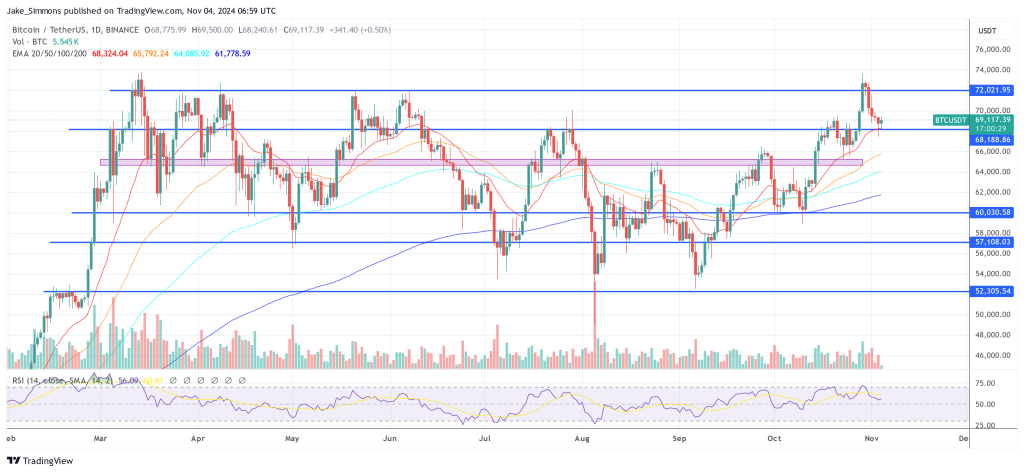
At press time, BTC traded at $69,117.
Bitcoin price
Bitcoin price holds above key support, 1-day chart | Source: BTCUSDT on TradingView.com
Featured image created with DALL.E, chart from TradingView.com
Jake Simmons

Jake Simmons

Jake Simmons has been a Bitcoin enthusiast since 2016. Ever since he heard about Bitcoin, he has been studying the topic every day and trying to share his knowledge with others. His goal is to contribute to Bitcoin's financial revolution, which will replace the fiat money system. Besides BTC and crypto, Jake studied Business Informatics at a university. After graduation in 2017, he has been working in the blockchain and crypto sector. You can follow Jake on Twitter at @realJakeSimmons.

İlgili Okumalar

South Korea’s KB Financial Completes Stablecoin Pilot As Lawmakers Press For Regulatory Framework

South Korea's KB Financial Group has completed a Proof-of-Concept (PoC) for a won-denominated stablecoin in partnership with several companies. The pilot integrated the entire financial process—from stablecoin issuance to offline payments, merchant settlements, and international remittances—into a single blockchain-based workflow. A key test involved offline payments at a coffee shop via QR code without requiring a digital wallet. For international transfers, the model converted the won stablecoin to a dollar stablecoin, completing the process within three minutes and reducing fees by approximately 87% compared to traditional methods. KB aims to launch services once digital asset regulations are established. However, South Korea's Digital Asset Act, which would establish rules for such stablecoins, faces significant delays due to a disagreement between the Financial Services Commission (FSC) and the Bank of Korea (BOK). The central bank advocates for a consortium of banks to hold a majority stake in any issuer, while the FSC worries this could stifle innovation and tech firm participation. Lawmakers and experts have urged the National Assembly to prioritize the legislation, warning that South Korea is falling behind in the global digital asset market despite accounting for 10% of global transactions. Bank of Korea Deputy Governor Chang Cheong-soo acknowledged the potential of won-pegged stablecoins as a competitive future payment method.

bitcoinist32 dk önce

South Korea’s KB Financial Completes Stablecoin Pilot As Lawmakers Press For Regulatory Framework

bitcoinist32 dk önce

The Bond Market Deals a Blow to the AI Bull Market

The article "Bond Market Deals a Blow to the AI Bull Market" discusses how a recent global bond sell-off is threatening to end the AI-driven stock market rally that had been ongoing for about a month and a half. A sharp sell-off in global equity markets began last Friday, with significant declines in indices like South Korea's KOSPI and Japan's Nikkei 225. The primary suspect, according to Morgan Stanley, is the bond market. Key long-term bond yields, such as the U.S. 30-year Treasury and Japan's 10-year government bond, have surged to multi-decade highs. This breach of critical yield levels (like 5% for the 30-year U.S. Treasury) is seen as a dangerous signal that historically precedes risk asset corrections. The root cause is identified as resurgent inflation, fueled by rising oil prices due to renewed Middle East geopolitical tensions, specifically the breakdown of U.S.-Iran talks and the blockade of the Strait of Hormuz. This has led markets to drastically revise expectations for U.S. Federal Reserve policy, now pricing in a significant chance of future rate hikes instead of cuts. Higher bond yields negatively impact stocks, especially high-growth tech/AI stocks, through two main channels: 1. **Valuation Pressure:** Higher yields increase the discount rate used to value future earnings, making the present value of distant AI-related cash flows less attractive. 2. **Relative Attraction:** Safer government bonds offering ~5% yields reduce the appeal of riskier equity investments in emerging markets and tech sectors. Despite the pressure from bonds, the AI bull market has fundamental support from strong sector earnings (e.g., semiconductor companies). The current situation is described as a "tug-of-war" between bond market turbulence and AI prosperity. However, warnings exist that AI stock valuations have become excessive. For investors, the advice is to increase portfolio flexibility. Suggestions include focusing on specific AI supply chain segments (domestic computing, semiconductors, equipment) and being prepared for continued volatility. The article concludes by noting the market is at a precarious point, caught between geopolitical uncertainty and the AI revolution, requiring careful navigation.

marsbit38 dk önce

The Bond Market Deals a Blow to the AI Bull Market

marsbit38 dk önce

İşlemler

Spot
Futures
活动图片