В III квартале криптохакеры и скамеры украли активы на $753 млн

cryptonews.ru2022-11-02 tarihinde yayınlandı2024-10-02 tarihinde güncellendi

По итогам III квартала 2024 года убытки участников криптоиндустрии в результате 155 случаев взломов, эксплойтов и мошенничеств составили $753 млн. Такие данные привели в CertiK.

🧵 Hack3D Report: Q3 2024 🧵

155 hacks, scams, and exploits drained $753,094,610 from Web3 in Q3 2024. This represents a 9.5% increase in value lost compared to Q2, despite fewer incidents.

🎥 Watch the breakdown in the video below.
📊 View the full report:… pic.twitter.com/WYhp7fGFCx

— CertiK (@CertiK) October 2, 2024

Сумма ущерба выросла на 9,5% по сравнению с предыдущим периодом — $687 млн, при этом число эпизодов сократилось на 27. С начала года кумулятивный показатель потерь достиг $2 млрд.

В июле-сентябре крупнейшим инцидентом стала кража у, предположительно, кредитора Genesis Trading 4064 BTC ($238 млн) 19 августа. В сентябре ФБР арестовало двоих подозреваемых в атаке.

Наряду со взломом в июле индийской биржи WazirX на $235 млн два упомянутых случая обеспечили наибольший вклад в квартальные потери.

Вернуть удалось $30,9 млн в 10 инцидентах. Поэтому откорректированный ущерб составляет ~$722,2 млн, при среднем значении $5,9 млн на одну атаку.

В разрезе блокчейнов антилидером оказался Ethereum. В сети произошло 86 эпизодов с совокупными убытками в размере более $387 млн. Биткоин оказался на втором месте с потерей монет на те самые $238 млн в результате единственного события.
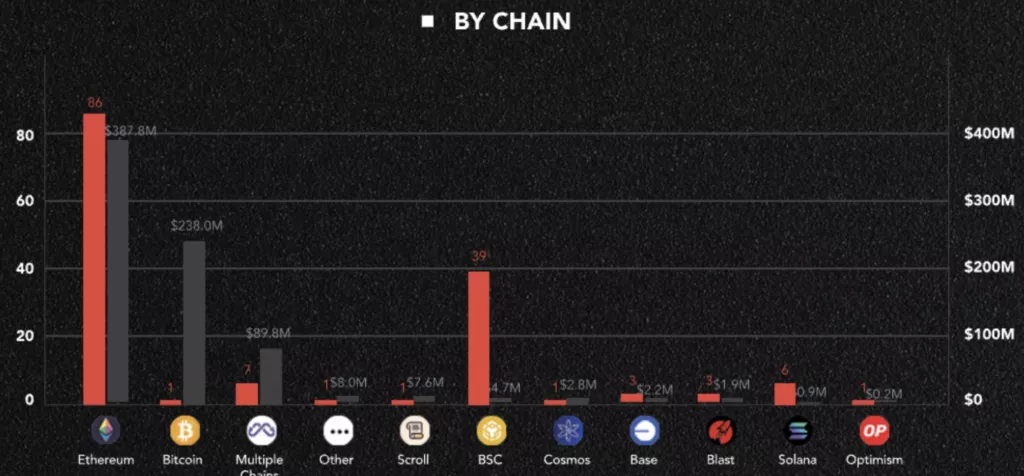
Данные: CertiK.

Фишинговые атаки принесли злоумышленникам наибольший доход за квартал — $343 млн по итогам 65 инцидентов.

«Чтобы не стать жертвой подобных атак, пользователям следует с осторожностью относиться к сообщениям с просьбой предоставить личную информацию, дважды проверять адреса веб-сайтов и электронной почты, а также включать двухфакторную аутентификацию», — отметили эксперты CertiK.

Фишинг в Web3: как защитить себя и свои активы

Компрометация закрытых ключей оказалась на втором месте — убытки в $324 млн всего за 10 таких случаев. Эти два направления ответственны за потерю 88,7% средств от общего показателя.
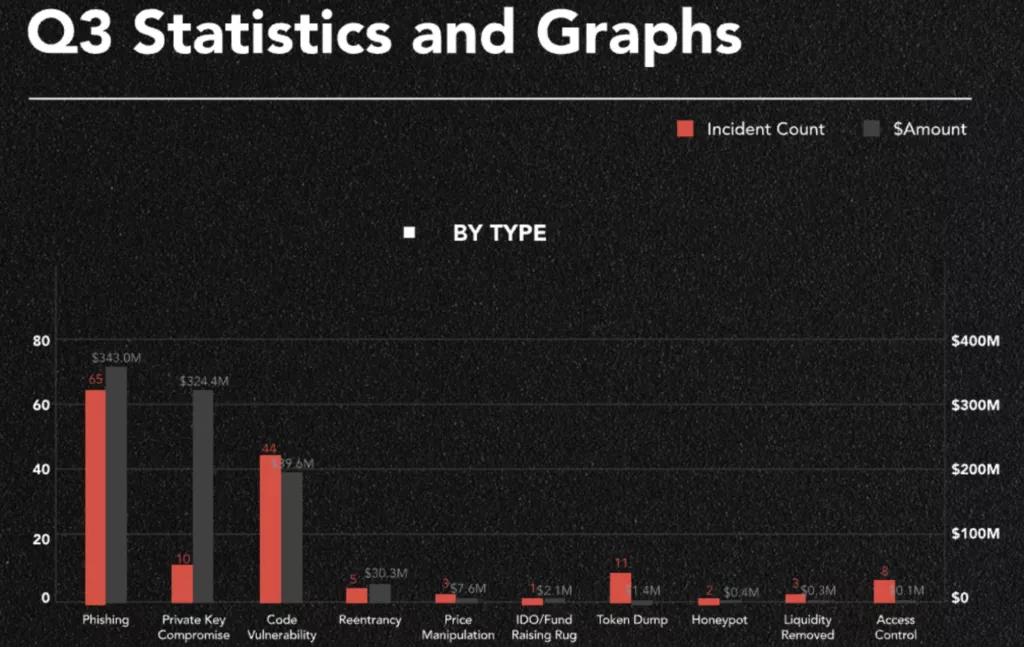
Данные: CertiK.

В числе других векторов атак оказались эксплуатация уязвимостей в коде, использование бага повторного входа и манипулирование ценами.

Напомним, эксперты Immunefi насчитали в III квартале 34 эпизода взломов и мошенничества с общим ущербом на $413 млн.


İlgili Okumalar

Former SpaceX Engineer Reconstructs Financial Execution System Using First Principles

Former SpaceX engineer Lex Li applies "First Principles Thinking" to financial infrastructure with Plan Execution Lab, recently raising angel funding at a $50M post-money valuation. The team argues that the core function of finance is capital allocation, and the critical gap is not in trading but in execution, which remains highly manual and fragmented. While assets, liquidity, and settlement have migrated on-chain, execution workflows (monitoring, risk management, liquidity coordination) are still human-native. In an era of accelerating AI agents, strategy decay is rapid, shifting the competitive edge from having the best strategy to having the most robust execution network. Plan Execution Lab introduces two core components: 1. **PlanX**: A Financial Execution Protocol designed as infrastructure for the migration from CEX to DEX, providing on-chain execution capabilities, liquidity access, risk management, and capital orchestration. 2. **Xgent**: An Autonomous Financial Runtime. Users define investment intents, risk preferences, and constraints; Xgent automatically constructs an execution graph, verifies it, and handles ongoing execution and optimization—streamlining the process from Intent to Autonomous Execution. The long-term vision is to create the "Bloomberg Terminal for Autonomous Finance"—a shared operating environment and execution network built collectively by participants like execution nodes, liquidity providers, and autonomous agents. The future of finance, they contend, belongs not to isolated algorithms but to open, collaborative execution networks.

marsbit13 dk önce

Former SpaceX Engineer Reconstructs Financial Execution System Using First Principles

marsbit13 dk önce

Former SpaceX Engineer Reconstructs Financial Execution System from First Principles

Plan Execution Lab, a financial infrastructure project founded by former SpaceX engineer Lex Li, has raised angel funding at a $50M post-money valuation. The startup is applying "first principles thinking" from Li's SpaceX experience to rethink financial market execution. Their analysis posits that while assets, liquidity, and settlement have moved on-chain, the execution layer remains fundamentally human-dependent and fragmented. In the era of AI Agents, strategy advantages decay rapidly, shifting the competitive edge from isolated algorithms to robust **execution networks**. Plan Execution Lab's solution is a two-part system: **PlanX**, a Financial Execution Protocol designed to facilitate the migration from centralized exchanges (CEX) to on-chain markets by providing core on-chain execution capabilities; and **Xgent**, an Autonomous Financial Runtime. Xgent allows users to define investment goals and constraints, then autonomously constructs and manages the execution logic—moving from **Intent to Execution Graph to Verification to Autonomous Execution**. The long-term vision is to create the "Bloomberg Terminal for Autonomous Finance"—an operating environment not for humans, but for agents and execution nodes. The future financial system, they argue, will be a collaborative network built by diverse participants contributing execution capabilities, not secret strategies. The core competition will shift to who builds the most powerful and adaptive execution network.

链捕手14 dk önce

Former SpaceX Engineer Reconstructs Financial Execution System from First Principles

链捕手14 dk önce

First Long-Horizon Doc2Repo Training Dataset: Code Agents Move Beyond Bug Fixing and Begin Creating Repositories

With the advancement of LLM Code Agents, the research focus is shifting towards long-horizon, real-world tasks, moving beyond simple bug fixes to full repository generation. To address this, researchers from Renmin University of China introduced the DeNovoSWE dataset. This dataset focuses on long-term software engineering tasks, specifically the "document-to-repository" challenge—generating an entire, executable code repository from a task description. The DeNovoSWE construction method employs a Divide & Conquer approach. It breaks down target repositories into core capabilities and uses a multi-agent Draft-Critic-Repair workflow to automatically generate high-quality, evaluation-aligned task documents. The dataset also implements difficulty-aware filtering to balance quality and diversity. The result is a high-quality, anti-leakage dataset of 4,818 instances. Experiments show that models trained on DeNovoSWE achieve significant improvements in long-horizon repository generation. For instance, Qwen3-30B-A3B-Instruct's performance on the BeyondSWE-Doc2Repo benchmark increased from 5.8% to 47.2%, and on NL2RepoBench from 4.3% to 23.0%. Similar gains were observed with stronger backbones, demonstrating that dedicated long-horizon training data is crucial for advancing Code Agents from maintainers to architects capable of planning and building complete software projects from scratch.

marsbit29 dk önce

First Long-Horizon Doc2Repo Training Dataset: Code Agents Move Beyond Bug Fixing and Begin Creating Repositories

marsbit29 dk önce

Even CZ Praised Hyperliquid as 'Awesome', But Its Biggest Moat Might Also Be Its Biggest Risk

In an episode of Galaxy Brains, Binance founder CZ praised Hyperliquid as "awesome" but clarified that while its product is strong, Binance cannot compete in its specific niche due to Hyperliquid's no-KYC, decentralized model. CZ noted he would not personally operate such a model, highlighting the inherent legal and compliance risks tied to its access advantage. The discussion underscores a core market structure conflict: on-chain perp platforms like Hyperliquid thrive on open, low-barrier access, which regulated exchanges like Binance cannot replicate without abandoning their global compliance posture. However, this very advantage makes Hyperliquid a clear target for regulatory scrutiny. The UK FCA has already issued a warning against Hyperliquid for potentially offering unauthorized services to UK users, framing it as a financial services provider rather than neutral infrastructure. Historical cases like the CFTC's action against bZeroX and Ooki DAO further illustrate that regulators may pursue decentralized structures if they facilitate leveraged trading for retail users without proper controls. Meanwhile, regulated venues like Cboe are developing US-compliant "continuous futures" that mimic perpetual exposure, narrowing the product gap. Hyperliquid's long-term edge may increasingly hinge on its access model—the very feature most exposed to regulatory pressure. The key question is whether its "access premium" can withstand escalating legal challenges as on-chain perps gain mainstream attention.

marsbit47 dk önce

Even CZ Praised Hyperliquid as 'Awesome', But Its Biggest Moat Might Also Be Its Biggest Risk

marsbit47 dk önce

İşlemler

Spot
Futures
活动图片