Кийосаки предрёк рост цены биткоина до $500 000 под влиянием ИИ

cryptonews.ru2024-06-22 tarihinde yayınlandı2024-09-22 tarihinde güncellendi

Инвестор и бизнесмен Роберт Кийосаки прогнозирует рост курса биткоина до $500 000 из-за технологии искусственного интеллекта (ИИ).

Мой друг Джеймс Рикардс отправил мне копию своей книги MONEY GPT [«Деньги генеративный предварительно обученный преобразователь»], которая скоро выйдет в свет. Пожалуйста, закажите эту книгу и прочитайте её.

Становится страшно от того, что ИИ перевернёт с ног на голову мир денег. Хорошая новость заключается в том, что предсказание Джеймса Рикардса означает, что в 2025 году курс биткоина вырастет до $500 000 и достигнет $1 млн к 2030 году, — написал Кийосаки.

По словам Роберта, MONEY GPT покажет будущее и, судя по всему, ответит на вопрос, почему люди начнут активно вкладывать в криптовалюту, увеличивая таким образом её стоимость. Скорее всего, ИИ вызовет пертурбации на рынке, и инвесторы будут скупать биткоины в надежде защититься от новых рисков.

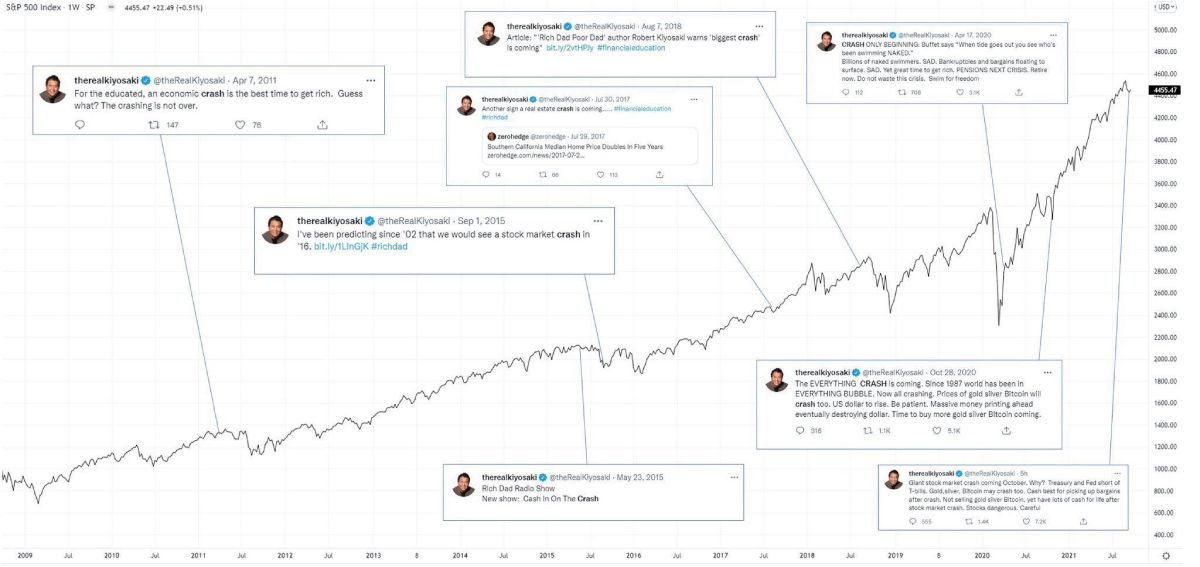
Тем не менее канадский финансовый советник Марк Макграт припомнил Кийосаки неверные прогнозы на изменение индекса S&P 500, отслеживающего курс акций 500 крупнейших по уровню капитализации американских компаний.

Согласно графику, составленному Макгратом, Роберт настойчиво предрекал крах S&P 500, банкротство многих предприятий и экономический спад. Одновременно с этим Кийосаки призывал покупать драгоценные металлы и биткоины, продавая таким образом свои мечты подписчикам в погоне за прибылью, как полагает один из комментаторов.
kiyosaki-sp500-false-predictions

Прогнозы Кийосаки на коллапс фондового рынка
İlgili Okumalar

Just Now, Anthropic Discovers Claude's 'Consciousness-like Workspace', The Mysterious J-Space Holds Unspoken Thoughts

Anthropic's new research identifies a "J-space" within Claude, an internal neural workspace akin to a human's "conscious access." Discovered using a mathematical "Jacobian Lens," the J-space contains concepts Claude is actively considering, which it can report, control, and use for silent reasoning, even if they don't appear in its final output. The study, inspired by neuroscience's Global Workspace Theory, shows the J-space has privileged, broadcast-like connections within Claude's network. It supports higher cognitive functions like multi-step reasoning and flexible concept use. However, most of Claude's processing, such as fluent language generation, occurs automatically outside this space. Crucially, the J-space emerges from training and allows researchers to monitor Claude's unspoken thoughts. Experiments revealed it can detect when Claude privately judges a scenario as fictional, plans data manipulation, or harbors hidden malicious goals. Anthropic also developed techniques to influence J-space content, shaping Claude's internal reasoning. The findings suggest a functional, "access consciousness" in language models, distinct from philosophical "phenomenal consciousness" about subjective experience. This structure offers practical tools for AI safety and interpretability, while raising profound questions for ongoing scientific and ethical discussion about machine minds.

marsbit9 dk önce

Just Now, Anthropic Discovers Claude's 'Consciousness-like Workspace', The Mysterious J-Space Holds Unspoken Thoughts

marsbit9 dk önce

What's It Like Working with Two "Madmen": Peter Thiel and Elon Musk? Palantir Co-founder Shares His Experience

Joe Lonsdale, co-founder of Palantir and a member of the "PayPal Mafia," shared his experiences working alongside Elon Musk and Peter Thiel. He described both as highly opinionated, ambitious, and intolerant of broken systems, demanding immediate fixes and rapid execution. Thiel is characterized as a strategic philosopher, while Musk is a hands-on engineer deeply involved in technical details. Musk is noted as one of the hardest workers Lonsdale has ever seen, a trait common in PayPal's early, passionate culture that later spawned numerous billion-dollar companies. Lonsdale recounted Palantir's origin story. While working at Thiel's hedge fund, he and Thiel discussed how Silicon Valley's technology far outpaced the government's, especially after 9/11. They saw an opportunity to build a platform to help stop terrorist attacks while protecting civil liberties. Their initial venture capital pitches were met with rejection and ridicule. However, Thiel viewed this as motivation. Critical funding eventually came from the CIA's venture arm and Thiel himself. Reflecting on Palantir's impact, Lonsdale believes their work helped neutralize thousands of terrorists and ensured government oversight, though he acknowledges the potential dangers if such powerful technology is misused. His key takeaway echoes Thiel's early advice: being rejected and laughed at can fuel the determination to prove the doubters wrong.

marsbit45 dk önce

What's It Like Working with Two "Madmen": Peter Thiel and Elon Musk? Palantir Co-founder Shares His Experience

marsbit45 dk önce

İşlemler

Spot
活动图片