什么是 DAO 核心领导力?

The SeeDAO2022-06-09 tarihinde yayınlandı2022-06-09 tarihinde güncellendi

Özet

talentDAO应用组织科学的研究,介绍了DAO核心领导力框架,旨在让DAO成员学习有效的领导行为,以推动进展,激励忠诚,激发协调。

talentDAO应用组织科学的研究,介绍了DAO核心领导力框架,旨在让DAO成员学习有效的领导行为,以推动进展,激励忠诚,激发协调。

马克·吐温曾经说过:"我没时间写一封短信,所以我写了一封长信。"于是我们在写《DAO领导力:建造在巨人的肩膀上》一文时也这样做了。这篇文章,是我们过去超过25年时间里,对DAO领导力研究的总结。前方预警,它属于“太长了,看不完”的文章。

01

领导力与DAO

领导力为组织提供方向、鼓舞和协调,以帮助其实现目标。随着组织的演化,出现了"去中心化自治组织"(DAO),它去中心化地治理和运作,带来了关于领导力的新问题。

在DAO中,"组织"意味着:

虚拟的、距离上分散的,高技能、自主的专业人员群体,他们将信息技术作为工作过程的一个组成部分,这种工作过程很难被标准化,特定的能力贡献需要被协调组织,从而实现复杂的、通常是无形的工作成果。[1,2]

在这些条件下运作的团体,纯粹的等级制领导是不可行的,原因有很多——其中包括工作不同步、沟通方式的匮乏、各自不同的背景文化——而这会导致意想不到的后果:单一领导人有可能成为团队失败导火索。因此,鉴于这些组织的性质,我们必须找到比等级制领导更合适的团体领导形式。

关于DAO领导力的说法比比皆是:它们是无领导的,没有老板,软件即规则,又称"代码就是法律"。对许多人来说,谈论DAO领导力是一个自相矛盾的说法。这不禁让人想起等级制度的矛盾:等级制度激励个人向上爬,这导致不同等级的成员有相反的利益和观念,并最终导致冲突,于是人们反过来又反对等级制度。然而,没有等级制度,DAO如何协调?谁负责执行提案?如何分配任务让成员各尽其职?如果每个人都是想一出是一出,谁来解决可能出现的冲突?归根结底,DAO中的领导到底是什么?

02

什么是DAO核心领导力

核心DAO领导力是灵活共享的,而不是由单人掌握的。DAO的目标应该是建立最低限度的有活力的等级制度[3],随着环境的演变而诞生和消亡。重点在于避免等级制度固化为全职的、自上而下的、僵化的安排,这些都会使权力集中,拖慢团队的进步,并损害士气。

在这样的前提下,我们把DAO领导力定义为:

一种动态的、层创进化的团体属性。人们灵活地相互领导——根据DAO不断变化的需求和背景,有选择地使用技能和专业知识——通过分担责任来执行具体的领导行为,以实现团体或组织目标。

在中心化组织中,领导者根据预先确定的角色接受正式任命,对人员和资源施加自上而下的影响/控制,随着阶梯的攀升而积累权力和权威,并根据他们的等级而不是贡献,给予最大的奖励。

在DAO中,成员共同管理和共享所有,参与决策,集体承接任务,与其他成员合作以实现他们的共同目标,并作为一个集体获得收益。领导者根据当下的情况(手头的问题)正式或非正式地出现,因此没有单一领导,只有领导者们。然而,我们不禁要问,在DAO中领导是什么意思?贡献者有责任履行哪些领导行为?
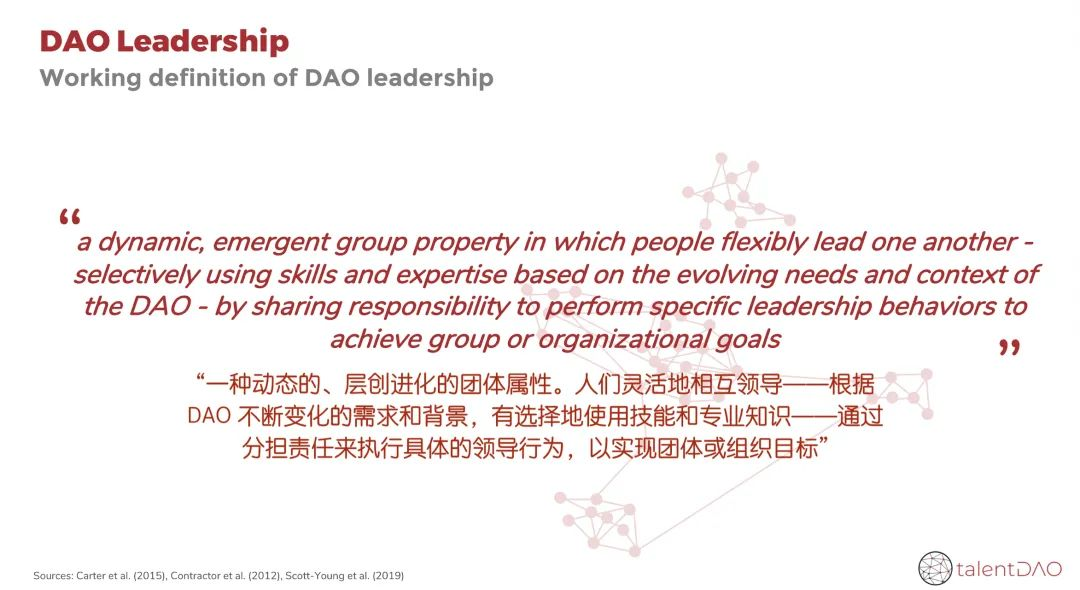
talentDAO关于DAO领导力的工作定义

03

领导行为效能的民主化

在DAO中的领导工作可以归结为,做那些维持组织运行的事情。在组织科学领域数十年的实地研究的基础上,我们开发了一个领导行为框架,该框架推动个人和组织取得结果,并适用于DAO。我们称其为DAO核心领导力,它包括自我、团体、任务和领导变更,经验研究表明这些行为可以提高组织的效能。
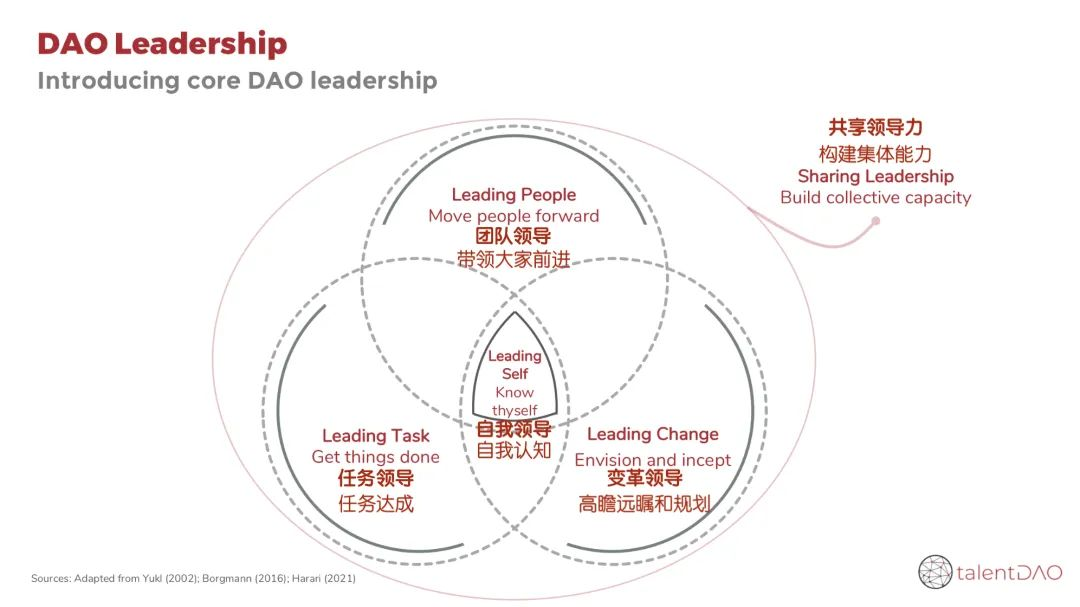
什么是DAO核心领导力

分享领导力意味着,这些行为的所有权要为促使团体效能服务,要以促进团队发展的方式行事。除了正式领导力的影响之外,非正式的领导力也可以对组织绩效产生重大影响。事实上,在共同领导的条件下,每个人都可以在组织中发挥作用,无论它是大是小。因此,DAO的目标是达到一种状态,即集体通过和谐地执行以下四组领导行为来领导自己。

04

驱动成果的领导行为

自我领导

自我领导意味着由内而外的领导:你通过自己的思想和行为影响自己,然后才想到影响和领导他人。自我领导的核心是人们对更高层次目标的追求,以及为实现这些目标而采取的管理或控制策略行为的行动。

团队领导

团队领导意味着在关注团体先于任务。领导者给团队成员挑战,让他们把团队的利益放在个人利益之前,鼓励他们不只为金钱做事,并支持他们舒适地自主工作。

任务领导

任务领导是指为完成工作所做的事情,如确定目标和期望,明确角色,制定计划,监督团队在成果方面的进展,并发放奖励和给予成就认可。

变革领导

变革领导包含的行为有:制定和沟通变革愿景,做出战略和战术决策,鼓励跳出传统范式的思考,以及通过推动项目发展来承担风险。

05

汇总

基于组织科学领域数十年的实地研究,以及对不同的组织环境中,数十万名领导者进行的统计学习,我们建立了核心DAO领导力框架。鉴于这些研究论证的特点,我们希望研究成果能够推广到不同的领域,包括去中心化自治组织。

带来成效的领导行为

由于领导力可以对团队、单位和组织等集体产生强大的影响,通过引入DAO的核心领导力框架,我们旨在让DAO成员学习有效的领导行为,以推动进展,激励忠诚,激发协调,为去中心化工作成为工作的未来而作出贡献。

THEEND

Source

[1]循证管理中心(2019)。关于知识工作者绩效相关因素的研究文献的简要论证评估。

[2]英国特许人事发展协会(2020)。关于高效虚拟团队属性的科学文献的简要论证评估。

[3]RichardBartlett在《Patternsfordecentralizedorganizing》中提到最小可行等级的概念。

İlgili Okumalar

a16z on Hiring: How to Choose Between Crypto-Native and Traditional Talent?

Hiring in Crypto: Balancing Crypto-Native and Traditional Talent As the crypto industry grows, founders face the dilemma of whether to prioritize hiring professionals with blockchain experience or those with traditional tech backgrounds who can learn. The key is recognizing that crypto companies are still tech companies at their core and should apply proven hiring best practices. Crypto-native talent offers immediate productivity and is essential for roles involving high-stakes, specialized work like smart contract development, where errors can be catastrophic. However, traditional professionals from large-scale software companies bring valuable experience in scaling products, operational flexibility, and expertise in areas like fintech, UX, and security, which are crucial as crypto products target mainstream adoption. Recruiting requires tailored approaches. Some candidates may be hesitant due to crypto's volatility or complexity, while others are excited by its innovative potential. Assess candidates' motivations, curiosity, and alignment with the company's vision early. Emphasize the opportunity to shape technology's future and address financial incentives, such as token-based compensation, which can offer liquidity compared to traditional equity. Onboarding is critical. Identify knowledge gaps during hiring and design education programs, mentorship, knowledge-sharing sessions, and resources like blogs or courses to accelerate learning. Pairing new hires with experienced crypto professionals helps bridge gaps and fosters collaboration. Ultimately, successful teams blend both crypto-native and traditional talent, leveraging their strengths to drive innovation and growth.

marsbit35 dk önce

a16z on Hiring: How to Choose Between Crypto-Native and Traditional Talent?

marsbit35 dk önce

DeFi Hacked Again for $292 Million, Is Even Aave No Longer Safe?

On April 19, a major DeFi security breach occurred, resulting in the loss of approximately $292 million. The attack targeted Kelp DAO’s rsETH bridge contract built on LayerZero, with 116,500 rsETH stolen. The attacker initiated the exploit using funds from Tornado Cash and manipulated the LayerZero EndpointV2 contract to transfer the assets. Kelp DAO confirmed the incident and temporarily paused rsETH contracts across multiple networks while collaborating with security experts for investigation. Initial analysis suggests the root cause was a compromised private key on the source chain, with the contract secured by only a 1/1 validator set, making it vulnerable to a single malicious transaction. The attacker used the stolen rsETH as collateral on lending platforms—including Aave, Compound, and Euler—to borrow more liquid assets like WETH, accumulating over $236 million in debt. Aave alone accounted for $196 million of this amount. In response, Aave froze its rsETH markets and stated it would explore covering potential bad debt through its Umbrella safety module, which holds around $50 million in WETH. This incident follows another large exploit earlier in April, where Drift Protocol on Solana lost $280 million. The repeated high-value attacks raise concerns about DeFi security, even affecting major protocols like Aave. Users are advised to exercise caution, diversify holdings, and limit exposure to on-chain protocols until more robust security measures are established.

marsbit2 saat önce

DeFi Hacked Again for $292 Million, Is Even Aave No Longer Safe?

marsbit2 saat önce

İşlemler

Spot
Futures
活动图片