孟岩:市场结构巨变下,哪些赛道值得特别关注?

长文源:区块律动2024-08-26 tarihinde yayınlandı2024-08-26 tarihinde güncellendi

İlgili Okumalar

South Korea’s KB Financial Completes Stablecoin Pilot As Lawmakers Press For Regulatory Framework

South Korea's KB Financial Group has completed a Proof-of-Concept (PoC) for a won-denominated stablecoin in partnership with several companies. The pilot integrated the entire financial process—from stablecoin issuance to offline payments, merchant settlements, and international remittances—into a single blockchain-based workflow. A key test involved offline payments at a coffee shop via QR code without requiring a digital wallet. For international transfers, the model converted the won stablecoin to a dollar stablecoin, completing the process within three minutes and reducing fees by approximately 87% compared to traditional methods. KB aims to launch services once digital asset regulations are established. However, South Korea's Digital Asset Act, which would establish rules for such stablecoins, faces significant delays due to a disagreement between the Financial Services Commission (FSC) and the Bank of Korea (BOK). The central bank advocates for a consortium of banks to hold a majority stake in any issuer, while the FSC worries this could stifle innovation and tech firm participation. Lawmakers and experts have urged the National Assembly to prioritize the legislation, warning that South Korea is falling behind in the global digital asset market despite accounting for 10% of global transactions. Bank of Korea Deputy Governor Chang Cheong-soo acknowledged the potential of won-pegged stablecoins as a competitive future payment method.

bitcoinist4 dk önce

South Korea’s KB Financial Completes Stablecoin Pilot As Lawmakers Press For Regulatory Framework

bitcoinist4 dk önce

The Bond Market Deals a Blow to the AI Bull Market

The article "Bond Market Deals a Blow to the AI Bull Market" discusses how a recent global bond sell-off is threatening to end the AI-driven stock market rally that had been ongoing for about a month and a half. A sharp sell-off in global equity markets began last Friday, with significant declines in indices like South Korea's KOSPI and Japan's Nikkei 225. The primary suspect, according to Morgan Stanley, is the bond market. Key long-term bond yields, such as the U.S. 30-year Treasury and Japan's 10-year government bond, have surged to multi-decade highs. This breach of critical yield levels (like 5% for the 30-year U.S. Treasury) is seen as a dangerous signal that historically precedes risk asset corrections. The root cause is identified as resurgent inflation, fueled by rising oil prices due to renewed Middle East geopolitical tensions, specifically the breakdown of U.S.-Iran talks and the blockade of the Strait of Hormuz. This has led markets to drastically revise expectations for U.S. Federal Reserve policy, now pricing in a significant chance of future rate hikes instead of cuts. Higher bond yields negatively impact stocks, especially high-growth tech/AI stocks, through two main channels: 1. **Valuation Pressure:** Higher yields increase the discount rate used to value future earnings, making the present value of distant AI-related cash flows less attractive. 2. **Relative Attraction:** Safer government bonds offering ~5% yields reduce the appeal of riskier equity investments in emerging markets and tech sectors. Despite the pressure from bonds, the AI bull market has fundamental support from strong sector earnings (e.g., semiconductor companies). The current situation is described as a "tug-of-war" between bond market turbulence and AI prosperity. However, warnings exist that AI stock valuations have become excessive. For investors, the advice is to increase portfolio flexibility. Suggestions include focusing on specific AI supply chain segments (domestic computing, semiconductors, equipment) and being prepared for continued volatility. The article concludes by noting the market is at a precarious point, caught between geopolitical uncertainty and the AI revolution, requiring careful navigation.

marsbit10 dk önce

The Bond Market Deals a Blow to the AI Bull Market

marsbit10 dk önce

Circle: From Issuance to Infrastructure

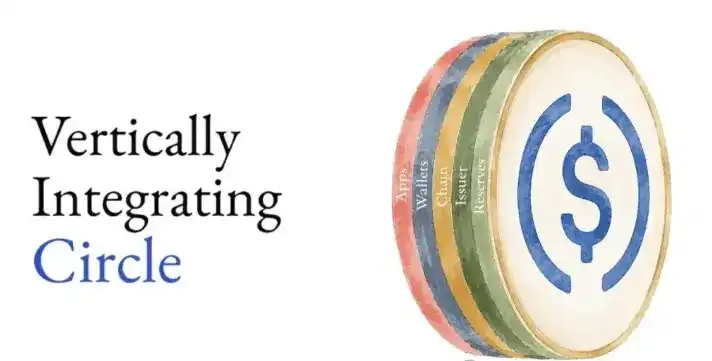
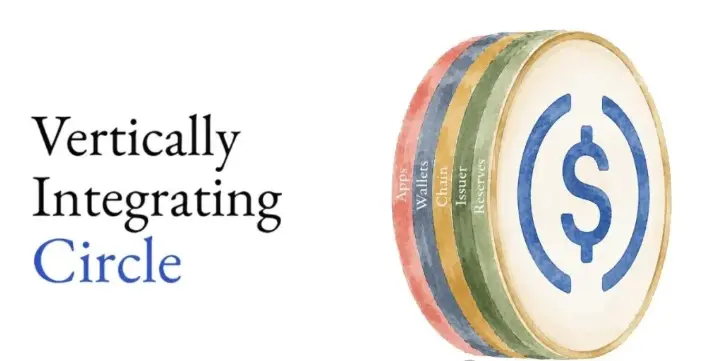
Title: Circle: From Issuance to Infrastructure Circle, the issuer of the USDC stablecoin, is undergoing a strategic transformation to reduce its dependence on interest income from reserve holdings, which is declining due to falling interest rates. Historically, Circle's revenue came primarily from the yield on US Treasury reserves backing USDC. However, it also paid significant fees (approximately 60 cents of every dollar earned) to partners like Coinbase for distributing and settling USDC. To capture more value across the financial stack, Circle is vertically integrating into three new layers: 1. **Settlement Layer:** It is launching **Arc**, a native Layer-1 blockchain. Arc, which uses USDC as its gas token, aims to capture transaction fees currently paid to other blockchains (like Ethereum and Solana) and offers features like privacy for institutional payments. 2. **Distribution Layer:** The **Circle Payments Network (CPN)** connects financial institutions directly to Circle, reducing reliance on exchanges like Coinbase. While not yet monetized, CPN growth has improved Circle's margins. 3. **Application Layer:** Circle is building an **AI Agent Economy** infrastructure with products like Agent Wallets and Nanopayments. The goal is to capture fees from high-volume, automated transactions executed by AI agents, a market where USDC already dominates. These moves represent Circle's shift from a single-product company (USDC issuance) to a full-stack financial platform. The strategy faces challenges, including market competition from players like Stripe and Tether, and potential internal tension regarding how value created by the new Arc blockchain and token (ARC) will accrue to Circle's public shareholders (CRCL). Circle's long-term success depends on its ability to successfully execute this vertical integration and diversify its revenue streams away from interest income.

marsbit38 dk önce

Circle: From Issuance to Infrastructure

marsbit38 dk önce

Circle: From Issuance to Infrastructure

Title: Circle: From Issuance to Infrastructure Circle, the issuer of the USDC stablecoin, is undergoing a strategic transformation from a single-product company dependent on reserve interest income to a vertically integrated, full-stack financial platform. Its primary revenue source, earnings from US Treasury reserves backing USDC, is under pressure from declining Federal Reserve interest rates. Furthermore, Circle pays out a significant portion (~60 cents per dollar earned) to partners like Coinbase for distribution and settlement, leading to value leakage. To address these challenges and capture more value across the payment stack, Circle announced three key initiatives in Q1 2026: 1. **Settlement Layer**: Launching its own Layer-1 blockchain, **Arc**. Designed for institutional use with configurable privacy and quantum-resistant architecture, Arc uses USDC as its native gas token, allowing Circle to capture transaction fees currently paid to other blockchains like Ethereum. 2. **Distribution Layer**: Expanding the **Circle Payments Network (CPN)**, which connects financial institutions directly to Circle, reducing reliance on third-party exchanges for USDC distribution and on/off-ramps. 3. **Application Layer**: Building infrastructure for an **AI agent economy**, including tools for agent wallets, nanopayments, and a marketplace. Circle aims to monetize the high volume of AI-driven microtransactions predominantly settled in USDC. This vertical integration strategy aims to diversify Circle's revenue away from volatile interest income. However, a key challenge remains: aligning the value capture of the new ARC token with the interests of existing public market shareholders (CRCL) who invested primarily for reserve yields. The success of this stack-wide expansion hinges on Arc's adoption and Circle's ability to balance value distribution between its core corporate entity and its new blockchain ecosystem.

链捕手44 dk önce

Circle: From Issuance to Infrastructure

链捕手44 dk önce

İşlemler

Spot
Futures
活动图片