Дежавю на крипторынке: Питер Брандт сравнивает текущее падение биткоина с 2016 годом

cryptonews.ru2022-11-06 tarihinde yayınlandı2024-08-06 tarihinde güncellendi

Питер Брандт (Peter Brandt), опытный трейдер и аналитик, заметил любопытную параллель между текущим снижением биткоина и событиями, предшествовавшими бычьему рынку 2016 года.

Дежавю или случайное совпадение?

Брандт поделился своими наблюдениями в соцсети X, заявив, что «снижение BTC после халвинга теперь похоже на то, что было в цикле бычьего рынка халвинга 2015-2017 годов». Он сравнил глубину коррекций рынка после дат халвинга и отметил сходство.

Давайте посмотрим на цифры:

  • В 2016 году халвинг биткоина произошел 9 июля, когда цена составляла $650.
  • В течение месяца рынок откатился до минимума в $474, что означало снижение на 27% после халвинга.
  • Затем цена взлетела до максимума цикла в $20 000 в декабре 2017 года.
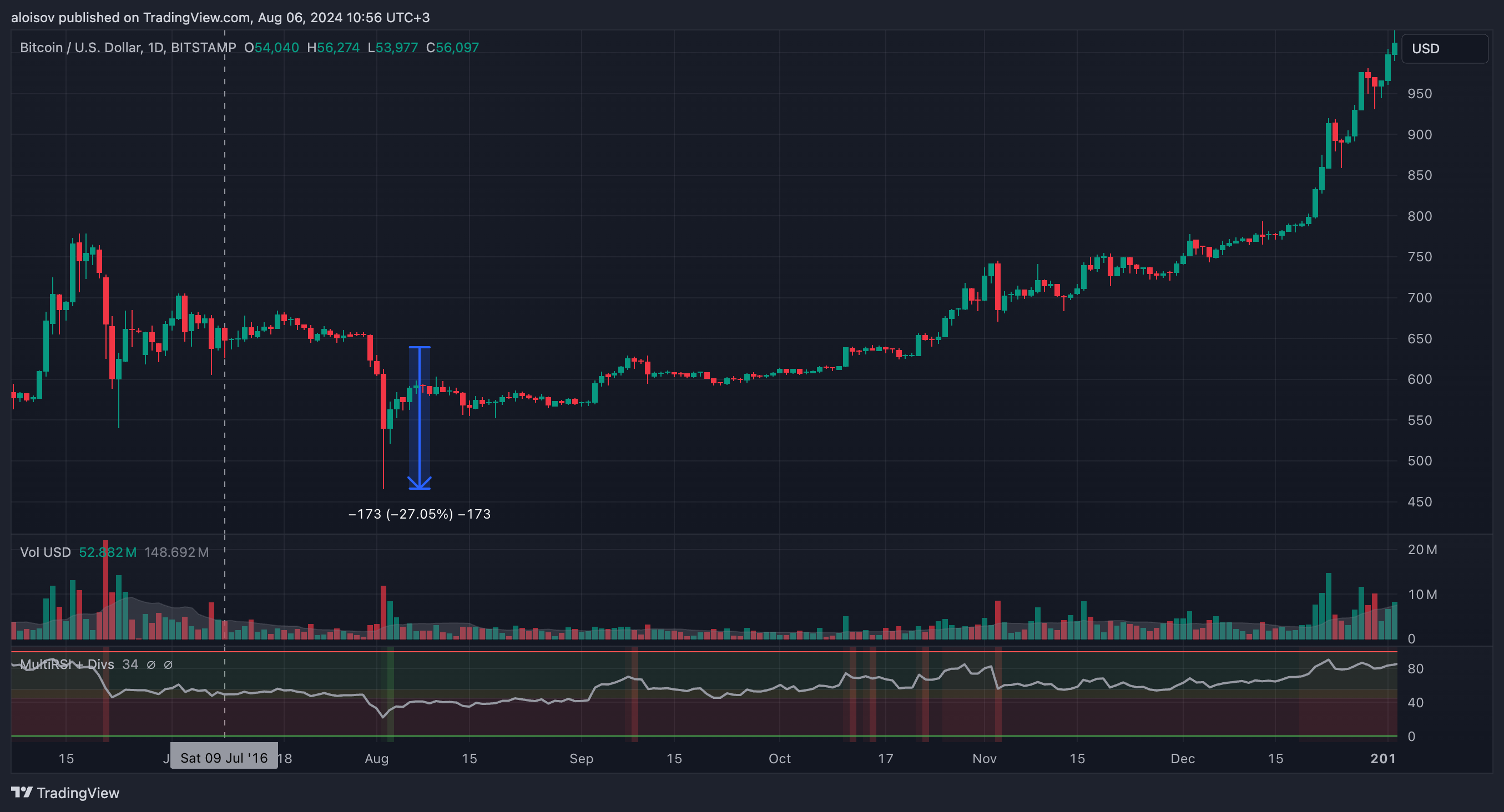
1-дневный график BTC/USD 2016 года. Источник: Bitstamp/TradingView

А теперь сравним с текущей ситуацией:

  • Недавнее падение биткоина ниже $50 000 представляет собой снижение на 26% от цены после халвинга в $64 962.

Как известно, история любит повторяться.

Не все так радужно

Однако некоторые аналитики предупреждают, что биткоин может упасть еще ниже. 5 августа цена на BTC обвалилась до $45 370, согласно данным скринера криптовалют Cryptovizor. С момента достижения $70 000 в конце июля криптовалюта потеряла 37%, но уже показывает признаки восстановления, вернувшись к отметке $56 000 во время ранних торгов в Азии 6 августа.
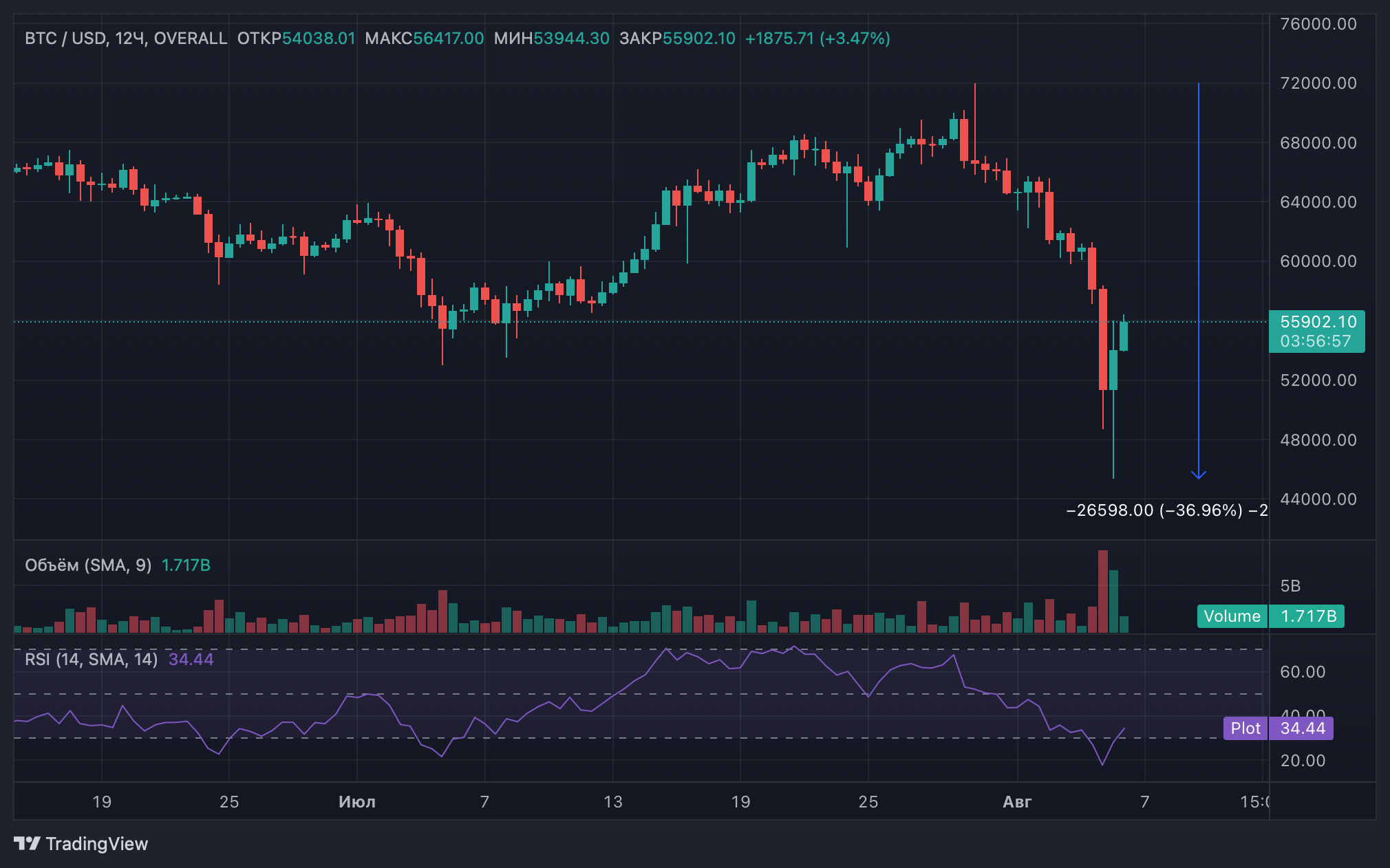
12-часовой график BTC/USD. Источник: Cryptovizor

Бенджамин Коуэн (Benjamin Cowen), основатель ITC Crypto, отметил в своем посте в соцсети X, что эта картина напоминает 2019 год, когда рынки росли в первой половине года, а затем обрушились в массивной коррекции во второй половине.
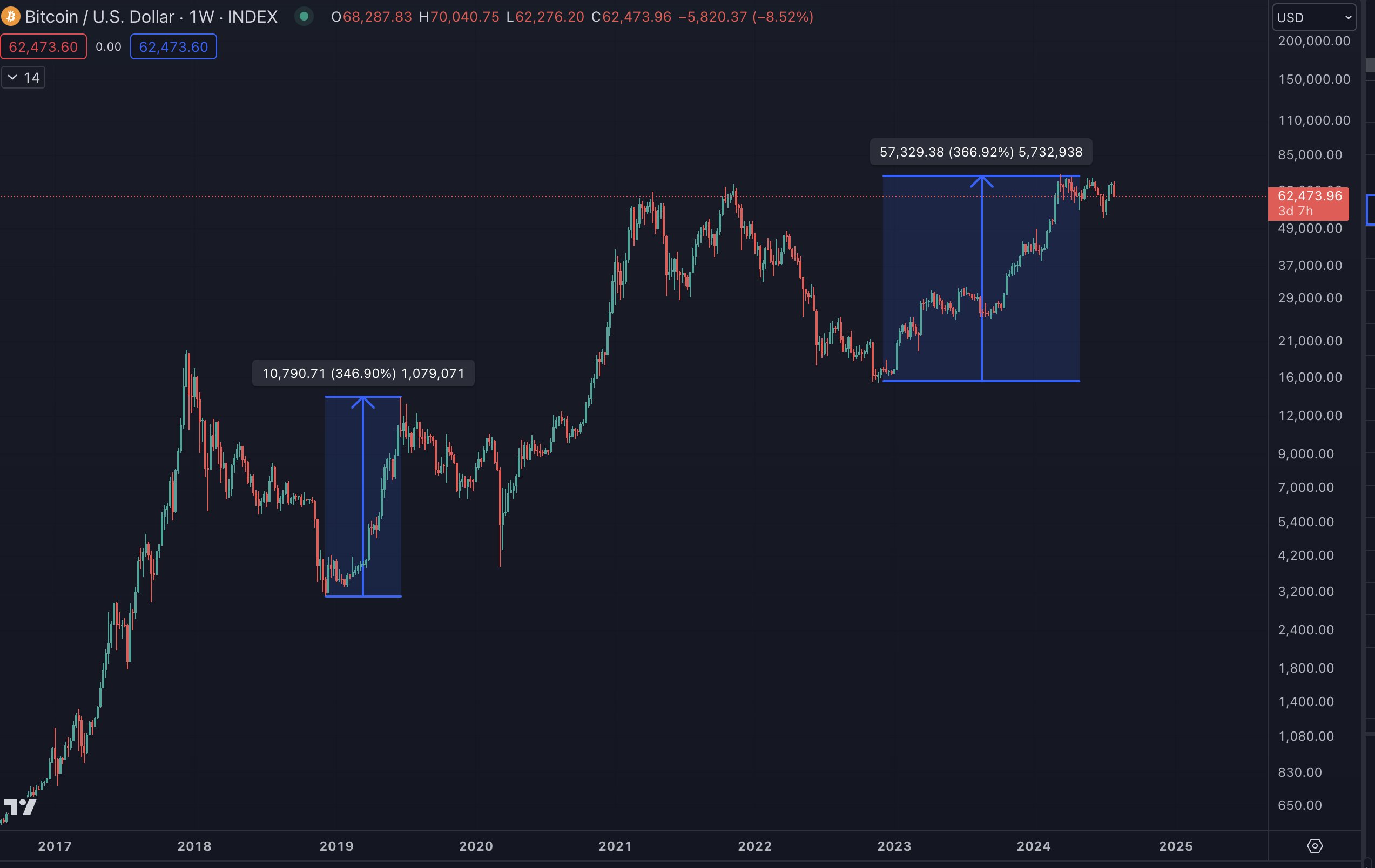
1-недельный график BTC/USD. Аналитика: Бенджамин Коуэн

Быстрое восстановление?

Тим Кравчуновский (Tim Kravchunovsky), основатель и генеральный директор децентрализованной телекоммуникационной сети Chirp, высказал мнение, что криптоактивы могут восстановиться гораздо быстрее, чем другие рисковые активы, как это было в 2020 году.

«В ближайшие часы и дни мы вполне можем увидеть разрыв корреляции между криптовалютами и акциями, подобное тому, что мы наблюдали в 2020 году», — отметил он.

Кравчуновский добавил: «Тогда криптовалюты продемонстрировали гораздо более быстрое и выраженное восстановление после обвала, вызванного пандемией, чем традиционные фондовые рынки, и на этот раз мы вполне можем увидеть нечто подобное».


İlgili Okumalar

Tidal Investment: We Remain Bullish on the AI Industry Chain, But for Different Reasons Now

Tidal Investments remains optimistic about the AI industry chain, but the rationale has shifted. The market is concerned about massive concurrent fundraising by tech giants like SpaceX, OpenAI, Alphabet, and Meta, fearing an AI peak. However, the authors argue this signals the next act of AI development, not its end. Capital expenditure (Capex) from major cloud providers (Alphabet, Amazon, Meta, Microsoft, Oracle) continues to surge aggressively into 2026. This investment cycle is more resilient than past hardware cycles due to its scale and complexity. Bottlenecks have shifted from chips to critical physical infrastructure like power grids, transformers, cooling, and data center construction—areas with long lead times and limited capacity for rapid expansion. Supply chain data (e.g., Eaton's orders) confirms substantial, tangible progress. Key market concerns are addressed: 1. **ROI vs. Capex Growth**: While Capex growth outpaces revenue, the authors note cloud giants have historically overcome similar phases through scale. The cycle will only be in danger if Capex guidance is cut, orders are canceled, or AI product demand falters—none of which are currently observed. 2. **Comparison to the 2000 Dot-com Bubble**: Unlike the telecom bubble, where cheap, oversupplied fiber crashed prices, AI infrastructure (especially power) is constrained, customized, and subject to lengthy approvals, making a similar supply glut and crash unlikely. In conclusion, the wave of fundraising reflects the immense, ongoing capital needs for AI's next phase, constrained by slow-moving physical bottlenecks. The AI cycle is not over; the script has simply changed.

链捕手4 dk önce

Tidal Investment: We Remain Bullish on the AI Industry Chain, But for Different Reasons Now

链捕手4 dk önce

Grayscale: These 15 Profitable Crypto Protocols Are Severely Undervalued

Grayscale Research identifies 15 top-revenue crypto protocols trading at significant valuation discounts, with many at single-digit or even 1x revenue multiples. Protocols like Pump.fun, PancakeSwap, and Meteora have market capitalizations roughly equal to their annual revenue. The report argues these financially-focused protocols (DEXs, lending, staking) are fundamentally undervalued and could benefit from the potential passage of the CLARITY Act, expected as soon as next month. This legislation aims to clarify digital asset regulation, potentially reducing institutional barriers and driving on-chain activity. The analysis breaks down the protocols into three groups: the "1x Club" (market cap ≈ revenue), mid-tier protocols with 3-9x multiples (e.g., Aave, Lido, Jupiter), and high-multiple protocols like Hyperliquid (15x) and Uniswap (37x), where valuation reflects future potential rather than current cash flows. Grayscale applies a traditional DCF model to Aave, suggesting a one-year price target of ~$175, representing ~130% upside from current levels. The report notes a risk-off macro environment since the Iran conflict has further compressed valuations, creating a potential entry window. The conclusion highlights that while the valuation data presents an intriguing opportunity, the investment thesis is contingent on the CLARITY Act's passage and subsequent institutional capital flows. Investors are cautioned to consider Grayscale's inherent conflict of interest as a crypto asset manager with products tied to these assets.

marsbit32 dk önce

Grayscale: These 15 Profitable Crypto Protocols Are Severely Undervalued

marsbit32 dk önce

Sam Altman's Personal Alchemy of Wealth: Investing in 400 Companies, Over 10 Deeply Tied to OpenAI

The article investigates Sam Altman's personal wealth strategy, centered around his investments in approximately 400 companies while serving as OpenAI's CEO. Despite not holding direct equity in OpenAI, Altman has built a vast portfolio, with at least 10 of his investments having commercial ties or ongoing negotiations with OpenAI. This creates a complex network of potential conflicts of interest, drawing scrutiny from U.S. congressional committees and state attorneys general. Key investments highlighted include the anti-aging startup Retro Biosciences (valued at $258 million for his stake as of late last year) and the chipmaker Cerebras, whose value soared following an OpenAI procurement deal. His most significant financial gain is linked to the nuclear fusion company Helion, where a recent funding round reportedly increased his stake's value to at least $4.1 billion. The article details a decade-long relationship between Altman, Helion, and OpenAI, including a controversial non-binding power purchase agreement and Altman's efforts to secure investments from OpenAI and its backer SoftBank for Helion. Other points include internal investigations at Tools for Humanity (developer of Worldcoin) and OpenAI's massive contracts with tech giants like Nvidia. According to Forbes, Altman's net worth is around $3.4 billion, ranking him 1251st globally—a rise of over 1400 places since 2024. OpenAI's board states that Altman's external dealings are transparent and potential conflicts are carefully managed.

Odaily星球日报53 dk önce

Sam Altman's Personal Alchemy of Wealth: Investing in 400 Companies, Over 10 Deeply Tied to OpenAI

Odaily星球日报53 dk önce

Former SpaceX Engineer Reconstructs Financial Execution System Using First Principles

Former SpaceX engineer Lex Li applies "First Principles Thinking" to financial infrastructure with Plan Execution Lab, recently raising angel funding at a $50M post-money valuation. The team argues that the core function of finance is capital allocation, and the critical gap is not in trading but in execution, which remains highly manual and fragmented. While assets, liquidity, and settlement have migrated on-chain, execution workflows (monitoring, risk management, liquidity coordination) are still human-native. In an era of accelerating AI agents, strategy decay is rapid, shifting the competitive edge from having the best strategy to having the most robust execution network. Plan Execution Lab introduces two core components: 1. **PlanX**: A Financial Execution Protocol designed as infrastructure for the migration from CEX to DEX, providing on-chain execution capabilities, liquidity access, risk management, and capital orchestration. 2. **Xgent**: An Autonomous Financial Runtime. Users define investment intents, risk preferences, and constraints; Xgent automatically constructs an execution graph, verifies it, and handles ongoing execution and optimization—streamlining the process from Intent to Autonomous Execution. The long-term vision is to create the "Bloomberg Terminal for Autonomous Finance"—a shared operating environment and execution network built collectively by participants like execution nodes, liquidity providers, and autonomous agents. The future of finance, they contend, belongs not to isolated algorithms but to open, collaborative execution networks.

marsbit1 saat önce

Former SpaceX Engineer Reconstructs Financial Execution System Using First Principles

marsbit1 saat önce

İşlemler

Spot
Futures
活动图片