2026 TradFi x Crypto Outlook: 8 Macro Forces and 7 Investment Trends Driving 2026

marsbit2026-01-22 tarihinde yayınlandı2026-01-22 tarihinde güncellendi

Özet

CoinFound's "TradFi x Crypto 2026 Outlook" report identifies 2025 as an inflection point of convergence and predicts an acceleration of "programmable finance" in 2026. It outlines eight key macro forces, including a fiat currency trust crisis driving demand for hard assets like Bitcoin, geopolitical shifts fostering parallel blockchain-based settlement systems, and AI automation necessitating machine-to-machine payments. The report also highlights seven major investment trends, forecasting a structural explosion in the RWA market, with stablecoins reaching a $320B base. Key developments include the evolution of stablecoins 2.0 competing for global payment infrastructure, rapid growth in tokenized stock liquidity, and a shift in private credit RWA towards asset-driven models due to default risks. A major prediction for 2026 is the shift of RWA from yield-bearing assets to high-frequency trading instruments, accompanied by credit expansion into riskier assets like corporate bonds. The overarching theme is the unification of TradFi and Crypto under "On-chain Finance," though the complexity of off-chain defaults triggering on-chain liquidations remains a significant systemic risk.

Author: CoinFound,A TradFi × Crypto Data Technology Company

On January 21, CoinFound officially released the "CoinFound Annual Report: TradFi x Crypto 2026 Outlook." This report focuses on the deep integration trends between TradFi and Crypto. Below is a summary of the report's content:

2025 is the "tipping point for integration," and 2026 will enter an acceleration period for "programmable finance."

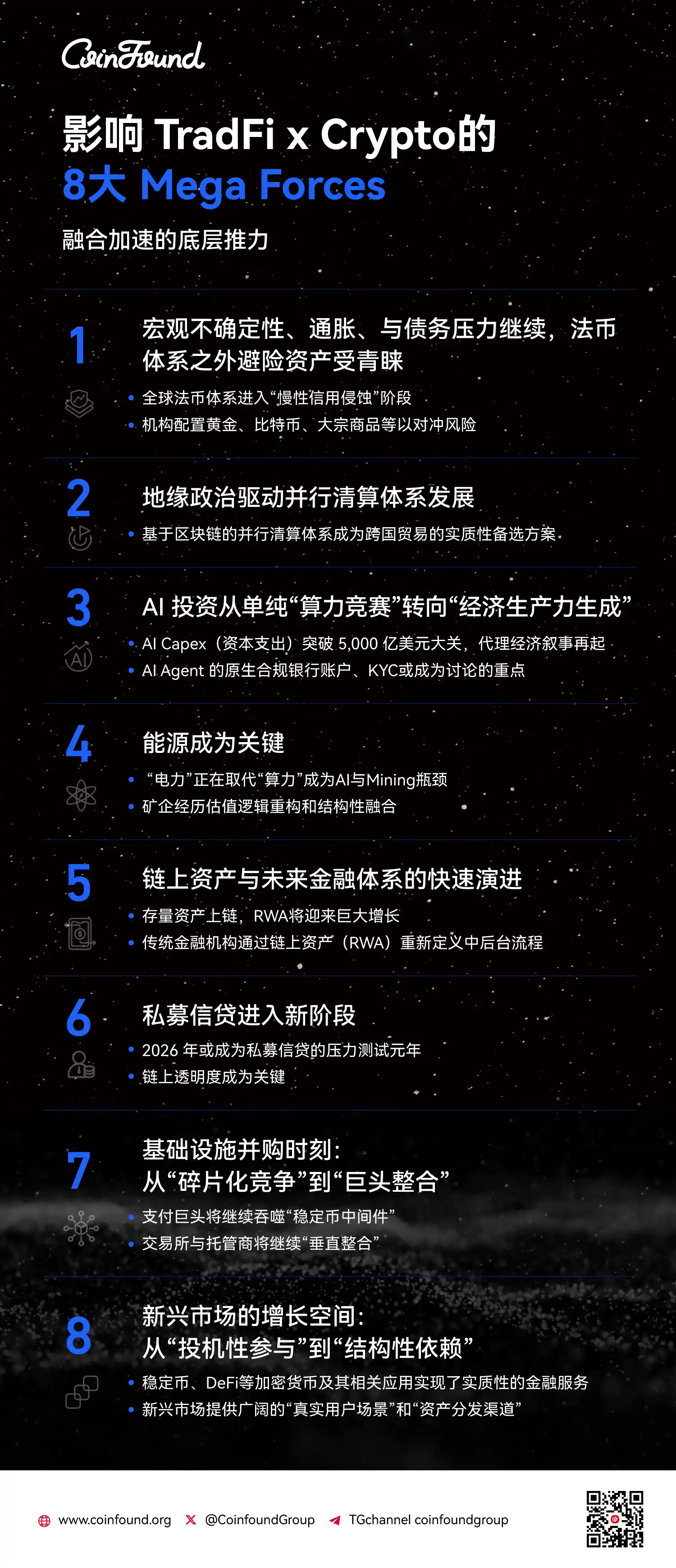
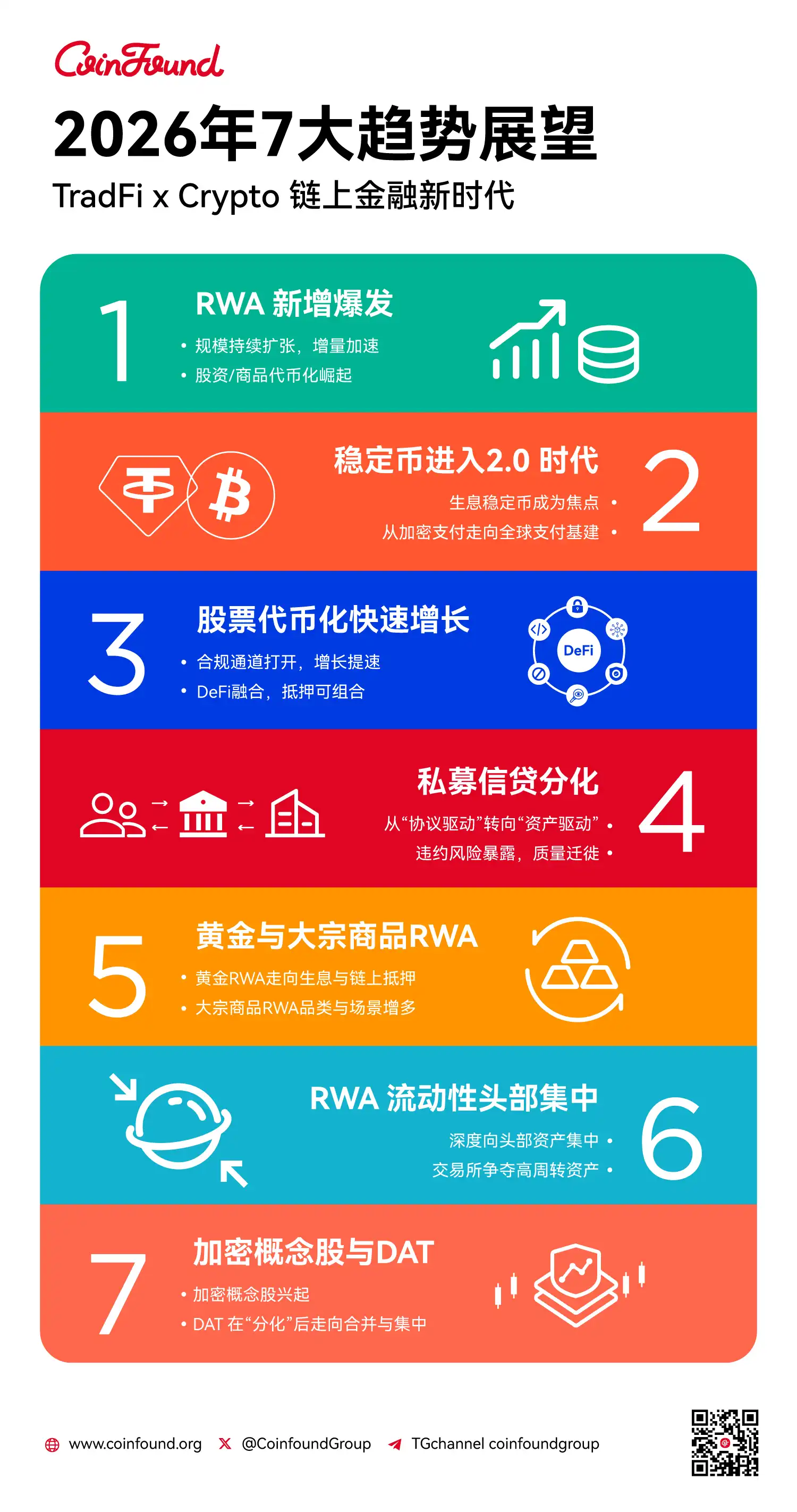
The report distills 8 Mega Forces and 7 trend outlooks: from Stablecoin 2.0 competing for global payment infrastructure, to RWA moving from "issuance" to "utility," and key variables such as stock tokenization, and the divergence and concentration of DATs.

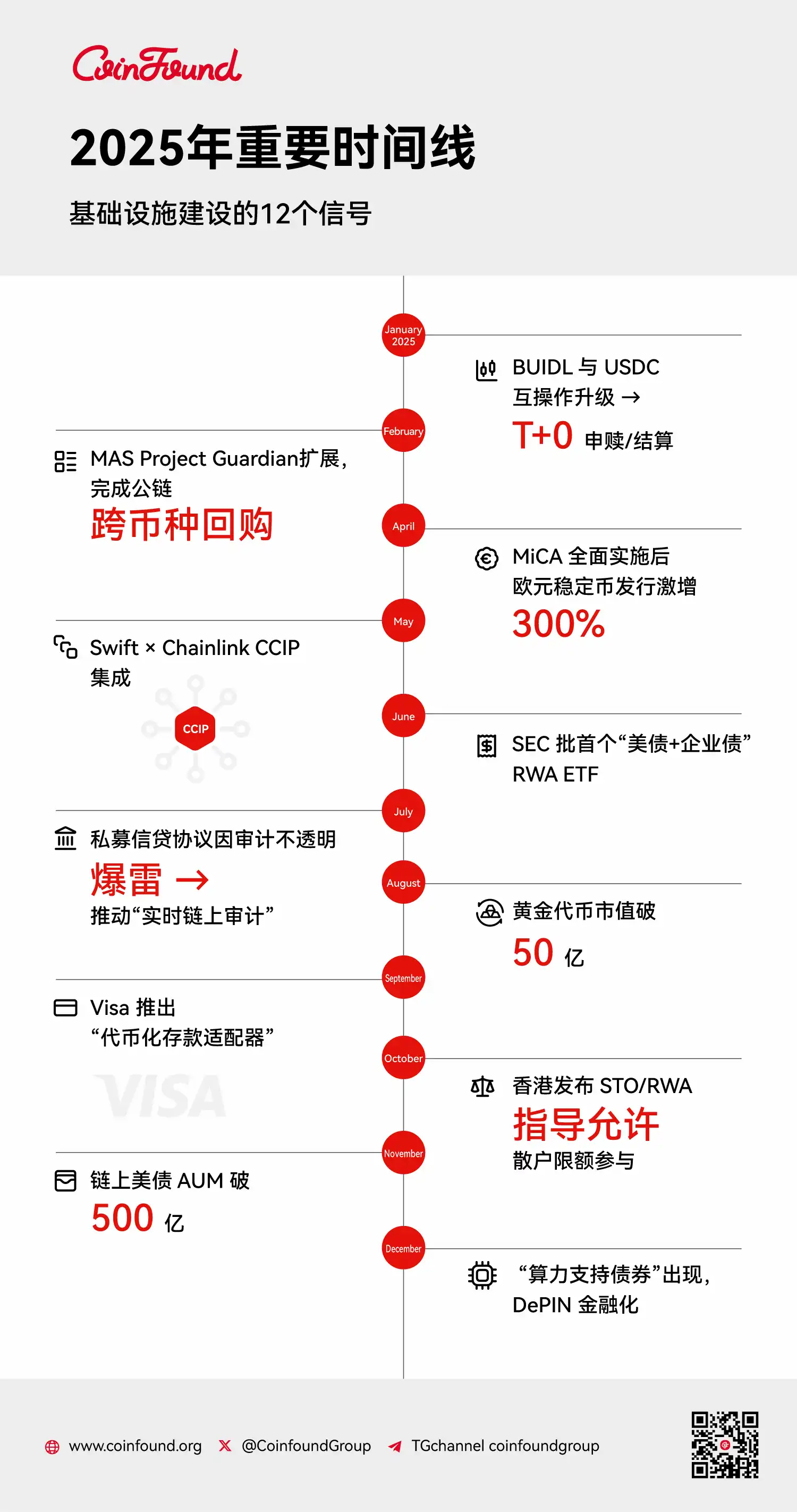
2025 Timeline of Key Events for Traditional Finance x Crypto
In 2026, the following macro trends will impact the TradeFi x Crypto field:

  • Fiat System Trust Crisis and Return to Hard Assets: Facing a global debt spiral and "fiscal dominance" risks, institutions are accelerating allocations to "hard assets" like gold, Bitcoin, and commodities to hedge against fiat currency credit erosion.
  • Geopolitics Driving the Implementation of Parallel Clearing Systems: The need for "de-weaponization" of financial infrastructure is pushing blockchain as an alternative settlement solution independent of SWIFT, with atomic settlement mechanisms effectively reducing trust and counterparty risks in cross-border transactions.
  • AI Productivity Monetization and the Rise of Machine Payments: The focus of AI investment is shifting from computing hardware to generating economic productivity, spurring a rigid demand from AI Agents for compliant stablecoins and on-chain automatic settlement to achieve value attribution between machines.
  • Energy as a Core Asset and the Infrastructure-ization of Mining Companies: Power shortages are driving mining companies to transform into "hybrid computing centers." Their scarce power access rights (Time-to-Power) are triggering acquisitions by tech giants, driving the revaluation of mining companies towards data center infrastructure.
  • On-Chain Assets (RWA) Moving from Issuance to Utility: Asset tokenization is entering the "programmable finance" stage. RWA is no longer just a digital certificate but serves as 24/7 core collateral, significantly enhancing the capital efficiency of repo markets and全域 liquidity.
  • Private Credit Faces Stress Tests and Transparent Transformation: The 2026 debt maturity wave may trigger default risks, forcing the industry to shift from "black boxes" to real-time on-chain transparent audits based on zero-knowledge proofs (ZK) to avoid DeFi chain liquidation crises.
  • Infrastructure Moves from Fragmented Competition to Giant Consolidation: The market is entering a consolidation period similar to the telecommunications industry. Payment and financial giants are acquiring stablecoin middleware and custodians to secure their positions, eliminating redundancy and building compliance moats. Emerging markets shift from speculation to structural dependence: Crypto assets have deepened into underlying tools for payments and remittances in emerging markets. Vast real-user scenarios make them a core hub connecting traditional financial assets with global retail liquidity.

The trend outlook for 2026 is as follows:

1. Structural explosion in the RWA market, stablecoins forming a base of a 3200 billion market, equities and commodities becoming new growth points

2. Stablecoins enter the 2.0 era, moving from crypto payments to competing for global payment infrastructure

3. Stock tokenization liquidity may grow rapidly, DeFi integration will be key

4. Private credit RWA shifts to "asset-driven," may accelerate differentiation under "default" risk pressure

5. Gold and commodity RWA usher in a new era of "full asset collateral"

6. RWA liquidity will further concentrate, three types of RWA assets are gaining favor with exchanges

7. The "rise" of crypto concept stocks, the "divergence" and "concentration" of DATs
Summary

2025 Summary: 2025 was a year of "demystification and integration" for TradeFi and Crypto. Blockchain technology is being还原 (restored) from the光环 (halo) of "revolution" to an efficient bookkeeping and settlement technology. The success of treasury RWA proved the feasibility of putting traditional assets on-chain, and the full entry of giants like BlackRock provided irreversible credit endorsement for the industry.

2026 Prediction: 2026 will be a year of "secondary market explosion and credit expansion." We judge:

  • Liquidity Explosion: With the improvement of infrastructure, RWA will shift from "hold-to-earn" to "high-frequency trading."
  • Credit Downward Drift: Asset classes will drift down from high-credit government bonds to corporate bonds, stocks, and emerging market credit. Risk Premium will become a new source of yield.
  • Risk Warning: As the scale of RWA expands, the complexity of off-chain default transmission to on-chain liquidation will be the biggest systemic risk.

In 2026, both TradeFi and Crypto will be unified under the banner of "On-chain Finance."

Full report link for "CoinFound Annual Report: TradFi x Crypto 2026 Outlook": https://app.coinfound.org/zh/research/4


İlgili Sorular

QWhat are the 8 Mega Forces that will influence the TradFi x Crypto field in 2026 according to the CoinFound report?

AThe 8 Mega Forces are: 1. Fiat system trust crisis and the return to hard assets. 2. Geopolitics driving the implementation of parallel clearing systems. 3. AI productivity realization and the rise of machine payments. 4. Energy as a core asset and the infrastructuralization of mining companies. 5. On-chain assets (RWA) moving from issuance to utility. 6. Stress testing and transparency transformation in private credit. 7. Infrastructure moving from fragmented competition to giant integration. 8. Emerging markets shifting from speculation to structural dependence.

QWhat are the 7 key investment trends outlined for 2026 in the report?

AThe 7 key investment trends for 2026 are: 1. Structural explosion of the RWA market with stablecoins forming a $320B base. 2. Stablecoins entering the 2.0 era, competing for global payment infrastructure. 3. Rapid growth in stock tokenization liquidity, with DeFi integration being key. 4. Private credit RWA shifting to 'asset-driven' models, potentially accelerating differentiation under default risk. 5. Gold and commodity RWA ushering in a new era of 'full-asset collateralization'. 6. Further concentration of RWA liquidity, with three types of RWA assets favored by exchanges. 7. The rise of 'crypto concept stocks' and the 'differentiation' and 'concentration' of DATs.

QHow does the report summarize the key difference between 2025 and the predicted landscape for 2026?

AThe report summarizes 2025 as a year of 'disillusionment and integration' where blockchain technology was reduced from a 'revolutionary'光环 to an efficient bookkeeping and settlement technology. In contrast, it predicts 2026 will be a year of 'secondary market explosion and credit expansion', characterized by liquidity爆发 (shifting from 'holding for yield' to 'high-frequency trading'), credit下沉 (expanding from high-credit sovereign bonds to corporate bonds, stocks, and emerging market credit for risk premium), and new systemic risks from off-chain defaults triggering on-chain liquidations.

QWhat is identified as the major systemic risk associated with the growing RWA market in 2026?

AThe major systemic risk identified is the complexity of off-chain asset defaults (Off-chain Default) triggering chain上清算 (On-chain Liquidation) as the scale of Real-World Assets (RWA) expands.

QWhat overarching concept does the report predict will unify both TradFi and Crypto by 2026?

AThe report predicts that by 2026, both TradFi and Crypto will be unified under the banner of 'On-chain Finance'.

İlgili Okumalar

380,000 Apps Exposed, 2,000+ Apps Leaked Secrets: AI Programming Turns 'Intranet' into Public Internet

Israeli cybersecurity firm RedAccess uncovered a severe data exposure trend linked to "vibe coding" or AI-powered software development tools. Their research found approximately 38,000 publicly accessible web applications built with platforms like Lovable, Base44, Netlify, and Replit. Of these, an estimated 2,000 apps exposed sensitive corporate and personal data, including medical records, financial information, internal strategic documents, and customer chat logs. In some cases, access even granted administrative privileges. The core issue stems from default privacy settings that make applications public by default, combined with a lack of built-in security controls (like authentication) in the AI-generated code. This allows employees without security expertise—"citizen developers"—to easily create and deploy applications that bypass standard corporate security reviews. The exposed apps, often indexed by search engines, are trivially discoverable. While some platform providers (Replit, Lovable, Wix/Base44) argue that security configuration is the user's responsibility and question the validity of some findings, security researchers confirm the widespread reality of such exposures. This pattern, also noted in prior studies, highlights a critical security gap as AI democratizes app creation, potentially leading to massive, unintentional data leaks.

marsbit23 dk önce

380,000 Apps Exposed, 2,000+ Apps Leaked Secrets: AI Programming Turns 'Intranet' into Public Internet

marsbit23 dk önce

Attracting Global Capital, Asia's New 'Super Cycle' Is Unfolding

Investors are turning to Asia as the next frontier for global equity growth, with a new "super cycle" unfolding across the region. Driven by the AI revolution, Asian markets, particularly South Korea, have seen significant rallies. According to Morgan Stanley analysis, the underlying drivers of Asia's industrial cycle are shifting from traditional sectors like real estate and manufacturing to massive investments in AI infrastructure, energy security and transition, and supply chain resilience. Fixed asset investment in Asia is projected to grow from around $11 trillion in 2025 to $16 trillion by 2030, with a 7% annual growth rate from 2026-2030. The AI wave is a primary catalyst, driving immense capital expenditure for chips, servers, data centers, and power systems. Asia is central to this hardware supply chain. In China, AI investment is focused on building a full-system domestic capability, with the local AI chip market potentially reaching $86 billion by 2030. Beyond AI, China's export story is expanding from EVs and batteries to robotics. The country already captures about half of new global industrial robot demand and over 90% of humanoid robot shipments. This growth phase mirrors the early stages of China's EV export boom. Simultaneously, energy security investments, spurred by AI's massive power needs, are rising, with China benefiting from its leadership in solar, batteries, and EVs. Regional defense spending is also increasing structurally, supporting demand for advanced manufacturing. The main beneficiaries are China, South Korea, and Japan, positioned in core supply chain areas. However, risks remain, including potential overcapacity, profit margin pressures from competition, persistent technological restrictions, geopolitical friction, and workforce displacement due to AI-driven automation. Market volatility is also expected to increase as investor expectations diverge on the realization of these capital investment and export themes.

marsbit24 dk önce

Attracting Global Capital, Asia's New 'Super Cycle' Is Unfolding

marsbit24 dk önce

Funding Weekly Report | 14 Public Funding Events, Kalshi Completes $10B New Funding Round at $220B Valuation Led by Coatue Management

Weekly Funding Roundup: 14 Deals and $10.49B+ in Total Funding, Led by Kalshi's $1B Round Last week (5.4-5.10) saw 14 notable funding events in the global blockchain ecosystem, raising over $10.49 billion in total. Key highlights include Kalshi, a prediction market platform, securing a $1 billion round led by Coatue Management, reaching a $22 billion valuation. The platform now boasts ~2 million MAUs and $178B in annualized trading volume. In DeFi, regulated on-chain reinsurer OnRe raised $5 million in Series A funding, and Bitcoin-backed credit protocol Saturn Credit completed a $2 million seed round. For Infrastructure & Tools, OpenTrade raised $17 million to expand its stablecoin yield infrastructure, and RWA platform Balcony secured $12.7 million to deploy its property settlement service in the US. Centralized Finance saw one deal: AI-driven trading platform Stockcoin.ai completed a seed round led by Amber Group. In the prediction market sector alongside Kalshi, AI-powered platform Elastics raised $2 million. Other notable deals include SC Ventures' strategic investment in crypto market maker GSR and Centrifuge securing a "seven-figure" investment from Coinbase to become a core RWA partner for Base. On the investor side, Haun Ventures raised a new $1 billion fund targeting crypto and AI, and Multi Investment raised ~$616 million to focus on blockchain and Web3 investments.

marsbit1 saat önce

Funding Weekly Report | 14 Public Funding Events, Kalshi Completes $10B New Funding Round at $220B Valuation Led by Coatue Management

marsbit1 saat önce

İşlemler

Spot
Futures
活动图片