2026 Crypto Funding Reshuffle: Game and DePIN Are Dead, Prediction Market Duo Takes 18% of All Year's Funding with Two Deals

marsbit2026-05-08 tarihinde yayınlandı2026-05-08 tarihinde güncellendi

Özet

Cryptocurrency Funding in 2026: Gaming & DePIN Falter as Prediction Markets Dominate Data from the first four months of 2026 reveals a stark shift in crypto venture funding. The gaming and DePIN (Decentralized Physical Infrastructure Networks) sectors have seen capital nearly dry up. In contrast, the "Consumer" category, led by two massive deals for prediction market platforms Kalshi ($1B) and Polymarket ($600M), captured a significant share. These two deals alone accounted for 18% of the year's total $8.65 billion raised and exceeded the combined funding of all 47 DeFi projects. Overall, the $8.65B across 305 deals is misleading. A March surge to $4.57B was largely due to two major acquisitions (BVNK at $1.8B and Kalshi). Excluding these, the underlying monthly funding rate is approximately $1B, indicating continued softness. The "Payments" and "Consumer" sectors together consumed 72% of all capital. Another notable trend is the rise of mergers and acquisitions (M&A), with 48 deals nearly matching the 57 seed-round investments. This signals a market pivot from funding new ideas to consolidating around established leaders. The most active investors so far in 2026 are Coinbase Ventures (18 deals), Tether (13 deals), Animoca Brands (11 deals), and GSR (11 deals). Notably, a16z's pace has slowed significantly compared to previous years.

Author:Memento Research

Compiled by: Deep Tide TechFlow

Deep Tide TechFlow Introduction: Crypto funding data for the first four months of 2026 reveals a harsh reality: the Game and DePIN sectors are nearly starved of capital, while Kalshi and Polymarket, two prediction market companies, have taken more money than all DeFi projects combined for the entire year. More alarmingly, the number of M&A deals has already matched seed rounds, indicating a shift in capital from betting on new ideas to acquiring existing leaders.

Funding Overview: March's Surge Was an Illusion

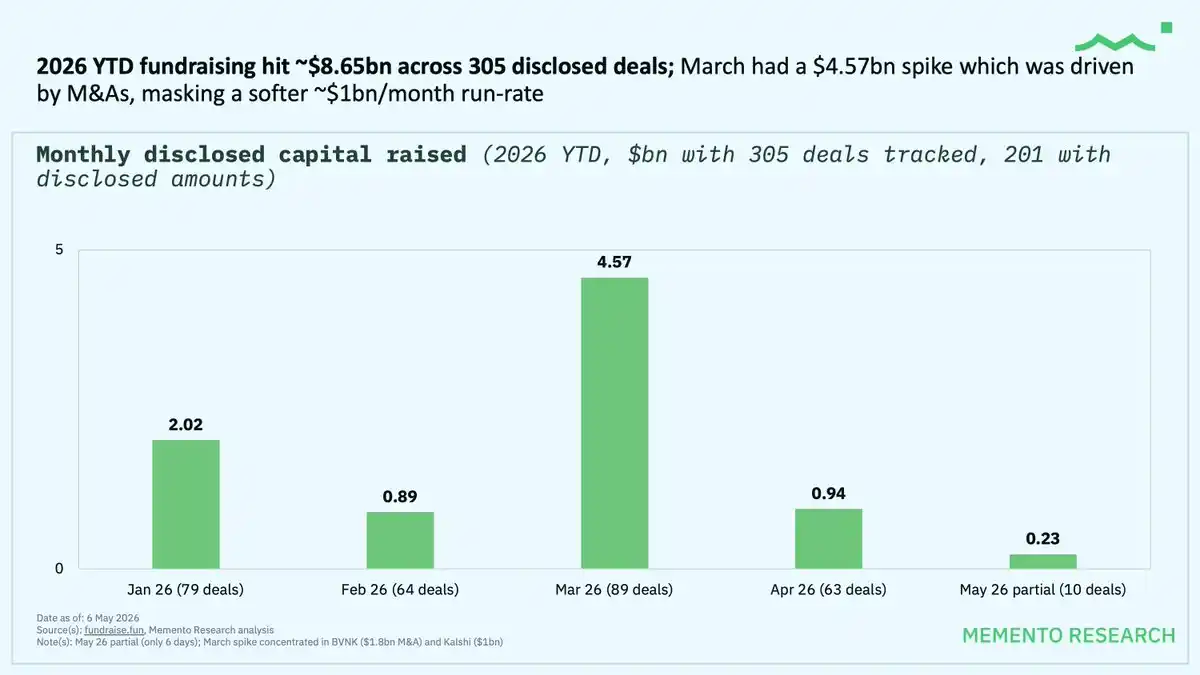
From January 1st to May 6th, 2026, the crypto industry completed 305 funding rounds, totaling $8.65 billion. However, the "surge" to $4.57 billion in March was actually just two massive M&A deals: BVNK's $1.8 billion and Kalshi's $1.0 billion.

Excluding these two deals, the real funding pace is about $1 billion per month, even weaker than at the end of 2025.

Capital Flow: Payments and Consumer Absorb 72%

By sector breakdown:

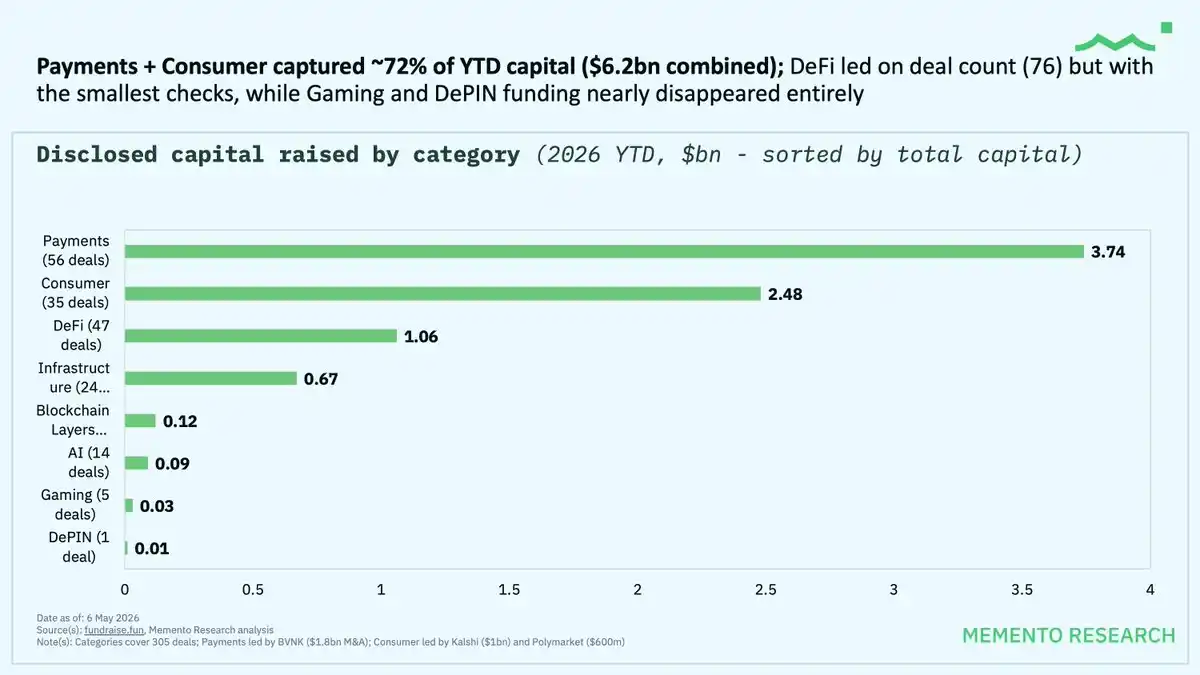
Payments: $3.74 billion (56 deals)

Consumer: $2.48 billion (35 deals)

DeFi: $1.06 billion (47 deals, the highest number of transactions)

The Payments and Consumer sectors combined account for 72% of the year's total funding. Funding for Game and DePIN has nearly vanished.

Prediction Markets Dominate the Consumer Sector

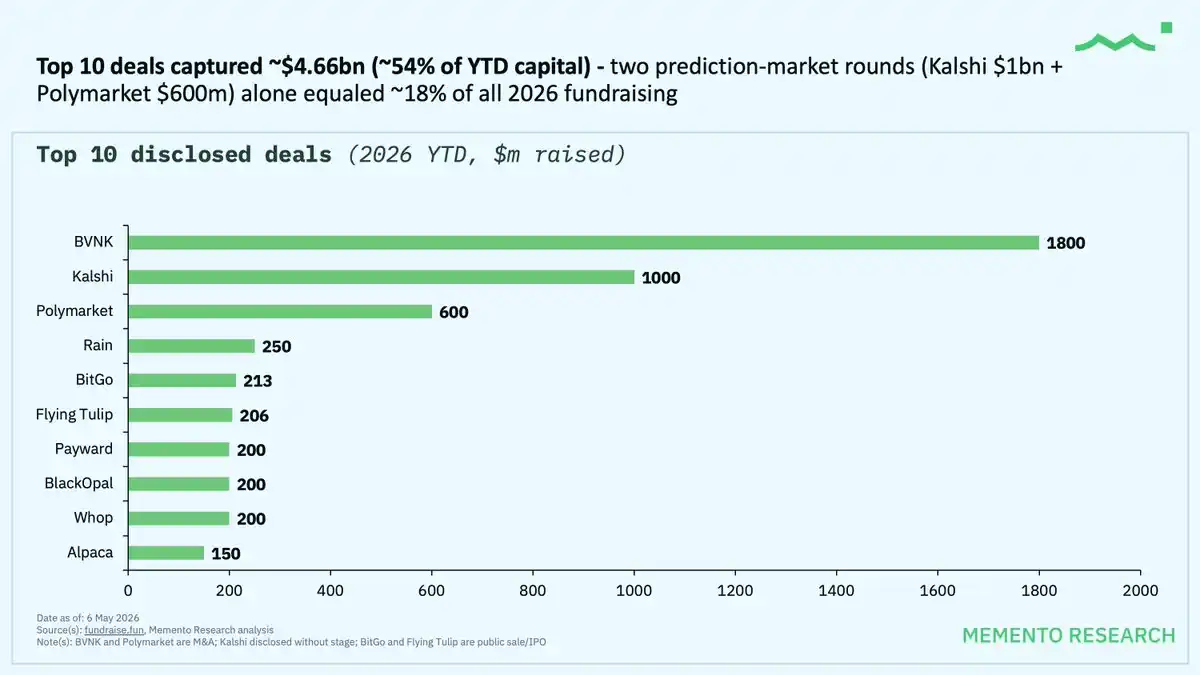
Two prediction market companies accounted for 18% of the year's total funding:

Kalshi: $1.0 billion

Polymarket: $600 million

These two deals totaling $1.6 billion exceed the sum of all 47 DeFi funding rounds.

M&A Becomes Mainstream

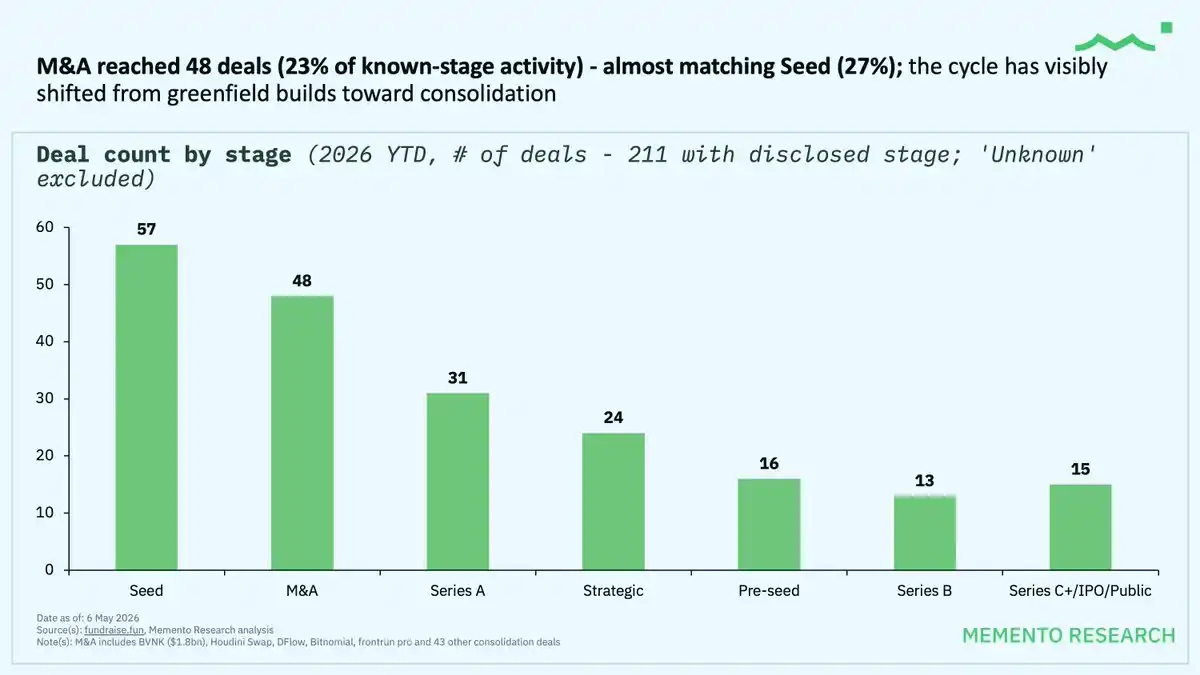
M&A deals reached 48 (accounting for 23% of known-stage transactions), nearly matching the 57 seed rounds (27%). This cycle has shifted from investing in new ideas in early stages to acquiring industry leaders.
Investor Rankings Reshuffled

Most active funds in 2026:

Coinbase Ventures: 18 deals (ranked second during 2021-26 period)

Tether: 13 deals (new top lead investor)

Animoca Brands: 11 deals (ranked first during 2021-26 period)

GSR: 11 deals

a16z: 7 deals (a significant drop compared to ~200 deals during 2021-26 period)

İlgili Sorular

QAccording to the article, which two sectors took the majority of crypto funding in early 2026?

AThe Payments and Consumer sectors took the majority of crypto funding, together accounting for 72% of the total capital raised.

QWhat significant trend does the data reveal about mergers and acquisitions (M&A) compared to seed funding?

AThe data shows that M&A deals reached 48 (23% of known-stage deals), almost catching up to seed rounds at 57 deals (27%). This indicates a shift in the investment cycle from funding new ideas to acquiring established industry leaders.

QWhy was the spike in funding for March 2026 described as an 'illusion'?

AThe spike to $4.57 billion in March was largely an illusion because it was driven by just two mega-deals: an $1.8 billion acquisition of BVNK and a $1 billion deal with Kalshi. Removing these two transactions reveals a slower, more sluggish monthly funding pace of around $1 billion.

QHow did the funding for prediction market companies compare to the total funding for all DeFi projects in the period covered?

AThe two prediction market companies, Kalshi ($1 billion) and Polymarket ($600 million), together raised a combined $1.6 billion. This amount exceeded the total raised by all 47 DeFi projects, which was $1.06 billion.

QWhich investment firms were the most active in terms of deal count during early 2026, and how did this compare to their historical activity?

AIn early 2026, the most active investors by deal count were Coinbase Ventures (18 deals, historically ranked 2nd from 2021-26), Tether (13 deals, new top investor), Animoca Brands (11 deals, historically ranked 1st), GSR (11 deals), and a16z (7 deals, showing a significant decline from its historical ~200 deals between 2021-26).

İlgili Okumalar

Can Generative Models Finally Be Trained End-to-End? The Core Is a For Loop

This article introduces a novel training paradigm for generative models called Explorative Modeling (XM), which enables true end-to-end training. Traditionally, powerful generative models like autoregressive and diffusion models are not trained end-to-end. They are trained to predict a single small step but require iterative multi-step sampling for inference. This "exposure bias" leads to error accumulation and limits performance. The core challenge XM addresses is "mode blurring." In generative tasks, a single input (e.g., "generate a dog") corresponds to many valid outputs (multiple modes). Standard training objectives like reconstruction loss force the model to average these modes, producing unrealistic, blurry outputs. To avoid this, existing models break generation into many small, almost deterministic steps, sacrificing end-to-end training. XM tackles this by restructuring the training loop itself. Its key insight is to amplify "generative expressivity." For each training input, instead of generating one sample, the model generates K candidate outputs. Only the candidate closest to the real data is used for computing the loss and updating the model via backpropagation. This simple "best-of-K" mechanism is implemented as a short for-loop. By exploring multiple possibilities, the model learns to distribute its guesses across different modes rather than collapsing to their uninformative average. The paper demonstrates that "exploration" acts as a new, powerful scaling axis. Gains from XM increase with model size, data scale, and compute. Experiments show improvements in FID scores for image generation and significant efficiency gains, sometimes outperforming larger models without exploration. When pushed to the limit, XM enables fully single-step, end-to-end generative models. In robotics tasks, an "Explorative Policy" matched the performance of a 100-step Diffusion Policy with a single forward pass, drastically improving inference speed. While the best-of-K concept is not entirely new, the authors' contribution lies in formally understanding it as a direct method to boost generative expressivity without fragmenting the generation process. This work suggests that as models scale, enhancing exploration during training may become crucial for overcoming fundamental performance bottlenecks.

marsbit10 dk önce

Can Generative Models Finally Be Trained End-to-End? The Core Is a For Loop

marsbit10 dk önce

Annual Salary of Millions Competing for Electricians, Meta Rushes to Open Its Own Technical School

The AI boom is facing an unexpected bottleneck: a severe shortage of skilled construction workers and electricians. As tech giants like Meta, OpenAI, and Alphabet race to build massive data centers—such as OpenAI's $16 billion "Stargate" project—they are hitting a critical labor wall. The U.S. needs an estimated 130,000 more electricians, 240,000 construction workers, and 150,000 supervisors by 2030 for AI infrastructure alone, but tens of thousands of electrician jobs go unfilled each year. While AI companies offer high premiums, with electricians earning up to $280,000 annually, worker scarcity still causes massive losses—delays on a single project can cost $14.2 million per month. The complexity of building AI data centers, which require immense power (equivalent to powering hundreds of thousands of homes), sophisticated electrical systems, and advanced liquid cooling solutions, demands highly skilled technicians who are in short supply. To combat this, companies are investing heavily in training. Meta has committed $115 million to a free training school offering tuition, housing, and stipends, targeting 5,000 new workers. OpenAI is partnering with unions to secure skilled labor. These efforts are paying off, with a significant rise in Gen Z interest in trade schools over college. However, the power demands are staggering. AI data centers are driving a rapid surge in electricity consumption, projected to account for up to 12% of U.S. power use by 2028 and raising costs for consumers. Furthermore, the construction boom is project-based, leading to a potential future glut of trained workers once building peaks, which could depress wages industry-wide. The race for AI supremacy now depends as much on skilled hands as on advanced chips.

marsbit1 saat önce

Annual Salary of Millions Competing for Electricians, Meta Rushes to Open Its Own Technical School

marsbit1 saat önce

İşlemler

Spot
活动图片