Long-term Bitcoin Holders Data Points to Price Breakout

Tap Chi Bitcoin2023-06-01 tarihinde yayınlandı2023-06-01 tarihinde güncellendi

Özet

Analysts at Bitfinex are currently anticipating “short-term market turbulence and price volatility risks” in June, especially with near-term expiration at the end of the month.Potential price levels that could act as a magnet according to the options market positioning are the maximum pain at expiration in May and June of $27,000 and $24,000 respectively.

Bitcoin volatility is dropping to historic lows due to macroeconomic instability and low market Liquidity . However, on-chain data and options markets signal volatility in June.

Used to measure daily price volatility, the Bitcoin Volatility Index shows a 30-day price movement of 1.52%, less than half of the historical annual average. (usually above 4%).

According to Glassnode, the bullish volatility prediction is a “reasonable conclusion” based on the fact that low volatility has only occurred in 19.3% of Bitcoin’s price history.

The latest weekly update from the on-chain analytics firm shows that Glassnode's monthly logical volatility metric for Bitcoin has slipped below the historic Bollinger Band lower limit, implying volatility is about to increase.
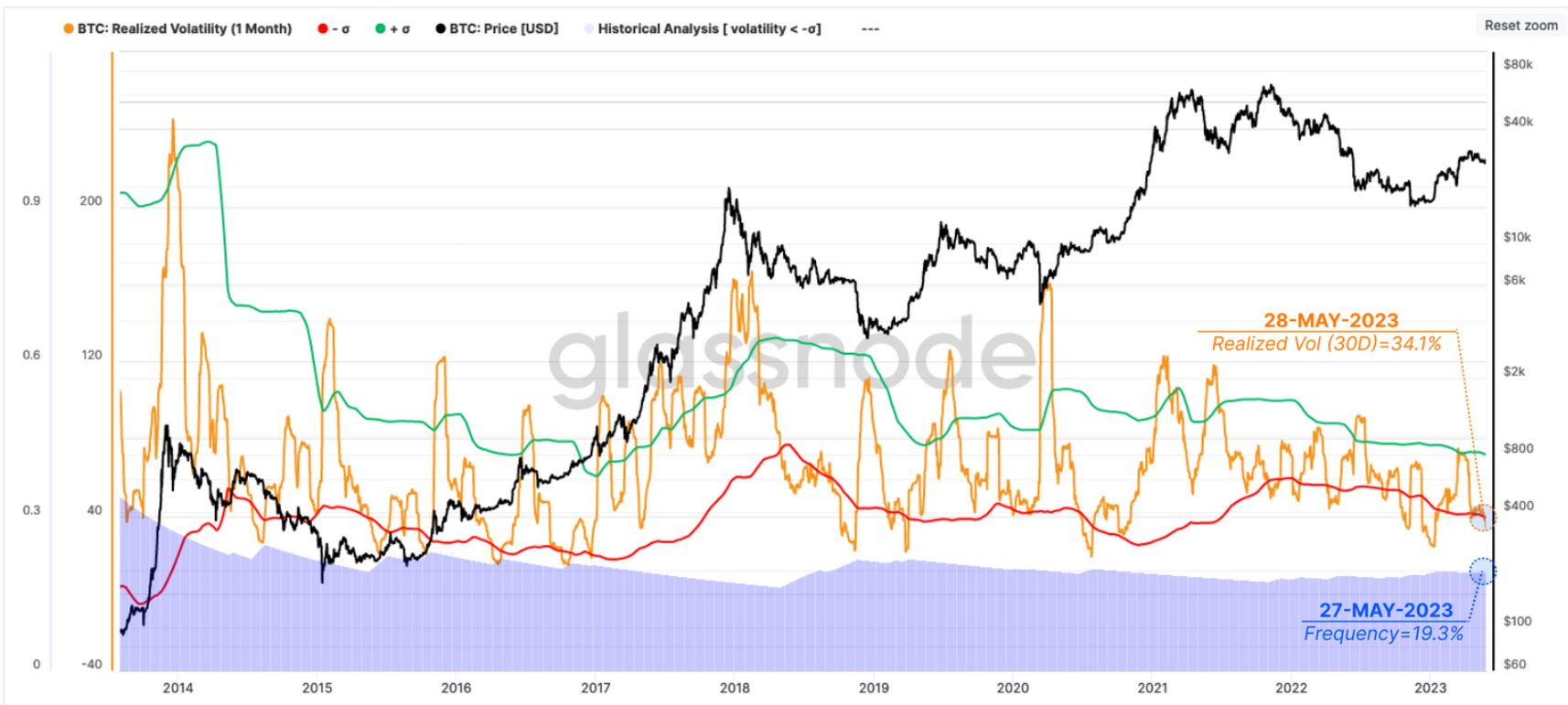
Bolinger Bands for Bitcoin Monthly Reasonable Volatility | Source: Glassnode

Bitcoin on-chain transfer volumes on exchanges have dropped to historic lows. According to the report, the price is also trading in favor of the short-term holders, indicating the “equilibrium position between gains and losses for new investors” who bought during and after the 2021-2022 bull cycle. Currently, only 50% of investors make a profit, the rest lose.

However, while short-term holders have reached equilibrium, long-term holders have moved in the recent correction, reinforcing the volatility argument.

Glassnode classifies coins that hold more than 155 days in a wallet as a long-term holder supply.

The gray bars in the image below show the long-term holders (LTH) binary spending indicator, which tracks whether LTH's average spend over the past 7 days is enough to reduce their total holdings. .

The chart shows previous instances where LTH spending has increased, often with increased volatility.
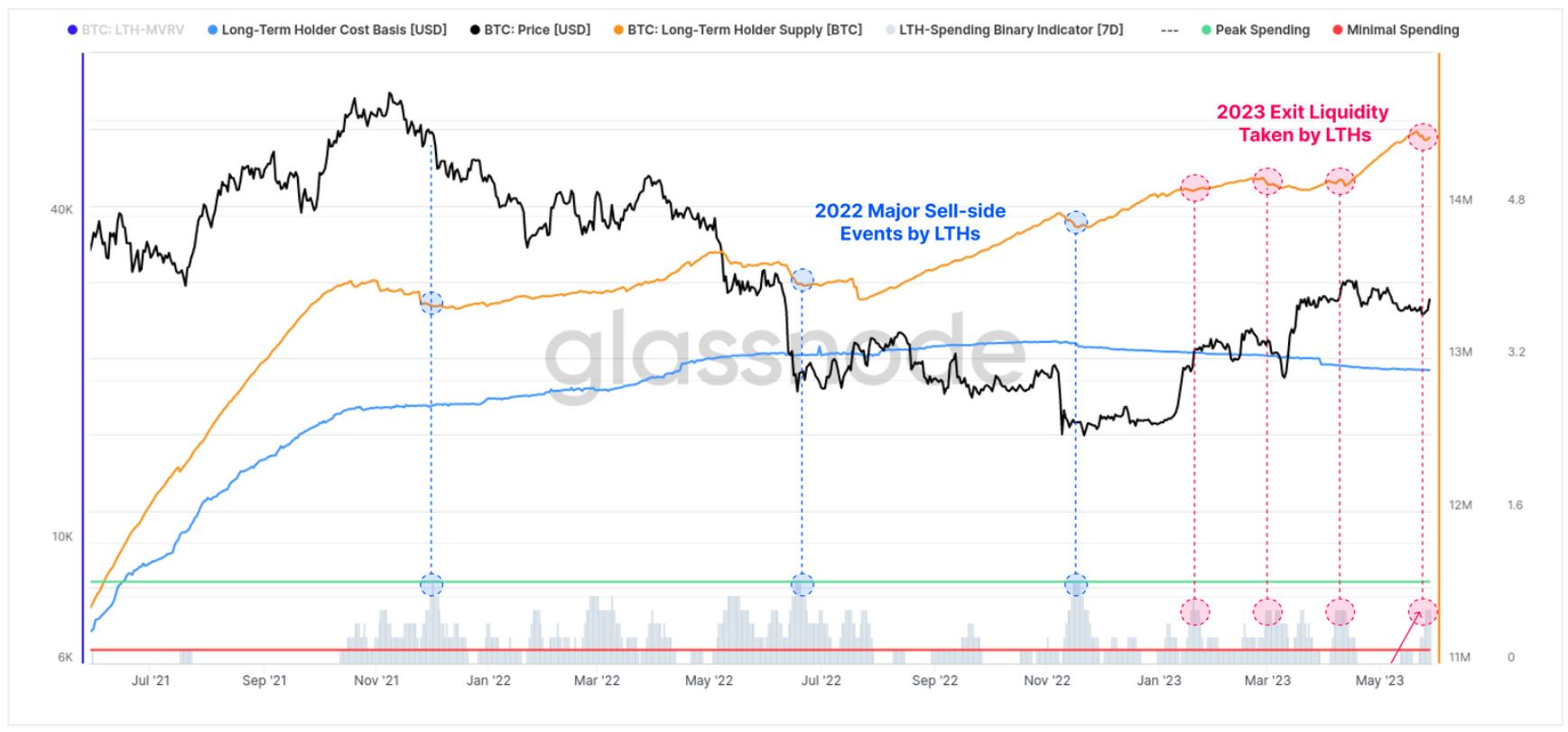
Long Term Holder Spending Binary Indicator | Source: Glassnode

Bitcoin’s recent price correction caused the indicator to drop slightly, “showing 4 out of 7 days of net divestment of LTH, which is similar to the Liquidity exit events so far this year.”

Analysts expect a wave of volatility to reach an equilibrium, where the market moves primarily due to accumulation or distribution of long-term holders' supply.

Options market data points to a similar theory of impending volatility.

The options market's latest expiration in May turned out to be a dull event, despite its nominal value of $2.3 billion. However, prolonged volatility compression could build momentum for an upcoming major price move.

Bitfinex's latest Alpha report shows that the DVOL index (which represents the market's expectations of Bitcoin's potential volatility over the next 30 days) has dropped to 45 from 50 just before expiration, representing a low annual.
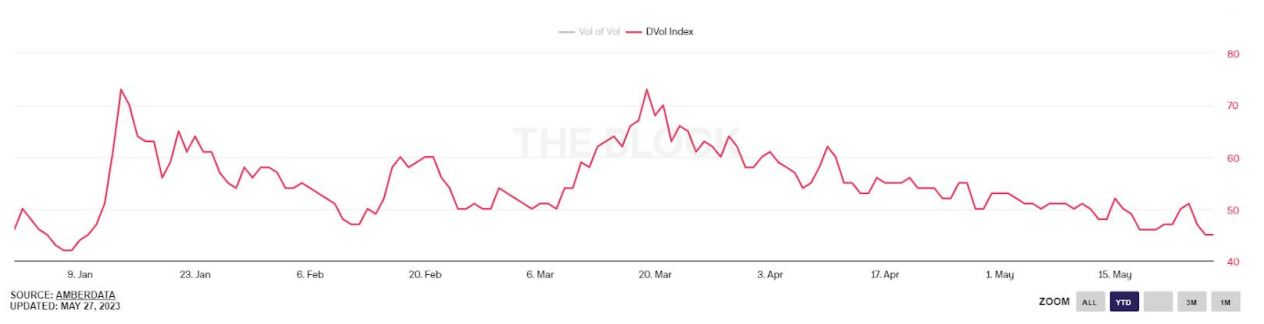
DVOL Index for Bitcoin Options | Source: Bitfinex

Implied volatility in options contracts refers to the market's expectation of an asset's future volatility, as reflected in the options' prices.

Bitfinex analysts said expectations of low volatility could be attributed to "coming events that are expected to change the market" or "uncertainty or market participants' increased risk aversion." ".

Right now, options traders are showing risk aversion and increasing their bearish positions as the month of May approaches the end of June.

Bitcoin put-to-call ratio increased from 0.38 to 0.5. A higher weighted put option shows that traders are slowly turning bearish.

Analysts at Bitfinex are currently anticipating “short-term market turbulence and price volatility risks” in June, especially with near-term expiration at the end of the month.

Potential price levels that could act as a magnet according to the options market positioning are the maximum pain at expiration in May and June of $27,000 and $24,000 respectively.

Maximum pain (also known as option pain) is a concept used in options trading and refers to the price at which the buyer must bear the maximum loss.


İlgili Okumalar

a16z on Hiring: How to Choose Between Crypto-Native and Traditional Talent?

Hiring in Crypto: Balancing Crypto-Native and Traditional Talent As the crypto industry grows, founders face the dilemma of whether to prioritize hiring professionals with blockchain experience or those with traditional tech backgrounds who can learn. The key is recognizing that crypto companies are still tech companies at their core and should apply proven hiring best practices. Crypto-native talent offers immediate productivity and is essential for roles involving high-stakes, specialized work like smart contract development, where errors can be catastrophic. However, traditional professionals from large-scale software companies bring valuable experience in scaling products, operational flexibility, and expertise in areas like fintech, UX, and security, which are crucial as crypto products target mainstream adoption. Recruiting requires tailored approaches. Some candidates may be hesitant due to crypto's volatility or complexity, while others are excited by its innovative potential. Assess candidates' motivations, curiosity, and alignment with the company's vision early. Emphasize the opportunity to shape technology's future and address financial incentives, such as token-based compensation, which can offer liquidity compared to traditional equity. Onboarding is critical. Identify knowledge gaps during hiring and design education programs, mentorship, knowledge-sharing sessions, and resources like blogs or courses to accelerate learning. Pairing new hires with experienced crypto professionals helps bridge gaps and fosters collaboration. Ultimately, successful teams blend both crypto-native and traditional talent, leveraging their strengths to drive innovation and growth.

marsbit37 dk önce

a16z on Hiring: How to Choose Between Crypto-Native and Traditional Talent?

marsbit37 dk önce

DeFi Hacked Again for $292 Million, Is Even Aave No Longer Safe?

On April 19, a major DeFi security breach occurred, resulting in the loss of approximately $292 million. The attack targeted Kelp DAO’s rsETH bridge contract built on LayerZero, with 116,500 rsETH stolen. The attacker initiated the exploit using funds from Tornado Cash and manipulated the LayerZero EndpointV2 contract to transfer the assets. Kelp DAO confirmed the incident and temporarily paused rsETH contracts across multiple networks while collaborating with security experts for investigation. Initial analysis suggests the root cause was a compromised private key on the source chain, with the contract secured by only a 1/1 validator set, making it vulnerable to a single malicious transaction. The attacker used the stolen rsETH as collateral on lending platforms—including Aave, Compound, and Euler—to borrow more liquid assets like WETH, accumulating over $236 million in debt. Aave alone accounted for $196 million of this amount. In response, Aave froze its rsETH markets and stated it would explore covering potential bad debt through its Umbrella safety module, which holds around $50 million in WETH. This incident follows another large exploit earlier in April, where Drift Protocol on Solana lost $280 million. The repeated high-value attacks raise concerns about DeFi security, even affecting major protocols like Aave. Users are advised to exercise caution, diversify holdings, and limit exposure to on-chain protocols until more robust security measures are established.

marsbit2 saat önce

DeFi Hacked Again for $292 Million, Is Even Aave No Longer Safe?

marsbit2 saat önce

İşlemler

Spot
Futures
活动图片