1 Billion DOT Minted Out of Thin Air, Yet Hacker Only Made $230,000

marsbit2026-04-13 tarihinde yayınlandı2026-04-13 tarihinde güncellendi

Özet

On April 13, a security breach occurred involving the Polkadot bridge on the Ethereum network, where an attacker exploited a replay vulnerability in the MMR proof mechanism of Hyperbridge’s ISMP protocol. By reusing a historically valid proof and pairing it with a malicious request, the attacker bypassed verification and gained admin and minting rights over the wrapped DOT contract on Ethereum. They then minted 1 billion wrapped DOT tokens—2,805 times the existing supply—and attempted to liquidate them. However, due to extremely low liquidity in the wrapped DOT market, the massive sell-off crashed the token’s price by 99.98%, from $1.22 to approximately $0.000128. The attacker ultimately exchanged the tokens for only about 108.2 ETH (worth roughly $237,000), with gas costs as low as $0.74. The same exploit had been used previously in attacks on MANTA and CERE tokens, resulting in a total loss of around $242,000. Polkadot confirmed that the incident only affected DOT bridged via Hyperbridge to Ethereum and did not impact the native Polkadot network or DOT on other bridges. Exchanges including Upbit and Bithumb temporarily suspended DOT deposits and withdrawals as a precaution. The event highlights ongoing vulnerabilities in cross-chain infrastructure and the critical role of liquidity in limiting actual damages during large-scale exploits. It also reflects a broader trend of increasing DeFi security incidents in early 2026.

Author: Zhou, ChainCatcher


On the morning of April 13th Beijing time, on-chain monitoring platforms issued alerts one after another: abnormal issuance of Polkadot bridged assets was detected on the Ethereum network.

According to CertiK's analysis, the attacker submitted a carefully crafted cross-chain request to the HandlerV1 contract on the Ethereum side via Hyperbridge's ISMP protocol, and paired it with a real MMR proof that had been historically accepted by the system, successfully bypassing the verification mechanism.
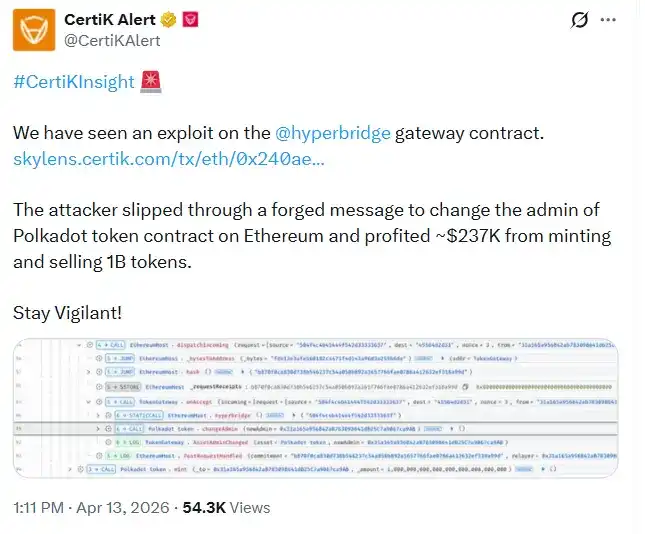
BlockSec Phalcon subsequently issued a technical alert, characterizing this vulnerability as an MMR proof replay vulnerability. According to their analysis, the root cause of the vulnerability lies in the fact that the replay protection of the HandlerV1 contract only verifies whether the hash of a request has been used before, but the proof verification process did not bind the submitted request payload to the proof being verified.

This logical flaw allowed the attacker to replay a historically valid proof and pair it with a newly constructed malicious request, thereby executing the ChangeAssetAdmin operation via the TokenGateway.onAccept() path, transferring the admin and minting permissions of the wrapped DOT contract on Ethereum (address: 0x8d...8F90b8) to an address controlled by the attacker.

On-chain data shows that after obtaining minting permissions, the attacker minted 1 billion wrapped DOT tokens, a quantity approximately 2805 times the reported circulating supply of about 356,000 tokens on Ethereum at the time.

Subsequently, the attacker exchanged the entire amount for approximately 108.2 ETH via Odos Router and Uniswap V4 liquidity pools, and transferred it to the attacker's external account, profiting about $237,000 at the time, with the gas cost for the entire attack being only about $0.74.

BlockSec Phalcon also mentioned that a previous attack using the same method had occurred, targeting MANTA and CERE tokens, resulting in a loss of about $12,000. The total combined loss from both attacks is approximately $242,000.

Following the incident, major South Korean exchanges Upbit and Bithumb announced the suspension of deposit and withdrawal services for DOT and the AssetHub Polkadot network to prevent potential fake deposit risks.

Polkadot officials stated that this vulnerability only affects DOT bridged to Ethereum via Hyperbridge, and does not affect DOT assets within the Polkadot ecosystem, nor DOT transferred via other bridges. Polkadot and its parachains, as well as native DOT, remain secure and unaffected. Hyperbridge has currently been suspended to investigate the issue.

It is worth mentioning that despite the minting scale reaching 1 billion tokens, the actual loss is far lower than the theoretical figure.Due to the extremely limited on-chain liquidity of wrapped DOT on Ethereum, the concentrated sell-off of 1 billion tokens instantly crashed the price of wrapped DOT from $1.22 to $0.00012831, a drop of 99.98%, rendering the vast majority of tokens unable to be effectively liquidated.

According to CoinMarketCap data, the price of native DOT tokens was also briefly dragged down by market sentiment, falling nearly 5%.

Users on X bluntly stated, who would have thought that DOT, once a cross-chain myth alongside Ethereum, would引爆 social media in this way. Cross-chain bridges have once again become the "Achilles' heel" of the crypto world. The once-deserted quiet has now turned into a scene of devastation and sighing. When 1 billion DOT appeared out of thin air, all technical indicators became worthless.

Other users jokingly remarked that low liquidity "saved Polkadot" in this incident by意外, limiting the actual loss to about $237,000.

However, while the low liquidity of bridged assets limited the hacker's profit, it exposed the potential fragility of the cross-chain interoperability layer.

It is reported that Hyperbridge, developed by Polytope Labs, is a cross-chain interoperability project within the Polkadot ecosystem, long positioning itself as trust-minimized cross-chain infrastructure with its core security mechanism relying on cryptographic proofs instead of multi-signature committees. The project had previously emphasized its resistance to common bridge attacks.

<极p>
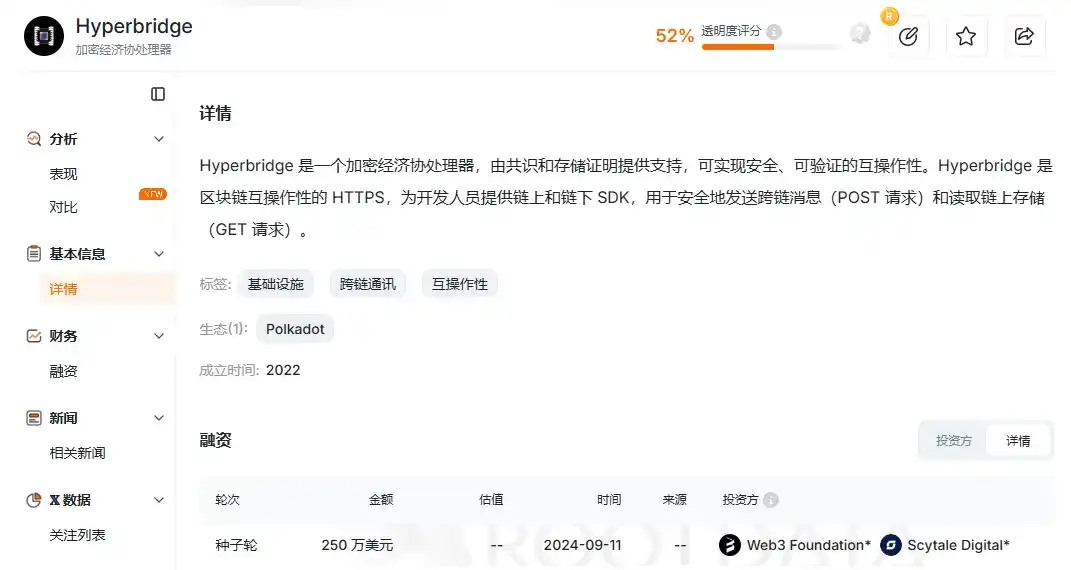
But this incident perhaps indicates that the integrity of the cryptographic proof mechanism itself is not sufficient to guarantee security; the specific implementation logic of the Gateway contract on the Ethereum side also constitutes an attack surface.

From a more macro perspective, this incident is a microcosm of the持续严峻 DeFi security landscape in 2026. Since the beginning of the year, several major attacks have occurred, including Venus generating $2.15 million in bad debt due to price manipulation, Resolve over-minting 80 million USR, and Drift losing over $285 million in assets. The attack methods varied and involved diverse areas.

Taking over minting rights for无限增发 is not a new attack模式. However, Hyperbridge's损失 was意外压低 due to its extremely shallow liquidity.

According to CertiK data, March alone recorded 46 security incidents, with total losses of approximately $39.8 million, the highest monthly record since November 2024. CertiK also pointed out that the increased frequency of code vulnerability exploits may be related to the rise of AI-assisted vulnerability mining tools.

The rise in attack frequency is also pushing the industry to重新审视 the boundaries of security and regulation. Circle's Chief Strategy Officer Dante Disparte previously, in response to the Drift Protocol theft, called for protocols, wallets, exchanges, and stablecoin issuers to treat security and accountability as a shared obligation. He suggested that DeFi protocols could develop on-chain technical protection measures参考 traditional market circuit breakers, and promote relevant legislation to enshrine property rights and financial privacy protection standards into law before the next major incident occurs.


İlgili Sorular

QWhat was the core vulnerability exploited in the Hyperbridge attack on April 13th?

AThe attack exploited an MMR proof replay vulnerability. The flaw was in the HandlerV1 contract, where the replay protection only checked if a request's hash had been used before, but the proof verification process did not bind the submitted request payload to the proof being validated. This allowed the attacker to replay a historically valid proof with a new, forged request.

QHow much wrapped DOT did the attacker mint, and why was the actual financial gain so low compared to the amount minted?

AThe attacker minted 1 billion wrapped DOT tokens. However, the actual financial gain was only about $237,000 because the on-chain liquidity for wrapped DOT on Ethereum was extremely limited. The massive sell-off crashed the token's price by 99.98%, from $1.22 to approximately $0.00012831, making it impossible to liquidate the vast majority of the tokens.

QWhich other tokens were previously targeted using the same attack method mentioned in the article?

AAccording to the article, the same attack method was previously used against MANTA and CERE tokens, resulting in losses of approximately $12,000.

QWhat was the official response from Polkadot regarding the scope and impact of this incident?

APolkadot official stated that the vulnerability only affected DOT that was bridged to Ethereum via Hyperbridge. It did not affect DOT within the Polkadot ecosystem, DOT bridged through other bridges, or native DOT. They confirmed that Polkadot, its parachains, and native DOT remained secure and unaffected. Hyperbridge was paused for investigation.

QWhat broader trend in DeFi security does this event represent, according to the article?

AThe article states this event is a reflection of the increasingly severe DeFi security landscape in 2026. It cites other major incidents like the Venus protocol ($2.15M in bad debt), Resolve (80M USR over-minted), and the Drift Protocol hack (over $285M). It also notes a rise in code vulnerability exploits, potentially linked to the emergence of AI-assisted bug-finding tools, with March alone seeing 46 security incidents totaling ~$39.8M in losses.

İlgili Okumalar

Cook's Curtain Call and Ternus Takes the Helm: The Disruption and Reboot of Apple's 4 Trillion Dollar Empire

Tim Cook has officially announced he will step down as CEO of Apple in September, transitioning to executive chairman after a 15-year tenure during which he grew the company’s market value from around $350 billion to nearly $4 trillion. He will be succeeded by John Ternus, a 50-year-old hardware engineering veteran who has been groomed for the role through increasing public visibility and internal responsibility. Ternus’s appointment signals a strategic shift toward hardware and engineering leadership, with Johny Srouji—head of Apple Silicon—taking on an expanded role as Chief Hardware Officer. This consolidation aims to strengthen Apple’s core technological capabilities. However, Cook’s departure highlights a significant unresolved issue: Apple’s delayed and fragmented approach to artificial intelligence. Despite early efforts, such as hiring John Giannandrea from Google in 2018, Apple’s AI initiatives—particularly around Siri—have struggled with internal restructuring and reliance on external partnerships, including with Google. The transition comes at a critical moment as Apple faces paradigm shifts with the rise of artificial general intelligence (ASI). The company’s closed ecosystem of hardware, software, and services—once a major advantage—now presents challenges in adapting to an AI-centric world where intelligence may matter more than the device itself. Ternus must quickly articulate a clear AI strategy, possibly starting at WWDC, to reassure markets and redefine Apple’s role in a new technological era. His task is not only to maintain Apple’s operational excellence but also to reinvigorate its capacity to innovate and lead in the age of AI.

marsbit47 dk önce

Cook's Curtain Call and Ternus Takes the Helm: The Disruption and Reboot of Apple's 4 Trillion Dollar Empire

marsbit47 dk önce

İşlemler

Spot
Futures

Popüler Makaleler

DOT Nasıl Satın Alınır

HTX.com’a hoş geldiniz! Polkadot (DOT) satın alma işlemlerini basit ve kullanışlı bir hâle getirdik. Adım adım açıkladığımız rehberimizi takip ederek kripto yolculuğunuza başlayın. 1. Adım: HTX Hesabınızı OluşturunHTX'te ücretsiz bir hesap açmak için e-posta adresinizi veya telefon numaranızı kullanın. Sorunsuzca kaydolun ve tüm özelliklerin kilidini açın. Hesabımı Aç2. Adım: Kripto Satın Al Bölümüne Gidin ve Ödeme Yönteminizi SeçinKredi/Banka Kartı: Visa veya Mastercard'ınızı kullanarak anında Polkadot (DOT) satın alın.Bakiye: Sorunsuz bir şekilde işlem yapmak için HTX hesap bakiyenizdeki fonları kullanın.Üçüncü Taraflar: Kullanımı kolaylaştırmak için Google Pay ve Apple Pay gibi popüler ödeme yöntemlerini ekledik.P2P: HTX'teki diğer kullanıcılarla doğrudan işlem yapın.Borsa Dışı (OTC): Yatırımcılar için kişiye özel hizmetler ve rekabetçi döviz kurları sunuyoruz.3. Adım: Polkadot (DOT) Varlıklarınızı SaklayınPolkadot (DOT) satın aldıktan sonra HTX hesabınızda saklayın. Alternatif olarak, blok zinciri transferi yoluyla başka bir yere gönderebilir veya diğer kripto para birimlerini takas etmek için kullanabilirsiniz.4. Adım: Polkadot (DOT) Varlıklarınızla İşlem YapınHTX'in spot piyasasında Polkadot (DOT) ile kolayca işlemler yapın.Hesabınıza erişin, işlem çiftinizi seçin, işlemlerinizi gerçekleştirin ve gerçek zamanlı olarak izleyin. Hem yeni başlayanlar hem de deneyimli yatırımcılar için kullanıcı dostu bir deneyim sunuyoruz.

354 Toplam GörüntülenmeYayınlanma 2024.12.12Güncellenme 2025.03.21

DOT Nasıl Satın Alınır

Tartışmalar

HTX Topluluğuna hoş geldiniz. Burada, en son platform gelişmeleri hakkında bilgi sahibi olabilir ve profesyonel piyasa görüşlerine erişebilirsiniz. Kullanıcıların DOT (DOT) fiyatı hakkındaki görüşleri aşağıda sunulmaktadır.

活动图片