Crypto market’s weekly winners and losers – LDO, PUMP, LIT, PI

ambcryptoPublished on 2026-07-19Last updated on 2026-07-19

Abstract

The crypto market saw mixed performance this week, with technical rallies and profit-taking driving action. Weekly winners were led by Lido DAO (LDO), up 16% and approaching a key resistance zone. Pump.fun (PUMP) followed with a 13% gain but remains below critical resistance. Venice Token (VVV) posted a 12.3% relief rally after a prolonged downtrend. Notable altcoin gainers included IOTA (SN9) and Akedo (AKE). On the losing side, Lighter (LIT) fell 16%, entering a cooldown phase after a strong rally. Pi Network (PI) declined 2.7%, breaking below key support to a new all-time low. Arbitrum (ARB) dropped as bulls failed to reclaim the $0.10 resistance. Other significant losers included Cash Cat (CASHCAT) and LAB. Overall, the week featured sharp swings, with recovery attempts in some assets and extended declines in others, highlighting ongoing market rotation and volatility.

This week, the crypto market was mixed.

Bitcoin traded sideways while several altcoins saw strong price swings. A handful of tokens posted solid weekly gains, while others extended their losses after failing to hold key support levels.

Overall, the week was driven by technical rallies, profit-taking, and continued rotation into select altcoins.

Weekly winners

Lido DAO [LDO] nears a key resistance zone

Lido DAO [LDO] led this week’s movers with a 16% rally. Notably, this comes after two straight weeks of upside, pushing LDO’s total gains to 25%. In just 21 days, the token has delivered a solid 40%+ recovery.

Why does this matter? Despite the recent move higher, LDO’s RSI is still far from the extreme overbought zone. This shows the rally has not yet entered a crowded phase, leaving room for further upside if momentum continues.

Technically, this suggests LDO’s move is more than just a random pump. The rally follows a sharp June sell-off, where LDO dropped toward $0.20 and broke below its Q1 lows. The current recovery shows buyers are stepping back in and attempting to reverse the previous downtrend.
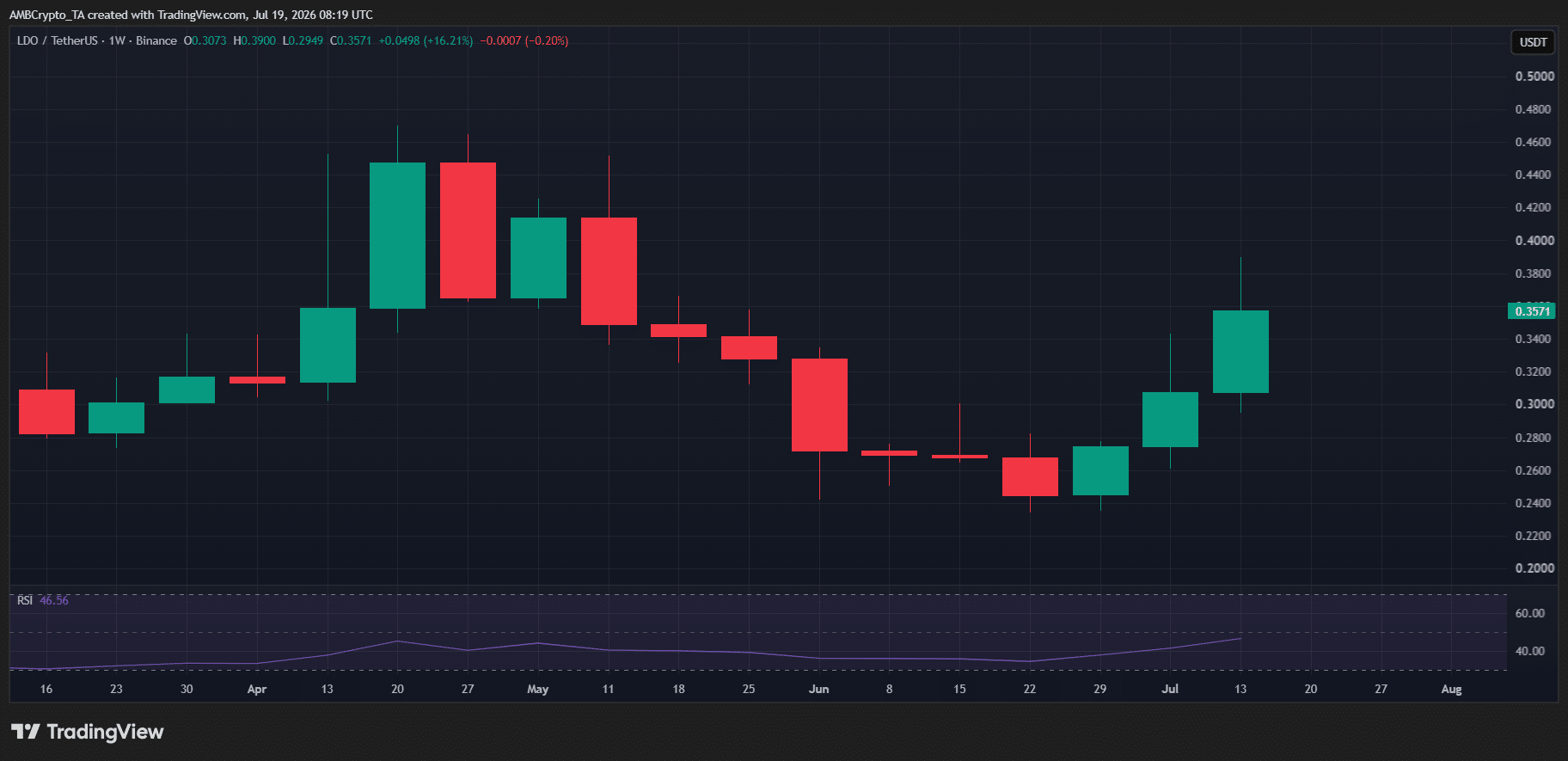
Source: TradingView (LDO/USDT)

If this momentum continues, a breakout toward the $0.40 resistance zone could be on the table.

For context, LDO faced heavy selling pressure around this level during Q1, making it a critical area for bulls to reclaim. A successful breakout could strengthen the recovery narrative, while another rejection may trigger a period of consolidation as traders reassess the next move.

Is Pump.fun [PUMP] still far from reaching full FOMO?

Pump.fun [PUMP] emerged as the second-biggest weekly winner with a 13% rally. While the RSI remains neutral and PUMP has seen strong trading volume in recent sessions, calling this a full-fledged breakout setup may still be too early.

For over two months, PUMP has been trading below the key $0.002 resistance zone, making this the most important level for bulls to reclaim. However, every weekly push higher has so far been followed by a sharp cooldown phase, showing that accumulation is still not strong enough to support a larger breakout.

In short, though, PUMP is showing early signs of recovery, the structure still needs confirmation. Until buyers can consistently defend higher levels and break through the $0.002 resistance, the token remains in a consolidation phase rather than a confirmed breakout trend.

Venice Token [VVV] sees a much-needed weekly relief rally

Venice Token [VVV] took the third spot this week with a 12.3% rally. For VVV, this could be one of its most significant weeks since mid-Q2. From a technical standpoint, VVV has been stuck in a consistent downtrend over the past eight weeks, with every weekly close ending in the red.

However, this week’s gains have clearly pushed VVV back into the spotlight. More importantly, the recovery came right after VVV broke below the key $10 support level, suggesting buyers stepped in at a critical zone. In this context, the rally looks more strategic, with bulls attempting to defend lower levels and build a recovery base.

If this trend holds, VVV could have started its recovery phase. The next key challenge sits around $15, which will determine whether this rebound can turn into a stronger reversal or remain just a short-term relief rally.

Other notable winners

Outside the majors, altcoin movers also stole the spotlight this week.

IOTA [SN9] led the market with a staggering 5,267% gain, followed by Akedo [AKE], which surged 874%, while TENDIES [TENDIES] climbed 615%, rounding out the week’s top performers.

Weekly losers

Lighter [LIT] enters a textbook cooldown phase

Lighter [LIT] led this week’s losses with a 16% decline. While LIT has seen similar pullbacks after strong weekly rallies since its mid-May breakout, this correction could be slightly different.

Notably, LIT’s drop comes after three straight weeks of upside, where the token rallied over 60% and reached a new all-time high of $2.70. More importantly, the breakout followed a successful retest of the $2 resistance zone, showing bulls were stepping in at key levels, a trend that has supported LIT’s Q2 rally.

However, this time, the RSI had climbed above 70, signaling an overheated move. The pullback toward 52 shows momentum has cooled, but it also suggests the market is resetting rather than losing strength.
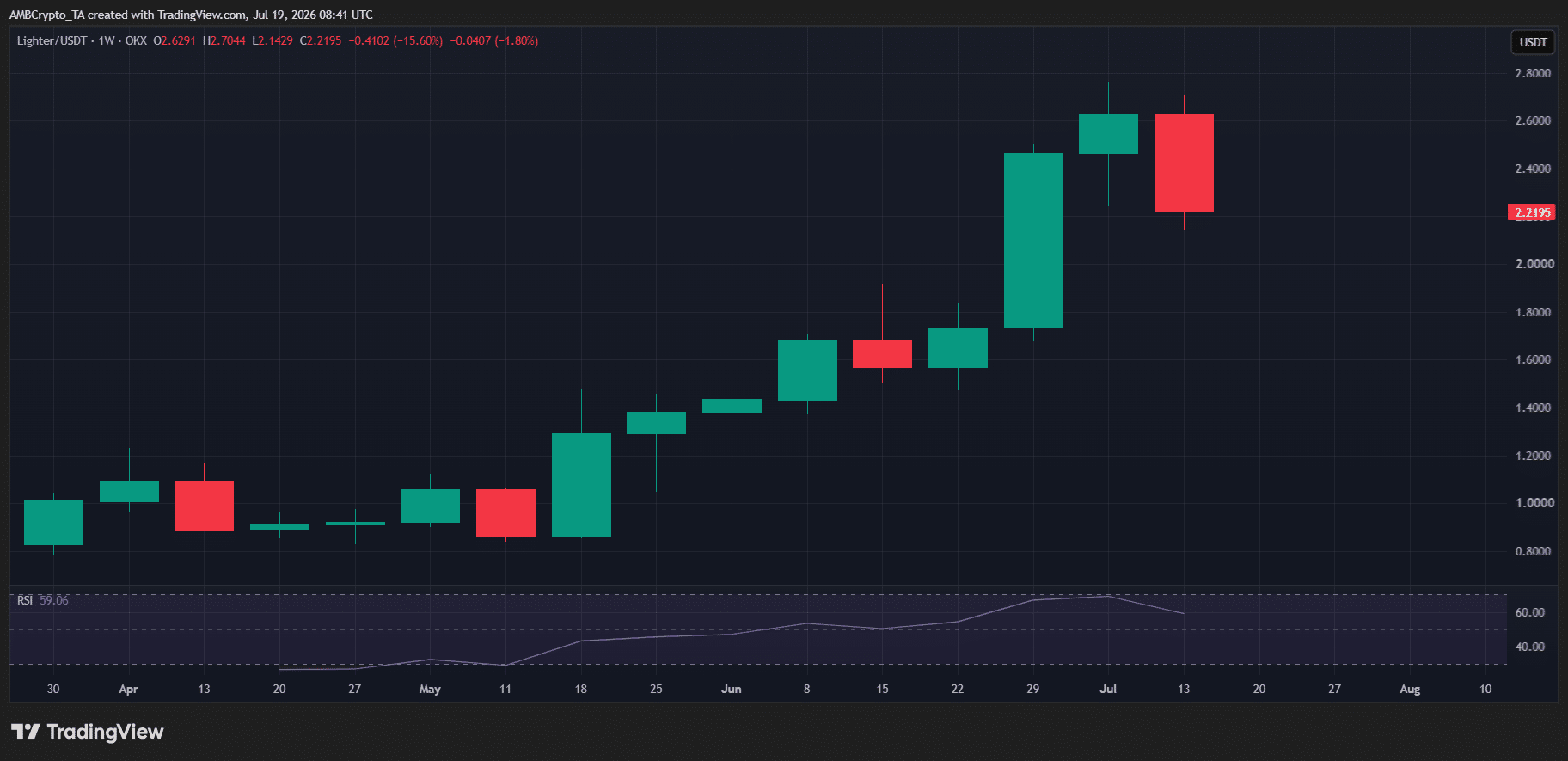
Source: TradingView (LIT/USDT)

Technically, however, this marks LIT’s strongest RSI pullback since its Q2 rally. In essence, this cooldown could become an important setup for LIT’s next move. If buyers step back in and the RSI starts recovering, this reset could fuel another upside attempt.

Otherwise, this could be the first real sign that LIT has formed a local top.

Pi Network [PI] broke below a key support zone

Pi Network [PI] emerged as the second-biggest loser this week with a 2.7% decline. While the drop looks modest compared to Lighter’s double-digit losses, PI’s chart looks much weaker, pointing to a stronger bearish bias.

Notably, this marks PI’s fourth straight week of losses. More importantly, the token broke below the key $0.10 support level, putting any near-term bounce under renewed selling pressure and printing a fresh all-time low.

Technically, PI remains firmly in a bearish structure. While the RSI has dropped into oversold territory, that alone doesn’t guarantee a recovery. Unless buyers reclaim the $0.10 level, any bounce could simply be a short-term relief rally rather than the start of a trend reversal, keeping PI as one of the weaker charts in the market right now.

Are Arbitrum [ARB] bulls losing their upper hand?

Arbitrum [ARB] took the third spot among this week’s biggest losers. Unlike PI, however, ARB’s chart hasn’t fully shifted into a bearish structure. The pullback comes after two straight weeks of gains, during which the token rallied more than 25%.

However, this week’s decline followed ARB’s failure to break above the key $0.10 resistance zone, a level that has capped price since the early May cycle. The rejection shows bulls are still struggling to reclaim this area, allowing sellers to regain short-term control.

Technically, ARB is at an important inflection point. If bulls can reclaim the $0.10 resistance zone, the recent pullback could turn into a healthy retest. Otherwise, continued rejection at this level may keep ARB stuck in a broader consolidation phase and hand bears the upper hand in the near term.

Other notable losers

In the broader market, downside volatility hit hard.

Cash Cat [CASHCAT] led the losers with a 72% decline, followed by LAB [LAB], which fell 66.5%, while ETHGas [GWEI] dropped 53.3% as bearish momentum intensified.

Conclusion

This week was a rollercoaster for crypto. Big pumps, sharp dips, and nonstop action. As always, stay sharp, do your own research, and trade smart.


Final Summary

  • Lido DAO [LDO], Pump.fun [PUMP], and Venice token [VVV] led the week in gains.
  • Lighter [LIT], Pi network[PI], and Arbitrum [ARB] saw significant declines.

Trending Cryptos

Related Questions

QWhich token led this week's biggest gainers, and what was its price performance?

ALido DAO [LDO] led this week's biggest gainers with a 16% rally. Over the last three weeks, it has gained 25%, and in the past 21 days, it has recovered over 40%.

QWhat is the key technical challenge for Lighter [LIT] following its pullback this week?

AFollowing its 16% pullback, the key technical challenge for Lighter [LIT] is whether the cooldown phase resets the market for another upside attempt or confirms a local top. The RSI has cooled from above 70 to around 52.

QWhy is the $0.002 level significant for Pump.fun [PUMP]?

AThe $0.002 level is a key resistance zone for Pump.fun [PUMP]. It has capped the token's price for over two months, and buyers need to consistently break through this level to confirm a breakout trend rather than remaining in consolidation.

QWhat factor makes Pi Network [PI]'s chart structure particularly weak despite its modest weekly loss?

APi Network [PI]'s chart structure is weak because it broke below the key $0.10 support level, printing a fresh all-time low. This marks its fourth consecutive week of losses, and the RSI being oversold does not guarantee a recovery without reclaiming that level.

QAccording to the article, what were the primary drivers of the crypto market's activity this week?

AThe primary drivers of the crypto market's activity this week were technical rallies, profit-taking, and continued rotation into select altcoins.

Related Reads

The Verdict in Choi Tae-won's Divorce Case: Revealing the Inheritance Undercurrent Behind SK Hynix's Trillion-Won Empire

SK Group Chairman Chey Tae-won's high-profile divorce case, involving a record 1.38 trillion won settlement, has drawn attention to the succession plans for Korea's second-largest conglomerate, especially its crown jewel, SK hynix. Unlike traditional chaebol scripts centered on the eldest son, Chey's three children from his marriage to former President Roh Tae-woo's daughter, Roh Soh-yeong, are carving distinct, non-traditional paths. Eldest daughter Chey Yun-jung (b. 1989) is seen as the most evident successor. With a scientific and consulting background, she holds executive roles at SK bioscience and SK Inc.'s growth support department, focusing on future strategy and biopharma. Her marriage is to an AI infrastructure entrepreneur, not a traditional business alliance. Second daughter Chey Min-jung (b. 1991) took a unique route, voluntarily serving as a South Korean naval officer, including an anti-piracy deployment. She later worked on policy and strategy for SK hynix in Washington D.C. before co-founding an AI-driven healthcare startup. She married a former U.S. Marine Corps officer, connecting her to U.S. defense and policy circles—networks crucial for a global semiconductor giant. The only son, Chey In-geun (b. 1995), who studied physics like his father, worked briefly at SK E&S before joining McKinsey. Despite fitting the traditional "heir" profile as the eldest son, he remains silent and holds no public position or shares in SK, suggesting the old succession playbook is obsolete. As SK hynix's valuation soars, becoming a geopolitical asset in the AI era, the heirs' legitimacy is no longer automatic. They must prove themselves in fields like AI biotech, global policy, and strategic consulting. Their marriages also reflect new elite networks in tech and defense, not old political alliances. Their inheritance is the complex challenge of navigating a globalized, tech-driven world, not just a corporate throne.

marsbit17h ago

The Verdict in Choi Tae-won's Divorce Case: Revealing the Inheritance Undercurrent Behind SK Hynix's Trillion-Won Empire

marsbit17h ago

From OpenSea to OpenRouter: Is Alex Atallah Repeating His 'Exit at the Peak' Playbook?

From OpenSea to OpenRouter: Is Alex Atallah Repeating His "Exit at the Peak" Playbook? According to the Wall Street Journal, payments giant Stripe is in talks to acquire the AI model aggregation platform OpenRouter in a potential deal valuing the company near $100 billion. This would mark founder Alex Atallah's second creation of a company reaching a $100 billion valuation, following his co-founding of NFT marketplace OpenSea. OpenRouter, founded just over three years ago, has grown rapidly by acting as a unified gateway for developers to access over 400 AI models. It currently has about 10 million users and processes over 200 trillion tokens monthly. While the platform's annualized revenue is around $50 million, its valuation has skyrocketed from $1.3 billion in March 2026. The potential acquisition by Stripe, a company OpenRouter's founder once likened it to, represents a major expansion into AI infrastructure for the payments leader. This move echoes Atallah's previous timing with OpenSea, where he departed before the NFT market's significant downturn. For OpenRouter, selling now may be strategic. Despite its scale, its business model—charging a 5-5.5% fee on AI inference calls—faces pressure from competition, open-source models, and potential price wars among model providers, limiting its profitability narrative for an IPO. A key asset for potential acquirers like Stripe is OpenRouter's vast repository of real-world AI usage data, which offers unique insights into model performance and developer preferences that are difficult to replicate. Whether this potential deal signifies a new valuation benchmark for AI infrastructure or another market peak signal remains to be seen.

链捕手18h ago

From OpenSea to OpenRouter: Is Alex Atallah Repeating His 'Exit at the Peak' Playbook?

链捕手18h ago

Trading

Spot

Hot Articles

Discussions

Welcome to the HTX Community. Here, you can stay informed about the latest platform developments and gain access to professional market insights. Users' opinions on the price of PUMP (PUMP) are presented below.

活动图片