Off to a Strong Start! USDD TVL Surpasses $1 Billion Mark, Embarking on a Powerful Journey in 2026

marsbitPublicado a 2026-01-16Actualizado a 2026-01-16

Resumen

USDD, a decentralized stablecoin, has achieved a significant milestone at the beginning of 2026 by surpassing $1 billion in Total Value Locked (TVL). This growth reflects strong market confidence in its decentralized mechanism, value stability, and sustainable model. Key drivers include its innovative yield-generating mechanism, multi-chain ecosystem, and robust risk management. USDD functions as an "interest-bearing USDT" through its Smart Allocator system, which dynamically allocates reserve funds to vetted on-chain projects, generating over $8.34 million in actual returns. The introduction of sUSDD allows users to easily earn passive yield with auto-compounding features. USDD has expanded across major blockchains like TRON, Ethereum, and BNB Chain. A collaboration with Binance Wallet’s Yield+ campaign attracted over 3,000 users in its first week, boosting sUSDD TVL by 867% to $295 million. The stablecoin uses an over-collateralized debt model with strict minimum collateral ratios, ensuring transparency and 1:1 redeemability with major stablecoins. In 2026, USDD aims to shift from incentive-driven growth to real-use-case adoption, focusing on deeper integration with DeFi protocols, exchanges, and payment tools. Its decentralized, non-freezable, and yield-bearing features position it as a compelling alternative to centralized stablecoins. Breaking the $1 billion TVL mark is just the beginning of its upward trajectory.

At the beginning of 2026, the decentralized stablecoin USDD has achieved a significant milestone—its Total Value Locked (TVL) has officially surpassed the $1 billion mark! This accomplishment not only marks a new phase in the development of the USDD ecosystem but also demonstrates the market's high recognition of its decentralized mechanism, stable value support, and sustainable development model.
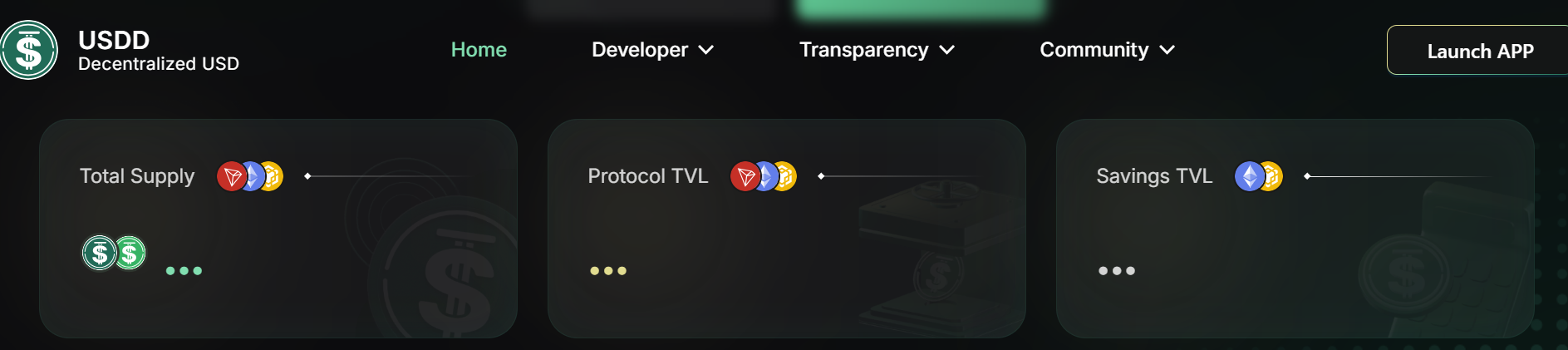
At a time when the DeFi industry is still undergoing structural differentiation and continuous reshuffling, USDD's "strong start" carries significant symbolic meaning. It not only validates USDD's long-term value logic but also injects new growth confidence into the decentralized stablecoin sector, setting a positive tone for the industry's development in 2026.

The Underlying Logic of Counter-Trend Growth: Synergistic Efforts in Mechanism, Ecosystem, and Risk Management

USDD's achievement of this milestone growth is primarily attributed to its three core advantages: an innovative sustainable yield mechanism, a robust multi-chain ecosystem layout, and an exceptional risk management system.

In terms of the yield mechanism, USDD has been positioned as an "interest-bearing version of USDT" since its inception. Through the Smart Allocator yield distribution mechanism, the protocol dynamically allocates a portion of reserve funds to rigorously vetted high-quality on-chain projects, generating diversified returns such as interest, protocol incentives, and platform rewards. According to disclosures, this mechanism has already generated over $8.34 million in actual returns.

Building on this, USDD introduced the interest-bearing token sUSDD, allowing users to seamlessly convert USDD to sUSDD with one click, enabling passive yield generation and automatic compounding without complex operations. This design significantly lowers the barrier to entry for users and extends USDD's utility from a mere value-pegging tool to a capital efficiency tool with yield attributes, enhancing its appeal within the DeFi ecosystem.

In terms of ecosystem layout, USDD has completed the critical transition from a single chain to a multi-chain framework, demonstrating strong user adoption and capital retention during its expansion. For example, during the recent Yield+ campaign launched in collaboration with Binance Wallet, the first week attracted over 3,000 participants, with sUSDD's TVL surging by over 867% in a short period, exceeding $295 million and becoming the fastest-growing stablecoin product during the same period.

Currently, USDD is natively deployed on mainstream public chains such as TRON, Ethereum, and BNB Chain, gradually building a cross-chain synergistic stablecoin infrastructure.

In terms of risk management, USDD adopts an over-collateralized debt position model with strict minimum collateral ratio requirements, ensuring that every USDD is backed by sufficient and transparent assets. Additionally, its stable peg module allows users to exchange USDD for mainstream stablecoins at a 1:1 ratio with zero slippage, providing dual guarantees for liquidity and price stability. It is this series of mechanism designs that enable USDD to maintain its price peg even during market volatility, continuously earning user trust.

Growth Driven by Real-World Adoption: Multi-Chain Ecosystem and Real-World Use Case Deployment in 2026

Looking ahead to 2026, USDD's development roadmap is becoming clearer and more long-term oriented. The team has explicitly stated its intention to gradually shift the ecosystem from "incentive-driven" to "real-use-driven." This means that USDD will increasingly focus on building application scenarios based on genuine demand, gradually reducing reliance on short-term subsidies and external incentives, and instead creating distributable value through endogenous mechanisms like the Smart Allocator.

Simultaneously, USDD plans to further deepen cooperation with on-chain exchanges and core DeFi protocols, exploring a dual-drive model that synergizes on-chain and off-chain activities. On one hand, it aims to expand the native use of USDD in scenarios such as trading, lending, and yield strategies; on the other hand, it seeks to enhance user reach and capital retention through wallets, payment systems, and aggregation tools, forming a positive feedback loop between the protocol, partners, and users.

Facing increasingly fierce competition in the stablecoin market, USDD has also established a clear differentiated positioning. Compared to centralized stablecoins, which offer ample liquidity but pose risks such as freezing and opaque yields, USDD provides a more attractive alternative through its decentralized architecture, anti-freezing characteristics, and mechanisms that reward holders. As the industry demands higher levels of transparency and sustainability, USDD's advantages are expected to become even more pronounced.

Surpassing $1 billion in TVL is just the beginning. In the opening phase of 2026, USDD has already charted a clear and steady upward trajectory, making its future growth potential and industry influence increasingly promising.

Criptos en tendencia

Preguntas relacionadas

QWhat major milestone did USDD achieve at the beginning of 2026?

AUSDD's Total Value Locked (TVL) surpassed the $1 billion mark.

QWhat are the three core advantages that contributed to USDD's growth?

AThe three core advantages are its innovative sustainable yield mechanism, robust multi-chain ecosystem layout, and excellent risk management system.

QWhat is the purpose of the sUSDD token introduced by USDD?

AThe sUSDD token allows users to convert USDD to sUSDD to participate in passive yield generation and automatic compounding with low entry barriers.

QWhich major blockchains has USDD been natively deployed on?

AUSDD has been natively deployed on TRON, Ethereum, and BNB Chain.

QHow does USDD ensure price stability and liquidity for its users?

AUSDD uses an over-collateralized debt model with strict minimum collateral requirements and a stable peg module that allows 1:1, no-slippage swaps between USDD and major stablecoins.

Lecturas Relacionadas

Tras tres trimestres consecutivos de caída, ¿puede el mercado cripto encontrar una ventana de estabilización en el tercer trimestre?

El mercado cripto sufrió su peor trimestre desde 2022, con una caída del 12.6% en la capitalización total (ahora en $2.1 billones). El volumen de operaciones y el valor de las stablecoins también disminuyeron, señalando una salida generalizada de capitales. Bitcoin y Ethereum cayeron un 14.2% y 25.4% respectivamente, rompiendo su correlación con los mercados de riesgo tradicionales. Los ETFs de Bitcoin en EE.UU. registraron importantes salidas netas ($4.67 mil millones en Q2), aunque datos sugieren que el ciclo de ventas podría estar cerca de su fin. La atención del mercado se centra ahora en la reunión de la FED a finales de julio, cuya postura (halcón o paloma) podría definir el rango de trading de Bitcoin para el trimestre. El avance de la ley CLARITY en el Senado estadounidense se ha estancado, reduciendo la probabilidad de aprobación en 2026 y manteniendo una prima de riesgo regulatorio alta. Solo dos sectores mostraron crecimiento: los mercados de predicción (volumen +48.7%) y los coleccionables tokenizados (volumen +143% vs. Q1). El sentimiento general es de cautela. La lógica del mercado ha cambiado, priorizando fundamentos como la política monetaria y la regulación frente a los simples impulsos narrativos. Aunque las bases para una caída extrema parecen limitadas, la recuperación sostenida en Q3 depende críticamente de la FED y de un posible progreso regulatorio.

marsbitHace 20 hora(s)

Tras tres trimestres consecutivos de caída, ¿puede el mercado cripto encontrar una ventana de estabilización en el tercer trimestre?

marsbitHace 20 hora(s)

BIT Trading Moments: BTC aún presionado por la EMA 200 semanal, tras el rechazo podría reiniciar la caída, los valores de almacenamiento y semiconductores que subieron fuertemente anoche comenzaron a caer en la sesión nocturna

**BIT Trading Moments: BTC aún presionado por la EMA 200 semanal; almacenamiento y semiconductores caen en el after-hours** El mercado de cripto continúa su recuperación, con **Bitcoin** manteniéndose cerca de los $66,000. Enfrenta una fuerte resistencia en la zona de los $68,000, nivel que coincide con el costo promedio de los inversores en los últimos cinco meses y un punto de fallo anterior. Los analistas señalan que se encuentra atrapado entre la media móvil simple (MA) de 200 semanas (~$63,333) y la media exponencial (EMA) de 200 semanas (~$68,328). Se necesitaría un cierre semanal por debajo de $55,000 o por encima de $70,000 para confirmar una dirección de mayor alcance. Los ETF de Bitcoin registran entradas netas por sexto día consecutivo. En Wall Street, los **futuros de los principales índices** caen. Después de fuertes ganancias el martes, las acciones de **semiconductores y almacenamiento** retroceden en el after-hours: el ETF de semiconductores cae un 2.22%, Micron un 2.29% y SK Hynix casi un 5%. Sin embargo, **Super Micro Computer (SMCI)** se dispara más de un 20% tras el cierre, impulsada por sólidos pedidos. Otras noticias positivas incluyen un contrato de $266M de la Fuerza Aérea para **Rocket Lab**. A pesar del repunte bursátil, factores como el **crudo Brent por encima de $91** y el **rendimiento del bono estadounidense a 10 años subiendo a ~4.64%** generan preocupaciones inflacionarias y enfrían el optimismo. Las acciones relacionadas con cripto, como Coinbase y Robinhood, tuvieron un buen desempeño apoyadas por avances regulatorios. En Asia, los mercados siguieron la recuperación tecnológica. El **índice KOSPI de Corea del Sur** subió un 0.74%, con acciones de semiconductores mostrando volatilidad. El principal riesgo es el **yen japonés**, que tocó su nivel más bajo desde 1986, lo que genera temores a una intervención del gobierno. **Próximos eventos clave:** Este miércoles 22 de julio, el enfoque está en los eventos de **AMD AI** y los resultados financieros de **Alphabet (Google), Tesla e IBM** después del cierre. El jueves 23, la **decisión de tasas del BCE** y los resultados de **Intel** serán cruciales para el sentimiento del mercado.

marsbitHace 20 hora(s)

BIT Trading Moments: BTC aún presionado por la EMA 200 semanal, tras el rechazo podría reiniciar la caída, los valores de almacenamiento y semiconductores que subieron fuertemente anoche comenzaron a caer en la sesión nocturna

marsbitHace 20 hora(s)

Trading

Spot

Artículos destacados

Cómo comprar USDD

¡Bienvenido a HTX.com! Hemos hecho que comprar USDD (USDD) sea simple y conveniente. Sigue nuestra guía paso a paso para iniciar tu viaje de criptos.Paso 1: crea tu cuenta HTXUtiliza tu correo electrónico o número de teléfono para registrarte y obtener una cuenta gratuita en HTX. Experimenta un proceso de registro sin complicaciones y desbloquea todas las funciones.Obtener mi cuentaPaso 2: ve a Comprar cripto y elige tu método de pagoTarjeta de crédito/débito: usa tu Visa o Mastercard para comprar USDD (USDD) al instante.Saldo: utiliza fondos del saldo de tu cuenta HTX para tradear sin problemas.Terceros: hemos agregado métodos de pago populares como Google Pay y Apple Pay para mejorar la comodidad.P2P: tradear directamente con otros usuarios en HTX.Over-the-Counter (OTC): ofrecemos servicios personalizados y tipos de cambio competitivos para los traders.Paso 3: guarda tu USDD (USDD)Después de comprar tu USDD (USDD), guárdalo en tu cuenta HTX. Alternativamente, puedes enviarlo a otro lugar mediante transferencia blockchain o utilizarlo para tradear otras criptomonedas.Paso 4: tradear USDD (USDD)Tradear fácilmente con USDD (USDD) en HTX's mercado spot. Simplemente accede a tu cuenta, selecciona tu par de trading, ejecuta tus trades y monitorea en tiempo real. Ofrecemos una experiencia fácil de usar tanto para principiantes como para traders experimentados.

435 Vistas totalesPublicado en 2024.12.11Actualizado en 2026.06.02

Cómo comprar USDD

Discusiones

Bienvenido a la comunidad de HTX. Aquí puedes mantenerte informado sobre los últimos desarrollos de la plataforma y acceder a análisis profesionales del mercado. A continuación se presentan las opiniones de los usuarios sobre el precio de USDD (USDD).

活动图片