Sony Bank To Launch Stablecoin For Games, Anime Payments

bitcoinistPublished on 2025-12-02Last updated on 2025-12-02

Abstract

Sony Bank is planning a US stablecoin launch as early as fiscal year 2026, aiming to power low-fee payments for...

Trusted Editorial content, reviewed by leading industry experts and seasoned editors. Ad Disclosure

Sony Bank is planning a US stablecoin launch as early as fiscal year 2026, aiming to power low-fee payments for Sony games and anime.

Sony Bank To Issue Stablecoin As New Payment Method For Games & Anime

As reported by Nikkei Asia, Sony Bank could issue a stablecoin pegged to the US Dollar as early as fiscal year 2026. Sony Bank, a subsidiary of Sony Financial Holdings, is one of the largest online banks in Japan. It applied for a banking license in the US back in October.

The bank’s parent company went public in September and spun off into its own entity separate from Sony Group. The firm, however, is continuing to support the group’s business developments. The stablecoin project is one such avenue, as Sony Group envisions that the USD-pegged token will be used by customers to pay for content like games and anime in its ecosystem.

Sony Group is a well-known name around the world, controlling multiple large media-related businesses like Sony Interactive Entertainment, the company behind the PlayStation, and Sony Pictures Entertainment, a filmmaker.

In the fiscal year that ended in March 2025, US customers made up 30% of the group’s overall sales to external customers. With Sony Bank’s stablecoin, the multinational conglomerate is now hoping these users can start paying in the ecosystem with digital assets, cutting back on the transaction fees paid to credit card companies.

The bank has formed a partnership with Bastion, an American stablecoin infrastructure solutions provider, to help with the project. “The bank plans to establish a subsidiary to handle its stablecoin business,” noted Nikkei.

The move from Sony comes a few months after President Donald Trump signed the GENIUS Act, establishing a regulatory framework for stablecoins in the US. These cryptocurrencies have also been gaining momentum in other parts of the world recently. Hong Kong launched its stablecoin legislation in August and plans on handing out issuer licenses next year. Japan saw the launch of its first yen-backed coin in October.

Major European banks have come together to form a consortium to launch a euro-pegged stablecoin, aiming a rollout in the second half of 2026 in a bid to challenge the currently USD-dominated market. Over the past year, the fiat-tied cryptocurrencies have enjoyed some sharp growth, but in the last month, they have suffered a slowdown as part of the downturn in the digital assets sector as a whole.

Below is a chart from DeFiLlama that shows how the market cap of the stablecoins has changed over the last several years.
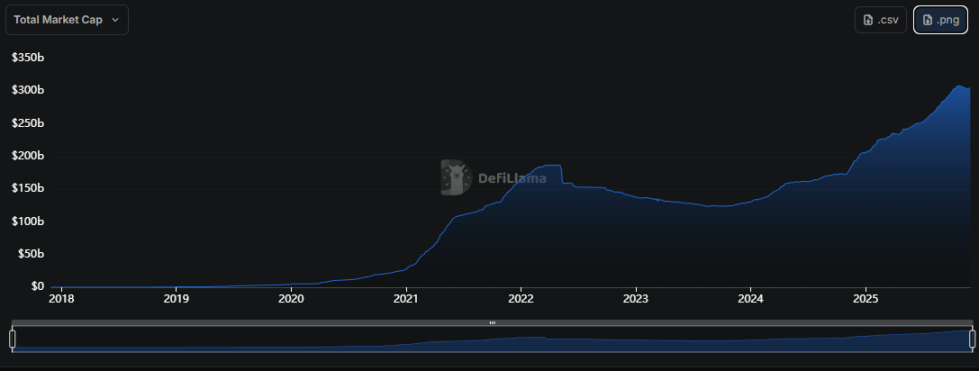
Stablecoins Market Cap

Looks like the metric has dropped into sideways movement in recent weeks | Source: DeFiLlama

The stablecoin market cap set a new record of $309 billion in late-October. Since then, the metric has seen a small decline to $306 billion. USDT and USDC, the two largest tokens in the space, alone account for about $261 billion of this figure.

Bitcoin Price

At the time of writing, Bitcoin is trading around $86,700, down nearly 6% over the last 24 hours.

Bitcoin Price Chart

The price of the coin seems to have plunged | Source: BTCUSDT on TradingView
Featured image from Nikita Kostrykin on Unsplash.com, DeFiLlama.com, chart from TradingView.com
Editorial Process for bitcoinist is centered on delivering thoroughly researched, accurate, and unbiased content. We uphold strict sourcing standards, and each page undergoes diligent review by our team of top technology experts and seasoned editors. This process ensures the integrity, relevance, and value of our content for our readers.

Keshav is a Physics graduate who has been employed as a writer with Bitcoinist since June 2021. He is passionate about writing and through the years, he has gained experience working in a variety of niches. Keshav holds an active interest in the cryptocurrency market, with on-chain analysis being an area he particularly likes to research and write about.

Trending Cryptos

Related Reads

The Verdict in Choi Tae-won's Divorce Case: Revealing the Inheritance Undercurrent Behind SK Hynix's Trillion-Won Empire

SK Group Chairman Chey Tae-won's high-profile divorce case, involving a record 1.38 trillion won settlement, has drawn attention to the succession plans for Korea's second-largest conglomerate, especially its crown jewel, SK hynix. Unlike traditional chaebol scripts centered on the eldest son, Chey's three children from his marriage to former President Roh Tae-woo's daughter, Roh Soh-yeong, are carving distinct, non-traditional paths. Eldest daughter Chey Yun-jung (b. 1989) is seen as the most evident successor. With a scientific and consulting background, she holds executive roles at SK bioscience and SK Inc.'s growth support department, focusing on future strategy and biopharma. Her marriage is to an AI infrastructure entrepreneur, not a traditional business alliance. Second daughter Chey Min-jung (b. 1991) took a unique route, voluntarily serving as a South Korean naval officer, including an anti-piracy deployment. She later worked on policy and strategy for SK hynix in Washington D.C. before co-founding an AI-driven healthcare startup. She married a former U.S. Marine Corps officer, connecting her to U.S. defense and policy circles—networks crucial for a global semiconductor giant. The only son, Chey In-geun (b. 1995), who studied physics like his father, worked briefly at SK E&S before joining McKinsey. Despite fitting the traditional "heir" profile as the eldest son, he remains silent and holds no public position or shares in SK, suggesting the old succession playbook is obsolete. As SK hynix's valuation soars, becoming a geopolitical asset in the AI era, the heirs' legitimacy is no longer automatic. They must prove themselves in fields like AI biotech, global policy, and strategic consulting. Their marriages also reflect new elite networks in tech and defense, not old political alliances. Their inheritance is the complex challenge of navigating a globalized, tech-driven world, not just a corporate throne.

marsbitYesterday 09:06

The Verdict in Choi Tae-won's Divorce Case: Revealing the Inheritance Undercurrent Behind SK Hynix's Trillion-Won Empire

marsbitYesterday 09:06

From OpenSea to OpenRouter: Is Alex Atallah Repeating His 'Exit at the Peak' Playbook?

From OpenSea to OpenRouter: Is Alex Atallah Repeating His "Exit at the Peak" Playbook? According to the Wall Street Journal, payments giant Stripe is in talks to acquire the AI model aggregation platform OpenRouter in a potential deal valuing the company near $100 billion. This would mark founder Alex Atallah's second creation of a company reaching a $100 billion valuation, following his co-founding of NFT marketplace OpenSea. OpenRouter, founded just over three years ago, has grown rapidly by acting as a unified gateway for developers to access over 400 AI models. It currently has about 10 million users and processes over 200 trillion tokens monthly. While the platform's annualized revenue is around $50 million, its valuation has skyrocketed from $1.3 billion in March 2026. The potential acquisition by Stripe, a company OpenRouter's founder once likened it to, represents a major expansion into AI infrastructure for the payments leader. This move echoes Atallah's previous timing with OpenSea, where he departed before the NFT market's significant downturn. For OpenRouter, selling now may be strategic. Despite its scale, its business model—charging a 5-5.5% fee on AI inference calls—faces pressure from competition, open-source models, and potential price wars among model providers, limiting its profitability narrative for an IPO. A key asset for potential acquirers like Stripe is OpenRouter's vast repository of real-world AI usage data, which offers unique insights into model performance and developer preferences that are difficult to replicate. Whether this potential deal signifies a new valuation benchmark for AI infrastructure or another market peak signal remains to be seen.

链捕手Yesterday 08:42

From OpenSea to OpenRouter: Is Alex Atallah Repeating His 'Exit at the Peak' Playbook?

链捕手Yesterday 08:42

Trading

Spot

Hot Articles

How to Buy ANIME

Welcome to HTX.com! We've made purchasing Animecoin (ANIME) simple and convenient. Follow our step-by-step guide to embark on your crypto journey.Step 1: Create Your HTX AccountUse your email or phone number to sign up for a free account on HTX. Experience a hassle-free registration journey and unlock all features.Get My AccountStep 2: Go to Buy Crypto and Choose Your Payment MethodCredit/Debit Card: Use your Visa or Mastercard to buy Animecoin (ANIME) instantly.Balance: Use funds from your HTX account balance to trade seamlessly.Third Parties: We've added popular payment methods such as Google Pay and Apple Pay to enhance convenience.P2P: Trade directly with other users on HTX.Over-the-Counter (OTC): We offer tailor-made services and competitive exchange rates for traders.Step 3: Store Your Animecoin (ANIME)After purchasing your Animecoin (ANIME), store it in your HTX account. Alternatively, you can send it elsewhere via blockchain transfer or use it to trade other cryptocurrencies.Step 4: Trade Animecoin (ANIME)Easily trade Animecoin (ANIME) on HTX's spot market. Simply access your account, select your trading pair, execute your trades, and monitor in real-time. We offer a user-friendly experience for both beginners and seasoned traders.

6.5k Total ViewsPublished 2025.06.18Updated 2026.06.02

How to Buy ANIME

Discussions

Welcome to the HTX Community. Here, you can stay informed about the latest platform developments and gain access to professional market insights. Users' opinions on the price of ANIME (ANIME) are presented below.

活动图片














