Standing Tall Through Storms, Gathering in Hong Kong to Ride the Tide | Registration Opens for Conflux Tree-Graph Digital Finance & Ecosystem Development Conference

marsbitPublished on 2026-05-09Last updated on 2026-05-09

Abstract

Every technological wave quietly reshapes the world. From the steam engine to the internet and the digital economy, each has been a growth engine. Today, the convergence of blockchain, AI, and digital finance is accelerating a new transformation. Digital assets are reaching new peaks, global regulatory attitudes are clarifying, and concepts like RWA and stablecoins are scaling into real-world applications. AI Agents are beginning to participate in human production. We stand at a historic juncture where traditional and digital finance are deeply integrating, presenting clear opportunities and tangible challenges. Having operated stably for five years and connected multiple regions globally, Conflux Network continues to serve digital finance and on-chain applications. Hong Kong, as an international financial hub bridging China and the world, is seeing progressive exploration and improved frameworks for Web3 and digital finance. Leveraging Conflux's technical foundation, the Conflux Digital Finance and Ecosystem Development Summit will be held in Hong Kong from May 13 to 15, 2026. This event will foster in-depth dialogue on the future: discussing the evolution of digital financial infrastructure, the compliant implementation of RWA and stablecoins, ecosystem reshaping and on-chain governance in the age of AI Agents, and Web3 security frameworks. It will gather global scholars, entrepreneurs, investors, financial institutions, and industry representatives for cross-disciplina...

Every wave of technological advancement quietly reshapes the world's operating paradigms. The steam engine propelled the rise of industry, information technology and the internet turned the "global village" into a reality, and the digital economy has gradually become a key engine of global growth. Today, the convergence of blockchain, AI, and digital finance is accelerating the arrival of a new transformative era.

The scale of digital assets continues to hit historical highs, global regulatory attitudes toward digital financial innovation are becoming increasingly clear, RWA and stablecoins are evolving from concepts to large-scale implementation, and AI Agents are beginning to actively participate in human production and creation. We stand at a historical juncture where traditional finance and digital finance are deeply integrating. Opportunities have never been so clear, and challenges have never been so tangible.

The Conflux Network tree-graph public blockchain has been operating stably for five years, connecting multiple countries and regions globally, and continuously serving the development of digital finance and on-chain applications. Hong Kong, as an international financial center, has long played a pivotal role as a hub connecting Mainland China with the world, where capital, information, and industries converge and flow. In recent years, explorations around digital finance and Web3 have been steadily advancing here, with institutional and market environments gradually improving, providing clearer space for the experimentation and implementation of new technologies.

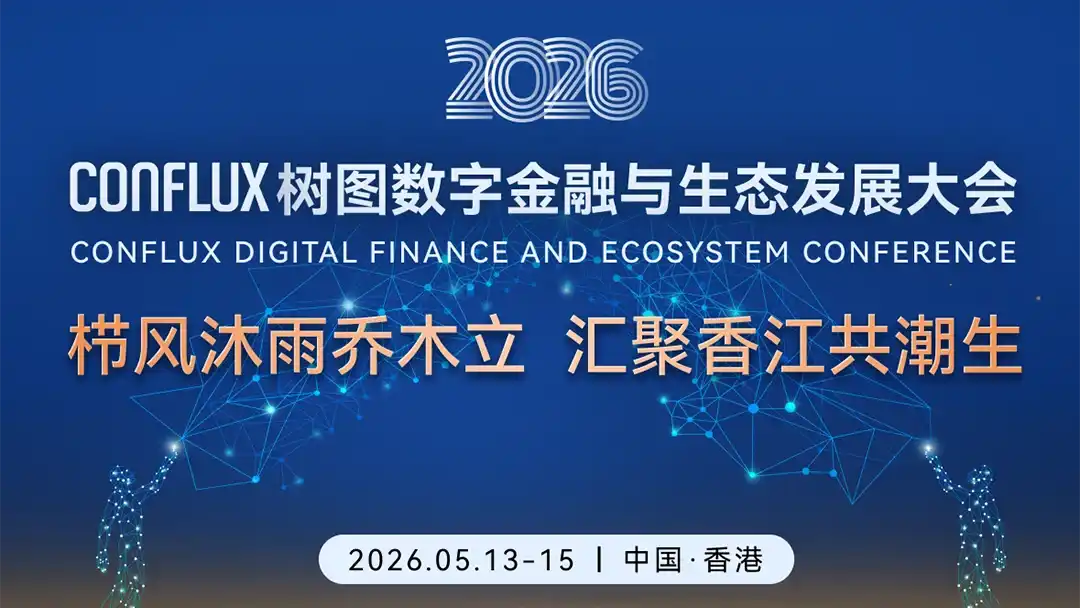
Leveraging Conflux's technological foundation, the Conflux Tree-Graph Digital Finance & Ecosystem Development Conference will be held in Hong Kong from May 13th to 15th, 2026.

This will be an in-depth dialogue about the present and the future: centering on core topics such as the evolution of digital financial infrastructure, the compliant implementation of RWA and stablecoins, ecosystem restructuring and on-chain governance in the era of AI Agents, and the construction of Web3 security systems, the event will gather academics, entrepreneurs, investors, financial institutions, and industry representatives from around the world for profound cross-disciplinary exchanges. On the final day of the conference, Conflux will co-host a themed salon with The University of Hong Kong, planting seeds of future-oriented thought in the minds of the younger generation.

Scan the QR code above to register

As technology transitions from "usable" to "scalably applicable," and as finance evolves from "digitalization" to "on-chain and intelligent" operation, the restructuring of industrial architecture has already begun. Whether you are a developer, researcher, entrepreneur, or an explorer keeping a watchful eye on digital finance and Web3, we look forward to meeting you in Hong Kong.

Trending Cryptos

Related Questions

QWhat is the main topic of the "Conflux Tree-Graph Digital Finance and Ecosystem Development Conference"?

AThe main topic is the intersection of blockchain, AI, and digital finance, focusing on infrastructure evolution, RWA and stablecoin compliance, ecosystem reshaping in the AI Agent era, on-chain governance, and Web3 security.

QWhen and where will the "Conflux Tree-Graph Digital Finance and Ecosystem Development Conference" take place?

AThe conference will take place in Hong Kong from May 13th to 15th, 2026.

QAccording to the article, why is Hong Kong considered a suitable location for this conference?

AHong Kong is a global financial hub connecting Mainland China and the world. It has increasingly clear regulations and a supportive market environment for exploring digital finance and Web3, providing space for the practical implementation of new technologies.

QWhat specific event is mentioned for the final day of the conference?

AOn the final day, Conflux will co-host a thematic salon with the University of Hong Kong, aiming to share insights about the future with the younger generation.

QWho is the target audience for this conference according to the article?

AThe target audience includes developers, researchers, entrepreneurs, investors, financial institutions, industry representatives, and anyone exploring or interested in digital finance and Web3.

Related Reads

What's New in Ethereum's Roadmap: Privacy, Quantum Security, Native Rollup?

On August 10, 2024, Ethereum co-founder Vitalik Buterin revealed an updated technical roadmap, highlighting significant changes in priorities and new focus areas. Key new additions include: - **Strong Privacy Protection**: Elevated to a top-tier protocol concern. Proposals like EIP-8250 (keyed nonces for concurrency), EIP-8272 (recent roots for verification), and EIP-8182 (shared protocol-level privacy pools) aim to enable private transfers of ETH and ERC-20s, moving toward default private accounts. - **Quantum Resilience**: Priority increased. The plan addresses risks to ECDSA/BLS signatures, KZG commitments, and ZK systems, exploring solutions like leanSPHINCS signatures, STARK proofs (considered quantum-resistant), and streamlined verification processes. A full L1 upgrade is tentatively targeted for ~2029. - **Native Rollups**: A novel concept where rollups could reuse Ethereum's core validation infrastructure via a new EXECUTE precompile (EIP-8079 draft). This aims to reduce custom code and enhance security for certain L2s, while specialized chains will continue to exist. - **Protocol Simplification & Formal Verification**: Leveraging AI tools to make full-protocol formal verification feasible, aiming for more rigorous and machine-verifiable specifications. Other notable shifts: - State storage is evolving from Verkle trees to a Partitioned Binary Tree (PBT, EIP-8347 draft). - Some 2023 items like VDFs and certain EVM improvements were deprioritized. - Long-term discussions include blob/gas futures and non-EVM instruction sets (e.g., RISC-V). The "Strawmap" outlines potential upgrades through ~2029 but is a directional guide, not a firm timeline. Key milestones to watch include the Glamsterdam (Q4 2026) and Hegotá (2027) forks. Many proposals remain in draft or research phases.

marsbit7m ago

What's New in Ethereum's Roadmap: Privacy, Quantum Security, Native Rollup?

marsbit7m ago

Hyperliquid Trading Volume Soars, So Why Are Profits Falling?

Hyperliquid, a leading decentralized perpetuals trading platform, has seen its open interest surge to a record high above $11 billion, capturing roughly 9% of the global market share. Trading volume remains robust, nearing $178 billion over 30 days, driven largely by the explosive growth of third-party markets offering tokenized real-world assets (RWAs) like stocks and commodities. Despite this growth, the platform's protocol revenue has declined for four consecutive quarters, falling 43% from its Q3 2025 peak of $357 million to approximately $202 million in Q2 2026. This divergence is primarily attributed to the HIP-3 governance proposal, which allows external developers to launch their own markets and keep up to half of the generated fees. These third-party markets now account for nearly 50% of total volume. Consequently, the share of revenue redistributed to developers, market makers, and the treasury has tripled from 6% to 18% in a year. This directly reduces the funds allocated to the platform's buyback-and-burn mechanism for its native HYPE token, weakening a key price support. HYPE's price has fallen 28% from its all-time high. The platform's growth is also heavily concentrated, with a single entity, Trade.xyz, responsible for over 90% of HIP-3 open interest, introducing systemic risk. Additionally, the ecosystem lacks diversity beyond HYPE, faces ongoing token unlocks adding sell pressure, and is encountering increased regulatory scrutiny and new competition from platforms like Robinhood Chain. While still a major revenue generator in crypto, Hyperliquid's model of sharing fees to fuel expansion is currently compressing its own earnings and token economics.

marsbit7m ago

Hyperliquid Trading Volume Soars, So Why Are Profits Falling?

marsbit7m ago

Citi Research Report Analysis: U.S. Proposed Ban on Chinese Optical Modules Has No Substantial Progress, Short-term Enforcement Faces Supply Constraints

Citi Report Analysis: U.S. Proposed Ban on Chinese Optical Modules Lacks Substantive Progress, Faces Supply Bottlenecks in Short Term. Reuters reported on August 4th that the U.S. government and FCC are considering a ban on Chinese optical modules. Citi's August 9th report clarifies that optical modules are not listed on any effective FCC ban. The FCC's Order 26-50 established two restricted list mechanisms (based on manufacturer and production location), but optical modules were only mentioned once, as an example in a disclosure requirement, not as a restricted product. The reported ban remains at a proposal stage. Citi estimates Chinese suppliers provide 60-70% of high-speed optical modules for U.S. hyperscalers. Non-Chinese suppliers cannot fill this gap in the short term, making the immediate implementation of a genuine ban unlikely. Future regulatory paths could be manufacturer-based (least likely), location-based covering all offshore production (strictest), or location-based covering only China (more feasible but with unresolved definitions). A ban would pressure U.S. AI infrastructure, conflicting with stated policy goals. Citi sees low near-term implementation probability, with the issue potentially becoming a negotiation chip in bilateral talks. U.S. domestic capacity build-out is a key long-term variable. Among Chinese companies, XSENS and Dongshan Precision have the highest U.S. exposure, while Tianfu Communication, as a passive component supplier, is relatively insulated. Citi maintains Buy ratings on all three with respective price targets. The conclusion is that Chinese modules are currently irreplaceable in the U.S. AI supply chain, creating a longer timeline for potential restrictions than the market may expect.

marsbit1h ago

Citi Research Report Analysis: U.S. Proposed Ban on Chinese Optical Modules Has No Substantial Progress, Short-term Enforcement Faces Supply Constraints

marsbit1h ago

Trading

Spot

Hot Articles

How to Buy TREE

Welcome to HTX.com! We've made purchasing TREEHOUSE (TREE) simple and convenient. Follow our step-by-step guide to embark on your crypto journey.Step 1: Create Your HTX AccountUse your email or phone number to sign up for a free account on HTX. Experience a hassle-free registration journey and unlock all features.Get My AccountStep 2: Go to Buy Crypto and Choose Your Payment MethodCredit/Debit Card: Use your Visa or Mastercard to buy TREEHOUSE (TREE) instantly.Balance: Use funds from your HTX account balance to trade seamlessly.Third Parties: We've added popular payment methods such as Google Pay and Apple Pay to enhance convenience.P2P: Trade directly with other users on HTX.Over-the-Counter (OTC): We offer tailor-made services and competitive exchange rates for traders.Step 3: Store Your TREEHOUSE (TREE)After purchasing your TREEHOUSE (TREE), store it in your HTX account. Alternatively, you can send it elsewhere via blockchain transfer or use it to trade other cryptocurrencies.Step 4: Trade TREEHOUSE (TREE)Easily trade TREEHOUSE (TREE) on HTX's spot market. Simply access your account, select your trading pair, execute your trades, and monitor in real-time. We offer a user-friendly experience for both beginners and seasoned traders.

3.5k Total ViewsPublished 2025.07.29Updated 2026.06.02

How to Buy TREE

Discussions

Welcome to the HTX Community. Here, you can stay informed about the latest platform developments and gain access to professional market insights. Users' opinions on the price of TREE (TREE) are presented below.

活动图片