Dual Governance 101: Explainer

项目方LDO(Lido)Published on 2025-06-03Last updated on 2025-11-10

Introducing Dual Governance: Giving stETH Holders a Voice


There is an inherent tension in DAO-run systems: those who shape the protocol’s design are not necessarily those who shoulder the outcomes firsthand. The DAO holds upgrade rights, while stETH holders bear the execution risk. Because upgrades are inevitable as Ethereum evolves, this tension only grows.


Dual Governance addresses these concerns by enabling stETH holders to express discontent and exit the protocol if confronted with controversial LDO-governance decisions.


At its core, Dual Governance represents a dynamic timelock: the more exit signals stETH holders submit, the longer LDO-governance motions are delayed.


This achieves two aims at once:

  1. Makes contention visible and measurable.
  2. Gives stakers the option to exit safely, avoiding unfavorable protocol changes.

Here is how it works, why it matters, and the key parameters that make it effective.


The Core Idea: The Right to Exit & Balanced Power

  1. Right to Exit Safely: stETH holders can withdraw their stake if they oppose governance decisions, preventing forced changes to their crypto-assets.
  2. Balance of Interests: No single group (LDO holders, node operators, or stakers) can unilaterally push harmful changes on stakers. Each has a voice, and strong disagreements trigger a built-in pause for negotiation or exit.


Why It’s Needed: The Risk of Governance Attack

Ethereum’s validator-exit queue can delay withdrawals for weeks or months during congestion. In that window, a hostile majority of LDO tokens could force smart-contract upgrades, eject node operators, or reassign user-withdrawal addresses.


Dual Governance mitigates such extreme scenarios by allowing stETH holders to voice disagreement and by blocking protocol governance for the time needed to exit.


This makes large-scale takeovers costly and impractical, enhancing the protection of Lido participants and, indirectly, Ethereum itself.


How Dual Governance Works

Dual Governance adds a “sentiment gauge” that lets stETH holders delay LDO-governance execution when opposition rises.


Ultimately, the contention is either mediated or—if an active governance attack targets protocol users—stakes can be withdrawn safely through the rage-quit gate.


The more stETH that signals disagreement, the longer the execution delay. Once opposition reaches a major threshold (10 % of TVL), governance cannot execute any change until the opposing stakers withdraw their tokens.


Key Scenarios: When Dual Governance Matters

Scenario 1: Voicing Opposition and De-escalation


  • LDO holders propose removing a node operator, unaware of critical reasons to keep them.
  • stETH holders signal a veto, triggering a temporary pause.
  • LDO holders reconsider and cancel the proposal.
  • Governance continues as usual without harming user trust.


Scenario 2: Reacting to Takeover—Guaranteed Exit

  • A large LDO-holding entity proposes a smart-contract change that jeopardizes user tokens.
  • Enough stETH holders lock tokens in the veto-signalling contract, delaying execution.
  • stETH holders exit if LDO holders refuse to cancel.
  • After withdrawals complete—or the proposal is canceled and stETH holders have unlocked their tokens—governance resumes.


Dual Governance Design

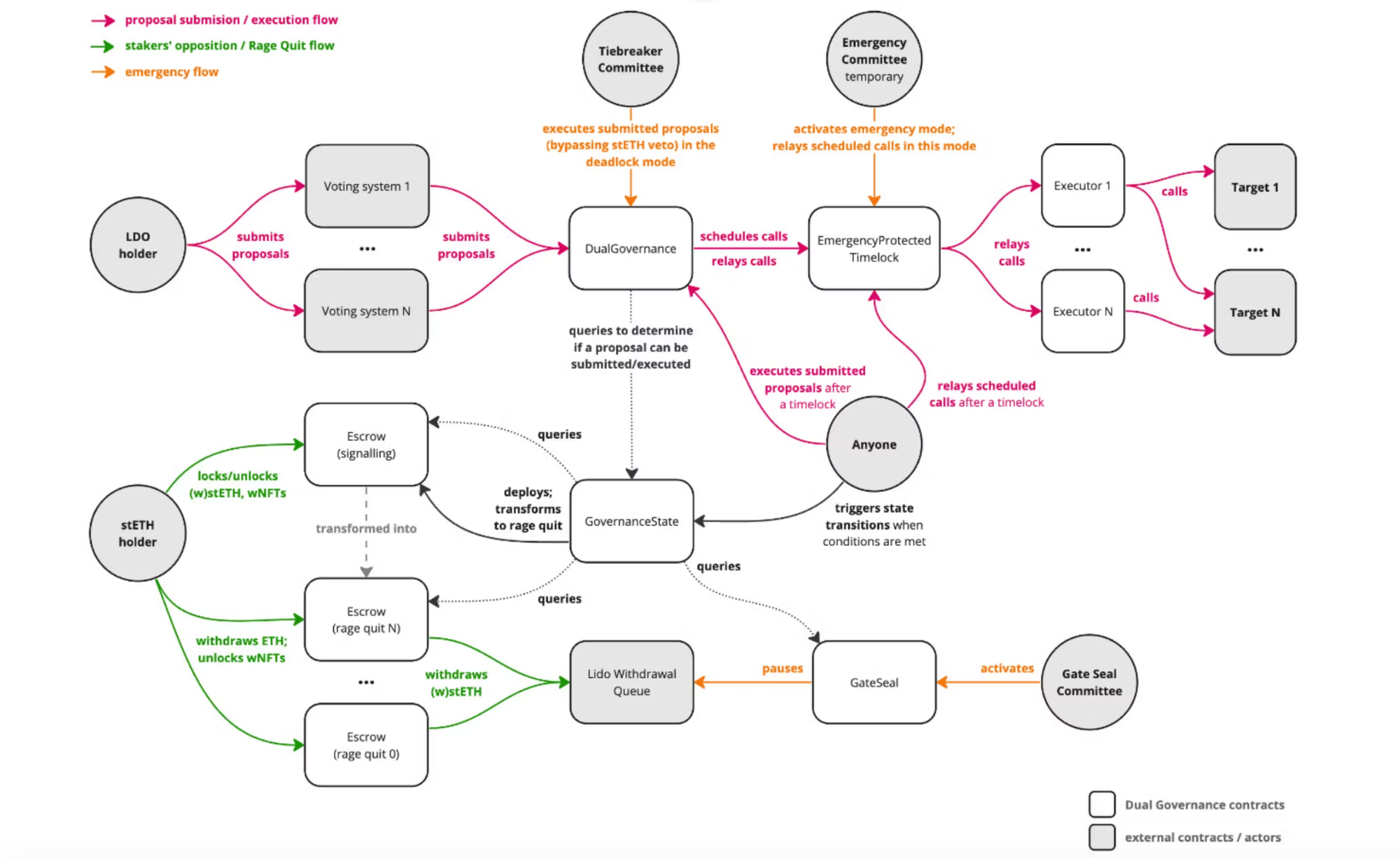
Dual Governance inserts a timelock between Lido-DAO decisions and execution. It is linked to an escrow where stETH holders can signal intent to exit by locking stETH, wstETH, or withdrawal NFTs.


Once deposits cross the first-seal threshold (1 % of Lido-on-Ethereum TVL), the timelock starts to grow. Reaching the second seal (10 % of TVL) triggers rage quit—execution is fully blocked until all locked stake is withdrawn to ETH.


All contracts have undergone multiple independent audits, ensuring the code meets the highest security standards.


The system has undergone third-party design reviews from Certora and Runtime Verification. Audit reports are available from Certora, Statemind, OpenZeppelin, and Runtime Verification.


All proposed parameters were tested by two independent teams: game-theoretic research by 20squares and agent-based modeling by CollectifDAO.


Proposal Lifecycle

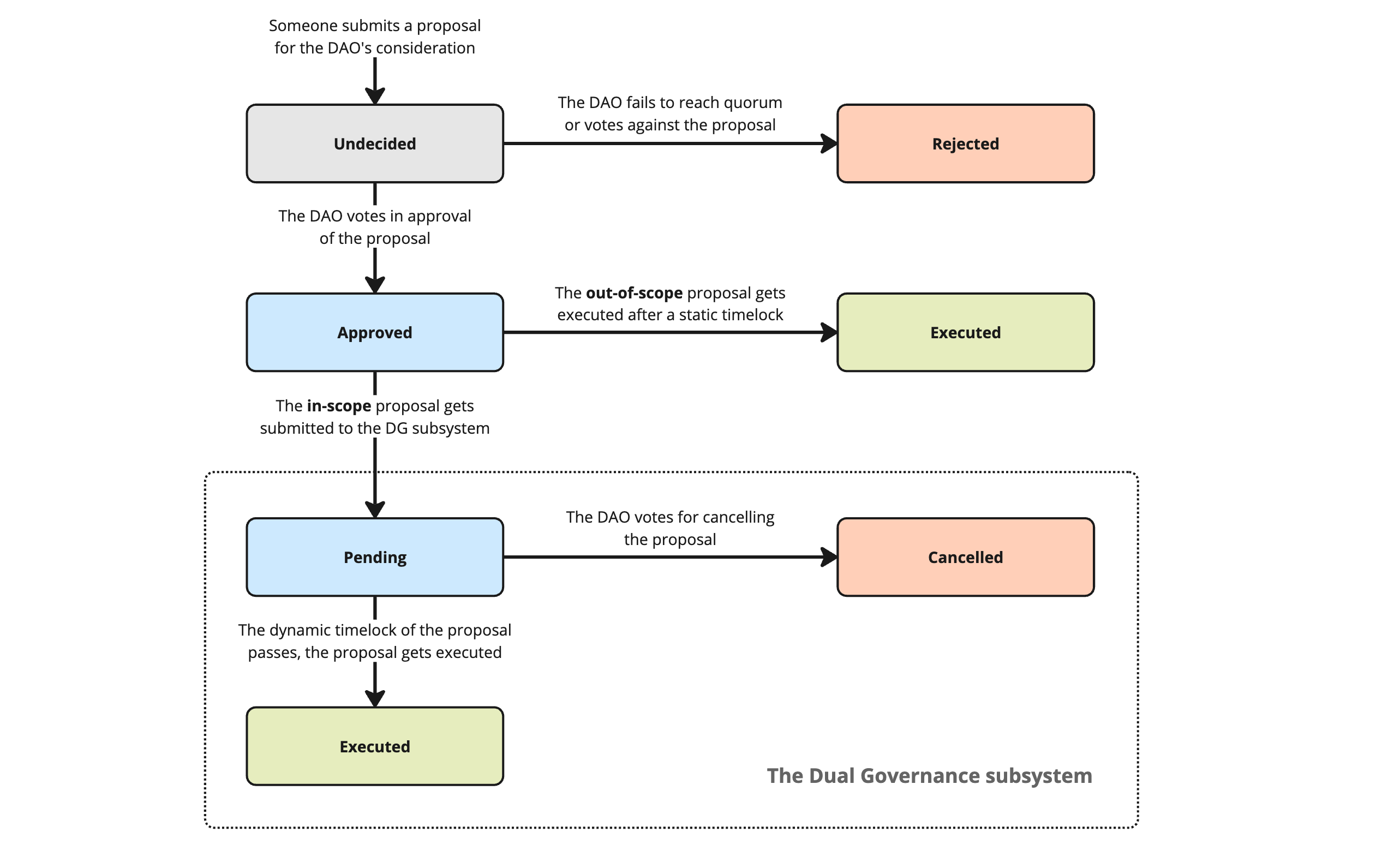
When the DAO (i.e., LDO holders) supports a proposal—such as upgrading a smart contract or adding a node operator—it does not execute immediately. Instead, it enters a four-day waiting period. During this time, stETH holders can trigger Veto Signaling by locking tokens.


If triggered, a dynamic timelock replaces the standard delay, extending the waiting period according to the amount of stETH committed (from five extra days at 1 % to a maximum of 45 days at 10 %). During this period:


  • The DAO can still cancel pending proposals if contention is visible.
  • stETH holders may escalate by locking more stETH, further extending the timelock or eventually triggering a rage quit.


Once the timelock expires, the proposal can be executed, allowing on-chain changes to take effect.


Governance States

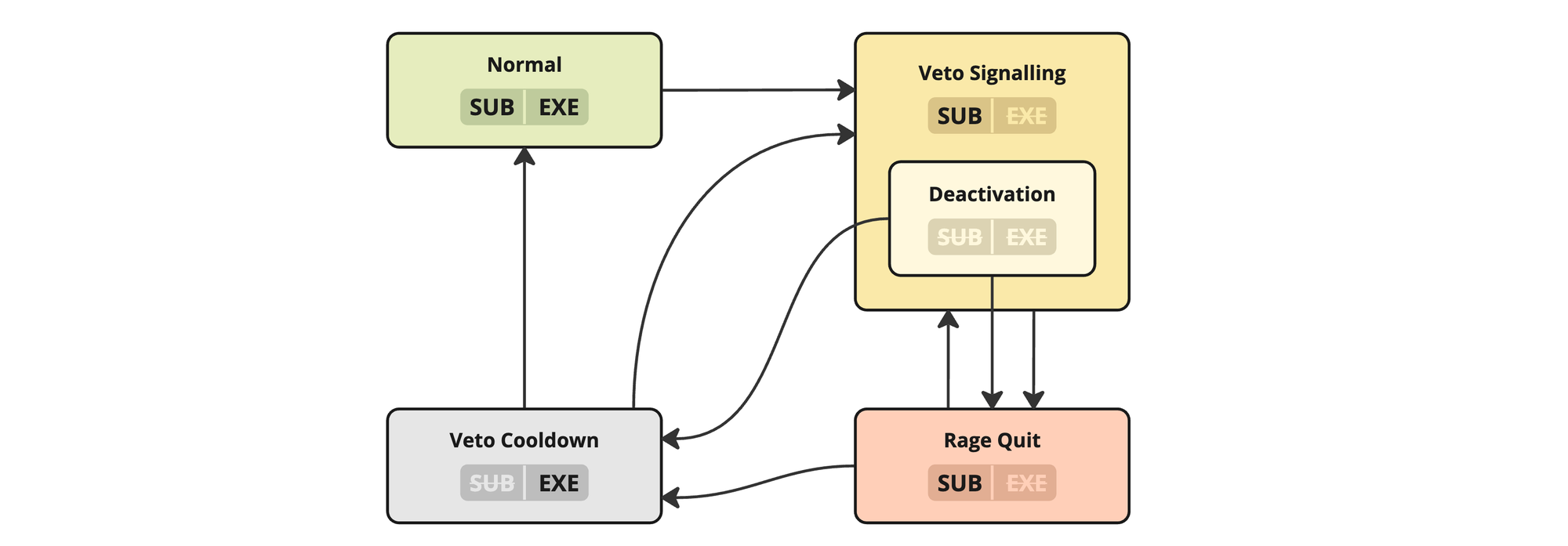
Dual Governance follows a state-machine model, each state imposing specific rules:

  1. Normal: Default state; proposals spend four days pending, then can be executed.
  2. Veto Signaling: Triggered when 1 % of stETH supply is escrowed in opposition. The proposal is paused under a dynamic timelock, which expands from five to 45 days proportional to stETH opposition.
  3. Rage Quit: If 10 % of stETH remains locked until the timelock ends, stakers exit. No new proposals can execute until withdrawals finish, shielding users from the contested motion.
  4. Veto-Signaling Deactivation and Veto Cooldown: Technical sub-states that resolve edge cases; only pending proposals may execute during Veto Cooldown.


The Role of Committees: Fine-Tuning Governance Resilience

Dual Governance introduces three new committees that cover different areas:

1. Reseal Committee

A safety net that extends the withdrawal pause triggered by GateSeal.

  • GateSeal: Pauses withdrawals for 11 days if a critical issue is detected.
  • Reseal: Extends GateSeal’s pause when Veto Signaling is active, giving the DAO more time to act.


2. Tiebreaker Committee

A last-resort measure for unlikely stalemates.

  • Can force execution of stuck proposals or unseal withdrawal contracts.
  • Activates only after long-term governance paralysis.


Structure: A “multisig of multisigs” comprising three subcommittees:

  • Ethereum Ecosystem (3/5 quorum)
  • Builders (3/5 quorum)
  • Node Operators (5/7 quorum)


At least two of the three subcommittees must reach quorum. All members are external to avoid conflicts of interest.


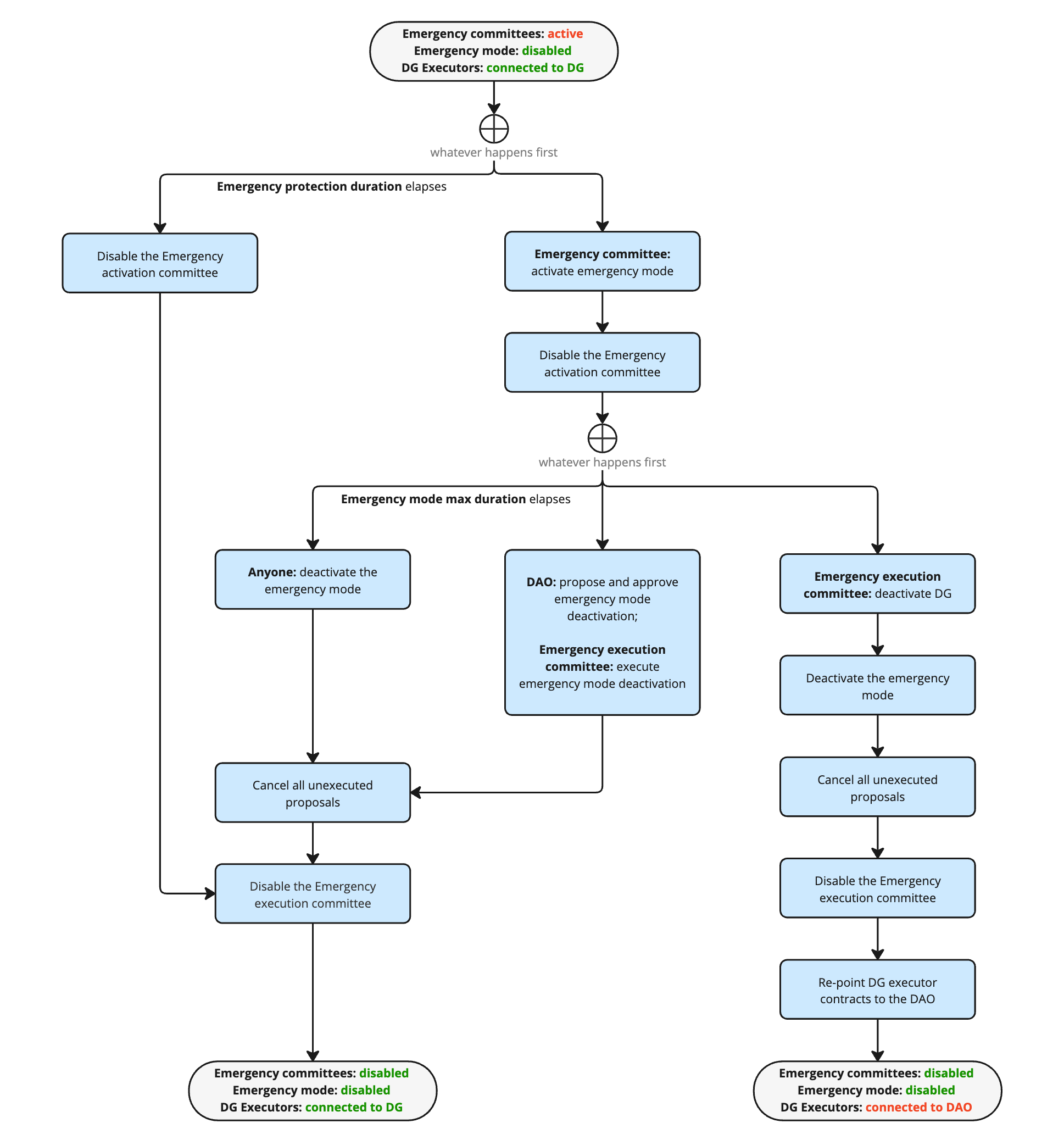
3. Emergency Committee

Purpose: Safety mechanism for the first year after deployment.


  • Can pause Dual Governance, halt permissionless execution, and temporarily restore LDO-token governance.
  • May execute proposals while DG is disabled to restore stability.


Composition

  • Activation multisig (4/7): May trigger emergency mode once, within a limited window.
  • Execution multisig (5/7): Temporarily controls governance logic to fix or revert.


Designed as a one-off failsafe, not a standing power.
 

Conclusion: Solid governance model for Liquid Staking on Ethereum

One of the key properties of DeFi is the user's right to exit, and Dual Governance implements it for Lido on Ethereum. While catering to Ethereum staking mechanics requires an intricate design, the resulting mechanism aims for resilience, mitigating even theoretical edge cases.


The very release of Dual Governance shifts the game theory around the protocol's upgrade levers, mitigating heavy risk vectors without ever being triggered.


While it won't prevent every potential governance risk, it makes large-scale attacks impractical and rebalances power toward those with the most at stake.

Trending Cryptos

Related Reads

Hardcore Research Report: After an Impressive Start, Analyzing Robinhood Chain's Revenue Potential Frame by Frame

Robinhood's crypto business is in steep decline, contributing only 8% of total revenue in Q2 2026 despite the company's overall record performance. Its new Layer 2 blockchain, Robinhood Chain, launched strongly in July, generating $3.6M in Real Economic Value (REV) and capturing 38% of all L2 network revenue that month. However, this early activity is heavily driven by speculative Meme coin trading (51% of spot volume), not the intended Real-World Asset (RWA) use case. While successful as a blockchain, the network's revenue alone is too small to meaningfully impact Robinhood's profits, with known revenue streams annualizing to about $54.8M—just 14% of the crypto segment's annualized revenue. For Robinhood Chain to revitalize the crypto business, Robinhood must monetize beyond infrastructure. The clearest path is scaling its native stablecoin, USDG, to generate interest income from its reserves. Another opportunity lies in commercializing its massive user distribution, particularly through its main app, as evidenced by the successful integration of Morpho. In contrast, distribution via the standalone Robinhood Wallet appears limited. Ultimately, Robinhood Chain may serve more as a user acquisition funnel for higher-value products rather than a major direct revenue line. To become a significant growth driver, Robinhood must successfully expand USDG or effectively monetize its main app's distribution power.

Odaily星球日报2m ago

Hardcore Research Report: After an Impressive Start, Analyzing Robinhood Chain's Revenue Potential Frame by Frame

Odaily星球日报2m ago

U.S. Stock Market Trend (August 11): Oil Prices Surge, Treasury Yields Rise, Tech Stocks Under Pressure, Optical Communication Plummets

U.S. Stock Market Trends (August 11): Oil Surge and Rising Bond Yields Pressure Tech; Optical Communication Stocks Plunge. U.S. stock indices closed slightly lower on Monday, with the S&P 500 and Dow Jones retreating from recent record highs. The primary market pressures were a significant oil price jump of over 5% amid unresolved negotiations to reopen the Strait of Hormuz and a consequent rise in U.S. Treasury yields, which weighed on growth stock valuations. The technology sector faced pressure, with Nvidia falling nearly 3% despite news of its pursuit of a $500 billion AI infrastructure financing consortium with major Wall Street firms. The optical communication sector saw a sharp sell-off, with Coherent dropping over 14%. In contrast, Chinese stocks listed in the U.S. were a notable bright spot, as the Nasdaq Golden Dragon China Index rose nearly 2%. Gold prices advanced for a second consecutive session on inflation hedging demand, while Bitcoin fell below $64,000. Key market movers included surging oil prices (WTI and Brent up ~5%) due to stalled Strait of Hormuz talks and heightened supply concerns, pushing the 10-year Treasury yield near 4.71%. Major tech stocks were mixed. Beyond Nvidia's decline, Intel fell over 4% on a new share offering plan. The Philadelphia Semiconductor Index dropped approximately 1.2%. Market attention remains on oil price dynamics, the impact of rising yields, and the forthcoming U.S. CPI data.

marsbit49m ago

U.S. Stock Market Trend (August 11): Oil Prices Surge, Treasury Yields Rise, Tech Stocks Under Pressure, Optical Communication Plummets

marsbit49m ago

JP Morgan Research Report Analysis: SK Hynix Fell 15% Last Week, Concerns Over HBM Pricing Overblown and Shareholder Returns to Land Ahead of Schedule

JPMorgan Research Report Interpretation: Addressing Concerns on SK Hynix's Recent Share Price Decline SK Hynix's stock fell 15% last week, underperforming the KOSPI (-5%) and Samsung (-9%). Key investor concerns centered on HBM pricing uncertainty, unclear shareholder return timelines, and a recently disclosed ₩54 trillion capital expenditure plan. JPMorgan's August 9 report addresses each point. Regarding HBM, JPMorgan refutes inaccurate media reports suggesting potential 50% price discounts for HBM4 in 2027. The firm's conservative model assumes <40% average HBM price growth by 2027, based on factors including memory suppliers prioritizing high-margin DDR5/LPDDR5/NAND in LTA allocations and the long-term partnership with key customer NVIDIA. The most significant near-term catalyst is shareholder returns. SK Hynix has committed to announcing additional shareholder return measures before the end of Q3 (September), earlier than its prior "year-end" guidance. JPMorgan anticipates a progressive policy, supported by an estimated cumulative free cash flow exceeding ₩800 trillion over three years and proceeds from the Kioxia stake sale. The substantial ₩54 trillion capex plan is for two new memory fabs to support its 2030 roadmap, not short-term aggressive expansion. The Yongin Y2 DRAM fab (₩35.2tn) and Cheongju M17 NAND fab (₩19.1tn) have construction starts scheduled for 2027, with clean room completion and investments stretching to 2028-2031. JPMorgan sees limited strategic value in a potential IPO for subsidiary Solidigm, noting SK Hynix's strong internal cash flow can fund capex without dilution, and an IPO might trigger dual-listing rule constraints in Korea. The report concludes last week's sell-off was an overreaction. JPMorgan maintains its Overweight rating and ₩2.75 million price target (~7x avg. 2026-2027 EPS), asserting the memory super-cycle thesis and SK Hynix's fundamentals remain intact.

marsbit52m ago

JP Morgan Research Report Analysis: SK Hynix Fell 15% Last Week, Concerns Over HBM Pricing Overblown and Shareholder Returns to Land Ahead of Schedule

marsbit52m ago

Trading

Spot

Hot Articles

How to Buy STETH

Welcome to HTX.com! We've made purchasing Lido Staked ETH (STETH) simple and convenient. Follow our step-by-step guide to embark on your crypto journey.Step 1: Create Your HTX AccountUse your email or phone number to sign up for a free account on HTX. Experience a hassle-free registration journey and unlock all features.Get My AccountStep 2: Go to Buy Crypto and Choose Your Payment MethodCredit/Debit Card: Use your Visa or Mastercard to buy Lido Staked ETH (STETH) instantly.Balance: Use funds from your HTX account balance to trade seamlessly.Third Parties: We've added popular payment methods such as Google Pay and Apple Pay to enhance convenience.P2P: Trade directly with other users on HTX.Over-the-Counter (OTC): We offer tailor-made services and competitive exchange rates for traders.Step 3: Store Your Lido Staked ETH (STETH)After purchasing your Lido Staked ETH (STETH), store it in your HTX account. Alternatively, you can send it elsewhere via blockchain transfer or use it to trade other cryptocurrencies.Step 4: Trade Lido Staked ETH (STETH)Easily trade Lido Staked ETH (STETH) on HTX's spot market. Simply access your account, select your trading pair, execute your trades, and monitor in real-time. We offer a user-friendly experience for both beginners and seasoned traders.

1.8k Total ViewsPublished 2024.03.29Updated 2026.06.02

How to Buy STETH

Discussions

Welcome to the HTX Community. Here, you can stay informed about the latest platform developments and gain access to professional market insights. Users' opinions on the price of STETH (STETH) are presented below.

活动图片