Справочный обменный курс предназначен только для справки и не является фиксированным. Окончательный курс определяется на основе фактической цены исполнения.
Текущая статистика FLOW
Реальлная цена Flow (FLOW) сейчас составляет $0.02 USD и текущая рыночная капитализация составляет $-- USD.
Получайте обновления по FLOW/USD в реальном времени на HTX. Оставайтесь в курсе последних данных и тенденций рынка, чтобы принимать разумные торговые решения. HTX – ваш надежный источник точной информации о ценах на криптовалюты.
Основные данные по Flow
Объем за 24ч (USD)
$--
Изменение цены сегодня
--
Оборотное предложение (FLOW)
1.68B
Зарегистрируйтесь и торгуйте, чтобы выиграть вознаграждения на сумму до 1,500 USDT.Участвовать
Динамика цены FLOW
Отслеживайте движение цены Flow, просматривая графики за периоды в 1 день, 30 дней, 60 дней, 90 дней, 1 год и за весь период с момента листинга на HTX.Просматривайте еще больше данных о ценах Flow
Время
Изменение
Изменение в %
Самая высокая цена
Самая низкая цена
No data
Рыночная информация по FLOW
Получайте последнюю информацию о цене Flow на HTX: ценовые максимумы и минимумы за 24 часа, исторический максимум (ATH), и ежедневный процент изменения цены.
24ч Мин
$0
24ч Макс
$0
Исторический максимум
$0
Рыночная капитализация
$0.00
Объем за 24ч (USD)
$--
Объем в обращении
--
Что такое FLOW?
Flow — это быстрый, децентрализованный и ориентированный на разработчиков блокчейн, созданный в качестве основы для нового поколения игр, приложений и цифровых активов, которые их поддерживают. Flow — это единственный блокчейн первого уровня, изначально созданный командой, которая неизменно предоставляла отличный опыт работы с блокчейном для потребителей: CryptoKitties, Dapper Wallet, NBA Top Shot. Flow — это блокчейн, разработанный с нуля для массового внедрения, и единственный блокчейн, который внедряет улучшения удобства использования на уровне протокола. Ведущие разработчики и некоторые крупнейшие мировые бренды уже используют Flow, предоставляя совершенно новый опыт работы с первоклассным контентом.
Для получения более подробной информации, пожалуйста, прочтите: Что такое Flow?
Как купить FLOW
Купить FLOW на HTX очень просто. Нажмите здесь, чтобы ознакомиться с полным руководством по покупке Flow.
Рынки FLOW в реальном времени
Обзор цен Flow в реальном времени на спотовых рынках HTX. Переключайтесь между спотовым и фьючерсным рынками, чтобы мгновенно сравнивать текущие цены и изменения цен за 24 часа.
Основываясь на исторических показателях Flow, наш инструмент прогнозирования предполагает, что цена Flow (FLOW) может достигнуть -- к -- году.
Прогноз цены FLOW за -- год
Наш самый последний прогноз говорит о том, что цена Flow (FLOW) вырастет до -- к -- году, а изменение цены составит --% и совокупный ROI составит приблизительно --%.
Купите свои первые FLOW на HTXРегистрация
Часто задаваемые вопросы о FLOW
Какая сегодня цена Flow (FLOW)?
Текущая цена Flow (FLOW) составляет $0.02 USD.
Какая рыночная капитализация Flow (FLOW)?
Текущая рыночная капитализация Flow (FLOW) составляет $0.00 USD, рассчитанная путем умножения его оборотного предложения на текущую цену.
Каково оборотное предложение Flow (FLOW)?
Текущее оборотное предложение Flow (FLOW) составляет -- FLOW.
Каким был исторический максимум Flow (FLOW)?
На 2026-08-21, исторический максимум Flow (FLOW) составляет $0 USD.
Каков 24-часовой объем торгов Flow (FLOW)?
24-часовой объем торгов Flow (FLOW) на HTX составляет -- USD.
Могу ли я купить Flow (FLOW) на HTX?
Да, HTX предлагает лучшие в отрасли торговые комиссии и высокую ликвидность, обеспечивая бесперебойную и безопасную торговлю Flow (FLOW).
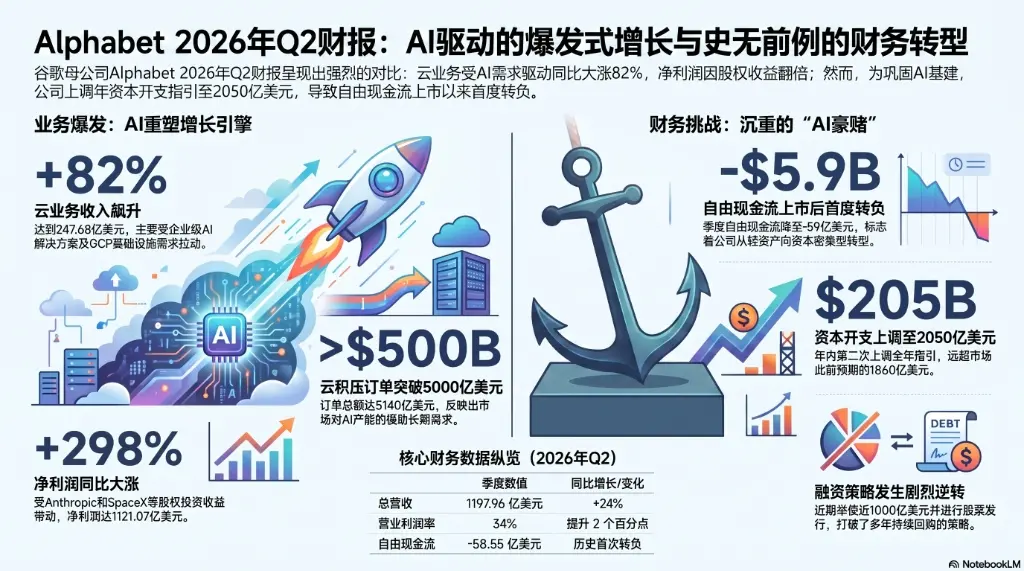
Alphabet (Google's parent) reported its Q2 2026 results. Revenue grew 24% to $119.8B, with Google Cloud revenue surging 82% to $24.8B, significantly exceeding expectations. Cloud backlog also surpassed $500B for the first time. However, the company's capital expenditures soared to $44.9B, leading to negative free cash flow (-$5.86B) for the first time in its history as a public company. Alphabet raised its full-year capex guidance to a range of $195B-$205B, its second upward revision this year. This massive spending on AI infrastructure fueled investor concerns about returns, causing the stock to fall. Despite the cash flow pressure, the results highlight a dual narrative: strong commercial returns from AI in the cloud, but significant financial strain from the ongoing investment race. CEO Sundar Pichai emphasized focus on the next-generation Gemini 4 model and stated that AI is reshaping the entire company.
Chip Design: The "Cash Flow Reconstruction" and "Capability Leap Window" of Institutional Rents
The first half of 2026 saw extreme divergence in China's chip design sector. While companies like Jiangbolong and GigaDevice reported massive profit surges, others like StarPower saw sharp declines. This disparity stems not from market cycles, but from a fundamental "institutional rent" transfer—profits were systematically shifted from downstream manufacturers (the payers) to upstream design firms (the recipients) due to supply constraints and policy-driven "domestic substitution" mandates.
For decades, China's chip design industry was trapped in a vicious cycle: no revenue without customers, no R&D without revenue, and no competitive products without sustained R&D, leading to perpetual cash flow crises. Crucially, this institutional rent, though distorting short-term competition, has inadvertently broken this deadlock. It has created a "cash flow reconstruction," funneling steady, policy-backed income to design houses for the first time.
This generates a critical "capability leap window"—a structural, long-term opportunity (potentially lasting over five years due to prolonged chip shortages and tightening export controls) for companies to invest rents into long-cycle R&D (e.g., automotive-grade, AI chips) rather than short-term speculation. Policy is also evolving from simple procurement subsidies to "ecosystem binding," forcing adoption and integration of domestic chips.
Conversely, rent-paying downstream firms face a painful but necessary "market clearing," forced into genuine competition and efficiency drives, which may spur deeper industry collaboration. Importantly, companies like Montage Technology and Fudan Microelectronics show growth based on real technological breakthroughs and market demand, not just policy rents, signaling the potential for independent capability growth.
The conclusion is that institutional rent is not an end but a means. The core investment thesis shifts from betting on rent persistence to identifying companies that successfully transform this reconstructed cash flow into proprietary technology and autonomous market viability. While a shakeout is imminent as certain mechanisms reverse, a new generation of technologically independent firms is quietly emerging under the cover of this rent-fueled window.
The mid-week session saw another shift in cryptocurrency ETF flow dynamics. Bitcoin once again lost ground due to resurgent share redemptions in two of the market's largest funds, while Ethereum quietly attracted fresh capital. Smaller altcoin categories remained unchanged.
Bitcoin ETFs recorded a net outflow of $61.16 million, entirely attributable to Fidelity and BlackRock. Fidelity's FBTC saw a larger outflow of $46.82 million, and BlackRock's IBIT added $14.34 million to the outflow. No other Bitcoin ETF reported a net inflow. This offset a modest inflow from the previous day, exacerbating the volatile demand pattern seen throughout the week.
In contrast, Ethereum ETFs finished the session with a net inflow of $7.38 million. Fresh capital primarily went into BlackRock's ETHA fund, providing a net gain after two days of weak or negative flows earlier in the week. The modest inflow occurred during a session where Bitcoin funds faced renewed pressure from the two major issuers.
Activity in other segments was muted. ETFs for Solana, XRP, and HYPE recorded zero net flows for the day. The data indicated institutional demand for cryptocurrencies remained selective and restrained, with Bitcoin experiencing the most volatility, Ethereum attracting some incremental capital, and the altcoin ETF market largely on the sidelines.
The article reveals that in the first half of 2026, all $11.2 billion in disclosed crypto industry funding flowed exclusively to businesses requiring regulatory licenses to operate, signaling a major shift in institutional valuation. Top-funded sectors were payments/stablecoins ($3.7B), prediction markets ($2B), and exchanges/trading platforms ($1.7B). The core argument is that capital's focus has moved from technological innovation ("what code can do") to compliance capability ("possession of a license"), as licenses represent a slow, costly barrier to entry that code cannot easily replicate. This mirrors the evolution of traditional fintech. Notably, a split is emerging: while institutional capital floods licensed, centralized entities, retail user activity continues to thrive on permissionless DeFi protocols. The article concludes that within the institutional framework, the industry's most valuable asset is being redefined from code to regulatory approval.
The narrative of AI investment is shifting from a technology story to a capital expenditure story, and now to a financing story. This marks a "critical moment for capital," as noted by Bridgewater's Greg Jensen. Morgan Stanley forecasts that the total cost of AI infrastructure through 2028 will reach $3.2 trillion, with approximately $1.75 trillion expected to be raised from credit markets. However, free cash flow projections for major hyperscale cloud providers are declining sharply, with Oracle's 2027 forecast nearing -$40 billion.
The bond market is already pricing in the rising risks. Apollo data shows AI-related bonds constitute 40% of long-duration supply. Credit spreads for hyperscalers have widened significantly this year—around 25 basis points for high-quality names—while the overall investment-grade market remained flat. Oracle's credit default swaps (CDS) have surged dramatically, indicating particular market concern. Renowned bond investor Jeff Gundlach sharply criticized financing plans using AI assets like GPUs as collateral, comparing them to "issuing 30-year ABS backed by bananas" due to the assets' rapid obsolescence.
Although current balance sheets for hyperscalers appear strong, the future funding gap is widening. Morgan Stanley has nearly doubled its 2027 cloud capital expenditure growth forecast to 29%, amplifying the financing challenge. Purchasing commitments have exploded to $982 billion, with significant capital expenditures now existing off-balance-sheet, meaning true funding pressure is being underestimated.
marsbit3天前
Треды
Приветствуем вас в Сообществе HTX. Здесь вы можете быть в курсе последних новостей платформы и получите доступ к профессиональной рыночной аналитике. Мнения пользователей о цене Flow (FLOW) представлены ниже.