Zhejiang University Research Team Proposes New Approach: Teaching AI How the Human Brain Understands the World

marsbitОпубликовано 2026-04-05Обновлено 2026-04-05

Введение

A research team from Zhejiang University published a paper in *Nature Communications* challenging the prevailing notion that larger AI models inherently think more like humans. They found that while model performance on recognizing concrete concepts improved as parameters increased (from 74.94% to 85.87%), performance on abstract concept tasks slightly declined (from 54.37% to 52.82%) in models like SimCLR, CLIP, and DINOv2. The key difference lies in how concepts are organized. Humans naturally form hierarchical categories (e.g., grouping a swan and an owl into "birds"), enabling them to apply past knowledge to new situations. Models, however, rely heavily on statistical patterns in data and struggle to form stable, abstract categories. The team proposed a novel solution: using human brain signals (recorded when viewing images) to supervise and guide the model's internal organization of concepts. This method, termed transferring "human conceptual structures," helped the model learn a brain-like categorical system. In experiments, the model showed improved few-shot learning and generalization, with a 20.5% average improvement on a task requiring abstract categorization like distinguishing living vs. non-living things, even outperforming much larger models. This research shifts the focus from simply scaling model size ("bigger is better") to designing smarter internal structures ("structured is smarter"). It highlights a new pathway for developing AI that possesses more hum...

Large models have been growing in size, with the mainstream view being that the more parameters a model has, the closer it gets to human-like thinking. However, a paper published by a Zhejiang University team on April 1 in Nature Communications presents a different perspective (original article link: https://www.nature.com/articles/s41467-026-71267-5). They found that as model size (primarily SimCLR, CLIP, DINOv2) increases, the ability to recognize specific objects does continue to improve, but the ability to understand abstract concepts not only fails to improve but can even decline. When parameters increased from 22.06 million to 304.37 million, performance on concrete concept tasks rose from 74.94% to 85.87%, while performance on abstract concept tasks dropped from 54.37% to 52.82%.

Differences Between Human and Model Thinking

When the human brain processes concepts, it first forms a system of categorical relationships. Swans and owls look different, but humans still classify them both as birds. Moving up, birds and horses can be further grouped into the animal category. When humans encounter something new, they often first consider what it resembles from past experience and which category it might belong to. Humans continuously learn new concepts, then organize this experience, using this relational system to recognize new things and adapt to new situations.
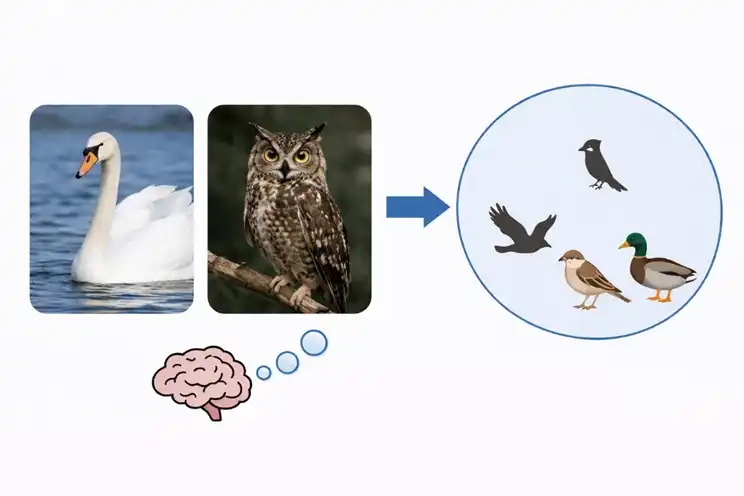
Models also classify, but they form these classifications differently. They rely primarily on patterns that repeatedly appear in large-scale data. The more frequently a specific object appears, the easier it is for the model to recognize it. When it comes to larger categories, models struggle more. They need to capture the commonalities between multiple objects and then group these commonalities into the same category. Existing models still have significant shortcomings here. As parameters continue to increase, performance on concrete concept tasks improves, while performance on abstract concept tasks sometimes even decreases.
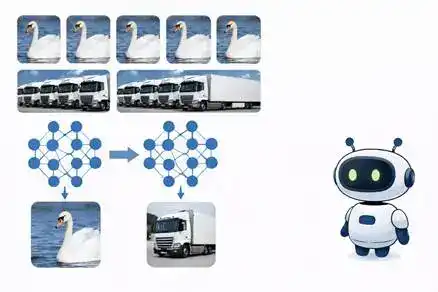
A commonality between the human brain and models is that both internally form a system of categorical relationships. However, their emphases differ. The higher-order visual regions of the human brain naturally distinguish broad categories like living and non-living things. Models can separate specific objects but find it difficult to stably form these larger categories. This difference means the human brain more easily applies past experience to new objects, allowing for rapid categorization of unseen things. Models, conversely, rely more on existing knowledge, so when encountering new objects, they tend to focus on superficial features. The method proposed in the paper addresses this characteristic, using brain signals to constrain the model's internal structure, making it closer to the human brain's categorization method.

The Solution from the Zhejiang University Team

The team's proposed solution is also unique: instead of simply adding more parameters, they use a small amount of brain signal data for supervision. These brain signals come from recordings of brain activity while humans view images. The original paper states the goal as transferring 'human conceptual structures' to DNNs. This means teaching the model, as much as possible, how the human brain classifies, generalizes, and groups similar concepts together.
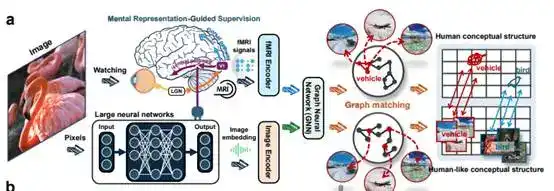
The team conducted experiments using 150 known training categories and 50 unseen test categories. The results showed that as this training progressed, the distance between the model's representations and the brain representations continuously narrowed. This change occurred for both categories, indicating that the model was learning not just individual samples but truly beginning to learn a conceptual organization method more akin to the human brain.

After this process, the model demonstrated stronger few-shot learning capabilities and performed better in novel situations. In a task requiring the model to distinguish abstract concepts like living vs. non-living things with very few examples, the model improved by an average of 20.5%, even surpassing much larger control models. The team also conducted 31 additional specialized tests, where several types of models showed improvements of nearly ten percent.

Over the past few years, the familiar path in the modeling industry has been larger model scale. The Zhejiang University team has chosen a different direction: moving from 'bigger is better' to 'structured is smarter'. Scaling up is indeed useful, but it primarily improves performance on familiar tasks. Abstract understanding and transfer capabilities, inherent to humans, are equally crucial for AI. This requires future AI thinking structures to more closely resemble the human brain. The value of this direction lies in redirecting the industry's attention from pure size expansion back to the cognitive structure itself.

Neosoul and the Future

This points to a larger possibility: AI evolution may not only occur during the model training phase. Model training can determine how AI organizes concepts and forms higher-quality judgment structures. Then, after entering the real world, another layer of AI evolution just begins: how an AI agent's judgments are recorded, tested, and how they continuously grow and evolve through real-world competition, learning and evolving on their own, much like humans. This is precisely what Neosoul is doing now. Neosoul doesn't just have AI agents produce answers; it places AI agents into a system of continuous prediction, verification, settlement, and selection, allowing them to continuously optimize themselves based on predictions and outcomes, preserving better structures and淘汰ing worse ones. What the Zhejiang University team and Neosoul jointly point towards is actually the same goal: enabling AI to not just solve problems, but to possess comprehensive thinking abilities and continuously evolve.


Связанные с этим вопросы

QWhat was the key finding of the Zhejiang University team's research published in Nature Communications regarding model scaling?

AThey found that as model parameters increased (from 22.06 million to 304.37 million), performance on recognizing concrete concepts improved (74.94% to 85.87%), but performance on understanding abstract concepts not only failed to improve but actually decreased (54.37% to 52.82%).

QWhat is the fundamental difference between how the human brain and AI models form conceptual categories?

AThe human brain naturally forms a hierarchical classification system (e.g., grouping specific birds into the 'bird' category, then 'birds' and 'horses' into 'animals'). AI models primarily rely on statistical patterns from large-scale data, excelling at recognizing specific, frequently appearing objects but struggling to form stable, larger abstract categories.

QWhat was the unique solution proposed by the Zhejiang University team to improve AI's abstract reasoning?

AInstead of scaling model size, they used a small amount of brain signal data (recordings of human brain activity when viewing images) as supervision to transfer human conceptual structures to the deep neural networks (DNNs), teaching them how to classify and generalize concepts more like the human brain.

QWhat improvements were observed in the model after being trained with the brain signal supervision method?

AThe distance between the model's representations and brain representations decreased. The model showed stronger few-shot learning capabilities and performed better in novel situations. In a task requiring abstract concept discrimination with very few examples, performance improved by an average of 20.5%, even surpassing much larger control models.

QWhat broader shift in AI development philosophy does the research and Neosoul project represent, according to the article?

AIt represents a shift from the 'bigger is better' paradigm focused on scaling parameters to a 'structured is smarter' approach. The focus is on improving the AI's cognitive structure to be more human-like, enabling abstract understanding and transfer capabilities, and creating systems for continuous learning and evolution through real-world prediction, verification, and competition.

Похожее

North Korean Hackers Loot $500 Million in a Single Month, Becoming the Top Threat to Crypto Security

North Korean hackers, particularly the notorious Lazarus Group and its subgroup TraderTraitor, have stolen over $500 million from cryptocurrency DeFi platforms in less than three weeks, bringing their total theft for the year to over $700 million. Recent major attacks on Drift Protocol and KelpDAO, resulting in losses of approximately $286 million and $290 million respectively, highlight a strategic shift: instead of targeting core smart contracts, attackers are now exploiting vulnerabilities in peripheral infrastructure. For instance, the KelpDAO attack involved compromising downstream RPC infrastructure used by LayerZero's decentralized validation network (DVN), allowing manipulation without breaching core cryptography. This sophisticated approach mirrors advanced corporate cyber-espionage. Additionally, North Korea has systematically infiltrated the global crypto workforce, with an estimated 100 operatives using fake identities to gain employment at blockchain companies, enabling long-term access to sensitive systems and facilitating large-scale thefts. According to Chainalysis, North Korean-linked hackers stole a record $2 billion in 2025, accounting for 60% of all global crypto theft that year. Their total historical crypto theft has reached $6.75 billion. Post-theft, they employ specialized money laundering methods, heavily relying on Chinese OTC brokers and cross-chain mixing services rather than standard decentralized exchanges. Security experts, while acknowledging the increased sophistication, emphasize that many attacks still exploit fundamental weaknesses like poor access controls and centralized operational risks. Strengthening private key management, limiting privileged access, and enhancing coordination among exchanges, analysts, and law enforcement immediately after an attack are critical to improving defense and fund recovery chances. The industry's challenge now extends beyond secure smart contracts to safeguarding operational security at the infrastructure level.

marsbit24 мин. назад

North Korean Hackers Loot $500 Million in a Single Month, Becoming the Top Threat to Crypto Security

marsbit24 мин. назад

Circle CEO's Seoul Visit: No Korean Won Stablecoin Issuance, But Met All Major Korean Banks

Circle CEO Jeremy Allaire's recent activities in Seoul indicate a strategic shift for the company, moving away from issuing a Korean won-backed stablecoin and instead focusing on embedding itself as a key infrastructure provider within Korea’s financial and crypto ecosystem. Despite Korea accounting for nearly 30% of global crypto trading volume—with a market characterized by high retail participation and altcoin dominance—Circle has chosen not to compete for the role of stablecoin issuer. Instead, Allaire met with major Korean banks (including Shinhan, KB, and Woori), financial groups, leading exchanges (Upbit, Bithumb, Coinone), and tech firms like Kakao. This approach reflects a broader industry transition: the core of stablecoin competition is shifting from issuance rights to systemic positioning. With Korean regulators still debating whether banks or tech companies should issue stablecoins, Circle is avoiding regulatory uncertainty by strengthening its role as a service and technology partner. The company is deepening integration with trading platforms, building connections, and promoting stablecoin infrastructure. This positions Circle to benefit regardless of which entity eventually issues a won stablecoin. Allaire also noted the potential for a Chinese yuan stablecoin in the next 3–5 years, underscoring a regional trend of stablecoins becoming more regulated and integrated with traditional finance. Ultimately, Circle’s strategy highlights that future influence in the stablecoin market will belong not necessarily to the issuers, but to the foundational infrastructure layers that enable cross-system transactions.

marsbit51 мин. назад

Circle CEO's Seoul Visit: No Korean Won Stablecoin Issuance, But Met All Major Korean Banks

marsbit51 мин. назад

SpaceX Ties Up with Cursor: A High-Stakes AI Gambit of 'Lock First, Acquire Later'

SpaceX has secured an option to acquire AI programming company Cursor for $60 billion, with an alternative clause requiring a $10 billion collaboration fee if the acquisition does not proceed. This structure is not merely a potential acquisition but a strategic move to control core access points in the AI era. The deal is designed as a flexible, dual-path arrangement, allowing SpaceX to either fully acquire Cursor or maintain a binding partnership through high-cost collaboration. This "option-style" approach minimizes immediate regulatory and integration risks while ensuring long-term alignment between the two companies. At its core, the transaction exchanges critical AI-era resources: SpaceX provides its Colossus supercomputing cluster—one of the world’s most powerful AI training infrastructures—while Cursor contributes its AI-native developer environment and strong product adoption. This synergy connects compute power, models, and application layers, forming a closed-loop AI capability stack. Cursor, founded in 2022, has achieved rapid growth with over $1 billion in annual revenue and widespread enterprise adoption. Its value lies in transforming software development through AI agents capable of coding, debugging, and system design—positioning it as a gateway to future software production. For SpaceX, this move is part of a broader strategy to evolve from a aerospace company into an AI infrastructure empire, integrating xAI, supercomputing, and chip manufacturing. Controlling Cursor fills a gap in its developer tooling layer, strengthening its AI narrative ahead of a potential IPO. The deal reflects a shift in AI competition from model superiority to ecosystem and entry-point control. With programming tools as a key battleground, securing developer loyalty becomes crucial for dominating the software production landscape. Risks include questions around Cursor’s valuation, technical integration challenges, and potential regulatory scrutiny. Nevertheless, the deal underscores a strategic bet: controlling both compute and software development access may redefine power dynamics in the AI-driven future.

marsbit1 ч. назад

SpaceX Ties Up with Cursor: A High-Stakes AI Gambit of 'Lock First, Acquire Later'

marsbit1 ч. назад

Торговля

Спот
Фьючерсы
活动图片