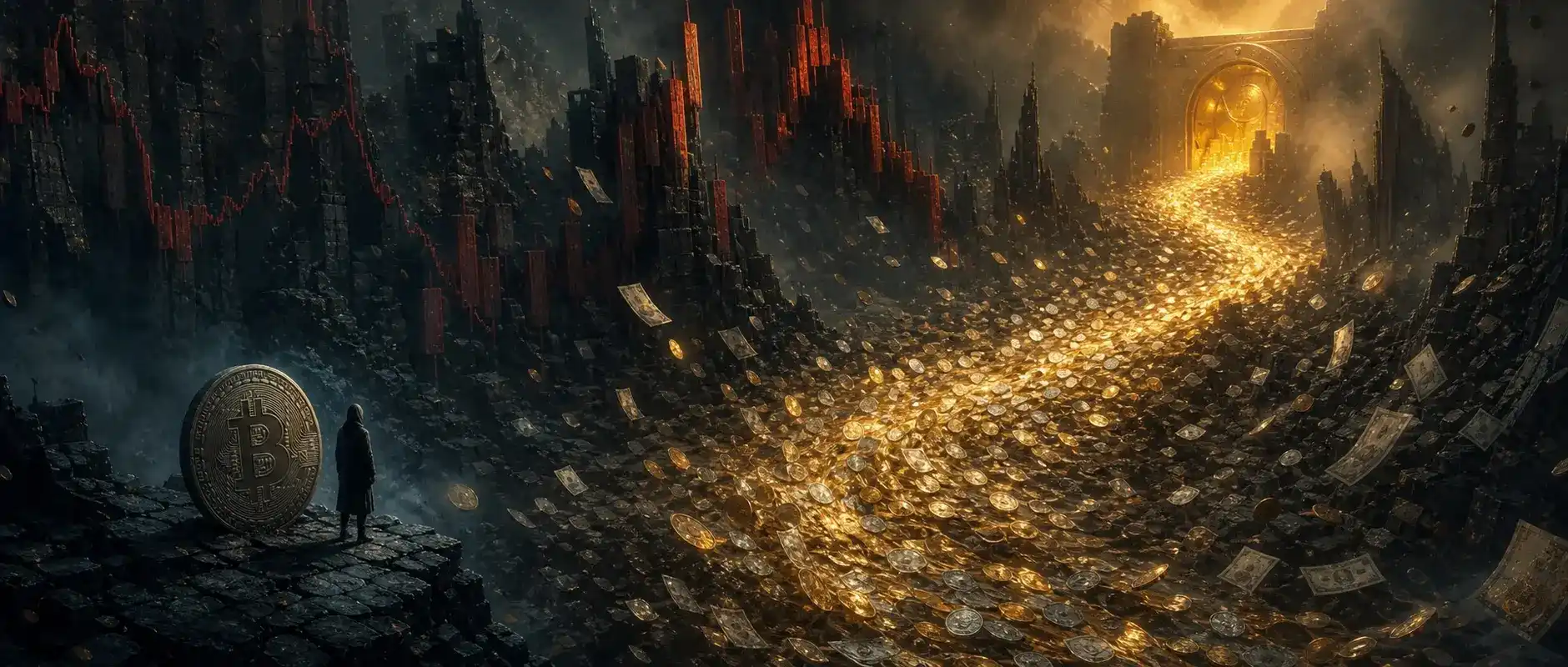
Will Espresso [ESP] hit $1B valuation? Korean listings spark 80% explosion

ambcryptoОпубликовано 2026-02-25Обновлено 2026-02-25

Введение

Espresso (ESP) surged 80% in 24 hours to $0.173, driven by aggressive capital inflows following its listings on major Korean exchanges Upbit and Bithumb. The breakout was supported by explosive volume of $881M and record Open Interest of $56.03M, indicating strong speculative and spot demand. Historically, Korean listings fuel extended rallies, and with support from Binance and Coinbase, the project's infrastructure narrative gained significant momentum. This capital rotation suggests a potential path toward a $1B valuation, though sustainability depends on continued demand and stable liquidity.

On the 24th of February, Espresso dominated headlines with raw momentum. The project operated as a shared sequencing layer for Ethereum Layer-2 rollups. That infrastructure narrative suddenly met aggressive capital inflows.

Notably, Binance and Coinbase had listed ESP on the 12th of February. However, Upbit and Bithumb listings shifted sentiment violently. Korean liquidity poured in fast. Could this wave sustain the breakout?

ESP up 80% in 24 hours, hitting $0.173

The move was sharp and relentless. Espresso [ESP] surged 80% within a single day, trading at $0.173 at press time. It outperformed a sluggish broader market without hesitation, leaving most altcoins behind.

Due to these developments, the price entered clean discovery territory. There was no historical resistance capping momentum.

Therefore, traders chased upside aggressively, fearing a missed opportunity. At the time of writing, the token was in a violent expansion phase, beating nearly every major token across the board.

Volume explodes and Open Interest hits all-time highs

The breakout was backed by undeniable participation. Volume exploded to $881M, according to CoinGlass data.

That number alone reflected intense speculative and spot demand, and it was exactly what investors wanted to see during a breakout of this scale. This was not thin liquidity or random retail noise. It showed real commitment and full conviction flowing into the market.

Meanwhile, Open Interest climbed to $56.03M at press time.

Fresh leverage entered quickly as traders positioned for continuation. These were not just small investors testing the waters. As a result, volatility risk increased alongside conviction, with serious capital now exposed to sharp swings.

Is this the start of a run to a $1B valuation?

Major Korean listings historically fueled extended rallies. In particular, Upbit access often amplified aggressive retail-driven expansion cycles. Also, Binance, the beast of liquidity, thanks to its deep liquidity, provided the structural backbone for sustained trading activity. This suggested the rally carried more than hype.

It carried access, reach, and serious market depth.

Moreover, $881M in Volume signaled undeniable capital rotation.

That level alone reflected intensity approaching billion-dollar territory. Therefore, a $1B valuation no longer seemed distant; it felt increasingly achievable under sustained pressure.

However, failure to sustain leverage could unwind gains sharply and brutally. Looking ahead, continuation required stable demand, disciplined positioning, and consistent liquidity support.


Final Summary

  • Espresso [ESP] surged 80% in 24 hours, trading at $0.173 after aggressive capital inflows.
  • Korean exchange listings on Upbit and Bithumb triggered a sharp sentiment shift and liquidity spike.

Связанные с этим вопросы

QWhat was the main catalyst for Espresso (ESP)'s 80% price surge in 24 hours?

AThe main catalyst was the listing of ESP on major Korean exchanges, Upbit and Bithumb, which triggered a violent shift in sentiment and a massive influx of Korean liquidity.

QWhat key on-chain metrics supported the legitimacy of the ESP breakout?

AThe breakout was supported by an explosion in trading volume to $881 million and Open Interest reaching a record high of $56.03 million, indicating intense speculative demand and serious capital commitment.

QWhy do the article's authors believe a $1 billion valuation for ESP is achievable?

AThe authors believe it's achievable due to the massive $881 million volume signaling intense capital rotation, combined with the deep liquidity and access provided by listings on major global exchanges like Binance and Coinbase, as well as Korean giants Upbit and Bithumb.

QWhat is the primary function of the Espresso project mentioned in the article?

AEspresso operates as a shared sequencing layer for Ethereum Layer-2 rollups, which is a key piece of infrastructure for the Ethereum ecosystem.

QWhat are the potential risks to ESP's price rally mentioned in the article?

AThe primary risk is a failure to sustain leverage, which could lead to gains being unwound sharply and brutally. Continuation of the rally requires stable demand, disciplined positioning, and consistent liquidity support.

Похожее

North Korean Hackers Loot $500 Million in a Single Month, Becoming the Top Threat to Crypto Security

North Korean hackers, particularly the notorious Lazarus Group and its subgroup TraderTraitor, have stolen over $500 million from cryptocurrency DeFi platforms in less than three weeks, bringing their total theft for the year to over $700 million. Recent major attacks on Drift Protocol and KelpDAO, resulting in losses of approximately $286 million and $290 million respectively, highlight a strategic shift: instead of targeting core smart contracts, attackers are now exploiting vulnerabilities in peripheral infrastructure. For instance, the KelpDAO attack involved compromising downstream RPC infrastructure used by LayerZero's decentralized validation network (DVN), allowing manipulation without breaching core cryptography. This sophisticated approach mirrors advanced corporate cyber-espionage. Additionally, North Korea has systematically infiltrated the global crypto workforce, with an estimated 100 operatives using fake identities to gain employment at blockchain companies, enabling long-term access to sensitive systems and facilitating large-scale thefts. According to Chainalysis, North Korean-linked hackers stole a record $2 billion in 2025, accounting for 60% of all global crypto theft that year. Their total historical crypto theft has reached $6.75 billion. Post-theft, they employ specialized money laundering methods, heavily relying on Chinese OTC brokers and cross-chain mixing services rather than standard decentralized exchanges. Security experts, while acknowledging the increased sophistication, emphasize that many attacks still exploit fundamental weaknesses like poor access controls and centralized operational risks. Strengthening private key management, limiting privileged access, and enhancing coordination among exchanges, analysts, and law enforcement immediately after an attack are critical to improving defense and fund recovery chances. The industry's challenge now extends beyond secure smart contracts to safeguarding operational security at the infrastructure level.

marsbit1 ч. назад

North Korean Hackers Loot $500 Million in a Single Month, Becoming the Top Threat to Crypto Security

marsbit1 ч. назад

Circle CEO's Seoul Visit: No Korean Won Stablecoin Issuance, But Met All Major Korean Banks

Circle CEO Jeremy Allaire's recent activities in Seoul indicate a strategic shift for the company, moving away from issuing a Korean won-backed stablecoin and instead focusing on embedding itself as a key infrastructure provider within Korea’s financial and crypto ecosystem. Despite Korea accounting for nearly 30% of global crypto trading volume—with a market characterized by high retail participation and altcoin dominance—Circle has chosen not to compete for the role of stablecoin issuer. Instead, Allaire met with major Korean banks (including Shinhan, KB, and Woori), financial groups, leading exchanges (Upbit, Bithumb, Coinone), and tech firms like Kakao. This approach reflects a broader industry transition: the core of stablecoin competition is shifting from issuance rights to systemic positioning. With Korean regulators still debating whether banks or tech companies should issue stablecoins, Circle is avoiding regulatory uncertainty by strengthening its role as a service and technology partner. The company is deepening integration with trading platforms, building connections, and promoting stablecoin infrastructure. This positions Circle to benefit regardless of which entity eventually issues a won stablecoin. Allaire also noted the potential for a Chinese yuan stablecoin in the next 3–5 years, underscoring a regional trend of stablecoins becoming more regulated and integrated with traditional finance. Ultimately, Circle’s strategy highlights that future influence in the stablecoin market will belong not necessarily to the issuers, but to the foundational infrastructure layers that enable cross-system transactions.

marsbit1 ч. назад

Circle CEO's Seoul Visit: No Korean Won Stablecoin Issuance, But Met All Major Korean Banks

marsbit1 ч. назад

Торговля

Спот
Фьючерсы
活动图片