What Ripple CEO Garlinghouse Said At WEF Davos 2026

bitcoinistОпубликовано 2026-01-22Обновлено 2026-01-22

Введение

Ripple CEO Brad Garlinghouse advocated for the pragmatic adoption of tokenization at the World Economic Forum 2026, highlighting stablecoins as the leading use case with transaction volumes growing from $19 trillion in 2024 to $33 trillion in 2025. He emphasized building bridges between traditional and decentralized finance rather than displacing existing systems, noting a significant positive shift in U.S. regulatory and political attitudes toward crypto. Garlinghouse stressed that tokenization must deliver real efficiency and transparency, not just novelty, and called for clear and practical regulations over theoretical perfection. He also addressed energy efficiency, noting the industry's move toward more sustainable blockchains, and reframed tokenization's value as democratizing investment access rather than encouraging speculation.

Ripple CEO Brad Garlinghouse used a Davos stage at the World Economic Forum’s 2026 annual meeting to make a pragmatic case for tokenization: stablecoins are already the lead use case, momentum has shifted sharply in the US, and the industry’s job now is to deliver measurable benefits rather than tokenize assets for novelty.

Why Ripple Is Building Bridges Between TradFi and DeFi

Garlinghouse’s remarks came on a panel titled “Is Tokenization the Future?” after the moderator cited Ripple-linked traction: tokenized assets on the XRP Ledger surged more than 2,200% last year. From there, Garlinghouse largely aligned with the panel’s theme that tokenization is moving from pilots toward mainstream financial plumbing, while drawing a clear boundary around monetary sovereignty.

“I do think the first poster child of tokenization is really stablecoins,” Garlinghouse said, arguing that usage growth has been decisive. He cited stablecoin transaction volumes rising from “$19 trillion of transactions on stablecoins in 2024” to “33 trillion in 2025,” describing that as “about 75% growth” and adding that “many in our industry would say that’s going to continue.”

Where the discussion turned to a “Bitcoin standard” framing, Garlinghouse emphasized the political reality of state money. “Sovereignty of fiat currencies, I believe, is for many countries sacrosanct,” he said, before invoking a line he attributed to Ben Bernanke from a prior Ripple event: “Governments will roll tanks into the street before giving up monetary supply, giving up the control of monetary supply, which stuck with me as yeah, that makes sense.”

That worldview shaped how Garlinghouse positioned Ripple’s strategy. “At Ripple, we very much focused on building the bridges between traditional finance and decentralized finance,” he said, describing work “with a lot of the banks around the world” as the practical path to scale rather than attempting to displace existing monetary regimes.

Garlinghouse also framed 2026 as a momentum year, not just a technology year. He argued that the political climate in the US has turned materially more constructive after a period he described as open hostility. “The US, the largest economy in the world, has been pretty openly hostile towards facets of crypto and blockchain technologies,” he said. “And that has shifted dramatically, you know, starting with the White House... [and] helped elect a much more pro-crypto pro-innovation Congress, and you’re seeing that play out.”

But the Ripple CEO repeatedly cautioned that narrative tailwinds are not enough. “Part of the tokenization topic [...] is like we shouldn’t tokenize everything just to tokenize something,” Garlinghouse said. “There has to be a positive outcome of efficiency or transparency [...] otherwise it’s just like okay it’s a nice science experiment.”

On regulation, Garlinghouse reiterated his pragmatic tone, arguing that the push for US crypto legislation should prioritize workable clarity over theoretical perfection. “What’s going on in the US right now is a classic dynamic of when you create new law, it’s never going to be perfect,” he said. “I subscribe to the idea that perfection is the enemy of good.”

He pointed to Ripple’s own history: “a five-year battle with the US government being sued because of the lack of clarity” to underline the stakes, adding: “We are very much an advocate of clarity is better than chaos.”

When pressed on whether stablecoins should pay rewards, one of the live fault lines in US policy debate, Garlinghouse positioned Ripple as less directly exposed than some peers, while still endorsing competitive symmetry. “Ripple doesn’t have as much of a dog in that fight as others in the industry,” he said, but added that a “level playing field goes two ways,” arguing that crypto firms and banks should face comparable standards when competing for the same activity.

Garlinghouse also addressed energy concerns around blockchain-based infrastructure, pushing back on a one-size-fits-all critique. “Not all layer 1 blockchains are created equal,” he said, contrasting proof-of-work systems with proof of stake and other consensus models, and arguing that stablecoin activity is already skewing toward “more power efficient blockchains.”

On tokenization’s social and market impact, Garlinghouse reframed a question about speculation as a question about access. He said he sees the opportunity in “the democratization of access to investment less so on the speculation side,” pointing to the idea that smaller investors could gain exposure to assets that are effectively inaccessible at modest ticket sizes today.

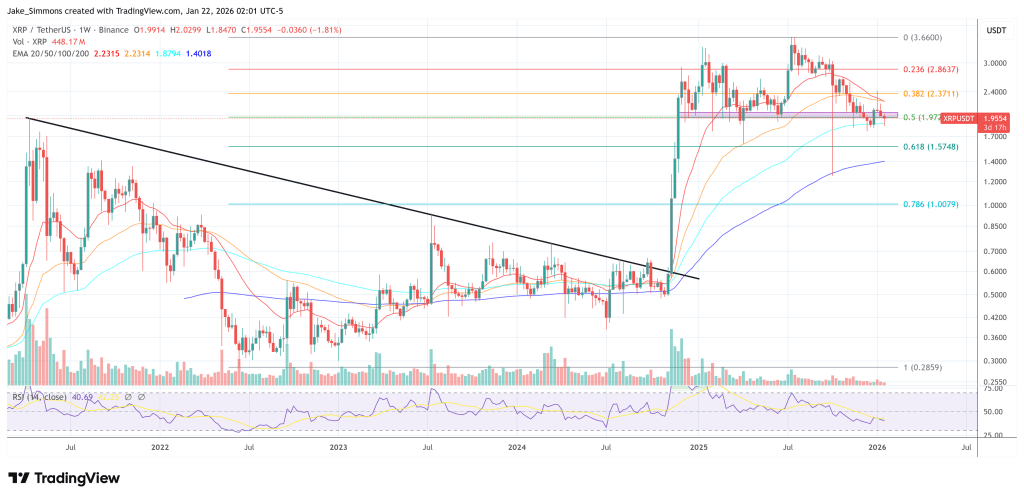
At press time, XRP traded at $1.9554.

XRP holds above the 100-week EMA, 1-week chart | Source: XRPUSDT on TradingView.com

Связанные с этим вопросы

QWhat did Ripple CEO Brad Garlinghouse identify as the 'first poster child of tokenization' at the WEF 2026 panel?

ABrad Garlinghouse identified stablecoins as the 'first poster child of tokenization'.

QAccording to Garlinghouse, what was the key reason for the dramatic shift in the US political climate towards crypto and blockchain technologies?

AHe stated that the shift started with the White House and was helped by the election of a much more pro-crypto, pro-innovation Congress.

QWhat pragmatic approach did Garlinghouse advocate for regarding US crypto legislation?

AHe argued that the push for legislation should prioritize workable clarity over theoretical perfection, stating that 'perfection is the enemy of good' and 'clarity is better than chaos'.

QHow did Garlinghouse position Ripple's core strategy in relation to traditional and decentralized finance?

AHe stated that Ripple is 'focused on building the bridges between traditional finance and decentralized finance,' working with banks worldwide as a practical path to scale.

QWhat was Garlinghouse's response to the concern about energy consumption in blockchain, and how did he differentiate between systems?

AHe pushed back on one-size-fits-all critiques, stating 'Not all layer 1 blockchains are created equal.' He contrasted energy-intensive proof-of-work systems with more efficient models like proof-of-stake, noting that stablecoin activity is already skewing towards more power-efficient blockchains.

Похожее

Fu Peng's First Public Speech in 2026: What Exactly Are Crypto Assets? Why Did I Join the Crypto Asset Industry?

Fu Peng, a renowned macroeconomist and now Chief Economist at New火 Group, delivered his first public speech of 2026 at the Hong Kong Web3 Festival. He explained his perspective on crypto assets and why he joined the industry, framing it within the context of macroeconomic trends and financial evolution. Fu emphasized that crypto assets are transitioning from an early, belief-driven phase to a mature, institutionally integrated asset class. He drew parallels to the 1970s-80s, when technological advances (like computing) revolutionized traditional finance, leading to the rise of FICC (Fixed Income, Currencies, and Commodities). Similarly, current advancements in AI, data, and blockchain are reshaping finance, with crypto assets becoming part of a new "FICC + C" (C for Crypto) framework. He noted that institutional capital, including traditional hedge funds, avoided early crypto due to its speculative nature but are now engaging as regulatory clarity emerges (e.g., stablecoin laws, CFTC classifying crypto as a commodity). Fu predicted that 2025-2026 marks a turning point where crypto becomes a standardized, financially viable asset for diversified portfolios, akin to commodities or derivatives in traditional finance. Fu defined Bitcoin not as "digital gold" in a simplistic sense but as a value-preserving, financially tradable asset. He highlighted that crypto's future lies in regulated, institutional adoption, moving away from retail-dominated trading. His entry into crypto signals this maturation, where traditional finance integrates crypto into mainstream asset management.

marsbit10 мин. назад

Fu Peng's First Public Speech in 2026: What Exactly Are Crypto Assets? Why Did I Join the Crypto Asset Industry?

marsbit10 мин. назад

Justin Sun Sues Trump Family: What $75 Million Bought Was Only a Blacklist

Justin Sun, founder of Tron, has filed a lawsuit in federal court against World Liberty Financial (WLF), alleging he was made the "primary target of a fraudulent scheme" after investing $75 million. Sun claims the investment secured him an advisor title and WLFI tokens, which were later frozen by WLF, causing "hundreds of millions in losses." The dispute began in late 2024 when Sun's investment helped revive WLF's struggling token sale, which ultimately raised $550 million. Shortly after, the SEC dropped its lawsuit against Sun following Donald Trump's inauguration. However, relations soured when Sun refused WLF's demands for additional funding. In August 2025, WLF added a "blacklist" function to its smart contract, allowing it to unilaterally freeze tokens. Sun's holdings, worth approximately $107 million, were frozen, and he was threatened with token destruction. The lawsuit highlights WLF's structure, which directs 75% of token sale profits to the Trump family, who had earned $1 billion by December 2025. WLF's CEO is Zach Witkoff, son of U.S. Middle East envoy Steve Witkoff. The project faces scrutiny for opaque operations, including a controversial loan arrangement on the Dolomite platform, co-founded by a WLF advisor. Despite Sun's history with the SEC, the case underscores centralization risks within DeFi, as WLF controls governance and holds powers to freeze assets arbitrarily. Sun's tokens remain frozen as legal proceedings begin.

marsbit18 мин. назад

Justin Sun Sues Trump Family: What $75 Million Bought Was Only a Blacklist

marsbit18 мин. назад

$500 to Buy OpenAI Stock: Silicon Valley's Most Respectable Liquidity Invitation

Silicon Valley's largest venture capital platform, AngelList, has launched a new fund called USVC, allowing U.S. retail investors to buy into high-profile AI companies like OpenAI, Anthropic, and xAI with a minimum investment of $500—no accredited investor status required. Promoted by AngelList co-founder Naval Ravikant, the fund is framed as an opportunity for ordinary people to access high-growth private tech investments traditionally reserved for VCs. However, critics argue it functions more like an exit vehicle for early insiders. USVC acquires shares not through primary rounds but largely via secondary transactions—purchasing stakes from early investors, VC funds, and employees looking to cash out at peak valuations. With companies like xAI heavily weighted in the portfolio, the fund effectively channels retail money into providing liquidity for insiders who entered at much lower valuations. The fund’s structure raises concerns: shares are illiquid, with no secondary market, and buybacks are limited and discretionary. The actual annual fee reaches 3.61%, far above the advertised 1% management fee. This model parallels the "low float, high fully diluted valuation" strategy seen in crypto, where early investors profit by selling to latecomers at inflated prices. The timing—alongside similar moves by platforms like Robinhood—suggests that Silicon Valley’s sudden interest in retail inclusion may be less about democratizing access and more about securing exits for insiders.

marsbit48 мин. назад

$500 to Buy OpenAI Stock: Silicon Valley's Most Respectable Liquidity Invitation

marsbit48 мин. назад

Торговля

Спот
Фьючерсы
活动图片