Veteran Chinese Public Chain NEO's Two Founders in a Feud, Financial Opacity as the Core Reason

marsbitОпубликовано 2026-01-01Обновлено 2026-01-01

Введение

Summary: A public conflict has erupted between Erik Zhang (Zhang Zhengwen) and Da Hongfei, the two co-founders of the Chinese-origin blockchain project NEO. The core issue is a lack of financial transparency within the NEO Foundation. Zhang, who had left NEO years ago and officially returned in September, accused Da of maintaining a "black box" of assets. He claims Da has sole control over the Foundation's non-token assets and lacks a proper audit mechanism. Zhang also alleged that Da was using NEO's resources to develop a separate project, EON, which prompted his return. The dispute escalated in December when Zhang publicly demanded financial disclosures and unilaterally announced that Da would be removed from NEO mainnet affairs to focus on sidechain and new project development starting January 1, 2026. In response, Da countered that Zhang actually controls the majority of the ecosystem's funds (NEO/GAS tokens) and consensus node voting power. He accused Zhang of delaying the transfer of these funds to a multi-signature wallet for years. Da committed to releasing a financial report for 2025 by Q1 2026.

It's unexpected that a veteran domestic public chain could come to such a day. What's even more lamentable is that top domestic AI projects like Manus, Kimi, and Minimax have had major news for two consecutive days—either being acquired for billions of dollars or raising hundreds of millions in funding—while this old-school public chain has started a feud.

As it stands, the two co-founders of the NEO public chain, founded in 2014, Zhang Zhengwen (Erik Zhang) and Da Hongfei, have essentially completely fallen out, continuing to trade barbs on X. Based on their statements and publicly available information online, let's try to figure out what exactly happened between the two founders of this veteran public chain.

Financial Black Box

Actually, Zhang Zhengwen had left NEO a few years ago, which he confirmed on his own Twitter, and then officially returned in September this year. The trigger for this feud was in November. According to community news and public information, Zhang Zhengwen, as the technical core, encountered obstacles when seeking to obtain the detailed financial report and fund flow of the Neo Foundation.
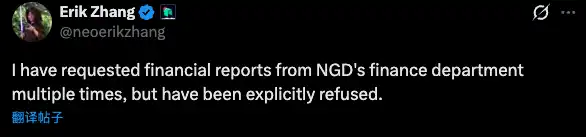
Subsequently, Zhang Zhengwen accused the Neo Foundation of long-term opaque operations, with its financial status resembling a "black box." He pointed out that Da Hongfei has long solely controlled the foundation's assets other than NEO/GAS tokens, and there is a lack of a complete, auditable disclosure mechanism.

In today's exchange of accusations, we also discovered the reason for Zhang Zhengwen's previous departure. He said that Da Hongfei approached him alone, stating that it was inefficient for the two of them to be responsible for NEO, so he chose to temporarily withdraw from management to "improve efficiency." However, he found that Da Hongfei was using NEO's resources to develop an independent public chain project, EON. This prompted him to return and intervene in the foundation's governance.

In community discussions in November, Zhang Zhengwen stated that NEO had previously relied on hackathons to create "false prosperity," with no real users, and many hackathon projects disappeared after receiving awards.

Escalation of Conflict

In December, Zhang Zhengwen publicly issued a statement demanding that Da Hongfei fulfill the financial disclosure obligations promised since December 9th. More explosively, Zhang Zhengwen unilaterally announced that, according to a previous phone agreement between them, starting January 1, 2026, Da Hongfei will no longer participate in NEO mainnet affairs and will instead focus on the development and operation of the sidechain NeoX and the new project SpoonOS.

Da Hongfei (Da Shu) responded immediately, stating that Zhang Zhengwen actually controls the vast majority of the funds in the NEO ecosystem (including the core assets NEO and GAS tokens) and dominates the voting rights of consensus nodes. He also accused Zhang Zhengwen of delaying the transfer of funds to the foundation's multi-signature address (Multisig) for years under various pretexts (such as waiting for the completion of the N3 migration).

Da Hongfei承诺将在 2026 年第一季度发布 2025 年末的财务报告,并会提前分享初步数据。

Связанные с этим вопросы

QWhat is the core reason for the public conflict between the two co-founders of NEO, as mentioned in the article?

AThe core reason is financial opacity, with Erik Zhang accusing Da Hongfei of controlling the foundation's assets (excluding NEO/GAS tokens) in a 'black box' manner without a complete, auditable disclosure mechanism.

QAccording to the article, why did Erik Zhang initially leave NEO's management?

AHe left because Da Hongfei told him that having two people in charge was inefficient. Zhang agreed to step back temporarily to 'improve efficiency'.

QWhat specific event prompted Erik Zhang to return and get involved in the NEO Foundation's governance?

AHe returned after discovering that Da Hongfei was using NEO's resources to develop an independent public chain project called EON.

QWhat did Erik Zhang unilaterally announce regarding Da Hongfei's role starting January 1, 2026?

AHe announced that, based on a prior phone agreement, Da Hongfei would no longer be involved in NEO mainnet affairs and would instead focus on developing and operating the sidechain NeoX and a new project called SpoonOS.

QHow did Da Hongfei counter Erik Zhang's accusations about financial control?

ADa Hongfei stated that Zhang actually controls the vast majority of the funds in the NEO ecosystem (including the core NEO and GAS tokens) and the consensus node voting power. He also accused Zhang of delaying the transfer of funds to the foundation's multi-signature address for years.

Похожее

Apple Also Has to Pay Rent Now

Apple Pays Rent Too: The Two-Way Flow of "Traffic Tax" and "AI Capability Rent" Between Tech Giants For over two decades, Google has paid Apple an estimated $20 billion annually to remain the default search engine on Safari, a "traffic tax" for a critical user entry point. However, in 2026, the direction of this cash flow partially reversed. Apple agreed to pay Google roughly $1 billion per year to license its Gemini AI models, as Apple's own models reportedly struggled with complex tasks. This creates a unique dynamic: Apple acts as the "landlord" in the established search ecosystem, collecting rent from Google for access. Simultaneously, in the emerging AI arena, Apple becomes the "tenant," paying Google for access to cutting-edge AI capabilities it cannot currently match internally. While Apple claims its new models are "distilled" from Gemini outputs and contain "not a drop" of Google's original code, core dependencies remain. Its knowledge base is refined using Gemini's outputs, and its most powerful cloud model runs on Google's infrastructure. Apple has structured the deal as non-exclusive, allowing it to theoretically switch AI suppliers—a hedge against over-reliance. The future hinges on whether advanced AI models become a commodity (cheap and abundant) or remain a concentrated, scarce resource (expensive and controlled by few). Apple is betting on the former, leveraging its massive device ecosystem to be a powerful, choosy customer. If the latter proves true, its bargaining power could erode. This power dynamic is extending to developers. Apple, Google, and WeChat are all pushing for apps to expose their core functions as standardized "actions" or "intents" that their respective AI assistants (Siri, Gemini, WeChat AI) can directly call. The new scarce resource is no longer just app store visibility, but "being selected by the AI." The currency of "rent" has changed from a 30% revenue share to ceding control over how users interact with an app's functions.

marsbit35 мин. назад

Apple Also Has to Pay Rent Now

marsbit35 мин. назад

Missed the SpaceX IPO? WEEX's "First Trade Protection" Lets You Experience US Stock Trading Risk-Free.

With the excitement around SpaceX's recent public listing reigniting interest in the US stock market, Chinese investors face significant challenges accessing compliant and convenient trading channels following regulatory actions against major online brokers. This article explores the available options, highlighting their risks and limitations. Traditional paths for US stock investments remain problematic. Qualified Domestic Institutional Investor (QDII) and Listed Open-Ended Fund (LOF) products, while compliant, suffer from high fees, significant purchase premiums, and a very limited selection of assets. Small, unregulated offshore brokers pose substantial risks, including potential insolvency. While secure, VIP accounts at banks in Hong Kong or Singapore require high minimum deposits (often 1-2 million RMB) and in-person visits, placing them out of reach for most retail investors. The article positions cryptocurrency exchanges, specifically their TradFi (traditional finance on-chain) offerings, as a compelling alternative. Platforms like WEEX are noted for providing access to a wide range of US stocks and ETFs, including SpaceX (SPCXON), through tokenized assets. This method offers advantages such as a single account for both crypto and traditional assets, USDT-based settlement avoiding fiat complexities, flexible leverage, and robust risk management. To attract users, WEEX is promoting a "First Trade Guarantee" campaign. Running from June 15 to July 8 (UTC+8), it features a $30,000 prize pool. Users who trade $500 worth of US stock contracts can qualify for a guarantee on their first eligible trade: 100% loss coverage up to $30 or a 20% bonus on profits up to $30. The campaign is presented as a low-risk opportunity for both crypto natives and traditional investors to experience US stock trading.

marsbit36 мин. назад

Missed the SpaceX IPO? WEEX's "First Trade Protection" Lets You Experience US Stock Trading Risk-Free.

marsbit36 мин. назад

How Difficult is Chip Making? A Division Error Costs 475 Million Dollars

How Hard Is It to Make a Chip? A Division Error Cost $475 Million Chip expert Shi Kan, a researcher at the Chinese Academy of Sciences and a popular tech creator, explains the immense challenges of chip development. Chips are foundational to modern technology, but their creation is extraordinarily difficult. The journey from sand to a functional chip involves complex design and manufacturing, but a critical bottleneck is verification—ensuring the design works flawlessly before costly production. A single, undetected bug can have catastrophic consequences, as illustrated by the infamous 1994 Intel Pentium FDIV bug. A flaw in the floating-point division unit forced a recall costing $475 million. Unlike software, chips cannot be easily patched after manufacture, making "first-time success" paramount. However, industry surveys show only 24% of chip projects achieve this; over three-quarters require at least one costly re-spin due to design flaws. Verification has thus become the dominant phase, consuming up to 70% of the design cycle. The core challenge is a "verification impossible triangle" between high performance, good debuggability, and low cost. Exhaustively verifying a modern CPU core could take 15,000 years with software simulation, or 30 years with advanced hardware emulation—timeframes utterly impractical for development. Despite being essential, verification is often seen as unglamorous "dirty work," receiving less academic attention than fields like AI. Shi and his team are tackling this by developing an agile verification research framework called ENCORE, based on FPGA technology, to improve verification efficiency and debug capability. Beyond research, Shi engages in public science communication through long-form video content, aiming to demystify chip technology, AI, and computer science. He argues for the value of pursuing "hard and long-term" endeavors, whether in the meticulous world of chip verification or in creating substantive educational content, believing such sustained effort is likely the right path forward.

marsbit46 мин. назад

How Difficult is Chip Making? A Division Error Costs 475 Million Dollars

marsbit46 мин. назад

Claude to Mandate "Face-Scan ID Verification", No ID No Service Starting July?

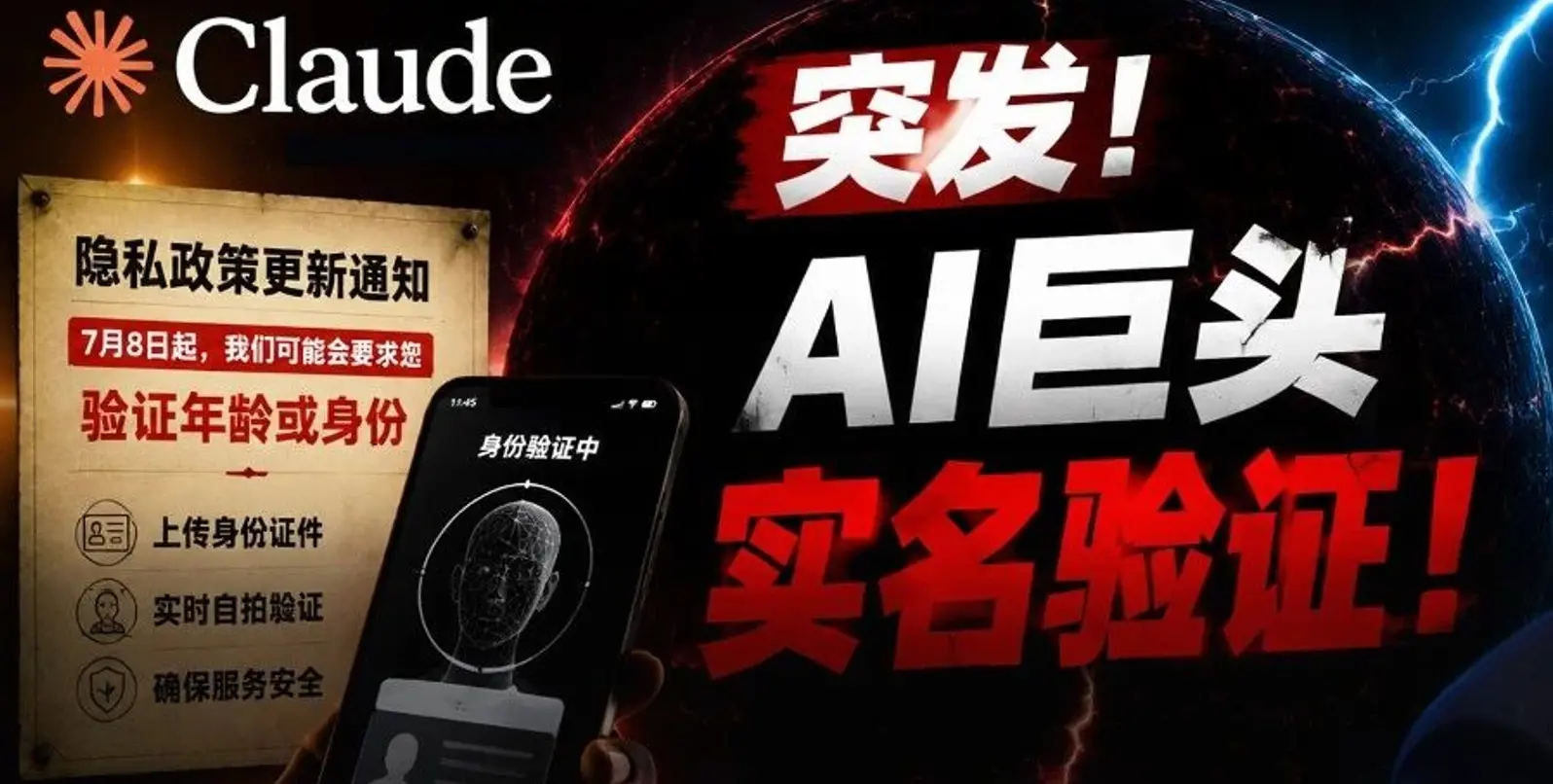
Anthropic, the creator of Claude AI, has sent privacy policy update emails to users, signaling a significant shift. The key change, effective July 8, is the potential requirement for consumer-level users (Free, Pro, Max plans) to verify their age or identity. This verification would be conducted through the third-party service Persona, involving uploading a government-issued photo ID and taking a live selfie for comparison. Anthropic states this data is for security purposes only, will not be used for model training, and is processed by Persona, not stored on its own servers. The update also clarifies data handling for Claude's new capabilities: when performing multi-step tasks or connecting to third-party apps, user data may flow between Anthropic and those external services. Additionally, more information may be collected from users who participate in Anthropic research. This move is seen as a major step towards establishing accountability as AI agents become more powerful and autonomous, capable of executing complex, real-world tasks. It follows previous enforcement actions, like the banning of the "Fable 5" account, and indicates a broader industry trend toward stricter user identification and safety measures. The verification is expected to apply in specific scenarios, particularly as users engage Claude in more complex agentic workflows.

链捕手59 мин. назад

Claude to Mandate "Face-Scan ID Verification", No ID No Service Starting July?

链捕手59 мин. назад

Blockchain Has Finally Started to Sail into the Mainstream After 18 Years

Blockchain Finds Its True Path After 18 Years: Becoming the Financial Backbone for AI Agents and Autonomy This analysis explores a pivotal shift in the blockchain and crypto investment landscape, driven by the dominance of AI. Major venture capital firms, including Variant, Paradigm, Haun Ventures, and YZi Labs, are moving beyond pure "crypto" investment theses. They are expanding their focus to AI, robotics, and frontier tech, signaling that blockchain is no longer seen as a standalone sector but as an underlying infrastructure layer. The core argument is that blockchain's killer application may not be user-facing apps, but rather providing the economic rails for the coming wave of AI agents, autonomous robots, and automated systems. Key capabilities like self-custody wallets, programmable stablecoins for micropayments, on-chain identity, and verifiable smart contracts are positioned as essential for a future where machines conduct economic activity. The recent $1.4 billion investment by Tether (via its venture arm) in German robotics company NEURA Robotics exemplifies this, aiming to embed Tether's wallet tools directly into robots for autonomous transactions. While many "AI + Crypto" projects remain superficial, the article concludes that true value lies where crypto is a necessary component—enabling machine-to-machine payments, agent autonomy, verifiable data provenance, and open financial settlement for the AI era. For crypto venture capital, this convergence with AI represents both an adaptation to shifting capital flows and a potential path to unlocking the large-scale, non-speculative utility the industry has long sought.

marsbit1 ч. назад

Blockchain Has Finally Started to Sail into the Mainstream After 18 Years

marsbit1 ч. назад

Торговля

Спот
Фьючерсы

Популярные статьи

Как купить CORE

Добро пожаловать на HTX.com! Мы сделали приобретение CORE (CORE) простым и удобным. Следуйте нашему пошаговому руководству и отправляйтесь в свое крипто-путешествие.Шаг 1: Создайте аккаунт на HTXИспользуйте свой адрес электронной почты или номер телефона, чтобы зарегистрироваться и бесплатно создать аккаунт на HTX. Пройдите удобную регистрацию и откройте для себя весь функционал.Создать аккаунтШаг 2: Перейдите в Купить криптовалюту и выберите свой способ оплатыКредитная/Дебетовая Карта: Используйте свою карту Visa или Mastercard для мгновенной покупки CORE (CORE).Баланс: Используйте средства с баланса вашего аккаунта HTX для простой торговли.Третьи Лица: Мы добавили популярные способы оплаты, такие как Google Pay и Apple Pay, для повышения удобства.P2P: Торгуйте напрямую с другими пользователями на HTX.Внебиржевая Торговля (OTC): Мы предлагаем индивидуальные услуги и конкурентоспособные обменные курсы для трейдеров.Шаг 3: Хранение CORE (CORE)После приобретения вами CORE (CORE) храните их в своем аккаунте на HTX. В качестве альтернативы вы можете отправить их куда-либо с помощью перевода в блокчейне или использовать для торговли с другими криптовалютами.Шаг 4: Торговля CORE (CORE)С легкостью торгуйте CORE (CORE) на спотовом рынке HTX. Просто зайдите в свой аккаунт, выберите торговую пару, совершайте сделки и следите за ними в режиме реального времени. Мы предлагаем удобный интерфейс как для начинающих, так и для опытных трейдеров.

600 просмотров всегоОпубликовано 2024.03.29Обновлено 2026.06.02

Как купить CORE

Обсуждения

Добро пожаловать в Сообщество HTX. Здесь вы сможете быть в курсе последних новостей о развитии платформы и получить доступ к профессиональной аналитической информации о рынке. Мнения пользователей о цене на CORE (CORE) представлены ниже.

活动图片