The $6 Billion Business of Stablecoin Wealth Management: Where Does the Yield Come From, and Where Does the Risk Go?

marsbitОпубликовано 2026-01-30Обновлено 2026-01-30

Введение

The article examines the resurgence of crypto yield products, specifically "Vaults," which manage over $6 billion in assets and are marketed as transparent, non-custodial alternatives to failed centralized lenders like Celsius and BlockFi. These Vaults use smart contracts to automate lending and trading strategies, offering yields from activities like liquidity provision and stablecoin lending. However, the piece highlights inherent risks: competitive pressure for higher returns can lead to increased leverage and off-platform exposures, as seen in the collapse of Stream Finance, which lost $93 million. While Vaults aim to avoid the opacity of previous models, the article questions whether transparency alone can prevent a shadow banking crisis, especially as stablecoin adoption grows and platforms like Coinbase promote high-yield products. The balance between innovation and risk remains unresolved.

Author:Muyao Shen

Compiled by: Deep Tide TechFlow

Deep Tide Guide: The collapse of BlockFi and Celsius in 2022 plunged the crypto lending industry into a deep freeze, but now, a Vault model touting "transparency and non-custodial" features is making a comeback with $6 billion in assets under management.

This article provides an in-depth analysis of this new format: how it uses smart contracts to avoid the black-box risks of traditional centralized lending, and how, under the pressure to pursue high yields, it might repeat the mistakes of a firm like Stream Finance.

As the "Genius Act" pushes stablecoins into the mainstream, are Vaults the cornerstone of crypto finance's maturation, or the next shadow banking crisis cloaked in transparency?

This article will reveal the old and new logic behind high yields.

Full Text Below:

When the crypto platform Stream Finance collapsed at the end of last year (resulting in the loss of approximately $93 million in user funds), it exposed a familiar breaking point in digital assets: when markets turn, promises of so-called "safe yield" often crumble.

This failure was disturbing not only because of the losses incurred, but also because of the mechanism behind it. Stream had positioned itself as part of a new generation of more transparent crypto yield products, designed to avoid the hidden leverage, opaque counterparty risks, and arbitrary risk decisions that brought down centralized lending institutions like BlockFi and Celsius in the previous cycle.

Instead, it demonstrated how quickly the same dynamics—leverage, off-platform risk exposure, and centralized risk—can return when platforms start chasing yield, even if the underlying infrastructure appears safer or the transparency is more reassuring.

Yet, the broader promise of safer crypto yield remains. According to industry data, Vaults—on-chain pools built around this idea—currently manage over $6 billion in assets. Crypto asset management firm Bitwise predicts that assets in Vaults could double by the end of 2026, driven by growing demand for stablecoin yield.

Cryptocurrency's "Safe" Yield Trade Reaches $6 Billion
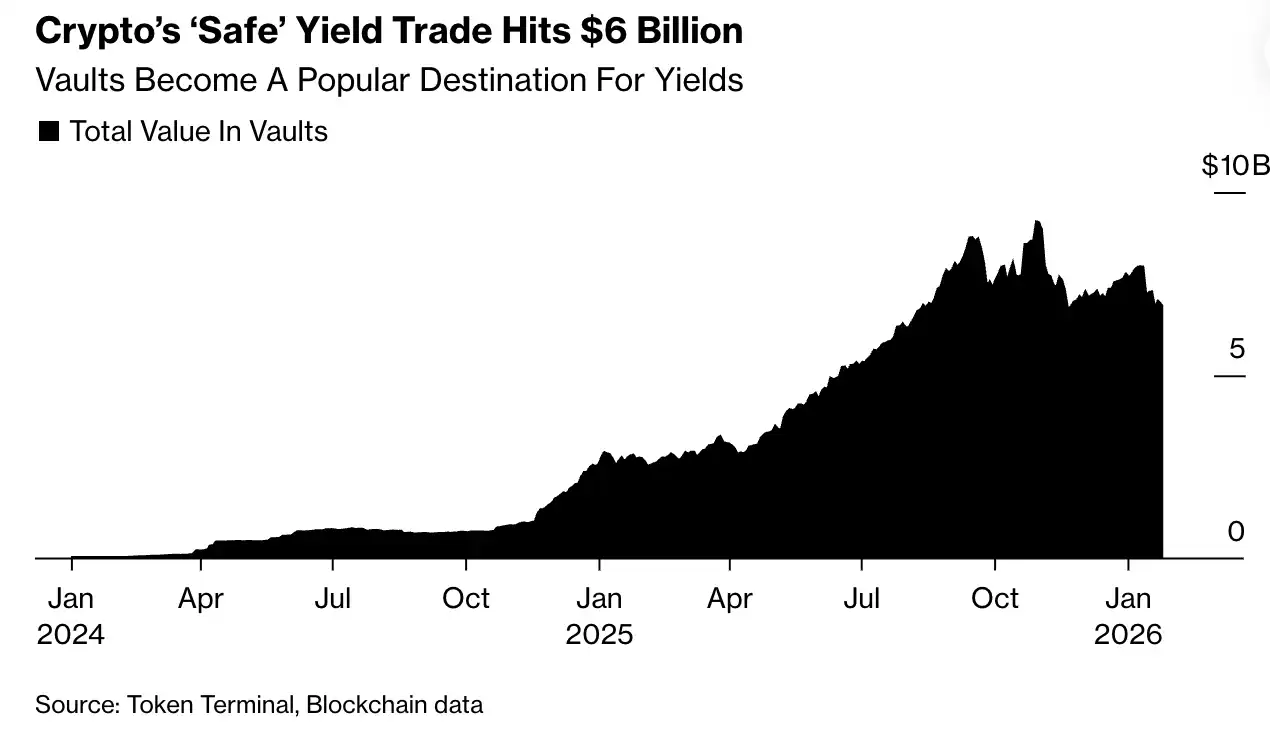
At a basic level, Vaults allow users to deposit cryptocurrency into shared pools, and these funds are deployed into lending or trading strategies designed to generate returns. The difference with Vaults lies in how they are marketed: they are promoted as a clean break from the opaque lending platforms of the past. Deposits are non-custodial, meaning users never hand over their assets to a company. Funds are held in smart contracts that automatically deploy capital according to pre-set rules, with key risk decisions clearly visible on the blockchain. Functionally, Vaults resemble a familiar component of traditional finance: pooled funds converted into yield and providing liquidity.

But their structure is distinctly crypto. This all happens outside the regulated banking system. Risk is not buffered by capital reserves or overseen by regulators—it is embedded in software, where algorithms automatically rebalance positions, liquidate collateral, or unwind trades as markets move, automating losses.

In practice, this structure can produce mixed results, as curators (the companies that design and manage Vault strategies) compete on returns, and users find themselves navigating just how much risk they are willing to bear.

"Some players will do a terrible job," said Paul Frambot, co-founder of Morpho, the infrastructure behind many lending Vaults. "They might not survive."

For developers like Frambot, this churn is less a warning sign and more a feature of an open, permissionless market—where strategies are tested in the open, capital flows quickly, and weaker approaches are replaced over time by stronger ones.

The timing of its growth is no accident. With the passage of the "Genius Act," stablecoins are moving into the financial mainstream. As wallets, fintech apps, and custodians race to distribute digital dollars, platforms face a common problem: how to generate yield without putting their own capital at risk.

Vaults have emerged as a compromise. They offer a way to manufacture yield while technically keeping assets off a company's books. Think of it like a traditional fund—but without handing over custody or waiting for quarterly disclosures. This is how curators pitch the model: users retain control of their assets while gaining access to professionally managed strategies that run automatically on-chain.

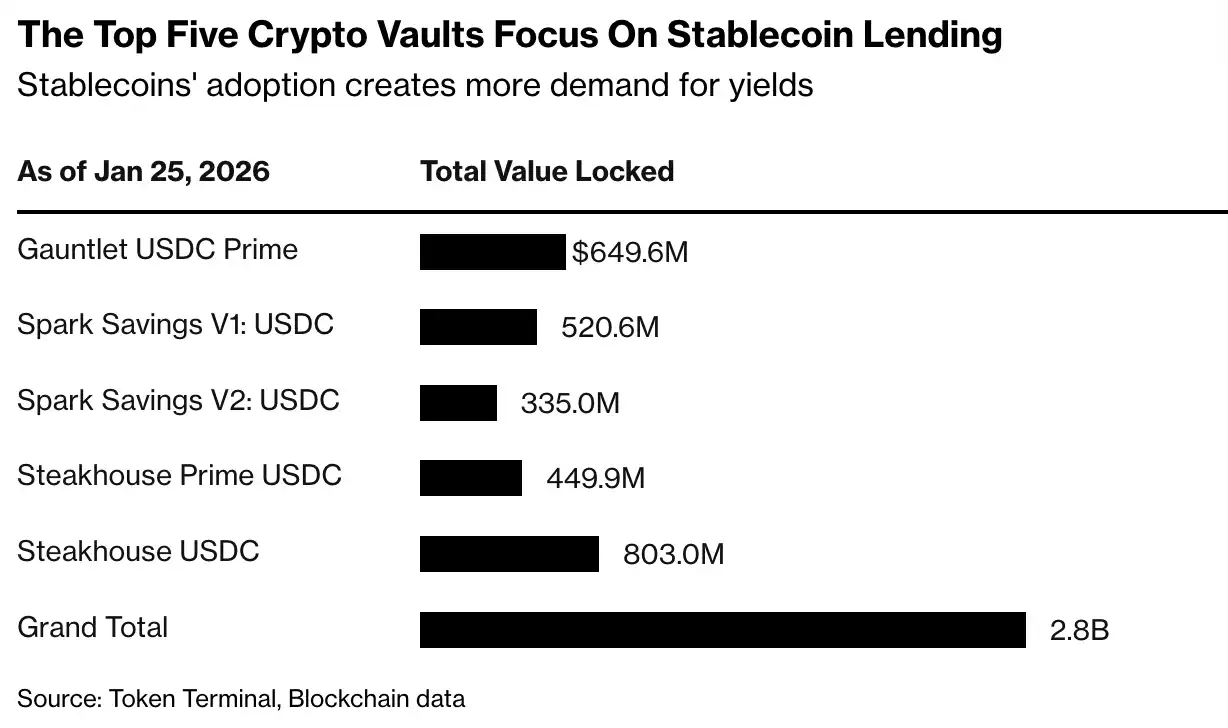
"The curator's role is similar to a risk and asset manager, like what BlackRock or Blackstone does for the funds and endowments they manage," said Tarun Chitra, CEO of crypto risk management firm Gauntlet, which also operates Vaults. "But, unlike BlackRock or Blackstone, it's non-custodial, so the asset manager never holds the user's assets; the assets are always in the smart contract."

This structure is designed to correct recurring weaknesses in crypto finance. In previous cycles, products marketed as low-risk often hid borrowed money, reused client funds without disclosure, or relied heavily on a handful of fragile partners. The algorithmic stablecoin TerraUSD offered yields nearing 20% by subsidizing returns. Centralized lenders like Celsius quietly parked deposits in high-risk bets. When markets turned, the damage spread quickly—and without warning.

Most Vault strategies today are more restrained. They typically involve floating-rate lending, market making, or providing liquidity to blockchain protocols, rather than pure speculation. The Steakhouse USDC Vault is one such example, lending stablecoins against what it describes as blue-chip cryptocurrencies and tokenized real-world assets (RWAs), offering a return of about 3.8%. Many Vaults are deliberately designed to be "boring": their appeal lies not in outsized returns, but in the promise of earning yield on digital cash without handing over custody or making users creditors of a single company.
"People want yield," said Jonathan Man, portfolio manager and head of multi-strategy solutions at Bitwise, which just launched its first Vault. "They want their assets to be productive. Vaults are just another way to do that."

Vaults could also gain more momentum if regulators move to ban paying yield directly on stablecoin balances—a suggestion floated in market structure legislation. If that happens, the demand for yield won't disappear; it will just shift.

"Every fintech company, every centralized exchange, every custodian is talking to us," said Sébastien Derivaux, co-founder of Vault curator Steakhouse Financial. "Traditional finance companies too."

But this restraint isn't hard-coded into the system. The pressure shaping the industry comes from competition, not technology. As stablecoins proliferate, yield becomes a primary tool for attracting and retaining deposits. Underperforming curators risk losing capital, while those offering higher returns attract more inflows. Historically, this dynamic has pushed non-bank lenders—both in crypto and elsewhere—to loosen standards, add leverage, or shift risk off-platform. This shift has already touched large consumer-facing platforms. Crypto exchanges Coinbase and Kraken have both launched products giving retail customers access to Vault-like strategies, advertising yields as high as 8%.

Transparency, in sum, can be misleading. Public data tools and visible strategies build confidence—and confidence attracts capital. But once money is in place, curators face pressure to deliver returns, sometimes by reaching into off-chain deals that are difficult for users to assess.

Stream Finance later exposed this breaking point; the platform had advertised returns as high as 18%, then reported significant losses related to an unnamed external fund manager. The event triggered a sharp pullback across the Vault industry, with total assets falling from a peak near $10 billion to around $5.4 billion.

Proponents of the model say Stream was not representative. Stream Finance did not respond to a request for comment sent via X private message.

"Celsius, BlockFi, all of these, even Stream Finance, I kind of lump them all together as failures of disclosure to the end user," said Bitwise's Man. "People in crypto always focus more on what the upside might be and less on what the downside risk is."

That distinction may matter for now. Vaults were built in response to the last wave of failures, with the explicit goal of making risk visible rather than hidden. The open question is whether transparency alone is enough to constrain behavior—or whether, as in previous cases of shadow banking, a clearer structure just makes it easier for investors to tolerate risk until the music stops.

"At the end of the day, it's about embracing transparency, but it's also about having proper disclosures for any type of product—DeFi or non-DeFi," Man said.


Связанные с этим вопросы

QWhat is the Vault model in crypto and how does it claim to be different from previous centralized lending platforms?

AThe Vault model allows users to deposit crypto into shared pools that are invested in lending or trading strategies to generate yield. It is marketed as a break from opaque, centralized lending platforms by being non-custodial (users never hand over assets to a company), using smart contracts with pre-set rules for automatic capital deployment, and making key risk decisions visible on the blockchain.

QAccording to the article, what is the predicted growth for assets under management in Vaults by 2026?

ACrypto asset management firm Bitwise predicts that the assets under management in Vaults could double by the end of 2026, driven by growing demand for stablecoin yield.

QWhat major event caused a significant withdrawal from the Vault industry, and what was the approximate amount involved?

AThe collapse of Stream Finance, which caused approximately $93 million in user losses, triggered a sharp withdrawal from the Vault industry, with total assets falling from a peak of nearly $10 billion to around $5.4 billion.

QHow does the article describe the potential risk or pressure that Vault curators face despite the transparent structure?

AThe pressure comes from competition rather than technology. Curators face the risk of losing capital if they underperform, which can push them to relax standards, increase leverage, or move risk off-platform to deliver higher returns and attract more inflows, similar to dynamics in traditional non-bank lending.

QWhat role does the 'Genius Act' play in the context of the growing Vault model?

AThe passage of the 'Genius Act' is helping to push stablecoins into the financial mainstream. As wallets, fintech apps, and custodians race to distribute digital dollars, Vaults offer a compromise solution for generating yield without taking the platform's own capital onto its balance sheet, thus meeting the demand for yield while technically keeping assets off the company's books.

Похожее

TechFlow Intelligence Bureau: Chip Stocks Lose Trillions in a Single Day, Bitcoin Falls Below $60,000, US-Iran Conflict Escalates

**Daily Tech & Markets Roundup: AI Advances, Market Turmoil, and Geopolitical Tensions** **AI / LLMs**: Anthropic's internal report on AI self-improvement sparked serious discussions about Recursive Self-Improvement (RSI). Meanwhile, debate continues on AI coding tools after Claude was accused of introducing bugs into the rsync codebase. In positive news, DeepSeek V4 Flash impressed in local deployment tests, and GitHub Copilot now supports custom endpoints for local models. A surprising research turn suggests removing chain-of-thought prompting can sometimes improve LLM performance. **Crypto / Web3**: Bitcoin plunged below $60,000, with its RSI hitting levels last seen during the COVID-19 crash, driven by strong U.S. jobs data reviving interest rate hike fears. Discussions highlight Ethereum DeFi's continued lack of a smooth consumer payment layer. **Chips / Hardware**: Chip stocks suffered a massive sell-off, with the Philadelphia Semiconductor Index posting its worst single-day drop in six years, erasing over a trillion dollars in value. Marvell, Micron, AMD, and Intel were among the biggest losers. **Tech Companies**: A leaked Microsoft document revealing goals to make Copilot "addictive" drew criticism. LinkedIn founder Reid Hoffman left Microsoft's board to focus full-time on his AI agent startup, Manus. Google was revealed to be paying SpaceX $920 million monthly for AI training compute. **Markets & Macro**: A blowout U.S. jobs report (172k vs. 80k expected) crushed hopes for near-term rate cuts, sending Treasury yields soaring and triggering a broad market sell-off. CEOs from Kraft, McDonald's, and Whirlpool simultaneously warned U.S. consumers are exhausting their savings. **Geopolitics**: U.S.-Iran tensions escalated with missile/drone interceptions and U.S. strikes on Iranian radar sites, keeping the critical Strait of Hormuz largely closed since late February and posing ongoing oil supply risks. **The Bottom Line**: The strong jobs data acted as a single trigger for correlated sell-offs across equities, crypto, and chips. Underlying the volatility is a stark contradiction between robust employment data and warnings of consumer weakness, alongside geopolitical risks that could reignite inflation, leaving markets to price in a fraught macro outlook with no clear "soft landing" path.

marsbit1 ч. назад

TechFlow Intelligence Bureau: Chip Stocks Lose Trillions in a Single Day, Bitcoin Falls Below $60,000, US-Iran Conflict Escalates

marsbit1 ч. назад

It Took Me a Year to See the Bitter Truth About Agent Payments

After a year building infrastructure for the Agent economy, engaging with major players like Stripe, Visa, and Coinbase, the author shares a sobering analysis of the current state of Agent payments. The core finding is a stark lack of genuine, immediate demand across most envisioned use cases. The article breaks down four key market segments: 1. **Agent-to-Merchant (Consumer Shopping):** For most product categories (e.g., clothing, electronics), conversational AI shopping is a step backwards from visual e-commerce interfaces. While agents excel at understanding needs, they can't replace side-by-side product comparison. Real merchant interest is defensive "Agent Engine Optimization," not driven by current customer demand. Potential exists for high-frequency, low-decision purchases (like food delivery) or navigating complex store UIs, but these require massive B2C distribution channels dominated by giants like Amazon. 2. **Agent-to-API (Developer Services):** Developers already have subscriptions and billing relationships for APIs (compute, data). Prepaid balances solve micro-payment issues for low transaction volumes. A deeper structural problem is that major SaaS vendors' business models rely on enterprise contracts, resisting granular pay-per-call pricing. While protocols like MPP and x402 serve the long tail of niche services, this market is small and developers are historically low-willingness-to-pay. 3. **Agent-to-Agent:** This remains largely theoretical with minimal transaction volume. While it represents a long-term bet on a fundamentally new transaction infrastructure (sub-second, micro-penny to million-dollar, multi-party settlements), it does not constitute a present market. 4. **Agent-to-Finance:** This is the only category with existing, paying demand. Integrating AI into financial workflows (trading, portfolio management) is a natural evolution and enables new capabilities like autonomous rebalancing. However, competition favors established, regulated institutions. The "real problem" is not moving money between agents, but the broader challenge of **coordination**—orchestrating work between agents and humans, verifying outcomes, and settling results. Payment is just one component of settlement, which is itself part of coordination. Companies that solve the coordination layer will subsume payment, not the other way around. While well-funded incumbents build defensively for a long-term future, startups must find where the market is today—which, for the author's team, lies outside these four categories in an area of real, growing, and underserved activity.

marsbit2 ч. назад

It Took Me a Year to See the Bitter Truth About Agent Payments

marsbit2 ч. назад

It Took Me a Year to See the Hard Truth About Agent Payments

**Title: It Took Me a Year to See the Hard Truth About Agent Payments** Over the past year, I've worked on infrastructure for the Agent economy, engaging with major players like Stripe, Visa, Coinbase, and numerous startups. The findings reveal a stark reality: genuine, widespread demand for Agent-based payments does not yet exist. **Key Observations:** * **Agent-to-Merchant (Shopping):** The user experience for AI shopping often falls short, especially for visual product discovery. While AI excels at understanding needs, conversational interfaces can't yet replace browsing and comparing multiple products visually. Current merchant interest is largely defensive ("Agent Engine Optimization") for a future that hasn't arrived. High-frequency, low-friction purchases (like food delivery) are potential fits, but lack open APIs and face high AI inference costs. Simpler, more affordable, or cross-language interactions for complex UIs are a niche opportunity but require massive consumer distribution to scale. * **Agent-to-API (Developer Tools):** Developer payment needs for APIs (computing, data, models) are already met through subscriptions and prepaid credits. The core challenge is not payment friction but supplier economics: most large SaaS providers prefer enterprise contracts over micropayments for API calls. Protocols like MPP and x402 suit the long-tail of smaller services but cater to a developer market historically reluctant to pay for these tools. Major infrastructure needs at the top of the stack are already being addressed. * **Agent-to-Agent (Machine Commerce):** This is a long-term vision with almost no current transaction volume. While a future with high-speed, high-frequency, multi-party machine-to-machine transactions would require novel infrastructure, it remains theoretical. The market is not here yet. * **Agent-to-Finance:** This is the only category with clear, present demand. Financial professionals and DeFi users already pay for tools, and AI augmentation is a natural evolution. Autonomous AI agents can enable entirely new financial strategies. However, competition is fierce from established, regulated incumbents who can more easily layer AI onto their existing products. **The Core Insight:** Companies, especially giants with long time horizons, are building defensively for a potential future of mass machine commerce. For them, early investment is a low-cost hedge. For startups, the current market reality is different. The primary challenge isn't just moving money between agents (payments). The larger, unsolved problem is **orchestration** – coordinating work between agents and humans, verifying outcomes, and then settling. Payment is just a part of settlement, which is just a part of orchestration. Companies that solve the orchestration problem will subsume payments, not the other way around. After a year of building, we see the real, growing, and underserved market opportunity lies in this broader domain of orchestration.

链捕手3 ч. назад

It Took Me a Year to See the Hard Truth About Agent Payments

链捕手3 ч. назад

Торговля

Спот
Фьючерсы
活动图片