Tether Expands South Korea Trademark Filings As Stablecoin Rules Take Shape

bitcoinistОпубликовано 2026-05-21Обновлено 2026-05-21

Введение

Tether has significantly expanded its trademark filings in South Korea, applying for seven trademarks covering its company name, logo, and Tether Gold (XAUT) token, a strategic departure from its previous focus on just product names. This move, coinciding with South Korea's development of new stablecoin regulations, suggests Tether is preparing to establish a formal business presence in the country, potentially in response to upcoming rules that may require foreign issuers to set up local branches. South Korea's large and active crypto market makes it a crucial battleground. Rival stablecoin issuer Circle has already made inroads, filing trademarks last year and increasing USDC's market share. While Circle has advanced its local relationships through high-level meetings, Tether's strategy also targets the broader payments landscape. It sees an opportunity to serve South Korea's export economy by offering faster, cheaper cross-border transactions using stablecoins as payment tools, indicating a future competition that extends beyond trading into mainstream finance.

Tether’s latest move in South Korea goes beyond protecting a product name. The company behind the world’s largest stablecoin filed seven trademark applications with the Korea Intellectual Property Rights Information Service on May 19, covering not just its tokens but its company name, official logo, and gold-backed asset Tether Gold, known as XAUT.

A Shift In Strategy

That’s a departure from how Tether has approached South Korea before. Earlier filings were limited to stablecoin product names. Covering the broader brand signals something bigger — a possible push toward establishing an actual business presence in the country, not just protecting a label.

Timing is everything here. South Korea is in the middle of drafting new rules under the second phase of its Digital Asset Basic Act.

One proposal under discussion would require foreign stablecoin companies to set up a local branch before they can legally offer their tokens to South Korean users.
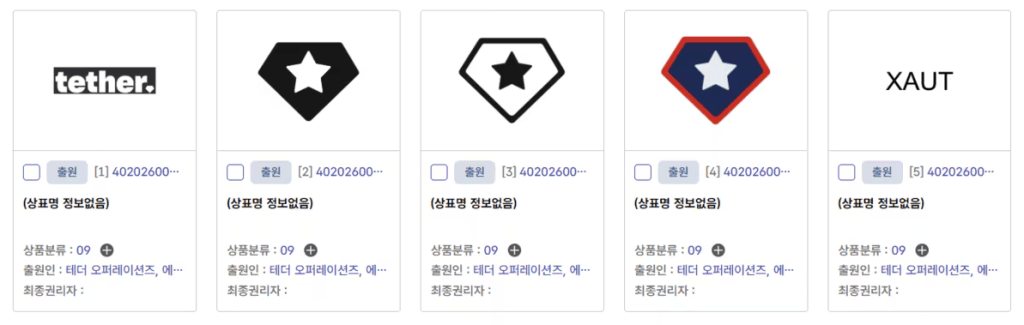
Trademarks for Tether's company name and logo filed with KIPRIS.

Tether’s trademark filings, some observers say, look like early preparation for that kind of requirement.

South Korea is not a small market. The country has one of the most active retail crypto trading populations in the world, which makes it a place no major stablecoin issuer can afford to ignore.

Circle Already Has A Head Start

Tether is not alone in moving on South Korea. Circle, the company behind USDC, filed 11 local trademarks last year and has already seen results — USDC’s market share in the country grew by 10%.

USDT market cap currently at $189 billion. Chart: TradingView

Tether now has seven active trademarks in South Korea, a number that has been growing as competition between the two stablecoin giants heats up.

Earlier this year, Circle CEO Jeremy Allaire traveled to South Korea and held meetings with major banks and crypto exchanges, exploring possible partnerships.

That kind of ground-level relationship building puts Circle ahead in terms of local ties, at least for now.

Seoul, South Korea. Image: Silversea

Payments, Not Just Trading

The trademark filings also fit into a wider ambition Tether has for South Korea. The country runs a significant export economy, and businesses there regularly move money across borders.

Tether sees that as an opening. Using blockchain-based payments instead of traditional bank transfers through systems like SWIFT could offer faster, cheaper transactions for South Korean exporters.

That vision — stablecoins as a real payment tool, not just a trading instrument — reflects where the bigger competition between Tether and Circle may eventually play out, well beyond crypto exchanges and into mainstream finance.

Featured image from Unsplash, chart from TradingView

Связанные с этим вопросы

QWhat is the main strategic shift indicated by Tether's recent trademark filings in South Korea?

AThe main strategic shift indicated is that Tether is now filing to protect its broader brand, including its company name, logo, and Tether Gold, rather than just product names. This signals a possible push toward establishing a formal business presence in the country, potentially in response to upcoming regulations.

QWhat specific regulatory requirement might Tether be preparing for with these trademark filings?

ATether might be preparing for a proposed requirement under South Korea's new Digital Asset Basic Act rules that would mandate foreign stablecoin companies to set up a local branch before legally offering their tokens to South Korean users.

QHow is Circle's position in the South Korean market different from Tether's according to the article?

ACircle already has a head start in the South Korean market. It filed trademarks last year, saw USDC's market share grow by 10%, and its CEO has personally traveled to South Korea to build ground-level relationships with major banks and crypto exchanges, giving it stronger local ties for now.

QBeyond crypto trading, what other major use case does Tether see for stablecoins in South Korea?

ABeyond crypto trading, Tether sees stablecoins as a payment tool for international commerce. It aims to serve South Korea's significant export economy by offering faster and cheaper blockchain-based cross-border payments for businesses, as an alternative to traditional systems like SWIFT.

QWhat broader competition does the article suggest is developing between Tether and Circle?

AThe article suggests the broader competition is shifting beyond dominance on crypto exchanges and into mainstream finance, specifically in establishing stablecoins as practical tools for global payments and financial services.

Похожее

The Value Distribution of Stablecoins

**Summary: The Value Distribution of Stablecoins** The article argues that stablecoins are evolving from mere trading tools into broader channels for dollar access. It divides the stablecoin ecosystem into four layers to analyze how value is distributed: 1. **Issuance Layer:** Mints stablecoins, holds reserve assets, and captures the spread between reserve yield and user costs (e.g., Tether, Circle). This layer currently earns the largest profit margin. 2. **Infrastructure Layer:** Connects stablecoins to the traditional financial system, handling fiat on/off-ramps, banking integration, compliance (KYC/AML), and asset management (e.g., Bridge, BVNK). This is the "unglamorous" but critical work, building the essential bridges between crypto and real-world finance. 3. **Acquiring/Distribution Layer:** Integrates stablecoins into merchant systems, manages payment flows, and provides enterprise financial software (e.g., Stripe, Coinbase). They act as the access point for businesses. 4. **Application Layer:** The end-users and businesses that ultimately use stablecoins for payments, settlements, or as a store of value. They benefit from convenience but have little pricing power. The core thesis is that while the issuance layer currently dominates profits, the often-overlooked **infrastructure layer holds significant long-term potential**. The real challenge and barrier to mass adoption is not the on-chain transfer of stablecoins (which is simple), but the complex "last mile" integration into existing business workflows, banking systems, and regulatory frameworks across different countries. Companies in this layer are currently in a "land grab" phase, investing heavily to build networks, secure bank partnerships, and establish compliance pathways. While their position is currently pressured by the profitable issuers above and distribution platforms below, the article suggests that if stablecoins become a default financial rail for businesses, the infrastructure providers who have done the hard work of integration will ultimately gain strong pricing power and become entrenched, essential players.

marsbit4 ч. назад

The Value Distribution of Stablecoins

marsbit4 ч. назад

The Value Distribution of Stablecoins

The Value Distribution of Stablecoins The article argues that stablecoins are evolving from a mere trading tool into a broad "dollar channel." It analyzes the industry's value chain through four layers: 1. **Issuance Layer (e.g., Tether, Circle):** The top layer that mints stablecoins, holds reserve assets, and captures the thickest interest rate spread. 2. **Infrastructure Layer (e.g., Bridge, BVNK):** Connects stablecoins to the traditional financial system, handling critical but complex "dirty work" like fiat on/off-ramps, banking integration, compliance (KYC/AML), and cross-border settlement. 3. **Acquiring/Distribution Layer (e.g., Stripe, Coinbase):** Embeds stablecoins into merchant systems, manages payment flows, and integrates with enterprise software. 4. **Application Layer:** End-users and businesses that ultimately use stablecoins for payments, settlement, or storing value. The author posits that while the issuance layer currently captures the most profit, the most overlooked and potentially critical layer is infrastructure. The core challenge for stablecoin adoption isn't the on-chain transfer (which is simple), but bridging the gap between blockchain and the real-world financial system. This involves solving practical problems for businesses: fiat conversion, reconciliation, tax handling, and user onboarding. Infrastructure companies are currently in a difficult "land-grab" phase—building networks, securing banking relationships, and achieving compliance country-by-country. They face pressure from both the profitable issuance layer above and distribution platforms below. However, the author suggests this layer is building a crucial moat. Once stablecoins become a default business rail, the infrastructure players who have done the hard work of integration may gain significant, durable value and pricing power.

链捕手4 ч. назад

The Value Distribution of Stablecoins

链捕手4 ч. назад

How to Do Research Well: Deliberately Practice the Real Skills That Matter

No one truly teaches you how to do research. You're often given a desk, a pre-selected problem, and vague instructions to "create something new." Consequently, many people reverse-engineer the job based on visible outputs—papers, posts, announcements—learning only how to *appear* like a researcher rather than how to *become* one. True research capability is built from stacking small, trainable skills, nearly all of which can be developed through deliberate practice. **Pick Your Own Problem:** Most researchers absorb problems from advisors or trends, lacking the underlying reasoning. Choosing a problem you genuinely care about, as John Schulman advises, leads to original work. Develop "taste" like a muscle: predict experiment outcomes, guess paper results from methods, and track which findings remain important over time. **Upgrade Your Inputs:** Relying on shared reading lists (arXiv hot lists, filtered group chats) leads to unoriginal conclusions. Undervalued old literature often holds crucial insights (e.g., MoE, LSTM, backpropagation). Richard Sutton's "The Bitter Lesson" or Claude Shannon's 1952 talk on creative thinking are more predictive than lengthy modern surveys. Breadth matters as much as depth: draw from neuroscience, mechanism design, hardware knowledge, and honest statistics. Read papers directly, especially appendices and limitations sections. **Write Everything Down:** As Paul Graham noted, writing exposes flaws in seemingly mature ideas. Writing is the cheapest defense against self-deception. Following Feynman's principle, Darwin programmatically wrote down facts contradicting his theory to combat memory bias. Maintain a detailed log of hypotheses, setups, predictions, results, and updated understandings. Reviewing past logs fosters essential humility.

marsbit6 ч. назад

How to Do Research Well: Deliberately Practice the Real Skills That Matter

marsbit6 ч. назад

Торговля

Спот
Фьючерсы
活动图片