Original Title: Strategy Takes a Hardline Stance Against MSCI: The Ultimate Defense of DAT
Original Author: KarenZ, Foresight News
The battle concerning the development of the Digital Asset Treasury (DAT) industry continues to intensify.
In October, global index compiler MSCI put forward a proposal to exclude companies with digital asset holdings accounting for 50% or more of their total assets from its global investable market indices. This move directly threatens the market position of digital asset treasury companies like Strategy and could potentially redirect capital flows for the entire DAT sector.
According to data compiled by Bitcoin for Corporations, 39 companies could be excluded from the MSCI Global Investable Market Index. J.P. Morgan analysts previously warned that the exclusion of Strategy alone could lead to nearly $2.8 billion in passive outflows. If other index providers follow suit with similar rules, it could result in outflows of up to $8.8 billion.
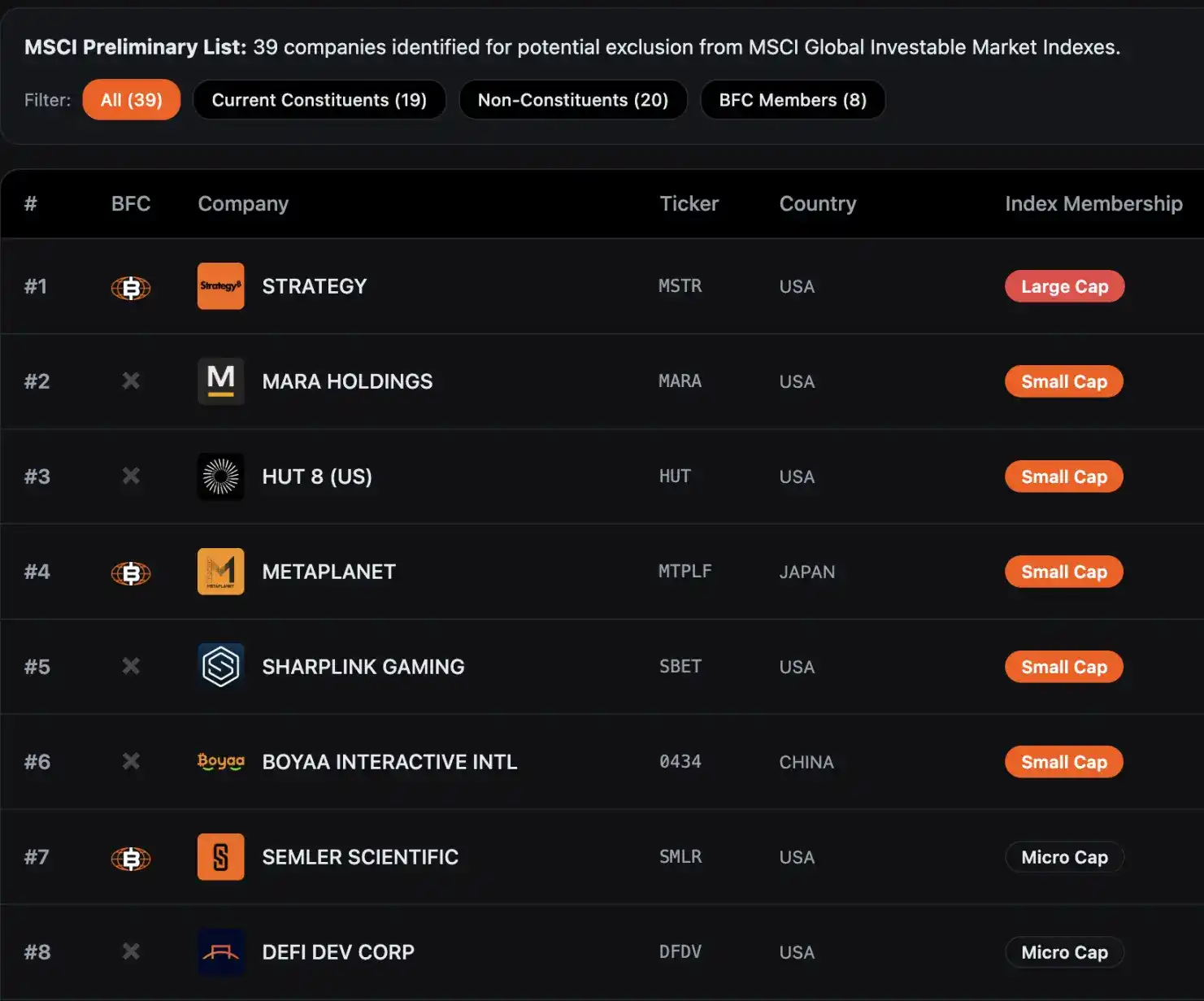
Currently, the consultation period for this MSCI proposal will last until December 31, 2025, with a conclusion expected by January 15, 2026. Any adjustments would be formally implemented during the index review in February 2026.
Facing this urgent situation, Strategy submitted a strongly worded 12-page open letter to the MSCI Equity Index Committee on December 10th. Signed jointly by Executive Chairman and founder Michael Saylor and President & CEO Phong Le, the letter clearly expresses firm opposition to the proposal. It states bluntly: "This proposal is seriously misleading and will have profoundly damaging consequences for the interests of global investors and the development of the digital asset industry. We strongly urge MSCI to completely withdraw this plan."
Strategy's Four Core Arguments for Defense
Digital Assets are a Revolutionary Foundational Technology Reshaping the Financial System
Strategy believes MSCI's proposal underestimates the strategic value of Bitcoin and other digital assets. Since Satoshi Nakamoto introduced Bitcoin 16 years ago, this digital asset has gradually grown into a key component of the global economy, with a current total market value of approximately $1.85 trillion.
In Strategy's view, digital assets are far from simple financial instruments; they represent a fundamental technological innovation capable of reshaping the global financial system—companies investing in Bitcoin-related infrastructure are building a new financial ecosystem, much like leading companies in history that deeply invested in single emerging technologies.
Just as Standard Oil in the 19th century focused on oil well extraction and AT&T in the 20th century全力 built telephone networks, these companies laid a solid foundation for subsequent economic transformations through前瞻性 investment in core infrastructure, ultimately becoming industry benchmarks. Strategy argues that companies focusing on digital assets today are following this path of "technology pioneers" and should not be simply dismissed by traditional index rules.
DATs are Operating Companies, Not Passive Funds
This is the core of Strategy's argument—Digital Asset Treasury companies (DATs) are operating businesses with complete business models, not merely investment funds passively holding Bitcoin. Although Strategy currently holds over 600,000 Bitcoin, its core value does not rely solely on Bitcoin's price fluctuations. Instead, it creates sustainable returns for shareholders by designing and launching unique "digital credit" instruments.
Specifically, Strategy issues "digital credit" instruments including various types with fixed dividend rates, floating dividend rates, different priority levels, and credit protection条款 preferred shares. It uses the funds raised from selling these instruments to acquire more Bitcoin. As long as the long-term investment return on Bitcoin exceeds Strategy's dollar-denominated financing costs, it can generate stable收益 for shareholders and clients. Strategy emphasizes that this model of "active operation + asset appreciation" is fundamentally different from the passive management logic of traditional investment funds or ETFs and should be regarded as a normal operating company.
Simultaneously, Strategy questions in the letter: Why can oil giants, real estate investment trusts (REITs), timber companies, etc., concentrate on holding单一类别 assets without being classified as investment funds and excluded from indices?Imposing special restrictions only on digital asset companies clearly violates the principle of industry fairness.
The 50% Digital Asset Threshold is Arbitrary, Discriminatory, and Impractical
Strategy points out that MSCI's proposal employs discriminatory standards. Many large companies in traditional industries also高度集中 hold单一 asset classes in their portfolios, including oil and gas companies, REITs, timber companies, and power infrastructure firms. Yet MSCI has established special exclusion criteria only for digital asset companies, constituting明显的 unfair treatment.
From an implementation feasibility perspective, the proposal also has serious issues. Due to the high volatility of digital asset prices, the same company could frequently enter and exit MSCI indices within days due to changes in asset value, causing market chaos. Furthermore, differences between accounting standards (the treatment of digital assets differs under US GAAP and international IFRS standards) will lead to differential treatment for companies with the same business model based on their jurisdiction of registration.
Violates Index Neutrality Principle, Introduces Policy Bias
Strategy believes that MSCI's proposal is essentially a value judgment on a certain asset class,violating the fundamental principle that index providers should remain neutral. MSCI claims to markets and regulators that its indices provide "exhaustive" coverage aimed at reflecting the evolution of the underlying equity market," and should not "make judgments about the goodness or appropriateness of any market, company, strategy, or investment."
By selectively excluding digital asset companies, MSCI is effectively making policy judgments on behalf of the market, which is precisely what index providers should avoid.
Contradicts US Digital Asset Strategy
Strategy特别 emphasizes that this proposal conflicts with the strategic goals of the Trump administration to advance US leadership in digital assets. The Trump administration signed an executive order in its first week to promote growth in digital financial technology and established a strategic Bitcoin reserve, aiming to make the US the global leader in the digital asset space.
However, if MSCI's proposal is implemented, it would directly prevent long-term US capital, such as pensions and 401(k) plans, from investing in digital asset companies, leading to tens of billions of dollars flowing out of the industry. This would not only hinder the development of US digital asset innovation companies but could also weaken US competitiveness in this strategic field, running counter to the government's stated policy direction.
Strategy cites analyst estimates suggesting that Strategy alone could face up to $2.8 billion in passive liquidation of its stock due to MSCI's proposal. This not only harms Strategy itself but will also have a chilling effect on the entire digital asset ecosystem. For example, it could force Bitcoin mining companies to sell assets prematurely to adjust their asset structure, thereby distorting the normal supply and demand dynamics of the digital asset market.
Strategy's Final Demands
Strategy makes two key demands in the open letter:
First, it hopes MSCI will completely withdraw the exclusion proposal, allowing the market to test the value of Digital Asset Treasury companies (DATs) through free competition, enabling indices to neutrally and faithfully reflect the development trends of next-generation financial technology.
Second, if MSCI still insists on "special treatment" for digital asset companies, it must expand the scope of industry consultation, extend the consultation period, and provide more substantial logical support to explain the rationality of the rules.
Strategy is Not Fighting Alone
Strategy is not fighting alone. According to data from BitcoinTreasuries.NET, as of December 11th,208 publicly traded companies globally hold over 1.07 million Bitcoin, exceeding 5% of Bitcoin's total supply, currently worth approximately $100 billion.
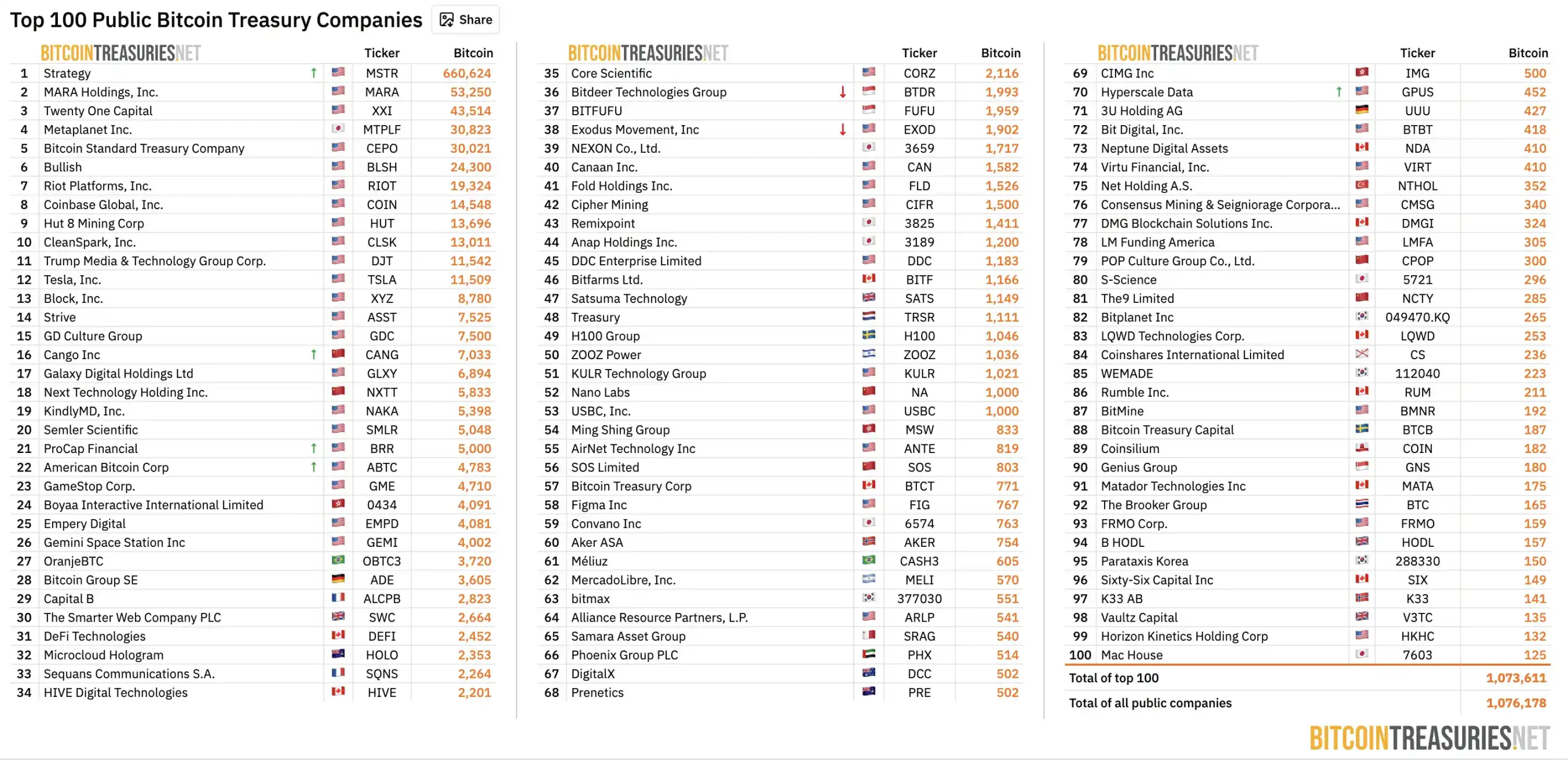
Source: BitcoinTreasuries.NET
These digital asset treasury companies have become important bridges for institutional adoption of cryptocurrencies, providing compliant indirect exposure for traditional financial institutions like pension funds and endowments.
Previously, the Bitcoin-holding public company Strive suggested that MSCI should leave the "choice" regarding digital asset companies to the market. A simple and direct solution is tocreate "ex-Digital Asset Treasuries" versions of existing indices, such as the MSCI USA ex Digital Asset Treasuries Index and the MSCI ACWI ex Digital Asset Treasuries Index. Through transparent screening mechanisms, investors can choose their tracking benchmark independently, preserving index integrity while meeting the needs of different investors.
Furthermore, the industry organization Bitcoin for Corporations has initiated a joint petition calling on MSCI to withdraw this digital asset proposal, advocating that classification should be based on a company's actual business model, financial performance, and operational characteristics, rather than simply drawing a line based on asset比例. According to the organization's website,309 companies or investors have currently signed the joint letter. Signatories include, besides Strategy, industry leaders such as Strive, BitGo, Redwood Digital Group, 21MIL, Btc inc, DeFi Development Corp, as well as numerous individual developers and investors.
Summary
The confrontation between Strategy and MSCI is essentially a fundamental debate about "how emerging financial innovations integrate into the traditional system." Digital Asset Treasury companies (DATs), as "cross-border entities" between traditional finance and the cryptocurrency world, are neither pure tech companies nor simple investment funds, but rather a new business model built upon digital assets.
MSCI's proposal attempts to use the "50% asset threshold" to categorize these complex entities as "investment funds" and exclude them from indices;而 Strategy insists that this simplified treatment is a serious misunderstanding of their business essence and a departure from the principle of index neutrality. As the January 15, 2026 decision date approaches, the outcome of this博弈 will not only determine the index "eligibility" of several Bitcoin-holding listed companies but will also define the crucial "survival boundaries" for the future地位 of the digital asset industry within the global traditional financial system.
References
<1> https://assets.contentstack.io/v3/assets/bltf8d808d9b8cebd37/blt26a263f232aa531c/693976b64c2a191113a60111/strategy-msci-letter.pdf
<2> https://app2.msci.com/webapp/index_ann/DocGet?pub_key=0bZz7Im3vZU%3D&lang=en&format=html
<3> https://x.com/ColeMacro/status/1996930014441623902
Recommended Reading:
Why Isn't Asia's Largest Bitcoin Treasury Company Metaplanet Buying the Dip?
Multicoin Capital: The Era of FinTech 4.0 Has Arrived
a16z-Backed Web3 Unicorn Farcaster Forced to Pivot, Is Web3 Social a False Proposition?