Stargate Project Pivots: OpenAI Abandons Construction for Leasing, Wakes from 1.4 Trillion Compute Empire Dream

marsbitОпубликовано 2026-03-17Обновлено 2026-03-17

Введение

OpenAI has significantly restructured its ambitious Stargate project, shifting from a plan to build its own data centers to leasing computing power from cloud providers like Microsoft Azure, Oracle, and Amazon AWS. Initially announced in January 2025 with a projected investment of up to $1.4 trillion, the project's budget has been reduced by 57% to around $600 billion through 2030. The change comes after more than a year of delays, with no employees hired and no construction started, largely due to lenders' reluctance to finance the project given OpenAI’s ongoing substantial operating losses. The restructured Stargate is now organized into three teams overseeing commercial partnerships, technical engineering, and physical operations, all managed by former Intel executive Sachin Katti. Despite the shift in strategy, OpenAI still aims to deploy nearly 7 gigawatts of server capacity over three years, with investments totaling over $400 billion. The company is also developing its own AI chips in collaboration with Broadcom to reduce inference costs. Annual spending is projected to reach about $120 billion, matching Microsoft's yearly capital expenditure, even as OpenAI's revenue remains significantly lower and profitability is not expected before 2030.

1.4 trillion dollars. This was the total value of the Stargate computing blueprint presented by OpenAI CEO Sam Altman to investors at the end of 2025. Fourteen months later, that number has been slashed to 600 billion.

According to a March 16th report by The Information, OpenAI has significantly restructured the Stargate computing infrastructure project, abandoning plans to build its own data centers and fully shifting to leasing computing power from cloud service providers like Microsoft Azure, Oracle, and Amazon AWS. Stargate has been split into three functional teams, all managed by former Intel Chief Technology and AI Officer Sachin Katti.

The reason for the pivot is straightforward. Stargate was announced with great fanfare at the White House in January 2025, revealing a joint venture with SoftBank and Oracle to build large data centers, with an initial investment of $100 billion and a total investment of $500 billion over four years. However, more than a year after the project's launch, not a single employee had been hired, and no substantive development of a data center had begun. According to CNBC, lenders were unwilling to provide billions in construction financing to a company still reporting massive operating losses. OpenAI also recently withdrew from negotiations to expand the Oracle Stargate facility in Abilene, Texas.

Over a year, zero employees, zero construction started. The "build-it-ourselves" path for Stargate never truly began.
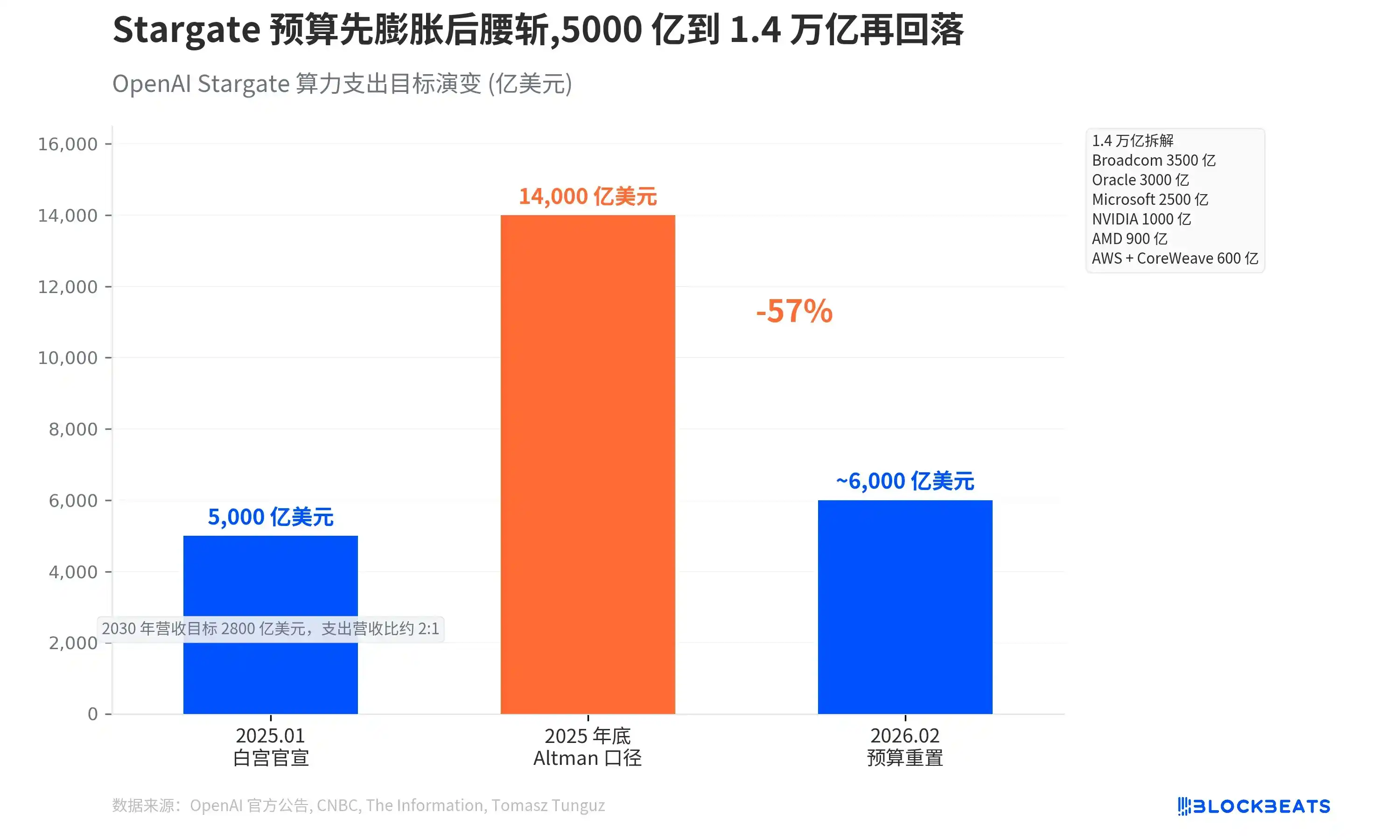
According to disassembled data from investor materials, the $1.4 trillion total commitment cited by Altman was distributed among seven suppliers. According to venture analyst Tomasz Tunguz's analysis of the investor materials, Broadcom accounted for $350 billion, Oracle $300 billion, Microsoft $250 billion, NVIDIA $100 billion, AMD $90 billion, with AWS and CoreWeave combining for $60 billion.

In February 2026, CNBC reported that this figure was reset to approximately $600 billion (by 2030), a 57% cut. The same report gave a slightly different but directionally consistent figure, with OpenAI expecting to spend $665 billion on cloud servers by 2030.

$600 billion is still a number that needs context. According to internal OpenAI forecasts, the company's revenue target for 2030 is $280 billion, meaning the cumulative spending-to-revenue ratio over five years is about 2:1. And according to internal financial data cited by ainvest, the company's projected loss for 2026 is $14 billion, with a gross margin of only 33% as reported by multiple media outlets (Note: Gross margin reflects the profitability of the product itself, while net loss is the final result after deducting all costs like R&D and management; the two can coexist).

Placing OpenAI's spending target within the panorama of the Big Tech computing arms race makes the proportions clearer.
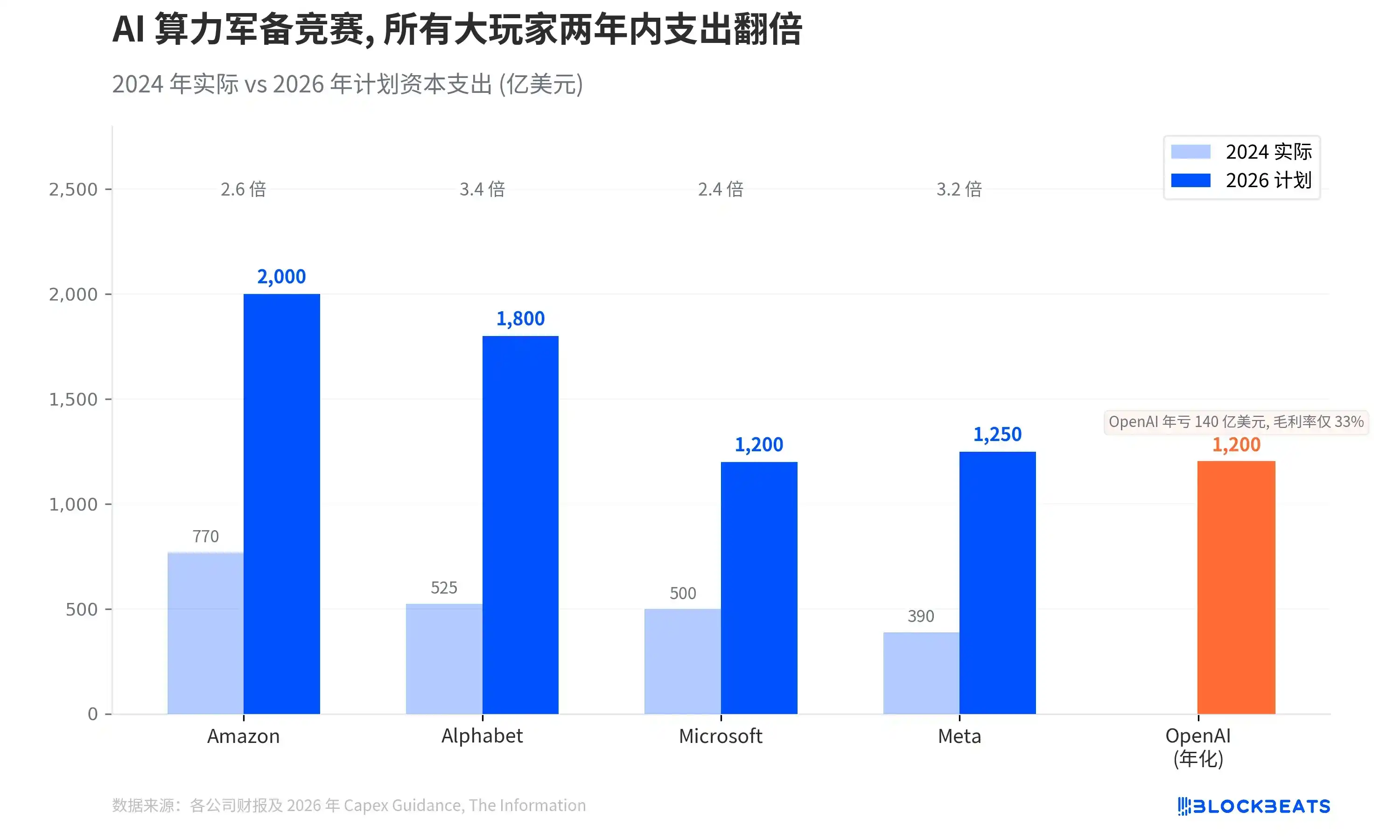
According to company financial reports and public Guidance, Amazon's planned capital expenditure for 2026 is $200 billion, Alphabet's is $180 billion, Meta's is $125 billion, and Microsoft's is approximately $120 billion. These four companies have seen their expenditures roughly double or triple within two years, totaling over $650 billion, with about three-quarters flowing into AI infrastructure.

OpenAI's $600 billion is a five-year cumulative target, annualized to about $120 billion, which is comparable to Microsoft's single-year capital expenditure. The difference is that Microsoft's annual revenue exceeds $240 billion, while OpenAI's annualized revenue has just reached $25 billion and is not expected to achieve positive cash flow before 2030.

The Stargate restructuring is more than just a change in budget numbers; the organizational adjustments reveal a deeper shift in direction.

The restructured Stargate is divided into three lines. The Epic business partnership group is led by longtime OpenAI employee and former Deloitte manager Peter Hoeschele, managing cloud contracts with Microsoft, Oracle, Amazon, and transactions with chip manufacturers. These deals include a multi-year contract with AMD (using up to 6 gigawatts of chips, costing up to 10% of AMD common stock) and an agreement with chip startup Cerebras Systems.
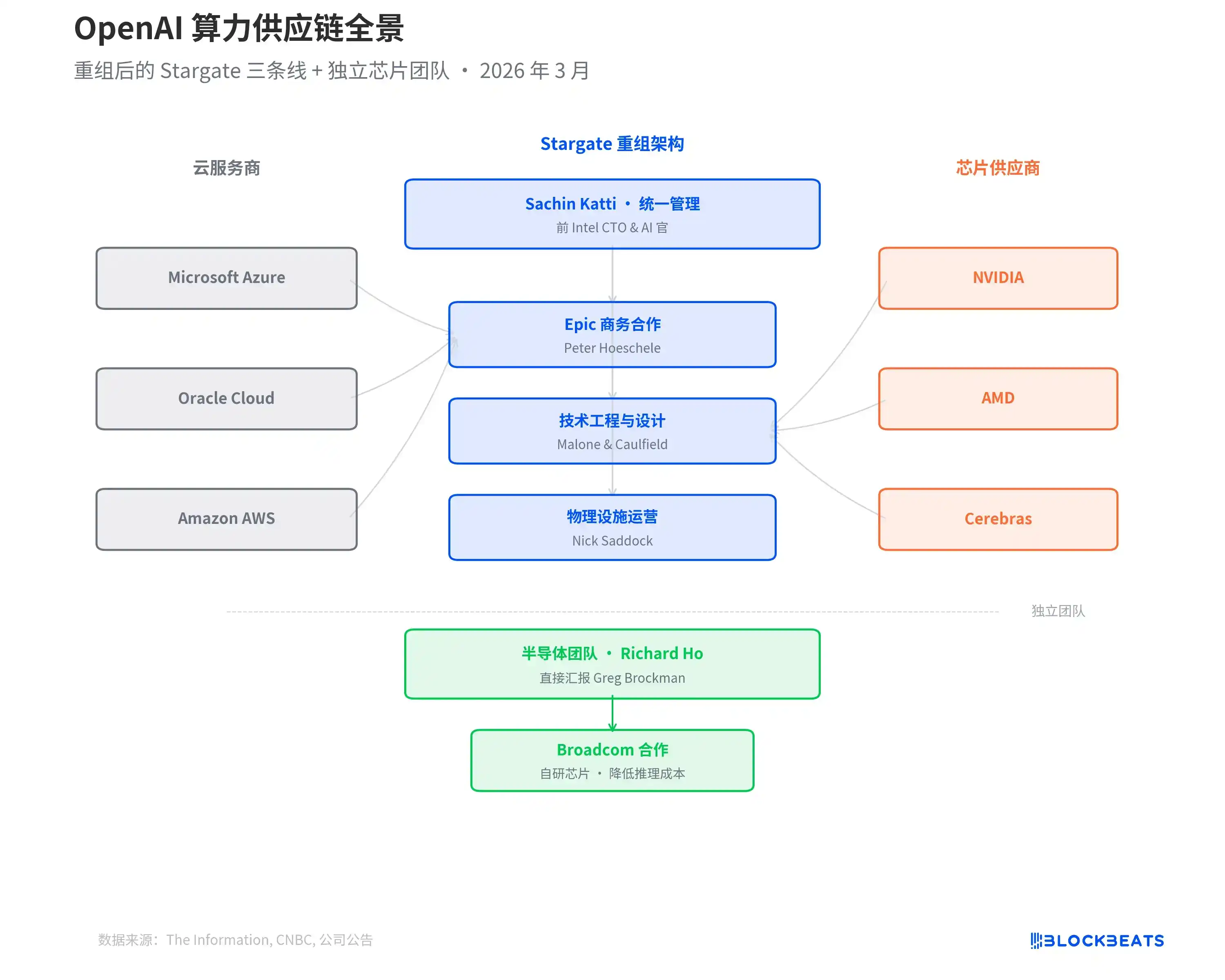
The technical engineering and design group is co-led by former Meta and Google engineer Chris Malone and former Microsoft engineering lead Adrian Caulfield, responsible for redesigning the AI server clusters used by OpenAI. The physical facilities operations group is led by former Google data center director Nick Saddock, replacing Keith Heyde who left weeks ago.

The semiconductor team led by former Google chip executive Richard Ho falls outside Katti's jurisdiction and reports directly to OpenAI President Greg Brockman. This team is collaborating with Broadcom to develop in-house chips, which OpenAI hopes will eventually reduce the inference costs of running products like ChatGPT.

The name "Stargate" remains, but what it refers to has completely changed. In January 2025, it was a joint venture with SoftBank and Oracle to build data centers. In March 2026, it is OpenAI's broad strategy for bringing gigawatt-scale server capacity online. It has gone from "I want to build my own power plant" to "I want to sign the best leases." The total planned capacity for all sites remains nearly 7 gigawatts, with a three-year investment total still exceeding $400 billion. OpenAI is shifting its computing direction towards NVIDIA's Vera Rubin platform, aiming to achieve the first gigawatt-scale capacity online in the second half of 2026.


Похожее

Has the 'Digital Gold' Narrative for BTC Failed?

**Title: Has the "Digital Gold" Narrative for Bitcoin Failed?** The article argues that Bitcoin's "digital gold" narrative remains valid despite a recent sharp price decline (from a peak near $126k in Oct 2025 to briefly under $61k in Feb 2026). It presents a long-term investment framework based on three core points: **1. Viewing Bitcoin as an Asset:** Bitcoin is presented as a superior potential store of value compared to gold. Key arguments are its absolute scarcity (21 million cap), superior portability, and transparent auditability via its public ledger. While acknowledging its current use in early, volatile stages (~3-4% global adoption), the author draws parallels to the early, disruptive phases of the internet and e-commerce. **2. Understanding the Recent Downturn:** The current ~50% correction is framed as a predictable, consensus-driven cycle following its post-halving peak (the 2024 halving preceded the Oct 2025 high). A crucial factor is a historic "changing of hands": the influx of new institutional buyers via ETFs allowed early, low-cost holders (miners, OG believers) to take profits. The author notes that while severe, Bitcoin's historical drawdowns (e.g., 93% in 2011, 77% in 2021-22) have been progressively smaller, suggesting maturing holder structure and decreasing volatility over time. **3. The Long-Term Perspective:** The long-term thesis hinges on Bitcoin capturing a portion of gold's market value. With Bitcoin's market cap at ~$1.4 trillion (at $70k) versus gold's ~$20 trillion, significant upside potential exists if the "digital gold" narrative is partially realized. However, the author strongly cautions that short-term risks remain, the bottom is unpredictable, and high volatility is inherent. The real risk is not Bitcoin failing but poor personal position management (over-leverage, wrong capital) and a lack of deep understanding, which can force investors out during severe downturns. The conclusion uses Amazon's 95% crash post-2000 dot-com bubble and subsequent 42x recovery as an analogy. The ultimate question is not if Bitcoin's price will rise, but if an investor's strategy and conviction can withstand the volatility to see the long-term play out. The recent divergence (gold up, Bitcoin down) is posed not as a narrative failure, but as potential evidence of this ongoing, painful transition from a speculative asset to a mainstream allocation.

marsbit7 ч. назад

Has the 'Digital Gold' Narrative for BTC Failed?

marsbit7 ч. назад

Has BTC's 'Digital Gold' Narrative Failed?

The article discusses Bitcoin's "digital gold" narrative, its recent price drop, and long-term outlook through the perspective of "Jason". It argues the narrative is not a failure but that Bitcoin represents a superior, new asset class due to its fixed supply (21 million), portability, and auditability. The piece compares its current ~3-4% global adoption rate to early internet/e-commerce, suggesting significant growth potential. Regarding the 2025-2026 price decline (from ~$126k to briefly under $61k), the author views it as a predictable, consensus-driven sell-off within Bitcoin's ~4-year cycle post-halving, exacerbated by a major "handover" from early, low-cost holders to new institutional buyers via ETFs. A key observation is that historical peak-to-trough drawdowns have lessened over time (e.g., 93% in 2011 to ~50% in 2026), indicating maturing volatility as holder structure changes. For the long term, the author uses a simple framework: Bitcoin's total market cap (~$1.4T at $70k) is only about 7% of gold's (~$20T). Even capturing 30-50% of gold's value would imply substantial upside. However, the article strongly cautions against viewing this as investment advice, emphasizing extreme volatility and the critical importance of risk management, position sizing, and deep fundamental understanding to survive severe drawdowns. It concludes by drawing a parallel to Amazon's 95% crash in 2000 and subsequent 42x recovery, stressing that the key is surviving market cycles to realize long-term potential.

链捕手7 ч. назад

Has BTC's 'Digital Gold' Narrative Failed?

链捕手7 ч. назад

From Code to Cognition: A Ten-Thousand-Word Guide to the Evolution of the Robot Brain

"From Code to Cognition: The Evolution of Robot Brains" The journey of robotic intelligence has shifted dramatically from manually coded systems to AI-driven brains. For decades, robots relied on layered software stacks—perception, state estimation, planning, control—each handcrafted. While predictable, they lacked adaptability. The 2010s saw deep learning revolutionize perception (e.g., object detection) and control (via reinforcement learning), but learned skills remained narrow. The arrival of Large Language Models (LLMs) marked a turning point. LLMs acted as high-level planners, interpreting natural language instructions and generating sequences of actions for traditional robotic systems to execute. However, true integration came with Visual-Language-Action (VLA) models, which fused vision, language, and motion prediction into a single network. Pioneered by models like RT-2 and open-source projects like OpenVLA, VLAs enable robots to reason and act directly from visual input and commands. The most advanced humanoid robots now employ a "dual-brain" architecture: a slow-thinking, large VLA (System 2) for reasoning and planning, and a fast-reacting, small network (System 1) for high-frequency motion control, sometimes with an even lower-level System 0 for balance. This split balances cognition with the physics of real-time movement. Computation is split between onboard hardware (e.g., NVIDIA Jetson) for safety-critical control loops and cloud/edge servers for non-critical tasks like learning and interfaces. A crucial driver is the open-source ecosystem—models like GR00T and OpenVLA allow startups to build upon pre-trained brains and fine-tune them with their own data, accelerating development. Despite progress, current systems struggle with recovery from errors, sample inefficiency, and long-horizon tasks. This has spurred the rise of **World Models**—neural networks that predict the consequences of actions. By simulating possible futures before acting (like NVIDIA Cosmos or Meta V-JEPA), robots can plan, recover, and generalize better. This represents the next frontier: shifting intelligence from learned reactions to an internal model of physics and cause-and-effect. The field is rapidly evolving. While not yet at its "ChatGPT moment," the convergence of cheaper hardware, scalable simulation, and world models points toward robots that are increasingly capable, adaptive, and useful. The question is shifting from "what can robots do?" to "what *should* they do?"

marsbit8 ч. назад

From Code to Cognition: A Ten-Thousand-Word Guide to the Evolution of the Robot Brain

marsbit8 ч. назад

Торговля

Спот
Фьючерсы
活动图片