Solana flips $90 support – SOL’s rally to $100 possible ONLY IF…

ambcryptoОпубликовано 2026-03-16Обновлено 2026-03-16

Введение

Solana broke out of its consolidation phase by successfully flipping the $90 level into support, reaching a monthly high of $94.2 before a slight retracement. At the time of writing, SOL was trading at $94.13, up 6.38% daily, reclaiming its EMA20 and testing the EMA50 resistance. Trading volume surged 102% to $4.37 billion, indicating strong market participation and bullish momentum. Derivatives data showed increased risk appetite, with perpetual trading volume recovering to over $600 million and futures netflow surging 983% to $255 million. This reflected heightened speculative activity and rising leverage, though it also raised the risk of cascading liquidations. On the spot market, buyers dominated, establishing a strong demand zone between $86–$91. Exchange outflows of over $300 million in 24 hours signaled aggressive accumulation. The RSI Cyclic Smoothed rose to 62, indicating strong buyer dominance. If demand holds, SOL could retest the EMA50 and target a move above $100. However, a breakdown may lead to a drop below $90, with $86 as the next support.

Solana finally broke out of the consolidation range after successfully flipping $90 into support. The altcoin jumped to a monthly high of $94.2 before a slight retracement.

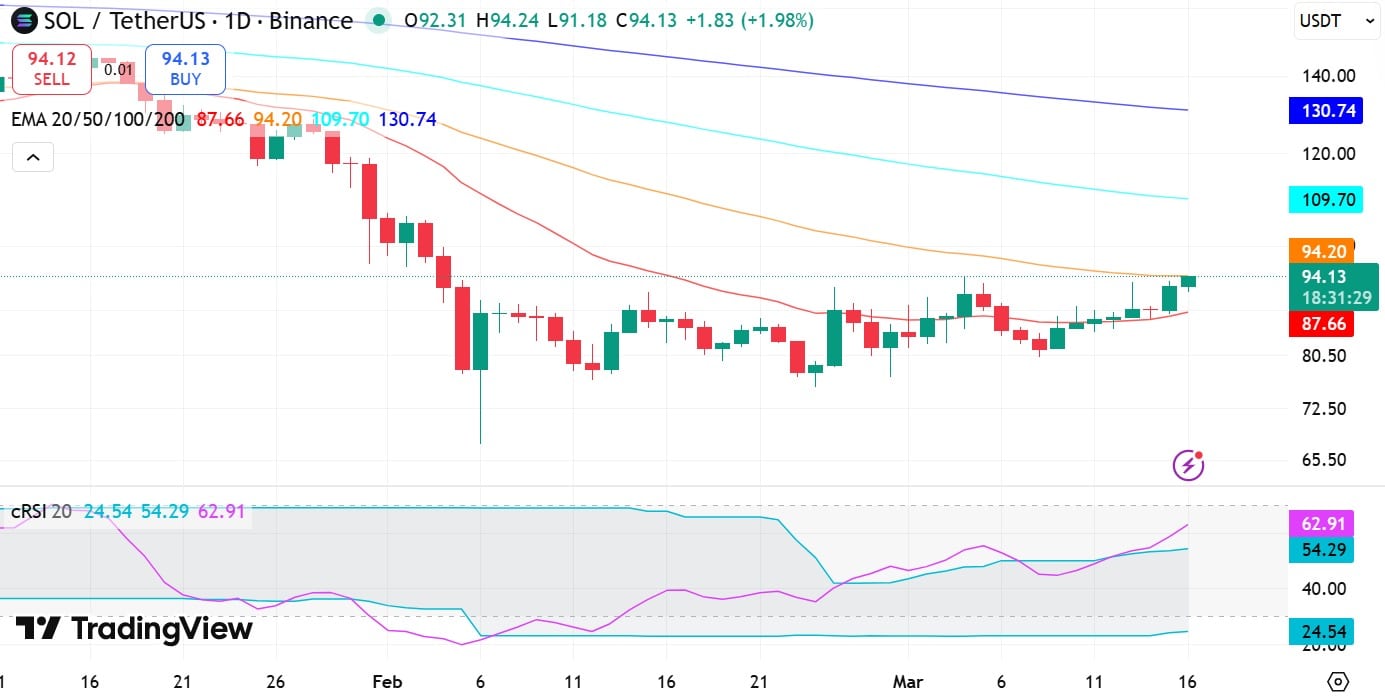
As of this writing, Solana [SOL] traded at $94.13, up 6.38% on the daily charts. In doing so, Solana flipped its EMA20 and was testing EMA50 at $94 at the same time.

Over the same window, volume climbed 102% to $4.37 billion, indicating increased market participation. These moves indicated strengthening upward momentum, as bulls gained ground.

Solana’s leverage is rising as risk appetite returns

Solana has recently seen significant demand across all market participants, with many perceiving prevailing conditions as perfect entry points.

This sentiment is extremely prevalent on the derivatives market, as traders have shown increased risk appetite.

According to DeFiLlama data, Perps Volume recovered from a $280 million slip to surpass $600 million. Perpetual’s trading volume rose by over $300 million in two days, indicating increased speculation as traders aggressively positioned.
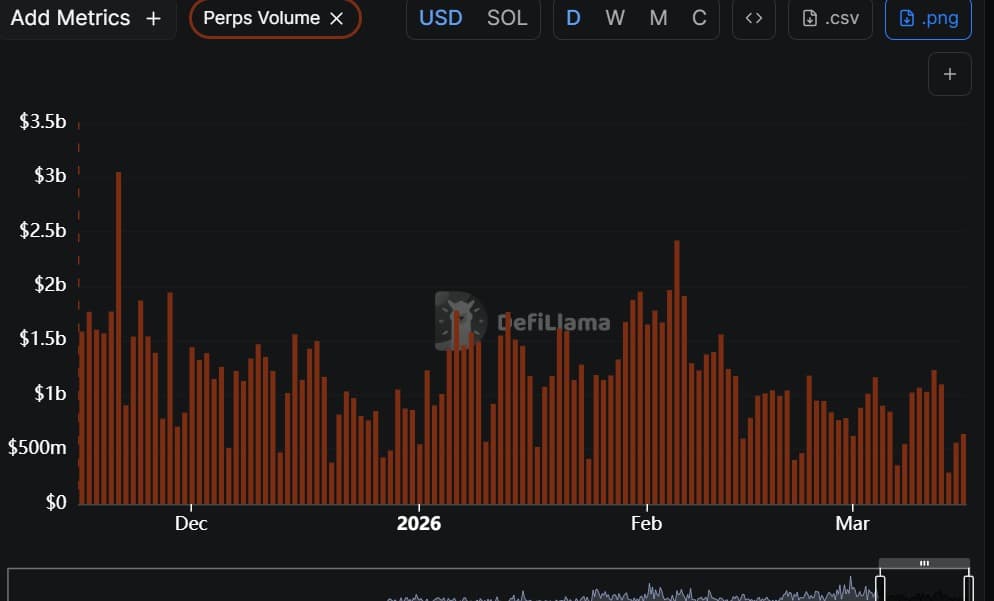
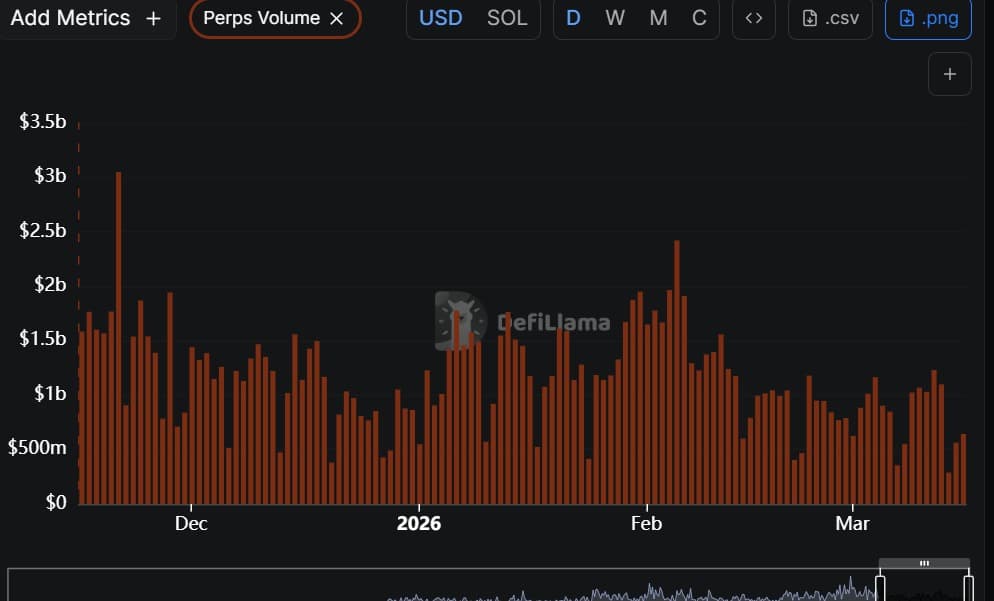
Source: DeFiLlama

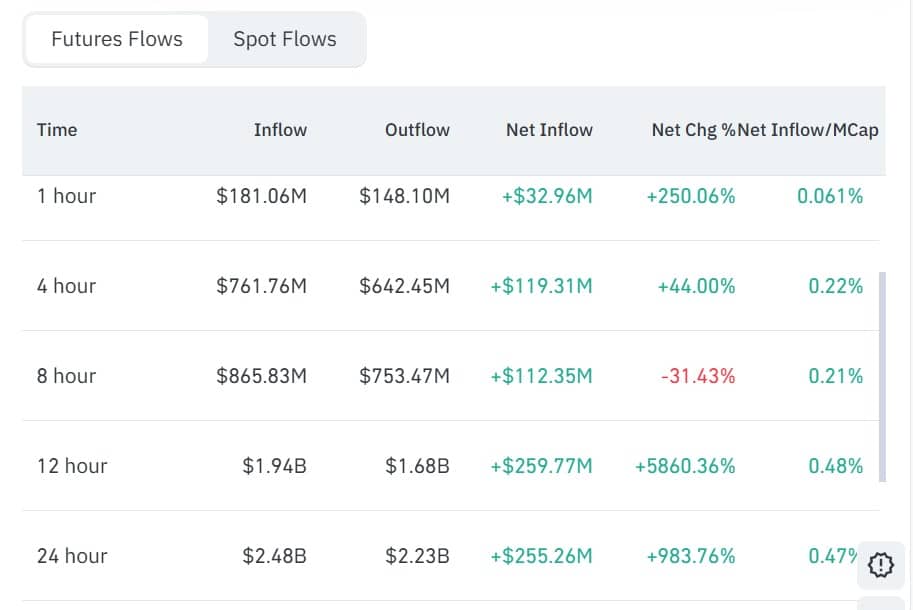
On top of that, significant capital flowed into futures, as Futures Inflow jumped to $2.48 billion while outflow rose to $2.2 billion.

As a result, Futures Netflow surged 983% to $255 million.
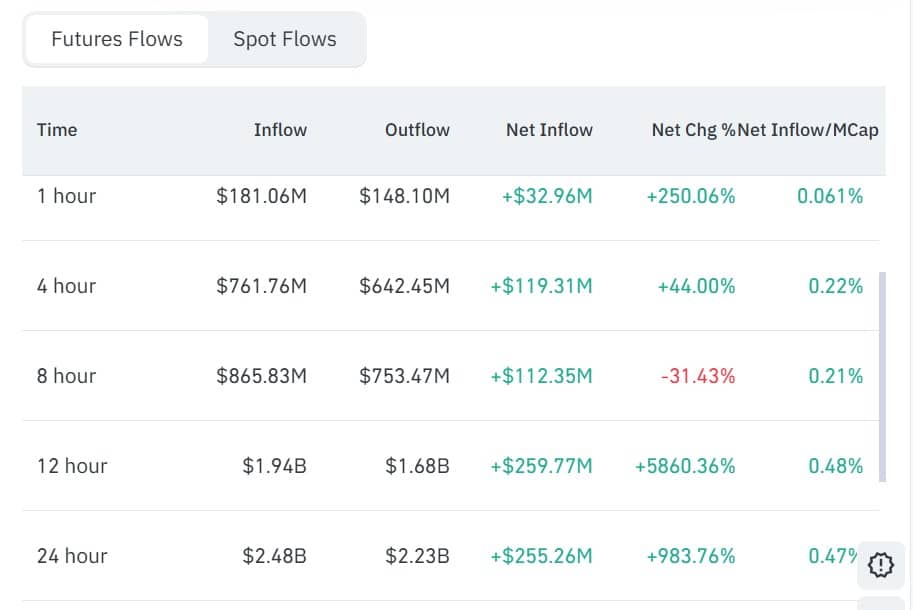
Source: CoinGlass

With Perps volume and futures inflows rising in tandem, this suggested heightened speculative activity as traders deployed more capital. While capital flowed into positions, rising Leverage also signaled a potential cascade of liquidations.

Buyers dip for a long haul

On the Spot side, buyers have dominated the market over the past 30 days. As such, buyers have established a strong demand zone between $86 and $91.

The Spot Taker CVD data from CryptoQuant showed that buyers have largely remained active during the prolonged period of weakness.
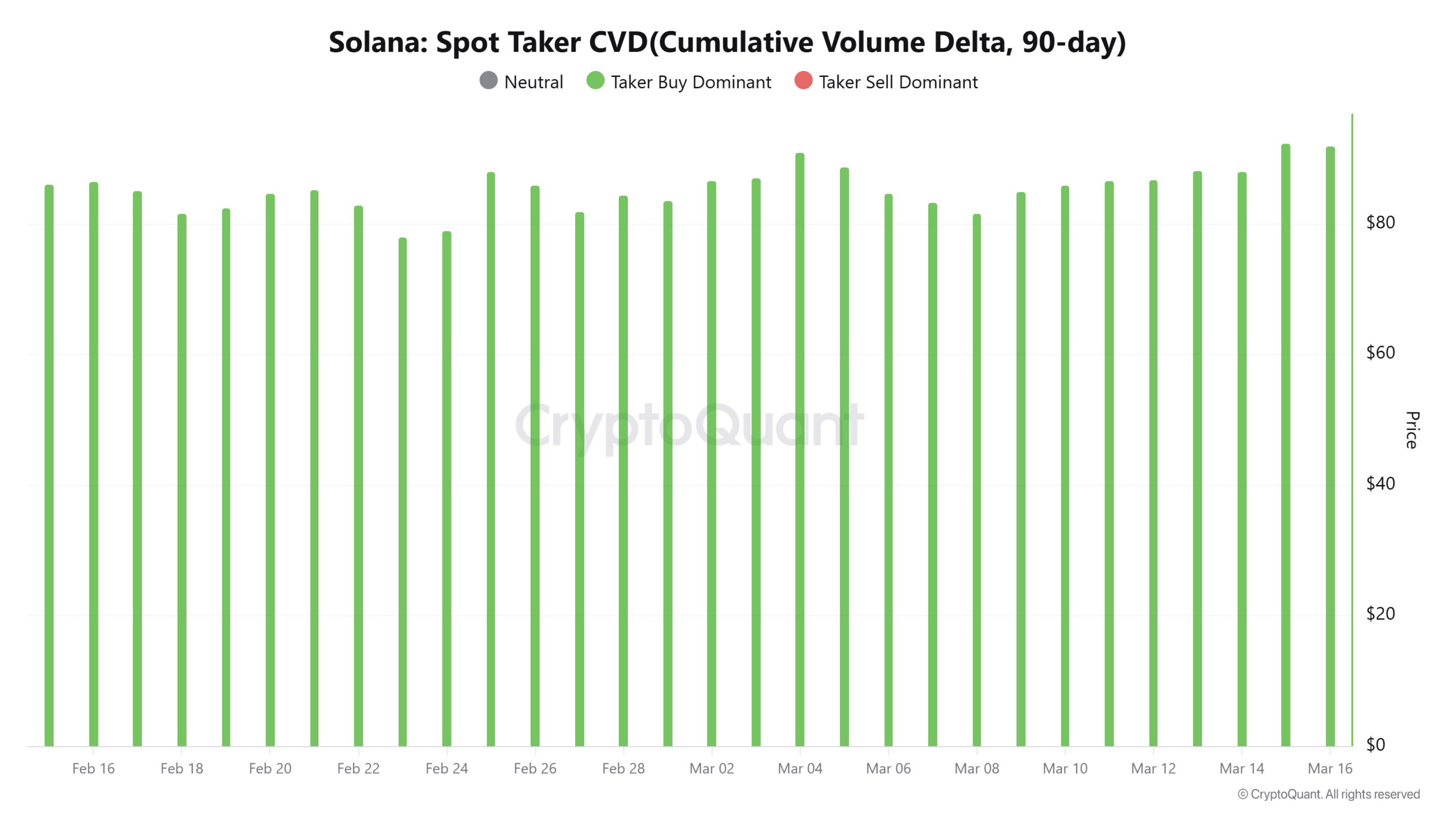
Source: CryptoQuant

On Binance in particular, buyers have significantly increased their accumulation. Over the past month, SOL recorded more than 206 million in buy volume, a trend that continued at press time.

On the 16th of March, the altcoin saw 5.4 million in buy volume on Binance, indicating strong demand. In fact, over $300 million flowed out of exchanges over the past 24 hours, a clear sign of aggressive spot accumulation.
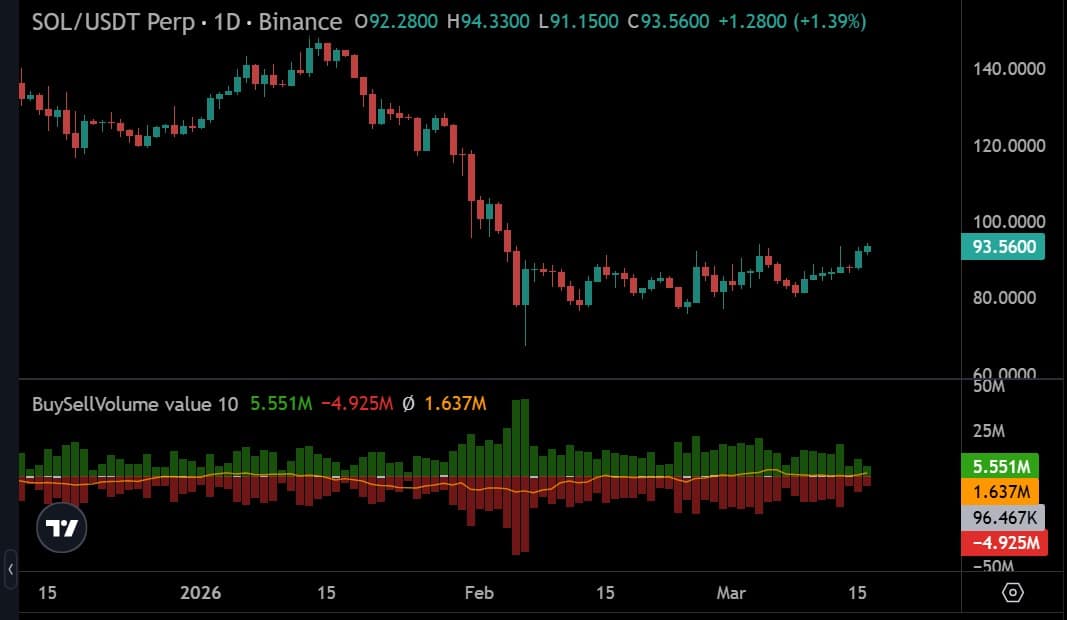
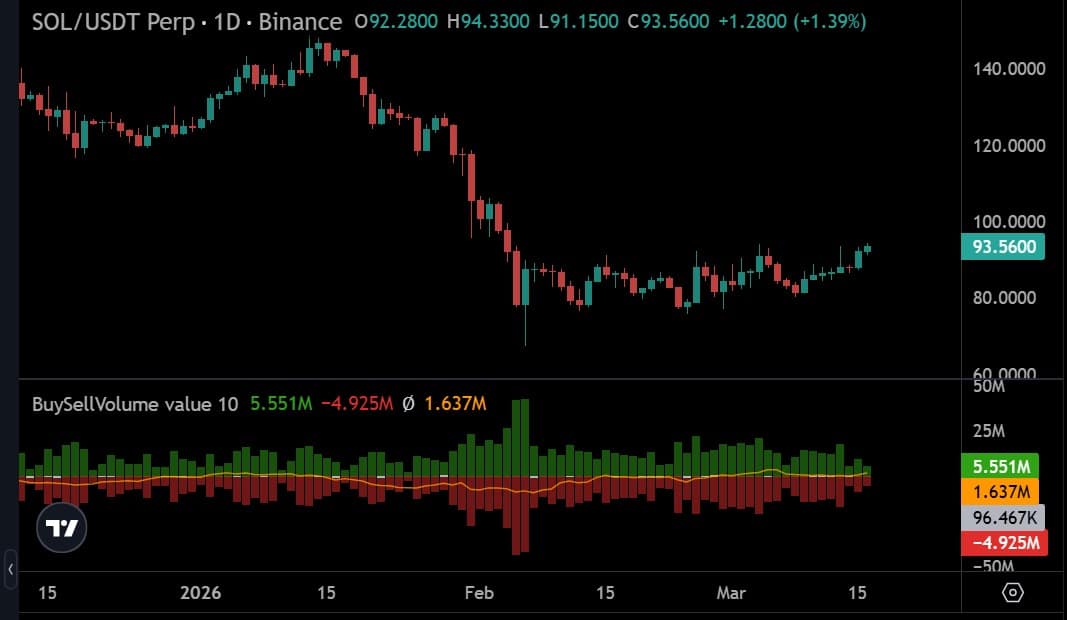
Source: Coinalyze

Can the momentum hold?

Solana’s upside momentum strengthened as traders across the market stepped in amid broader improvements in sentiment.

For that reason, the altcoins’ RSI Cyclic Smoothed jumped above its Highband and rose to 62. A jump above these levels signaled the buyer’s commanding dominance in the market.
Source: TradingView

At the same time, SOL jumped above its short-term moving average EMA20, further validating the trend’s strength. Usually, these market conditions point towards a potential trend continuation.

If demand holds, SOL could successfully retest EMA50 and eye a move above the key resistance of $100. However, if the move collapses and triggers mass liquidations, the altcoin could drop below $90 again, with $86 as support.


Final Summary

  • Solana broke out of consolidation, flipping the $90 level into support and briefly reaching a monthly high near $94.2.
  • Price momentum strengthened, with SOL trading around $94.13 after gaining 6.38% and reclaiming the EMA20 while testing the EMA50.


Связанные с этим вопросы

QWhat key price level did Solana (SOL) successfully flip into support, and what was its monthly high?

ASolana successfully flipped the $90 level into support and reached a monthly high of $94.2.

QAccording to the article, what two significant metrics increased to indicate heightened market participation and speculative activity?

ATrading volume climbed 102% to $4.37 billion, and Perpetuals trading volume rose by over $300 million in two days to surpass $600 million.

QWhat does the surge in Futures Netflow to $255 million represent, and what potential risk does it signal?

AThe 983% surge in Futures Netflow to $255 million represents a large influx of capital into futures positions, and it signals a potential risk of a cascade of liquidations due to rising leverage.

QWhat on-chain data from CryptoQuant and Coinalyze suggests strong buyer accumulation in the spot market?

AThe Spot Taker CVD data shows buyers remained active, and over $300 million flowed out of exchanges in 24 hours, which is a clear sign of aggressive spot accumulation.

QWhat are the two potential price targets for SOL mentioned, and what condition is necessary for it to reach the higher target?

AThe two targets are a move above the key resistance of $100 or a drop to $86 support. Reaching $100 is contingent on demand holding and a successful retest of the EMA50.

Похожее

Lowering Expectations for BTC's Next Bull Market

The author, Alex Xu, explains his decision to significantly reduce his Bitcoin holdings (from full to ~30% of his portfolio) during the current bull cycle, citing a lowered long-term outlook for BTC's price appreciation in the next cycle. He outlines six key reasons for this reduced expectation: 1. **Diminished Growth Drivers:** The narrative of exponential user adoption has largely played out with institutional ETF adoption. The next major growth phase—adoption by sovereign national reserves or central banks—seems unlikely in the near future. 2. **Personal Opportunity Cost:** More attractive investment opportunities have emerged in other assets, such as undervalued companies. 3. **Industry-Wide Contraction:** The broader crypto industry is struggling, with most Web3 business models (SocialFi, GameFi, DePIN) failing. This overall萧条 (depression) reduces the fundamental demand and consensus for Bitcoin. 4. **Strain on Major Buyer:** MicroStrategy, a major corporate buyer of BTC, faces rising financing expenses for its debt, which could slow its purchasing rate and create significant marginal pressure on the market. 5. **Increased Competition from Gold:** The emergence of "tokenized gold" has closed the functional gap (portability, divisibility) between physical gold and Bitcoin, offering a strong competitor in the non-sovereign store-of-value space. 6. **Security Budget Concerns:** The block reward halving continues to exacerbate the long-standing issue of funding Bitcoin's network security, with new fee source explorations like Ordinals and L2s largely failing. The author's decision to hold a significant (though reduced) position reflects a cautious, not bearish, outlook. He remains open to increasing his exposure if the fundamental reasons for his skepticism change or if new positive catalysts emerge.

marsbit38 мин. назад

Lowering Expectations for BTC's Next Bull Market

marsbit38 мин. назад

Can Iran 'Control' the Strait of Hormuz?

Iran has announced a comprehensive plan to assert control over the strategic Strait of Hormuz, a critical global oil shipping chokepoint. The proposed measures include requiring all vessels to obtain Iranian permission for passage, imposing fees for security, environmental protection, and navigation management—preferably paid in Iranian rials—and absolutely banning Israeli ships. Vessels from countries deemed hostile by Iran’s top security bodies may also be barred. Analysts suggest Iran’s motives are multifaceted: increasing pressure on the U.S. and Israel by leveraging control over oil transit to influence global prices and inflation; creating a new revenue stream, potentially exceeding $7.7 billion annually, to counter Western sanctions and support postwar reconstruction; and using transit permissions as bargaining chips in future negotiations, notably with the U.S. However, the plan faces significant practical and diplomatic challenges. Enforcing comprehensive interception and fee collection in the busy waterway, patrolled by international military forces, would be difficult. The U.S. has already countering with a blockade of Iranian ports and threats to intercept any ship paying fees, potentially strangling Iran’s oil exports and fee revenue. Broad international opposition, led by European and Gulf states, and legal controversies further complicate implementation. The proposal may ultimately serve more as a negotiating tactic than a feasible policy, with its execution remaining highly uncertain.

marsbit1 ч. назад

Can Iran 'Control' the Strait of Hormuz?

marsbit1 ч. назад

Торговля

Спот
Фьючерсы

Популярные статьи

Обсуждения

Добро пожаловать в Сообщество HTX. Здесь вы сможете быть в курсе последних новостей о развитии платформы и получить доступ к профессиональной аналитической информации о рынке. Мнения пользователей о цене на SOL (SOL) представлены ниже.

活动图片