SKR Airdrop Now Live: Is Solana Mobile Worth Watching?

marsbitОпубликовано 2026-01-21Обновлено 2026-01-21

Введение

Solana Mobile has officially launched its native token SKR, marking a strategic shift from the "random airdrop" model of its first Saga phone to a more structured "mobile ecosystem economy" with its second device, Seeker. SKR's initial supply is 10 billion tokens, with an initial circulating allocation distributed to over 100,000 eligible users across five tiers, ranging from 5,000 to 750,000 SKR. Early price action saw SKR trading between $0.006-$0.01, offering returns of up to 14x for the highest-tier holders relative to the phone's $450-$500 cost. The token is central to Solana Mobile's TEEPIN (Trusted Execution Environment Platform Infrastructure Network), where stakers can delegate to "Guardians" — operators like Anza and Helius that validate devices, audit apps, and enforce community standards. This aims to create a decentralized, open mobile platform alternative to Apple and Google's monopolies. While the airdrop successfully attracted over 150,000 Seeker pre-orders, long-term challenges remain. Sustaining user engagement beyond initial rewards and competing with established mobile giants will require cultivating must-have applications and real utility within the ecosystem. The success of SKR hinges on transitioning from speculative interest to genuine ecosystem growth.

Author: Chloe, ChainCatcher

With Solana Mobile officially launching its native token SKR today (21st), it marks a shift in its incentive mechanism from the "random wealth effect" of the first-generation Saga phone to a more scalable and sustainable "mobile ecosystem economy" for the second-generation Seeker.

This article details SKR's token economic model and provides a neutral perspective on its long-term development: exploring the potential future challenges for Solana Mobile and how SKR, as a "launch lever," can drive the growth of its open platform's application ecosystem.

SKR Officially Live for Claim: How's the Token Price Performing?

Solana Mobile officially opened SKR token claims today (21st). As the first native asset in the Solana ecosystem to deeply align the interests of phone holders, developers, and the protocol, SKR's launch has attracted significant market attention.
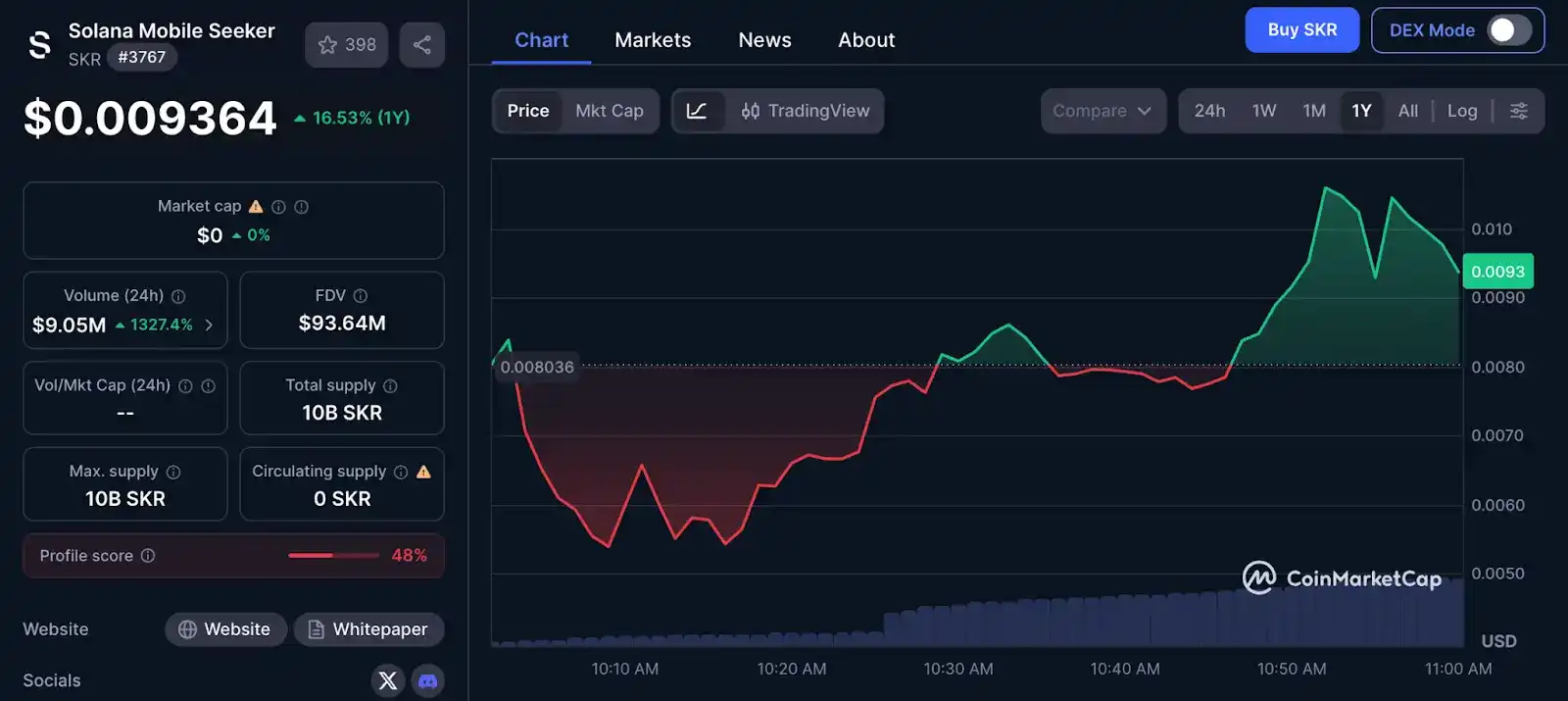
Data shows that SKR's price fluctuated between $0.006 and $0.01 within the first hour of trading. At the current market price of approximately $0.0095 at the time of writing, the airdrop value for the lowest-tier Scout holders is $47.5; while the highest-tier Sovereign holders receive up to $7,125. Compared to the Seeker phone's pre-sale cost of around $450 to $500, the highest return rate exceeds 14x.

However, with the release of the first wave of liquidity, the market is also observing the long-term staking ratio, which will determine whether SKR can transition from short-term speculation to long-term governance motivation.

Solana Mobile's Vision and the Mission of the Second-Gen Seeker Phone

Solana Mobile states in its vision that the current mobile web ecosystem is under the long-term monopoly of the two giants, Apple and Google. These two systems not only control application distribution and payment channels but also hold the power to set rules, which goes against the open spirit of Web3. Therefore, Solana Mobile's mission is not just to manufacture mobile hardware but to build a true alternative: an open, permissionless mobile platform.

Looking back at the sudden popularity of the first-generation Saga phone, although it contained an element of serendipity, its value largely stemmed from random airdrops from third-party projects (such as BONK and other tokens). This "loot box" style wealth effect successfully attracted attention but also raised questions about the sustainability of the incentive model.

To transform these fragmented traffic flows into long-term, predictable ecosystem growth drivers, Solana Mobile launched the second-generation phone, Seeker, and simultaneously initiated the Seeker Season series of ecosystem incentive programs. Seeker is not just an iteration in hardware performance but also a ticket into the Solana Mobile ecosystem.

Since beginning shipments in August 2025, Seeker pre-orders have exceeded 150,000 units. Its core competitiveness lies in the transformation of the incentive mechanism: by issuing the native token SKR, the official has formally shifted from relying on random third-party rewards to an institutionalized incentive system, aiming to achieve deep alignment of interests among users, developers, and the platform.

SKR Token Economics and the TEEPIN Architecture

According to official disclosures, SKR's initial total supply is set at 10 billion tokens, utilizing a linear decreasing inflation model to balance early development and long-term stability. The first-year inflation rate is set at 10%, decreasing by 25% each subsequent year, eventually stabilizing at a 2% inflation rate. Solana Mobile aims to use SKR to build an interest-aligned "ecosystem flywheel" to drive the long-term development of decentralized mobile hardware and crypto application ecosystems.

The official mentioned that in Seeker Season 1, nearly 2 billion SKR were allocated to ecosystem contributors, accounting for 20% of the total supply. After anti-sybil attack review, a final total of 100,908 users qualified.

User allocation tiers are as follows:

  • Scout: 5,000 SKR

  • Prospector: 10,000 SKR

  • Vanguard: 40,000 SKR

  • Luminary: 125,000 SKR

  • Sovereign: 750,000 SKR

Additionally, to incentivize early developers, 141 million SKR will be allocated to 188 developers who have listed high-quality applications on the Seeker ecosystem, with each developer receiving 750,000 SKR.

The token economics and lock-up periods are as follows: Airdrop share: 30% (unlocked at launch), Growth & Partnerships: 25% (28% unlocked at launch, remainder linearly unlocked over 18 months), Team share: 15% (locked for the first year, then linearly unlocked over 36 months), Liquidity & Launch: 10% (unlocked at launch), Solana Labs: 10% (locked for the first year, then linearly unlocked over 36 months), and Community Treasury: 10% (unlocked at launch, managed by governance).
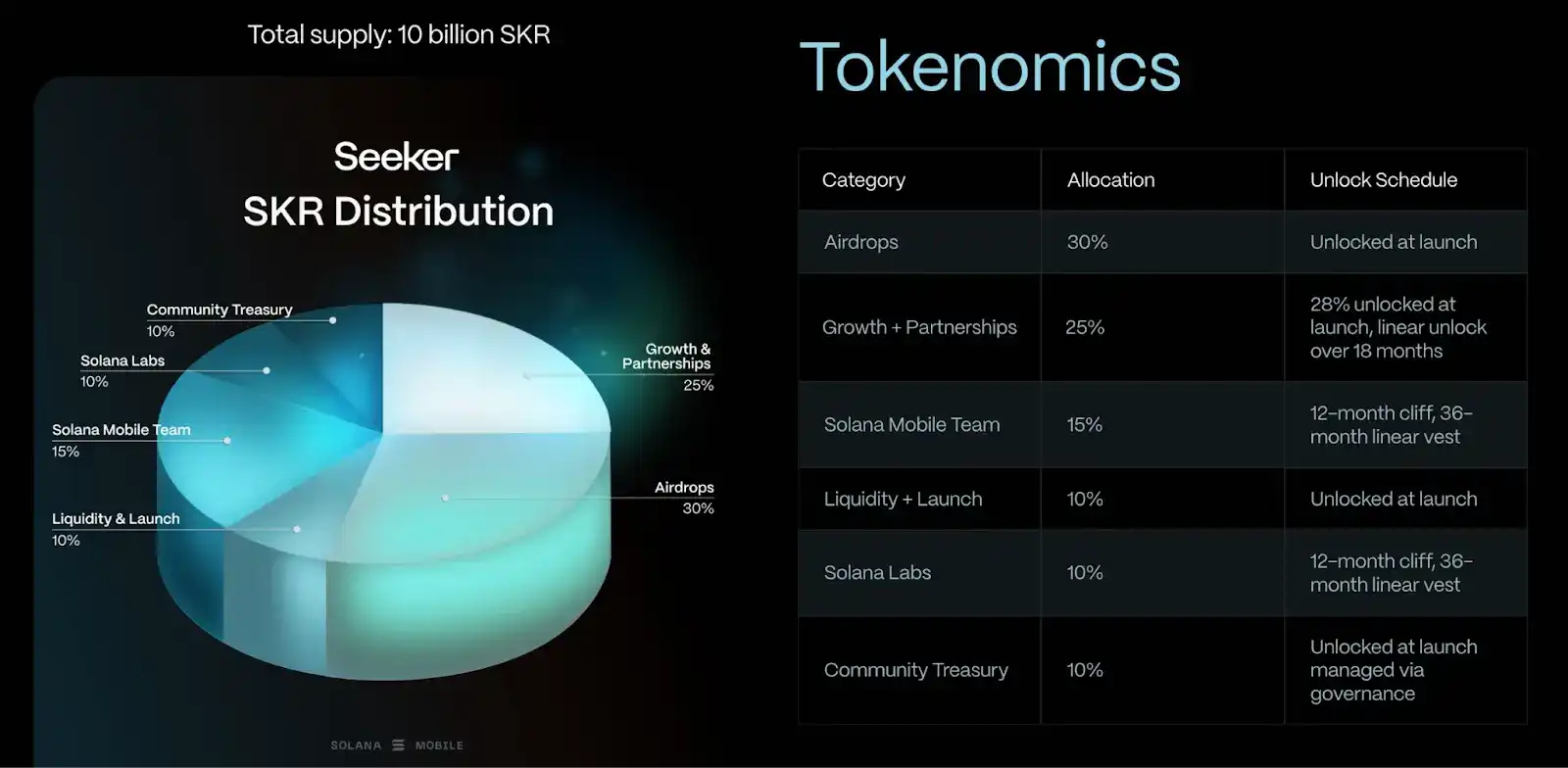
The core value of SKR lies in its support for TEEPIN (Trusted Execution Environment Platform Infrastructure Network).

In 2026, SKR holders will be able to stake their tokens to "Guardians". Guardians are operators responsible for ensuring platform security, with duties including:

  1. Device Identity Verification: Ensuring the integrity of hardware and software.

  2. App Store Curation: Reviewing submissions to the decentralized application store.

  3. Enforcing Community Standards: Upholding rules set by the community.

  4. Distributing Staking Rewards: Staking SKR to Guardians allows participation in governance and earning yields for securing the network.

Teams including Anza, DoubleZero, Triton, Helius, and Jito have joined as the first Guardians. Solana Mobile states that this multi-operator model ensures no single company can control the curation or verification process, laying the foundation for an open mobile platform.

SKR Airdrop Claim, Staking, and Seeker Season 2 Outlook

With SKR now officially live, eligible users can proceed to claim their tokens and participate in staking. After claiming, users can stake their tokens directly within the Seed Vault wallet or through the official website portal to earn yields. Additionally, staked SKR rewards are settled and distributed every 48 hours.

Furthermore, the Seeker Season 2 campaign officially launched on the 9th of this month. The official stated that Season 2 will introduce more applications to its open platform and provide exclusive SKR incentive programs. Users simply need to continue using the Seeker phone, explore newly launched applications, and participate in ecosystem activities to accumulate participation data for Season 2.

From Airdrop Incentives to Ecosystem Development: Has Solana Mobile's Long Race Just Begun?

The launch of the SKR token marks a significant strategic shift in Solana Mobile's development direction. If the success of the first-generation Saga phone began with the surprise of "random airdrops," then the evolution from Saga to Seeker represents the project's attempt to transform this偶然性 into a more scalable and sustainable "mobile ecosystem economy" mechanism.

However, while SKR has generated enormous market attention, it is still necessary to examine the potential challenges for its long-term development. The current wealth effect has successfully attracted over 150,000 seed users, but token rewards are essentially a "launch lever," not the ultimate goal of ecosystem development.

Firstly, if Solana Mobile relies solely on token incentives, it will be difficult to maintain high user activity levels in the long term. As the early subsidy effect gradually dilutes over time, can Solana Mobile foster truly "phenomenal" applications? Without applications that solve real user needs and possess high stickiness, these 150,000 users are likely to migrate to other ecosystems after the reward周期 ends.

Secondly, in the highly competitive global mobile phone market, Solana Mobile faces Apple iOS and Google Android, which have extremely high technological moats and user stickiness. The advantages of an open platform, developer sovereignty, and censorship resistance may not necessarily translate into conditions attractive enough for average users to cross the ecosystem threshold. This will be a key consideration for whether Seeker can successfully transition from a "toy for crypto enthusiasts" to a "tool for the mass market."

The delivery of these 150,000 phones is just the starting point for Solana Mobile. The real battle lies in whether, within the economic framework built by SKR, it can cultivate an open application ecosystem capable of challenging the traditional giants.


Связанные с этим вопросы

QWhat is the initial price range of the SKR token upon its launch?

AThe SKR token traded in a range of $0.006 to $0.01 during its first hour after launch.

QWhat is the core mission of Solana Mobile as stated in the article?

ASolana Mobile's mission is to build a true alternative to the monopolistic mobile ecosystems of Apple and Google by creating an open, permissionless mobile platform.

QWhat is the total initial supply of SKR tokens and what is its inflation model?

AThe initial total supply of SKR is 10 billion tokens. It uses a linear decreasing inflation model, starting at 10% in the first year and decreasing by 25% each subsequent year until it stabilizes at 2%.

QWhat is the role of 'Guardians' in the TEEPIN architecture supported by SKR?

AGuardians are operators responsible for ensuring platform security. Their duties include verifying device identity, auditing the app store, enforcing community standards, and distributing staking rewards.

QWhat is identified as a key long-term challenge for Solana Mobile's initial success?

AA key challenge is moving beyond relying solely on token incentives to fostering a sustainable ecosystem with 'phenomenal' applications that solve real user needs, in order to compete with the entrenched ecosystems of iOS and Android.

Похожее

The Value Distribution of Stablecoins

**Summary: The Value Distribution of Stablecoins** The article argues that stablecoins are evolving from mere trading tools into broader channels for dollar access. It divides the stablecoin ecosystem into four layers to analyze how value is distributed: 1. **Issuance Layer:** Mints stablecoins, holds reserve assets, and captures the spread between reserve yield and user costs (e.g., Tether, Circle). This layer currently earns the largest profit margin. 2. **Infrastructure Layer:** Connects stablecoins to the traditional financial system, handling fiat on/off-ramps, banking integration, compliance (KYC/AML), and asset management (e.g., Bridge, BVNK). This is the "unglamorous" but critical work, building the essential bridges between crypto and real-world finance. 3. **Acquiring/Distribution Layer:** Integrates stablecoins into merchant systems, manages payment flows, and provides enterprise financial software (e.g., Stripe, Coinbase). They act as the access point for businesses. 4. **Application Layer:** The end-users and businesses that ultimately use stablecoins for payments, settlements, or as a store of value. They benefit from convenience but have little pricing power. The core thesis is that while the issuance layer currently dominates profits, the often-overlooked **infrastructure layer holds significant long-term potential**. The real challenge and barrier to mass adoption is not the on-chain transfer of stablecoins (which is simple), but the complex "last mile" integration into existing business workflows, banking systems, and regulatory frameworks across different countries. Companies in this layer are currently in a "land grab" phase, investing heavily to build networks, secure bank partnerships, and establish compliance pathways. While their position is currently pressured by the profitable issuers above and distribution platforms below, the article suggests that if stablecoins become a default financial rail for businesses, the infrastructure providers who have done the hard work of integration will ultimately gain strong pricing power and become entrenched, essential players.

marsbit3 ч. назад

The Value Distribution of Stablecoins

marsbit3 ч. назад

The Value Distribution of Stablecoins

The Value Distribution of Stablecoins The article argues that stablecoins are evolving from a mere trading tool into a broad "dollar channel." It analyzes the industry's value chain through four layers: 1. **Issuance Layer (e.g., Tether, Circle):** The top layer that mints stablecoins, holds reserve assets, and captures the thickest interest rate spread. 2. **Infrastructure Layer (e.g., Bridge, BVNK):** Connects stablecoins to the traditional financial system, handling critical but complex "dirty work" like fiat on/off-ramps, banking integration, compliance (KYC/AML), and cross-border settlement. 3. **Acquiring/Distribution Layer (e.g., Stripe, Coinbase):** Embeds stablecoins into merchant systems, manages payment flows, and integrates with enterprise software. 4. **Application Layer:** End-users and businesses that ultimately use stablecoins for payments, settlement, or storing value. The author posits that while the issuance layer currently captures the most profit, the most overlooked and potentially critical layer is infrastructure. The core challenge for stablecoin adoption isn't the on-chain transfer (which is simple), but bridging the gap between blockchain and the real-world financial system. This involves solving practical problems for businesses: fiat conversion, reconciliation, tax handling, and user onboarding. Infrastructure companies are currently in a difficult "land-grab" phase—building networks, securing banking relationships, and achieving compliance country-by-country. They face pressure from both the profitable issuance layer above and distribution platforms below. However, the author suggests this layer is building a crucial moat. Once stablecoins become a default business rail, the infrastructure players who have done the hard work of integration may gain significant, durable value and pricing power.

链捕手4 ч. назад

The Value Distribution of Stablecoins

链捕手4 ч. назад

How to Do Research Well: Deliberately Practice the Real Skills That Matter

No one truly teaches you how to do research. You're often given a desk, a pre-selected problem, and vague instructions to "create something new." Consequently, many people reverse-engineer the job based on visible outputs—papers, posts, announcements—learning only how to *appear* like a researcher rather than how to *become* one. True research capability is built from stacking small, trainable skills, nearly all of which can be developed through deliberate practice. **Pick Your Own Problem:** Most researchers absorb problems from advisors or trends, lacking the underlying reasoning. Choosing a problem you genuinely care about, as John Schulman advises, leads to original work. Develop "taste" like a muscle: predict experiment outcomes, guess paper results from methods, and track which findings remain important over time. **Upgrade Your Inputs:** Relying on shared reading lists (arXiv hot lists, filtered group chats) leads to unoriginal conclusions. Undervalued old literature often holds crucial insights (e.g., MoE, LSTM, backpropagation). Richard Sutton's "The Bitter Lesson" or Claude Shannon's 1952 talk on creative thinking are more predictive than lengthy modern surveys. Breadth matters as much as depth: draw from neuroscience, mechanism design, hardware knowledge, and honest statistics. Read papers directly, especially appendices and limitations sections. **Write Everything Down:** As Paul Graham noted, writing exposes flaws in seemingly mature ideas. Writing is the cheapest defense against self-deception. Following Feynman's principle, Darwin programmatically wrote down facts contradicting his theory to combat memory bias. Maintain a detailed log of hypotheses, setups, predictions, results, and updated understandings. Reviewing past logs fosters essential humility.

marsbit6 ч. назад

How to Do Research Well: Deliberately Practice the Real Skills That Matter

marsbit6 ч. назад

Торговля

Спот
Фьючерсы

Популярные статьи

Обсуждения

Добро пожаловать в Сообщество HTX. Здесь вы сможете быть в курсе последних новостей о развитии платформы и получить доступ к профессиональной аналитической информации о рынке. Мнения пользователей о цене на SOL (SOL) представлены ниже.

活动图片