Six Years Since DeFi Summer, How Will the Decentralized Financial Revolution Continue?

marsbitОпубликовано 2026-04-21Обновлено 2026-04-21

Введение

In 2026, the DeFi sector faces a severe trust crisis following a series of high-profile security breaches, including a $292 million theft from KelpDAO’s rsETH, a $2.85 million exploit at Drift Protocol due to permission vulnerabilities, and a $14.9 million lending failure at Venus Protocol. These incidents triggered a withdrawal of approximately $10 billion from DeFi over a single weekend, highlighting systemic risks beyond smart contract flaws—such as governance, cross-chain complexity, and operational weaknesses. Despite these challenges, on-chain finance continues to grow, with capital shifting toward safer, regulated products. Stablecoins like USDT ($185B) and USDC ($78B) have reached a combined market cap of $263 billion, while tokenized U.S. Treasuries surged to $10.93 billion. Visa’s growing USDC settlement volume, now annualized at $3.5 billion, signals increasing institutional adoption of compliant blockchain-based financial infrastructure. The competition for the future of on-chain finance is intensifying. While native DeFi struggles with trust and capital outflows, regulated products—stablecoins, tokenized assets, and ETFs—are gaining dominance by offering programmable, 24/7 settlement without high DeFi risks. Over 80 crypto projects shut down in Q1 2026, reflecting dwindling patience for speculative ventures. The core challenge for open DeFi is to rebuild trust and demonstrate irreplaceable value—or risk ceding its role as the primary entry point to on-chain fin...

Written by: Liam 'Akiba' Wright

Compiled by: Saoirse, Foresight News

The theft of $292 million worth of rsETH from KelpDAO occurred at an extremely inopportune time for the DeFi industry. Prior to this, the Drift Protocol security breach on April 1st and the Venus lending protocol debacle in March had already severely damaged market confidence. Following this incident, approximately $10 billion in funds fled the entire DeFi sector over the weekend.

The叠加 of multiple crises has made the困境 facing DeFi increasingly difficult to ignore. Although the open-source decentralized financial system still exists, it is gradually losing its core status as the default on-chain financial entry point. Stablecoins, tokenized treasuries, and compliant settlement channels continue to expand rapidly, while permissionless native protocols持续承受 a market trust discount.

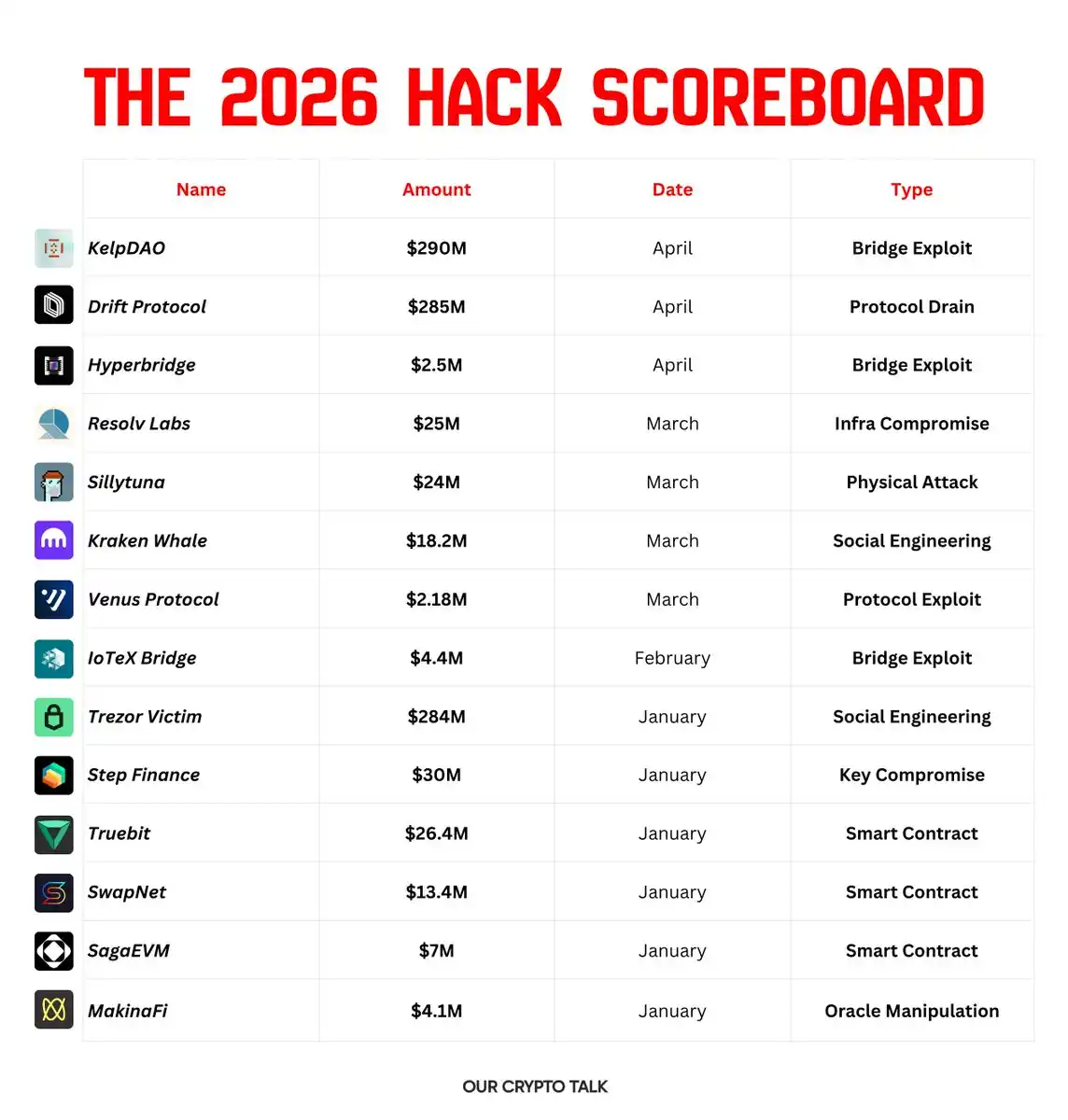
A list of theft incidents for 2026 circulating on social platform X直观反映了 the current industry's悲观情绪.

2026 Hacker Leaderboard (Source: Our Crypto Talk)

Some security incidents have been fully reviewed, some risks are still发酵, and many events blur the lines between protocol vulnerabilities, cross-chain bridge failures, and user asset theft. This article focuses on the confirmed security incidents of 2026 and the industry landscape changes暴露 by these events.

The current industry situation is vastly different from the peak of DeFi Summer in 2020 and the bull market of 2021; that glory now exists only in memory. Back then, DeFi told the market a narrative of open, efficient, and composable finance; by 2026, these traits still exist but no longer carry their own halo and market faith.

Every major coin theft event increases the trust cost for users to participate in DeFi. And currently, the fastest-growing and most secure areas of on-chain finance are becoming payment networks, tokenized treasuries, and compliant token products,不再是 the complex token ecosystems of native DeFi.

The real test for the industry now is: can open-source DeFi quickly rebuild market trust and maintain its position as the mainstream on-chain entry point? Currently, it appears the entire sector is not heading towards extinction, but rather处于空间被挤压的处境.

DeFi's Security Risks Extend Far Beyond Smart Contract Vulnerabilities

A common misconception after a major hack is to attribute all incidents to smart contract code vulnerabilities. The Drift protocol loss of approximately $285 million恰恰证明 this perception is outdated.

On-chain data analysis firm Chainalysis disclosed that the attack stemmed from permission abuse, admin pre-signature operation vulnerabilities, and fake collateral assets, not simple code statement defects. The market thus realized: a significant portion of DeFi's risks today lie in governance permissions, signature mechanisms, operational architecture, and other layers.

This fundamental change alters the underlying objects users need to trust. Code audits and market-proven contracts are still important, but they can no longer cover the complete risk chain: signature nodes, cross-chain bridges, oracles, and market parameter configurations all harbor potential risks. When protocols span multiple public chains, management committees, liquidity platforms, and collateral derivatives, the attack surface expands much faster than the update speed of the decentralization narrative.

The post-mortem of the Venus protocol also exposed similar issues, albeit in a different risk form. The attacker borrowed approximately $14.9 million in assets through overvalued asset抵押借贷, leaving the protocol with over $2 million in bad debt. Although the cause differed from Drift's, the conclusion was the same: leading DeFi lending platforms remain vulnerable to asset crises under conditions of weak liquidity and structural edge anomalies.

Then came the sudden implosion of KelpDAO. According to CryptoSlate statistics, this漏洞 directly triggered a挤兑出逃 of approximately $10 billion from the entire DeFi market, forcing all rsETH-related markets to freeze. Even though market sentiment later eased and the capital outflow data was revised, the signal remained clear: when faced with cross-chain complexity, collateral uncertainty, and systemic contagion risk, users' first choice is to withdraw funds.

This trend also aligns with the 2026 security report released by security agency TRM: the vast majority of stolen losses in the industry in 2025 came from infrastructure attacks, already surpassing单纯 smart contract vulnerabilities.

DeFi's trust crisis is becoming increasingly difficult to isolate because the industry needs to defend no longer just the code itself, but the entire complex operating system built on top of it.

On-Chain Finance is Still Growing, But Funds are Flowing to Safer Products

The overall capital landscape does not support the notion of a "complete collapse of DeFi." CryptoSlate data from April shows:

  • USDT market capitalization has reached $185 billion, USDC market cap has reached $78 billion;
  • Total stablecoin value on Tron chain is $86.958 billion, on Solana chain is $15.726 billion.

The Ethereum chain still retains the core存量资金 of native DeFi. The market is exhibiting more of a concentrated migration of funds rather than a complete exit.

The shift of funds towards low-volatility wealth management sectors is even more apparent. As of March 12, 2026, the scale of tokenized U.S. Treasury bonds reached $10.9 billion, held by over 55,000 people.

Users are still using blockchain for settlement and asset ownership confirmation, but are no longer willing to invest assets into structurally complex, high-risk native DeFi projects.

Market differentiation is very clear:

Trust Pressure and Capital Outflow Signals:

  • KelpDAO's $292 million theft triggered ~$10 billion outflow from the entire industry;
  • Drift's TVL halved due to permission vulnerabilities;
  • Venus exposed lending risks of weak liquidity and frequent bad debts.

On-Chain Growth Positive Signals:

  • Combined USDT+USDC total market cap ~$263 billion;
  • Tokenized U.S. Treasury scale reached $1.093 billion, held by over 55k;
  • Visa持续推进 USDC settlement,布局 institutional-grade stablecoin ecosystem.

Capital is clearly aggregating towards products with clear logic, sufficient collateral, and suitability for institutional entry.

Visa's 2026 stablecoin strategy report is worth special attention: its data shows that the total stablecoin supply increased by over 50% in 2025, growing from $186 billion at the beginning of the year to $274 billion at year-end; and proposes that 2026 will be the first year of正式布局 stablecoins by institutions, meaning the stablecoin track is moving towards mainstream standardization.

The same is true at the settlement level. Visa disclosed its annualized USDC monthly settlement volume has exceeded $3.5 billion.

The figure itself is not a large proportion of the entire stablecoin market, but its industry significance is profound: compliant traditional financial infrastructure is connecting to the on-chain network, no longer needing to rely on the entire ecosystem narrative of native DeFi.

Core Industry Competition: Who Will Master the Future On-Chain Infrastructure

CryptoSlate previously pointed out: compliant institutions are competing for an on-chain capital pool exceeding $330 billion, which includes approximately $317 billion in stablecoins and nearly $13 billion in tokenized treasuries.

These funds持续追求 the advantages of high speed, programmability, and 7x24 hour uninterrupted settlement. Market attention is also focused on top-tier assets and basic settlement networks, rather than various niche governance experiment projects.

The contrast with the 2021 bull cycle is particularly striking.

In past cycles, DeFi simultaneously handled both underlying infrastructure and end products: the birthplace of innovation, the source of high yields, and the blueprint for future finance were all concentrated here. By 2026, the future of on-chain finance is being stripped of the messy risks of native DeFi and repackaged.

Tokenized funds achieve 24/7 circulation and rapid清算; stablecoins undertake payment and treasury operations; institutions enjoy the advantages of blockchain while tightly controlling compliance, counterparty risk, and market structure.

CryptoSlate's project shutdown report shows: In Q1 2026, over 80 crypto projects have officially ceased operations or entered liquidation procedures. Although not limited to DeFi, it足以说明: capital's patience has run out for projects that cannot generate long-term value, stable returns, and real applications.

Crypto spot ETFs also fall within this major trend. Compliant products持续承接 market funds and attention, with users and institutions preferring infrastructure that can enjoy the advantages of blockchain without bearing the high trust risks of native DeFi.

This also leaves native DeFi with its own定位, albeit in a narrowed space: open composability and permissionless innovation still hold value, serving as a financial primitive innovation laboratory—exploring and testing new models before they are absorbed and popularized by compliant products.

The core industry矛盾 remains trust squeeze.

Native open-source DeFi is losing narrative dominance. If it cannot quickly rebuild trust, optimize operational architecture, and prove the irreplaceability of its complex design, it will gradually lose its position as the front-end entry point for on-chain finance.

The core博弈 of the industry is now clear: who will承接 the next wave of on-chain demand? And currently, it appears that safer, compliant on-chain packaged products are gaining the upper hand.

Связанные с этим вопросы

QWhat were the major DeFi security incidents mentioned in the article that contributed to a loss of market confidence?

AThe major incidents included the $292 million theft from KelpDAO's rsETH, the $285 million security breach at Drift Protocol due to permission abuse and admin pre-signing vulnerabilities, and the Venus lending protocol exploit in March where attackers used overvalued assets as collateral to extract approximately $14.9 million, leaving over $2 million in bad debt.

QAccording to the article, what is the current trend in capital flow within the on-chain finance sector?

ACapital is flowing away from complex, high-risk native DeFi projects and is instead migrating towards safer, more structured products. This is evidenced by the growth in stablecoins (USDT and USDC with a combined market cap of ~$263 billion), tokenized U.S. Treasuries (reaching $10.93 billion), and compliant settlement channels like Visa's USDC network.

QHow has the nature of DeFi security risks evolved beyond simple smart contract vulnerabilities?

ASecurity risks have expanded beyond smart contract code flaws to include vulnerabilities in governance permissions, signature mechanisms, operational architecture, cross-chain bridges, oracles, and market parameter configurations. The TRM 2026 security report indicated that most losses now come from infrastructure attacks rather than pure contract exploits.

QWhat key signal does the Visa 2026 stablecoin strategy report provide about the future of on-chain finance?

AVisa's report signals that 2026 is the year institutions will formally enter the stablecoin space, moving towards mainstream standardization. It highlighted that stablecoin total supply grew over 50% in 2025 and that Visa's own USDC settlement volume has reached an annualized rate of $3.5 billion per month, indicating traditional finance is building compliant on-chain infrastructure independent of native DeFi.

QWhat is the core challenge or 'squeeze' that native, open-source DeFi is currently facing according to the article?

AThe core challenge is a 'trust squeeze.' Native DeFi is losing narrative dominance and its position as the default on-chain financial front-end. It cannot quickly rebuild market trust, optimize its operational architecture, and prove the indispensable value of its complex designs, it risks ceding its role to safer, more compliant on-chain wrapped products.

Похожее

North Korean Hackers Loot $500 Million in a Single Month, Becoming the Top Threat to Crypto Security

North Korean hackers, particularly the notorious Lazarus Group and its subgroup TraderTraitor, have stolen over $500 million from cryptocurrency DeFi platforms in less than three weeks, bringing their total theft for the year to over $700 million. Recent major attacks on Drift Protocol and KelpDAO, resulting in losses of approximately $286 million and $290 million respectively, highlight a strategic shift: instead of targeting core smart contracts, attackers are now exploiting vulnerabilities in peripheral infrastructure. For instance, the KelpDAO attack involved compromising downstream RPC infrastructure used by LayerZero's decentralized validation network (DVN), allowing manipulation without breaching core cryptography. This sophisticated approach mirrors advanced corporate cyber-espionage. Additionally, North Korea has systematically infiltrated the global crypto workforce, with an estimated 100 operatives using fake identities to gain employment at blockchain companies, enabling long-term access to sensitive systems and facilitating large-scale thefts. According to Chainalysis, North Korean-linked hackers stole a record $2 billion in 2025, accounting for 60% of all global crypto theft that year. Their total historical crypto theft has reached $6.75 billion. Post-theft, they employ specialized money laundering methods, heavily relying on Chinese OTC brokers and cross-chain mixing services rather than standard decentralized exchanges. Security experts, while acknowledging the increased sophistication, emphasize that many attacks still exploit fundamental weaknesses like poor access controls and centralized operational risks. Strengthening private key management, limiting privileged access, and enhancing coordination among exchanges, analysts, and law enforcement immediately after an attack are critical to improving defense and fund recovery chances. The industry's challenge now extends beyond secure smart contracts to safeguarding operational security at the infrastructure level.

marsbit59 мин. назад

North Korean Hackers Loot $500 Million in a Single Month, Becoming the Top Threat to Crypto Security

marsbit59 мин. назад

Circle CEO's Seoul Visit: No Korean Won Stablecoin Issuance, But Met All Major Korean Banks

Circle CEO Jeremy Allaire's recent activities in Seoul indicate a strategic shift for the company, moving away from issuing a Korean won-backed stablecoin and instead focusing on embedding itself as a key infrastructure provider within Korea’s financial and crypto ecosystem. Despite Korea accounting for nearly 30% of global crypto trading volume—with a market characterized by high retail participation and altcoin dominance—Circle has chosen not to compete for the role of stablecoin issuer. Instead, Allaire met with major Korean banks (including Shinhan, KB, and Woori), financial groups, leading exchanges (Upbit, Bithumb, Coinone), and tech firms like Kakao. This approach reflects a broader industry transition: the core of stablecoin competition is shifting from issuance rights to systemic positioning. With Korean regulators still debating whether banks or tech companies should issue stablecoins, Circle is avoiding regulatory uncertainty by strengthening its role as a service and technology partner. The company is deepening integration with trading platforms, building connections, and promoting stablecoin infrastructure. This positions Circle to benefit regardless of which entity eventually issues a won stablecoin. Allaire also noted the potential for a Chinese yuan stablecoin in the next 3–5 years, underscoring a regional trend of stablecoins becoming more regulated and integrated with traditional finance. Ultimately, Circle’s strategy highlights that future influence in the stablecoin market will belong not necessarily to the issuers, but to the foundational infrastructure layers that enable cross-system transactions.

marsbit1 ч. назад

Circle CEO's Seoul Visit: No Korean Won Stablecoin Issuance, But Met All Major Korean Banks

marsbit1 ч. назад

SpaceX Ties Up with Cursor: A High-Stakes AI Gambit of 'Lock First, Acquire Later'

SpaceX has secured an option to acquire AI programming company Cursor for $60 billion, with an alternative clause requiring a $10 billion collaboration fee if the acquisition does not proceed. This structure is not merely a potential acquisition but a strategic move to control core access points in the AI era. The deal is designed as a flexible, dual-path arrangement, allowing SpaceX to either fully acquire Cursor or maintain a binding partnership through high-cost collaboration. This "option-style" approach minimizes immediate regulatory and integration risks while ensuring long-term alignment between the two companies. At its core, the transaction exchanges critical AI-era resources: SpaceX provides its Colossus supercomputing cluster—one of the world’s most powerful AI training infrastructures—while Cursor contributes its AI-native developer environment and strong product adoption. This synergy connects compute power, models, and application layers, forming a closed-loop AI capability stack. Cursor, founded in 2022, has achieved rapid growth with over $1 billion in annual revenue and widespread enterprise adoption. Its value lies in transforming software development through AI agents capable of coding, debugging, and system design—positioning it as a gateway to future software production. For SpaceX, this move is part of a broader strategy to evolve from a aerospace company into an AI infrastructure empire, integrating xAI, supercomputing, and chip manufacturing. Controlling Cursor fills a gap in its developer tooling layer, strengthening its AI narrative ahead of a potential IPO. The deal reflects a shift in AI competition from model superiority to ecosystem and entry-point control. With programming tools as a key battleground, securing developer loyalty becomes crucial for dominating the software production landscape. Risks include questions around Cursor’s valuation, technical integration challenges, and potential regulatory scrutiny. Nevertheless, the deal underscores a strategic bet: controlling both compute and software development access may redefine power dynamics in the AI-driven future.

marsbit2 ч. назад

SpaceX Ties Up with Cursor: A High-Stakes AI Gambit of 'Lock First, Acquire Later'

marsbit2 ч. назад

Торговля

Спот
Фьючерсы
活动图片