Singapore's Regulatory Landscape Revealed: The Top Choice for Global Crypto Institutions 'Going Abroad' (Part 1)

比推Опубликовано 2026-02-04Обновлено 2026-02-04

Введение

Singapore is emerging as a global hub for cryptocurrency institutions, driven by its systematic regulatory framework established by the Monetary Authority of Singapore (MAS). Key legislation includes the Payment Services Act (PSA), which regulates digital payment tokens (DPTs) and requires licensing for related services, and the Financial Services and Markets Act (FSMA), extending oversight to entities based in Singapore serving overseas clients. Core licenses include the Major Payment Institution (MPI) license for DPT services and the Digital Token Service Provider (DTSP) license for cross-border operations. As of now, MAS has granted MPI licenses to 36 international institutions, with strict compliance requirements ensuring financial stability and consumer protection. The regulatory approach emphasizes clarity, risk management, and anti-money laundering measures, positioning Singapore as a preferred jurisdiction for crypto businesses compared to fragmented regimes like the U.S. or high-cost environments like Europe. The article also highlights partnerships between licensed entities and local institutions, such as DBS Bank, in advancing stablecoin and digital payment solutions.

Amid the global wave of digital currencies, Singapore is emerging as an "overseas hub" for international crypto institutions. Whether it's stablecoin issuance, digital asset trading, or institutional-grade custody and payment clearing, global fintech companies are seeking compliant and stable landing paths here.

Behind this lies a systematic regulatory framework established by the Monetary Authority of Singapore (MAS): clear legal frameworks, comprehensive licensing systems, and a regulatory philosophy that balances risk and innovation, setting Singapore apart from major jurisdictions worldwide. Unlike the fragmented regulatory environment in the United States and the high compliance costs in Europe, Singapore offers a predictable and actionable compliance path.

This series of reports will systematically interpret Singapore's digital asset ecosystem from five dimensions: regulatory framework, licensed institutions, financial institution practices, international cooperation, and institutional advantages, showing how its system attracts global institutions while providing reference for the Asia-Pacific and global markets.

Regulatory Framework and Main Licensing System

(I) Core Regulatory Authority

The Monetary Authority of Singapore (MAS) is the unified regulatory authority for Singapore's digital asset and financial markets, fully responsible for the regulation of payment systems, digital currencies, fintech, and related financial services. MAS implements a management model combining functional regulation and risk-oriented regulation for digital asset activities through a combination of legislation and licensing systems.

(II) Regulatory Laws and Overall Framework

1. Payment Services Act (PSA)

The Payment Services Act is the foundational legal framework for digital asset regulation in Singapore. The act defines digital currencies/cryptocurrencies as "Digital Payment Tokens (DPTs)" and brings related services such as payment, exchange, transfer, and custody into the payment services regulatory system.

The act clarifies the following core requirements:

  • Digital Payment Token services require licensed operation;

  • Sets Anti-Money Laundering (AML) and Countering the Financing of Terrorism (CFT) obligations;

  • Clarifies compliance standards such as capital adequacy, customer asset segregation, and risk management;

  • Ensures financial stability and consumer protection through continuous supervision.

2. Financial Services and Markets Act (FSMA)

The Financial Services and Markets Act further expands Singapore's regulatory boundaries for digital asset activities on the basis of the PSA. Unlike the PSA's primary regulatory logic targeting "services provided to local Singaporean customers," the FSMA's regulatory scope extends to all institutions registered in Singapore or with business premises there, and which use Singapore as an operational base to conduct digital asset-related business, even if their service targets are located overseas. Specifically, any activity involving the issuance, trading, matching, custody, or related services of digital currencies through a Singapore entity falls under the FSMA's regulatory purview.

The act officially生效 (takes effect) from 2025. MAS has clearly required that any institution established in Singapore but providing digital asset services only to overseas customers must obtain the corresponding license within the specified period, otherwise facing high fines and even criminal liability, plugging the regulatory loophole of using Singapore as an "offshore channel" at the institutional level.

(III) License Types and Regulatory Division

Currently, the core licenses for the crypto asset field in Singapore mainly include the DPT (Digital Payment Token Service) license under the Payment Services Act and the DTSP (Digital Token Service Provider) license.

1. Licenses under the Payment Services Act (DPT System)

According to the Payment Services Act, entities involved in digital payments, remittances, e-money, or cryptocurrency services need to possess one of the following licenses:

(1) Standard Payment Institution (SPI) License – Applicable to payment service providers with smaller business scales;

(2) Major Payment Institution (MPI) License – Applicable to institutions with larger transaction volumes, involving cross-border payments or digital asset services.

It is particularly important to note that currently, only MPI license holders are permitted to conduct Digital Payment Token (DPT) related business; SPI license holders have not yet been granted this permission.

Therefore, the so-called "DPT license" in the industry essentially refers to an MPI license that includes the scope of digital payment token services.

2. DTSP License (Digital Token Service Provider)

According to the provisions of the Financial Services and Markets Act, entities without a DTSP license are prohibited from providing any digital token-related services to overseas clients through their business premises in Singapore. The DTSP license primarily targets digital asset institutions providing "external services," its regulatory scope is broader than the DPT system, and its compliance requirements are also stricter.

After the implementation of the new DTSP policy, Singapore systematically cleaned up crypto enterprises characterized by "establishing local entities but lacking substantive operations." Except for a few institutions with genuine business and compliance capabilities, most substandard enterprises needed to cease related business or relocate their entities away from Singapore before June 30, 2025, effectively forming a round of regulatory clearance.

According to industry analysis, if an institution is already under the following regulatory frameworks, it usually does not need to apply for a DTSP license separately:

(1) Already holds a license under the Payment Services Act;

(2) Has obtained an exemption under the Payment Services Act;

(3) Already holds a relevant license under the Securities and Futures Act or the Financial Advisers Act.

It should also be noted that what is referred to as "DTSP licensed institutions" in media reports, in MAS's public information system, mostly corresponds to "MPI license holders including digital payment token services," rather than independently published DTSP license holders.

As of now, MAS has not publicly released a complete list of DTSP license holders; related information is mainly reflected through regulatory documents and policy explanations.

Singapore's Digital Asset Licensing System

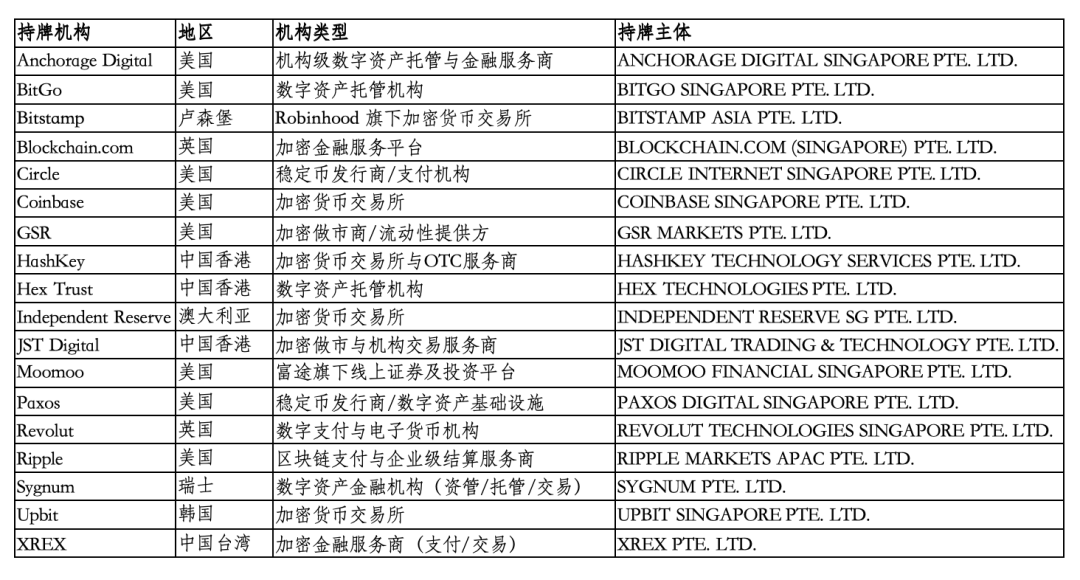
As of the writing date, MAS has issued MPI licenses including the Digital Payment Token Service business scope to 36 institutions with international backgrounds.

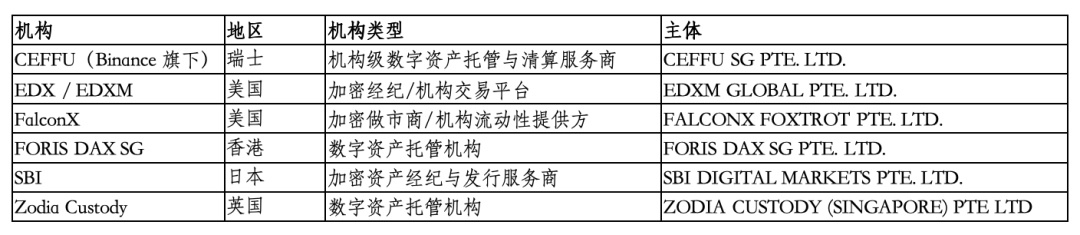
In terms of the composition of licensed entities, although some institutions have US or other overseas backgrounds, or are controlled by multinational groups, they must use locally registered legal entities as the licensed主体 (subject) when conducting related business in Singapore. Relevant compliance obligations, regulatory responsibilities, and business scopes are all borne by this Singapore entity to MAS in accordance with the Payment Services Act, reflecting Singapore's consistent regulatory principle of "territorial regulation, entity responsibility."

(I) MPI Licensing/Exemption Status of Global Institutions

1. Licensed Status (List sorted A-Z)
2. Exempt Status (List sorted A-Z)
3. Unique Business Situations

  • December 2025: Coinbase launched prediction market features in the US, not applicable to Singapore users.

  • November 2024: Paxos Singapore and DBS Bank issued the USDG dollar stablecoin.

(II) MPI Licensing/Exemption Status of Local Singapore Institutions

1. Licensed Status (List sorted A-Z)
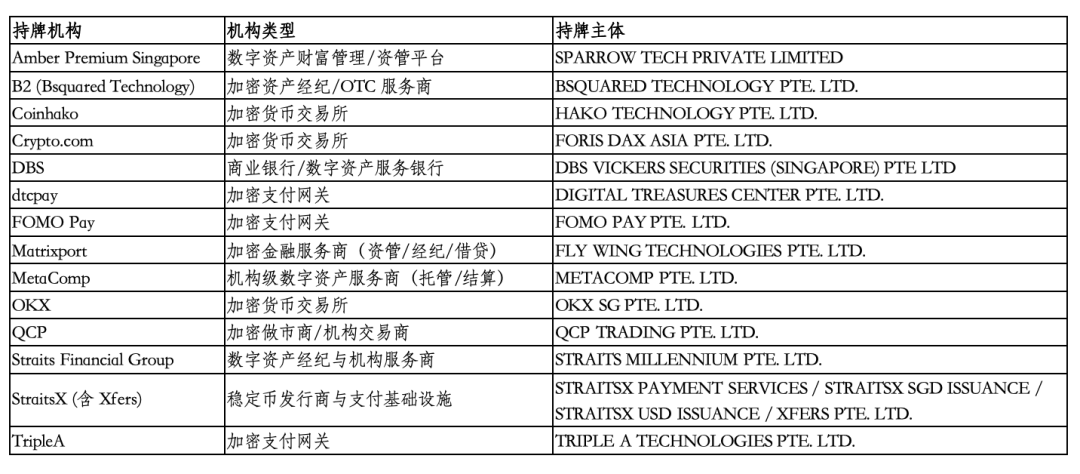
2. Exempt Status (List sorted A-Z)
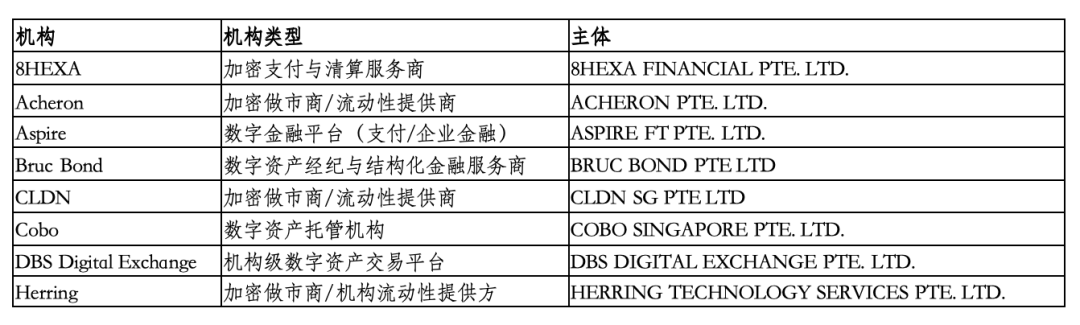
3. Unique Business Situations

December 2025: Crypto platform Crypto.com announced cooperation with the largest local bank, DBS Group, to enhance fiat currency payment functions, allowing local users to more conveniently use SGD and USD deposit and withdrawal services. The same month, StraitX announced plans to launch its Singapore dollar stablecoin XSGD (issued in 2020) and US dollar stablecoin XUSD on the Solana public chain in early 2026.

  • November 2025: Grab and StraitsX developed a digital wallet supporting stablecoin payments.

  • September 2025: OKX Singapore launched stablecoin payment functionality at GrabPay merchants.

  • August 2025: Singapore's DBS Bank launched tokenized structured notes on Ethereum. The same month, Volkswagen Singapore cooperated with FOMO Pay to support digital currency payments.

So far, we have梳理 (sorted out) Singapore's digital currency regulatory framework, core laws, and licensing system, and also understood the composition of licensed institutions and market structure. It can be seen that Singapore is not simply "crypto-friendly," but has built a robust and attractive digital asset ecosystem through clear systems and strict license management.

In the next part, we will continue in-depth, taking you to understand how local financial institutions participate in digital asset practices, international cooperation and innovation trends, and the practical significance of Singapore's system for global institutions.


Twitter:https://twitter.com/BitpushNewsCN

Bitpush TG Discussion Group:https://t.me/BitPushCommunity

Bitpush TG Subscription: https://t.me/bitpush

Original link:https://www.bitpush.news/articles/7608574

Трендовые криптовалюты

Связанные с этим вопросы

QWhat is the core regulatory authority for digital assets in Singapore and what is its role?

AThe Monetary Authority of Singapore (MAS) is the core regulatory authority. It is the unified regulator for Singapore's digital asset and financial markets, comprehensively responsible for overseeing the payment system, digital currencies, fintech, and related financial services. MAS implements a management model that combines functional regulation and risk-oriented supervision through legislation and a licensing system.

QWhat are the two key legislative acts that form Singapore's regulatory framework for digital assets?

AThe two key legislative acts are the Payment Services Act (PSA) and the Financial Services and Markets Act (FSMA). The PSA is the foundational legal framework that defines cryptocurrencies as 'Digital Payment Tokens' (DPTs) and regulates related services. The FSMA, effective from 2025, extends regulatory boundaries to include institutions based in Singapore that serve clients overseas.

QWhat are the main types of licenses for crypto asset services under Singapore's Payment Services Act?

AThe main licenses under the Payment Services Act are the Standard Payment Institution (SPI) license for smaller-scale payment service providers and the Major Payment Institution (MPI) license for larger institutions involved in cross-border payments or digital asset services. Importantly, only MPI license holders are currently permitted to conduct Digital Payment Token (DPT) related business.

QWhat is the purpose of the DTSP license introduced by the Financial Services and Markets Act (FSMA)?

AThe Digital Token Service Provider (DTSP) license, introduced by the FSMA, targets digital asset institutions that provide services to overseas clients from a Singapore base. Its purpose is to regulate 'outbound services,' covering a broader scope than the DPT system and imposing stricter compliance requirements. It effectively closes the regulatory loophole for using Singapore as an 'offshore channel' without substantial operations.

QHow many institutions had received the MPI license with Digital Payment Token service permission as of the writing date, and what is the regulatory principle for these entities?

AAs of the writing date, MAS had granted the MPI license with Digital Payment Token service permission to 36 institutions with international backgrounds. The regulatory principle is 'territorial regulation, entity responsibility,' meaning that even if an institution has foreign backing, its Singapore-registered legal person is the license holder and is responsible for all compliance obligations and regulatory duties to MAS under the Payment Services Act.

Похожее

Треугольник невозможного — это вообще псевдопроблема

Автор Билли Гао утверждает, что основное ограничение для массового внедрения блокчейн-технологий не в классической «трилемме» (масштабируемость, децентрализация, безопасность), а в двух фундаментальных недостатках: отсутствии легитимности и конфиденциальности. Несмотря на создание мощнейшей криптографической системы, все транзакции и балансы по умолчанию прозрачны для всех, что аналогично постоянному налогу из-за MEV (максимально извлекаемой стоимости) и препятствует входу институционального капитала. Блокчейн — это медленный, дорогой, но беспристрастный компьютер общего пользования, идеально подходящий для учета активов, которыми и является сам этот учет (например, деньги). Однако его реальное использование ограничивается узкой прослойкой пользователей, тогда как крупные фонды и обычные люди не могут его применять из-за юридических рисков и полной публичности финансовой деятельности. Первый недостаток — легитимность — начинает решаться через регулирование (например, закон GENIUS). Второй и главный — «прозрачность как налог» — требует внедрения конфиденциальности по умолчанию с помощью современных криптографических инструментов, таких как доказательства с нулевым разглашением. Это позволит доказывать соответствие правилам (например, платежеспособность или KYC), не раскрывая самих данных. Таким образом, добавление проверяемой конфиденциальности к децентрализованному консенсусу — это чистое улучшение, которое откроет блокчейн для триллионов долларов институциональных и частных капиталов, для которых он изначально и был предназначен.

marsbit9 ч. назад

Треугольник невозможного — это вообще псевдопроблема

marsbit9 ч. назад

Трилемма невозможности — это искусственная проблема

**Резюме: "Невозможный треугольник" — это псевдопроблема** Криптоиндустрия построила мощнейшую криптографическую систему, но она не обеспечивает приватности финансовых операций по умолчанию. Все транзакции и балансы публичны. Основная причина, по которой триллионы долларов не переходят на блокчейн — не в масштабируемости (старая "трилемма" решена), а в двух других, более фундаментальных недостатках: **легитимности и конфиденциальности**. **Легитимность**: Безграничный доступ (permissionless) создаёт правовую неопределённость для крупного капитала. Однако с появлением регуляторных рамок (например, закона GENIUS) этот барьер начинает снижаться. **Конфиденциальность (Приватность)**: Прозрачность блокчейна — это не преимущество, а **налог**. Публичность каждой позиции и транзакции приводит к потерям от MEV, фронтраннинга и слежки, что неприемлемо для институциональных инвесторов, фондов и обычных пользователей. Парадокс в том, что система, построенная на криптографии, не шифрует основную деятельность пользователей — их финансы. Однако современные криптографические примитивы (например, доказательства с нулевым разглашением — zk-SNARKs) позволяют решить эту проблему, не жертвуя проверяемостью (аудитом) или соблюдением норм (compliance). Можно доказать платёжеспособность, пройденный KYC или соответствие лимитам, не раскрывая самих данных. **Вывод**: Добавление **доказуемой приватности с возможностью контролируемого раскрытия информации** — это чистое улучшение текущей модели. Оно закрывает главные барьеры для институционального капитала, превращая блокчейн из "публичной таблицы" в конфиденциальный и легитимный расчётный слой, для которого он, по сути, и был предназначен. Только тогда наступит переход к массовому использованию.

链捕手9 ч. назад

Трилемма невозможности — это искусственная проблема

链捕手9 ч. назад

Оптические чипы: коллективное расширение производства

Рост спроса на оптические чипы для ИИ-инфраструктуры стимулирует глобальную волну расширения производственных мощностей. В США Coherent получает государственное финансирование для расширения завода по производству 6-дюймовых InP-пластин, а также заключает стратегические сделки с NVIDIA. Nokia наращивает мощности по тестированию и упаковке фотонных чипов. В Японии JX Advanced Metals инвестирует в увеличение производства InP-подложек в 7–10 раз. Европейские компании, такие как Tower Semiconductor и ST, активно расширяют производство кремниевой фотоники, заключая долгосрочные соглашения. Китай демонстрирует агрессивный рост: Soarse расширяет производство чипов и модулей, Sanan Photonics наращивает выпуск InP-чипов, а Yunnan Germanium увеличивает мощности по производству пластин. Основной движущей силой является растущая потребность ИИ-центров обработки данных в пропускной способности, что требует большего количества оптических компонентов независимо от того, будут ли использоваться традиционные съемные модули или перспективные технологии, такие как CPO, NPO или гибридные архитектуры. Гонка за лидерство в эпоху фотоники набирает обороты, поскольку США, Япония, Европа и Китай стремятся укрепить свои позиции в цепочке поставок.

marsbit11 ч. назад

Оптические чипы: коллективное расширение производства

marsbit11 ч. назад

1996 или 1999? Первым испытанием Уолша стало «Как смотреть на ИИ»

Назначенный председателем ФРС Вош столкнулся с ключевой дилеммой: как оценить текущий бум искусственного интеллекта? Экономисты разделились на два лагеря. Одни считают, что рост производительности благодаря ИИ скоро подавит инфляцию, позволяя ФРС бездействовать. Другие предупреждают, что спрос опережает предложение, и промедление с повышением ставок приведёт к необходимости более резких мер в будущем. Вош, судя по заявлениям, склоняется к подходу 1996 года, когда Алан Гринспен не стал повышать ставки во время бума производительности, что оказалось верным решением. Однако нынешняя ситуация отличается: растущие тарифы, большой дефицит бюджета и снижение выгод глобализации создают дополнительное инфляционное давление. Критики, такие как глава Чикагского ФРС Гулсби, утверждают, что ожидаемый всеми рост производительности от ИИ уже сейчас вызывает перегрев экономики, так как люди и компании увеличивают расходы в ожидании будущих выгод. Это требует более жёсткой денежно-кредитной политики. Оппоненты отмечают, что многие домохозяйства не могут брать кредиты под будущий рост доходов, что ослабляет этот эффект. Вош также сталкивается с парадоксом: он хочет отказаться от практики «прогнозирующего руководства» (forward guidance), установленной как раз в 1999 году для предупреждения рынков о ужесточении политики. Если экономика пойдёт по сценарию 1999 года, ему придётся либо использовать эту практику, либо рисковать вызвать рыночные потрясения молчанием. Таким образом, первый серьёзный вызов для Воша — определить, повторяет ли экономика оптимистичный сценарий 1996 года или ведёт к необходимости жёстких мер по образцу 1999 года. От этого выбора зависит не только ближайшая политика ФРС, но и его историческая репутация.

marsbit14 ч. назад

1996 или 1999? Первым испытанием Уолша стало «Как смотреть на ИИ»

marsbit14 ч. назад

Отчет по Ethereum за первый квартал 2026 года: снижение комиссий, рекордное количество пользователей и транзакций

В первом квартале 2026 года сеть Ethereum продемонстрировала парадоксальную динамику: количество активных пользователей, транзакций и пропускная способность достигли исторических максимумов, в то время как комиссии за транзакции, общая заблокированная стоимость (TVL), объем торгов и рыночная капитализация ETH снизились. Этот феномен объясняется стратегическим переходом к этапу «низких комиссий для роста масштаба» после обновления Fusaka, которое удешевило блок-пространство. Парадокс Джевонса проявляется в том, что снижение стоимости использования высвобождает новый спрос. Ключевой тренд — смещение нарратива от DeFi-платформы к глобальному расчетному слою для институциональных финансов. Ethereum сохраняет доминирующую позицию в сегментах стейблкоинов (61,8% среди топ-5 сетей), токенизированных фондов (73%) и товаров (84%), привлекающих таких гигантов, как BlackRock и JPMorgan. Инвестиции в масштабирование и снижение комиссий нацелены на укрепление сетевых эффектов и долгосрочную ценность ETH как базового актива для расчетов в цифровой экономике.

marsbit15 ч. назад

Отчет по Ethereum за первый квартал 2026 года: снижение комиссий, рекордное количество пользователей и транзакций

marsbit15 ч. назад

Торговля

Спот
Фьючерсы

Популярные статьи

Как купить S

Добро пожаловать на HTX.com! Мы сделали приобретение Sonic (S) простым и удобным. Следуйте нашему пошаговому руководству и отправляйтесь в свое крипто-путешествие.Шаг 1: Создайте аккаунт на HTXИспользуйте свой адрес электронной почты или номер телефона, чтобы зарегистрироваться и бесплатно создать аккаунт на HTX. Пройдите удобную регистрацию и откройте для себя весь функционал.Создать аккаунтШаг 2: Перейдите в Купить криптовалюту и выберите свой способ оплатыКредитная/Дебетовая Карта: Используйте свою карту Visa или Mastercard для мгновенной покупки Sonic (S).Баланс: Используйте средства с баланса вашего аккаунта HTX для простой торговли.Третьи Лица: Мы добавили популярные способы оплаты, такие как Google Pay и Apple Pay, для повышения удобства.P2P: Торгуйте напрямую с другими пользователями на HTX.Внебиржевая Торговля (OTC): Мы предлагаем индивидуальные услуги и конкурентоспособные обменные курсы для трейдеров.Шаг 3: Хранение Sonic (S)После приобретения вами Sonic (S) храните их в своем аккаунте на HTX. В качестве альтернативы вы можете отправить их куда-либо с помощью перевода в блокчейне или использовать для торговли с другими криптовалютами.Шаг 4: Торговля Sonic (S)С легкостью торгуйте Sonic (S) на спотовом рынке HTX. Просто зайдите в свой аккаунт, выберите торговую пару, совершайте сделки и следите за ними в режиме реального времени. Мы предлагаем удобный интерфейс как для начинающих, так и для опытных трейдеров.

1.5k просмотров всегоОпубликовано 2025.01.15Обновлено 2026.06.02

Как купить S

Sonic: Обновления под руководством Андре Кронье – новая звезда Layer-1 на фоне спада рынка

Он решает проблемы масштабируемости, совместимости между блокчейнами и стимулов для разработчиков с помощью технологических инноваций.

2.3k просмотров всегоОпубликовано 2025.04.09Обновлено 2025.04.09

Sonic: Обновления под руководством Андре Кронье – новая звезда Layer-1 на фоне спада рынка

HTX Learn: Пройдите обучение по "Sonic" и разделите 1000 USDT

HTX Learn — ваш проводник в мир перспективных проектов, и мы запускаем специальное мероприятие "Учитесь и Зарабатывайте", посвящённое этим проектам. Наше новое направление .

1.8k просмотров всегоОпубликовано 2025.04.10Обновлено 2025.04.10

HTX Learn: Пройдите обучение по "Sonic" и разделите 1000 USDT

Обсуждения

Добро пожаловать в Сообщество HTX. Здесь вы сможете быть в курсе последних новостей о развитии платформы и получить доступ к профессиональной аналитической информации о рынке. Мнения пользователей о цене на S (S) представлены ниже.

活动图片