Ripple, Stellar Show Up In New Epstein Files, Ex-CTO Schwartz Reacts

bitcoinistОпубликовано 2026-02-03Обновлено 2026-02-03

Введение

Newly released Jeffrey Epstein documents include a 2014 email from Blockstream co-founder Austin Hill that mentions Ripple and Stellar. In the email, Hill reportedly complained to Epstein and others about investors supporting competing projects, framing backers of Ripple or Stellar as "enemies/opponents" to his Bitcoin-centric ecosystem. Former Ripple CTO David Schwartz publicly responded, stating he knows of no direct connections between Epstein and either Ripple, XRP, or Stellar. He emphasized there is no evidence that anyone from these projects met with Epstein or his close associates. Schwartz criticized the "enemy/opponent" mindset as harmful to the entire crypto space and dismissed the notion of deeper involvement as speculative conspiracy. He also addressed a question about Ripple's for-profit structure versus Stellar's non-profit, revealing he had opposed the non-profit model early on, believing it seemed dishonest and borderline illegal. At the time of reporting, XRP was trading at $1.64.

Ripple and Stellar were pulled into a fresh round of social-media speculation this weekend after newly surfaced emails from the Epstein document release appeared to reference the two projects in a 2014 investor dispute. Former Ripple CTO David Schwartz pushed back publicly, saying he knows of no direct links between Epstein and either network, and framed the episode as another example of tribal politics bleeding into crypto.

Schwartz Reacts After Epstein Docs Mention Ripple, Stellar

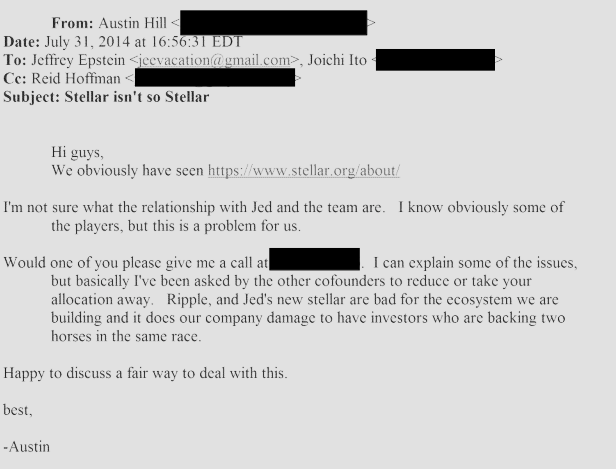
The spark came from a screenshot circulating on X that shows an email chain in which Austin Hill (co-founder of Blockstream) complained to a group of high-profile recipients, including Epstein, about investors allocating capital across competing projects. According to Schwartz, the document “is an email from Austin Hill to Jeffrey Epstein explaining that Hill felt that support for Ripple or Stellar made someone an enemy/opponent,” adding that Hill likely shared similar views “to many other people.”

As the image spread, some posts characterized the mere inclusion of Ripple and Stellar in the email as evidence of deeper involvement. Schwartz responded with a message that tried to separate inflammatory framing from what the document actually shows.

“I don’t know of any connections between Jeffrey Epstein and Ripple, XRP, or Stellar. [I don’t know of] any evidence anyone at Ripple or Stellar ever met with Epstein or anyone closely connected to him,” he wrote. “There are some indirect ties between Epstein and people connected to Bitcoin in various ways, but that’s probably true of most very wealthy people.”
Source: X @JoelKatz

Schwartz’s first post on the thread captured the mood of the day, both suspicion and a reluctance to feed it. “I hate to be a conspiracy theorist, but I wouldn’t be at all surprised if this is just the tip of a giant iceberg,” he wrote while linking to the DOJ-hosted file. He later argued the more corrosive issue was the “enemy/opponent” mindset, writing that “we really are all in this together and this kind of attitude hurts everyone in the space.”

In the underlying 2014 email described in the source material, Hill is portrayed as objecting to backers funding multiple “horses” at once, treating support for Ripple or Stellar as hostile to the bitcoin-centric “ecosystem” he was building at Blockstream. Reports summarizing the chain say it was sent to Joichi Ito, Epstein, and Reid Hoffman, and included language that investors in both camps were “backing two horses in the same race.”

The resurfaced email also revived an older fault line in how early projects structured themselves. In response to a user asking about Ripple versus Stellar’s nonprofit posture, Schwartz said the idea was debated early on and that he opposed it.

“We discussed it in the early days. I was strongly against it because it seemed dishonest and borderline illegal to have a non-profit whose success was so tied to the gains of private parties,” he wrote. “It felt, at least to me, like Walmart creating a non-profit to help educate people about how much money they could save by shopping at Walmart.”

At press time, XRP traded at $1.64.
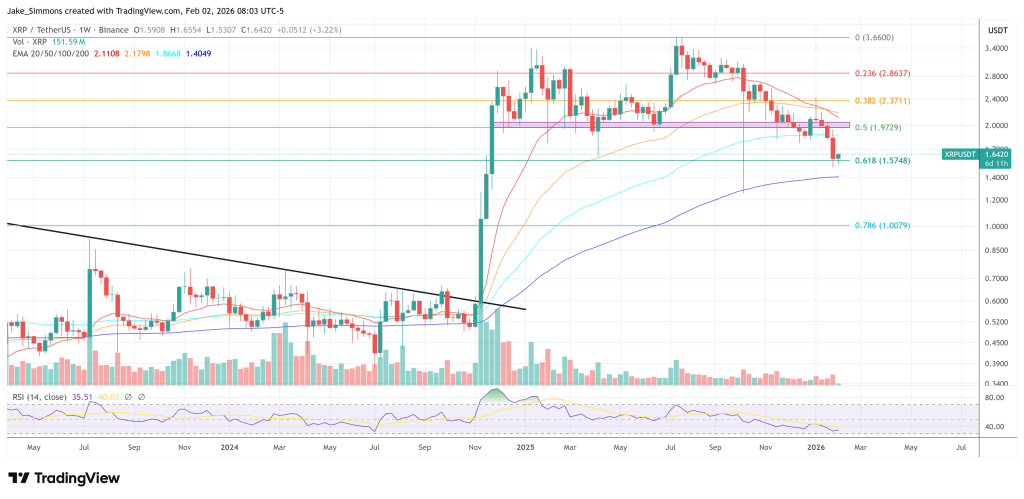
XRP holds above the 0.618 Fib, 1-week chart | Source: XRPUSDT on TradingView.com

Связанные с этим вопросы

QWhat sparked the recent social-media speculation involving Ripple and Stellar?

AThe speculation was ignited by a screenshot of a 2014 email chain from the Epstein document release, in which Blockstream co-founder Austin Hill complained to Jeffrey Epstein and others about investors allocating capital across competing projects like Ripple and Stellar.

QHow did former Ripple CTO David Schwartz respond to the allegations of connections between Epstein and Ripple/Stellar?

ADavid Schwartz publicly stated that he knows of no direct connections between Jeffrey Epstein and Ripple, XRP, or Stellar, and that he was unaware of any evidence that anyone at Ripple or Stellar had ever met with Epstein or anyone closely connected to him.

QWhat was the main complaint in Austin Hill's 2014 email as described in the article?

AIn the email, Austin Hill objected to investors funding multiple competing projects simultaneously, characterizing support for Ripple or Stellar as being hostile to the bitcoin-centric 'ecosystem' he was building at Blockstream, and referred to it as 'backing two horses in the same race.'

QWhat did David Schwartz identify as the more corrosive issue in the crypto space, beyond the Epstein speculation?

ASchwartz argued that the more corrosive issue was the 'enemy/opponent' mindset, stating that 'we really are all in this together and this kind of attitude hurts everyone in the space.'

QWhat was David Schwartz's stated position on Ripple adopting a non-profit structure in its early days?

ASchwartz said he was strongly opposed to the idea of Ripple becoming a non-profit because he felt it seemed dishonest and borderline illegal to have a non-profit whose success was so tied to the gains of private parties, comparing it to 'Walmart creating a non-profit to help educate people about how much money they could save by shopping at Walmart.'

Похожее

Fu Peng's First Public Speech in 2026: What Exactly Are Crypto Assets? Why Did I Join the Crypto Asset Industry?

Fu Peng, a renowned macroeconomist and now Chief Economist at New火 Group, delivered his first public speech of 2026 at the Hong Kong Web3 Festival. He explained his perspective on crypto assets and why he joined the industry, framing it within the context of macroeconomic trends and financial evolution. Fu emphasized that crypto assets are transitioning from an early, belief-driven phase to a mature, institutionally integrated asset class. He drew parallels to the 1970s-80s, when technological advances (like computing) revolutionized traditional finance, leading to the rise of FICC (Fixed Income, Currencies, and Commodities). Similarly, current advancements in AI, data, and blockchain are reshaping finance, with crypto assets becoming part of a new "FICC + C" (C for Crypto) framework. He noted that institutional capital, including traditional hedge funds, avoided early crypto due to its speculative nature but are now engaging as regulatory clarity emerges (e.g., stablecoin laws, CFTC classifying crypto as a commodity). Fu predicted that 2025-2026 marks a turning point where crypto becomes a standardized, financially viable asset for diversified portfolios, akin to commodities or derivatives in traditional finance. Fu defined Bitcoin not as "digital gold" in a simplistic sense but as a value-preserving, financially tradable asset. He highlighted that crypto's future lies in regulated, institutional adoption, moving away from retail-dominated trading. His entry into crypto signals this maturation, where traditional finance integrates crypto into mainstream asset management.

marsbit58 мин. назад

Fu Peng's First Public Speech in 2026: What Exactly Are Crypto Assets? Why Did I Join the Crypto Asset Industry?

marsbit58 мин. назад

Justin Sun Sues Trump Family: What $75 Million Bought Was Only a Blacklist

Justin Sun, founder of Tron, has filed a lawsuit in federal court against World Liberty Financial (WLF), alleging he was made the "primary target of a fraudulent scheme" after investing $75 million. Sun claims the investment secured him an advisor title and WLFI tokens, which were later frozen by WLF, causing "hundreds of millions in losses." The dispute began in late 2024 when Sun's investment helped revive WLF's struggling token sale, which ultimately raised $550 million. Shortly after, the SEC dropped its lawsuit against Sun following Donald Trump's inauguration. However, relations soured when Sun refused WLF's demands for additional funding. In August 2025, WLF added a "blacklist" function to its smart contract, allowing it to unilaterally freeze tokens. Sun's holdings, worth approximately $107 million, were frozen, and he was threatened with token destruction. The lawsuit highlights WLF's structure, which directs 75% of token sale profits to the Trump family, who had earned $1 billion by December 2025. WLF's CEO is Zach Witkoff, son of U.S. Middle East envoy Steve Witkoff. The project faces scrutiny for opaque operations, including a controversial loan arrangement on the Dolomite platform, co-founded by a WLF advisor. Despite Sun's history with the SEC, the case underscores centralization risks within DeFi, as WLF controls governance and holds powers to freeze assets arbitrarily. Sun's tokens remain frozen as legal proceedings begin.

marsbit1 ч. назад

Justin Sun Sues Trump Family: What $75 Million Bought Was Only a Blacklist

marsbit1 ч. назад

$500 to Buy OpenAI Stock: Silicon Valley's Most Respectable Liquidity Invitation

Silicon Valley's largest venture capital platform, AngelList, has launched a new fund called USVC, allowing U.S. retail investors to buy into high-profile AI companies like OpenAI, Anthropic, and xAI with a minimum investment of $500—no accredited investor status required. Promoted by AngelList co-founder Naval Ravikant, the fund is framed as an opportunity for ordinary people to access high-growth private tech investments traditionally reserved for VCs. However, critics argue it functions more like an exit vehicle for early insiders. USVC acquires shares not through primary rounds but largely via secondary transactions—purchasing stakes from early investors, VC funds, and employees looking to cash out at peak valuations. With companies like xAI heavily weighted in the portfolio, the fund effectively channels retail money into providing liquidity for insiders who entered at much lower valuations. The fund’s structure raises concerns: shares are illiquid, with no secondary market, and buybacks are limited and discretionary. The actual annual fee reaches 3.61%, far above the advertised 1% management fee. This model parallels the "low float, high fully diluted valuation" strategy seen in crypto, where early investors profit by selling to latecomers at inflated prices. The timing—alongside similar moves by platforms like Robinhood—suggests that Silicon Valley’s sudden interest in retail inclusion may be less about democratizing access and more about securing exits for insiders.

marsbit1 ч. назад

$500 to Buy OpenAI Stock: Silicon Valley's Most Respectable Liquidity Invitation

marsbit1 ч. назад

Торговля

Спот
Фьючерсы
活动图片