Ripple Calls XRPL Permissioned Domains A ‘Gamechanger’ As Go-Live Nears

bitcoinistОпубликовано 2026-01-14Обновлено 2026-01-14

Введение

RippleX announces that the XRP Ledger's "Permissioned Domains" amendment is nearing activation, requiring an 80% validator consensus. Currently at 76.47%, this feature introduces institutional-grade access controls on the public blockchain, enabling regulated entities to use permissioned trading and lending protocols without private infrastructure. It paves the way for a Permissioned DEX, limiting market interactions to approved participants, and supports future applications like on-chain foreign exchange and lending. The community highlights the need for more stablecoins and real-world assets to boost liquidity. XRP price is noted at $2.15.

Ripple’s developer arm RippleX says the XRP Ledger’s “Permissioned Domains” amendment is nearing its activation threshold, positioning the network to roll out institution-friendly access controls that could underpin a permissioned version of XRPL’s native decentralized exchange.

In a series of posts on X late Tuesday, RippleX framed Permissioned Domains as a “gamechanger” enabling layer for “permissioned flows” on a public blockchain, an approach aimed squarely at regulated firms that want on-chain settlement and trading without adopting fully private infrastructure.

Ripple’s Next ‘Gamechanger’ For The XPR Ledger

Via X, RippleX said: “The amendment for Permissioned Domains is nearing the threshold for activation.Ripple supports this feature, as well as the Permissioned DEX which this will ultimately enable. “

Under XRPL’s governance process, amendments become active after maintaining a 80% validator supermajority for a sustained period. According to xrpl.org, the PermissionedDEX is currently open for voting and has reached 50.00% thus far, while the PermissionedDomains amendment stands at 76.47%.

RippleX describes the feature as a “game-changer for XRPL because they bring institutional-grade controls to a public network, without sacrificing the trade-offs of a private chain.”

The company further writes: “While the Permissioned Domains amendment is an enabling feature, it sets the stage for financial institutions to engage in permissioned flows on a fast, scalable, and resilient blockchain network, the XRPL. The Permissioned DEX will enable permissioned trading flows, and the upcoming lending protocol may apply Permissioned Domains for controlled lending and borrowing flows.”

On XRPL’s documentation, permissioned domains are described as controlled environments that “do nothing on their own,” but can be used by higher-level features, such as permissioned DEX functionality and lending protocols,to restrict and manage access for compliance-driven deployments. Permissioned DEXes are the practical endpoint: regulated entities participating in XRPL’s native order books while enforcing who can interact with specific markets.

“Traditionally, any XRPL DEX offer can be matched by anyone. A permissioned DEX changes that,” Ripple wrote, describing permissioned trading as rules-based matching limited to approved participants.

RippleX also points to adjacent roadmap items, including an upcoming lending protocol that could apply the same domain-based controls to borrowing and lending flows, suggesting the design pattern is intended to extend beyond trading into broader onchain finance primitives.

The announcement drew immediate interest from XRP community voices. Popular community member Krippenreiter highlighted “on-chain FX” as a headline application, while Anodos Finance CEO Panos Mekras responded that “the only thing left is to bring the actual assets and liquidity to flow.” Krippenreiter agreed, calling for “more stablecoins, RWAs, and more market making.”

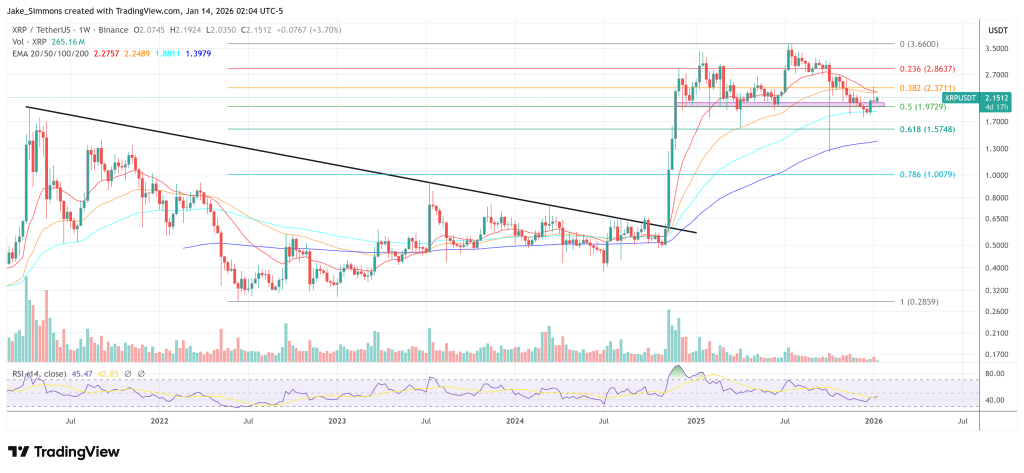
At press time, XRP traded at $2.15.

XRP needs to reclaim the 0.382 Fib, 1-week chart | Source: XRPUSDT on TradingView.com

Связанные с этим вопросы

QWhat is the 'Permissioned Domains' amendment on the XRP Ledger and why is it significant?

AThe 'Permissioned Domains' amendment is an enabling feature that introduces institution-grade access controls to the public XRP Ledger network. It is significant because it allows for 'permissioned flows' on a public blockchain, enabling regulated firms to use on-chain settlement and trading without having to adopt fully private infrastructure, thus combining the benefits of a public network with the controls of a private chain.

QWhat is the governance process for activating an amendment on the XRPL, and what is the current status of the PermissionedDomains vote?

AUnder XRPL's governance process, an amendment becomes active after it maintains an 80% validator supermajority for a sustained period. At the time of the article, the PermissionedDomains amendment had reached 76.47% of the vote.

QHow does a Permissioned DEX differ from the traditional XRPL DEX?

ATraditionally, any offer on the XRPL DEX can be matched by any participant. A Permissioned DEX changes this by enabling rules-based matching that is limited to only approved, vetted participants, which is crucial for compliance-driven deployments by regulated entities.

QBeyond trading, what other potential use cases for Permissioned Domains does RippleX mention?

ARippleX mentions that the upcoming lending protocol could apply the same Permissioned Domains feature to control borrowing and lending flows, suggesting the design pattern is intended to extend into broader on-chain finance primitives beyond just trading.

QWhat was the price of XRP at the time the article was published?

AAt press time, the price of XRP was $2.15.

Похожее

How Many Tokens Away Is Yang Zhilin from the 'Moon Chasing the Light'?

The article explores the intense competition between two leading Chinese AI companies, DeepSeek and Kimi (Moon Dark Side), and the mounting pressure on Yang Zhilin, the founder of Kimi. While DeepSeek re-emerged after 15 months of silence with its powerful V4 model—boasting 1.6 trillion parameters and low-cost, long-context capabilities—Kimi has been focusing on long-context processing and multi-agent systems with its K2.6 model. Yang faces a threefold challenge: technological rivalry, commercialization pressure, and investor expectations. Despite Kimi’s high valuation (reaching $18 billion), its revenue heavily relies on a single product with low paid conversion rates, while DeepSeek’s strategic silence and open-source influence have strengthened its market position and valuation prospects, now targeting over $20 billion. Both companies reflect broader trends in China’s AI ecosystem: Kimi aims for global influence through open-source contributions and agent-based advancements, while DeepSeek prioritizes foundational innovation and hardware independence, notably shifting to Huawei’s chips. Their competition is seen as vital for China’s AI progress, with the gap between top Chinese and U.S. models narrowing to just 2.7% on the Elo rating scale. Ultimately, the article argues that this rivalry, though anxiety-inducing for leaders like Zhilin, is essential for driving innovation and solidifying China’s role in the global AI landscape.

marsbit10 ч. назад

How Many Tokens Away Is Yang Zhilin from the 'Moon Chasing the Light'?

marsbit10 ч. назад

Торговля

Спот
Фьючерсы
活动图片