NVIDIA Earnings Countdown: Beating Expectations Is a Near Certainty, but Wall Street Is Most Concerned About These Five Questions

marsbitОпубликовано 2026-05-20Обновлено 2026-05-20

Введение

NVIDIA Earnings Countdown: Beating Expectations is a Given, but Wall Street Cares Most About These Five Issues The upcoming NVIDIA Q1 earnings report is expected to easily surpass the consensus revenue estimate of ~$78.7B. However, Wall Street's focus has shifted from the numbers themselves to five key strategic questions. **1. Shareholder Returns: Will "Frugality" Change?** Despite being the S&P 500's largest company, NVIDIA's shareholder returns (dividends + buybacks) averaged only 47% of its free cash flow from 2022-2025, far below the 80% peer average and its own historical norm. Its 0.02% dividend yield also lags the peer average of 0.89%. This low cash return, partly due to investments in AI ecosystem partners, is cited as a core reason for NVIDIA's valuation discount compared to other "Magnificent 7" stocks. Increasing returns could attract long-term income funds and be a catalyst. **2. Vera Rubin: The Next-Gen Chip Timeline** Analysts expect the next-generation Vera Rubin (R200) platform to ramp in the second half of 2026, following the current Blackwell series. It will use TSMC's 3nm process and share Blackwell Ultra's "Oberon" rack architecture, suggesting a smooth transition with limited gross margin impact. The market also awaits any update on NVIDIA's $1 trillion cumulative revenue forecast for 2025-2027. **3. Gross Margin: Can the 75% Level Hold?** Gross margin, a key valuation support, is expected to stabilize in the near term due to the shared architecture...

Original Author: Long Yue

Original Source: Wall Street News

NVIDIA earnings season—the most important thing is no longer the numbers themselves.

On May 18, Bank of America Securities analyst Vivek Arya's team released a preview report for NVIDIA's Q1 earnings, which will be announced after the U.S. market close on Wednesday, May 20.

According to NVIDIA's historical pattern over the past ten quarters, actual revenue has averaged 7% to 8% above management guidance. Management previously provided F1Q27 revenue guidance of $78 billion. Based on this calculation, actual revenue is highly likely to fall in the range of $83 billion to $84 billion, while the current market consensus is only $78.7 billion.

In other words, 'beating expectations' is almost a foregone conclusion. But analysts believe what will truly move the market's nerve after the earnings release are the following five questions.

Cash Return: Can NVIDIA Change Its 'Stinginess'?

This is the most discussed topic in the report and is considered by them to be the core reason for NVIDIA's long-term valuation discount.

NVIDIA is currently the largest company by market cap in the S&P 500, accounting for a high weight of 8.3% in the index, exceeding the historical peaks of Apple (7.9%) and Microsoft (7.2%). However, the problem is that NVIDIA's shareholder return efforts are severely mismatched with its size.

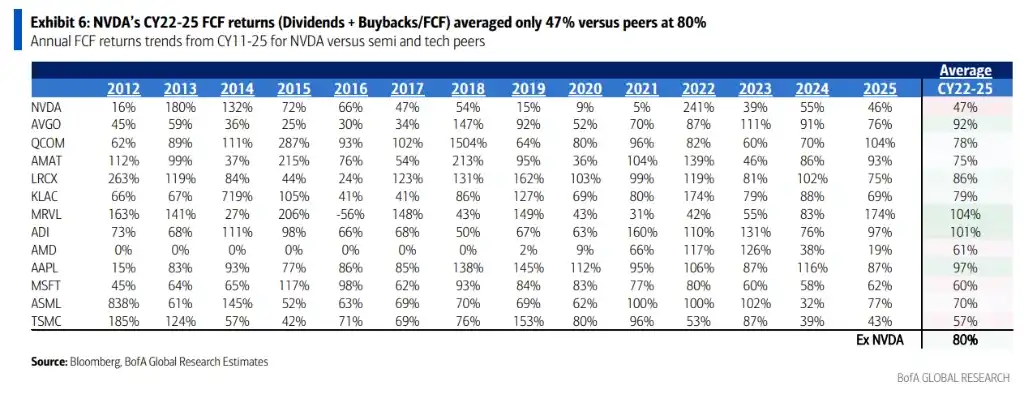
The data is straightforward: from 2022 to 2025, NVIDIA's free cash flow payout ratio (dividends + buybacks) averaged only 47%, while the average for comparable peers in the same period was 80%. Even NVIDIA's own average over the previous ten years was 80%.

Meanwhile, NVIDIA's current dividend yield is only 0.02%, while the peer average is 0.89%. Among equity income funds, NVIDIA is held by only 16% of funds, while Microsoft is held by 57% and Apple by 32%.
Where is the money going? Analysts point out that NVIDIA is investing heavily in the ecosystem—OpenAI, Anthropic, technology partners. These investments are seen as controversial by some outsiders, with voices suggesting it's "round-trip financing"—NVIDIA lends money to customers, who then use that money to buy NVIDIA's chips.

How large is the valuation discount? Data shows that NVIDIA's forward P/E ratio for 2026/2027 is 26x/19x, while the mean for other 'Magnificent Seven' members is 49x/42x, representing a discount of nearly 50%.

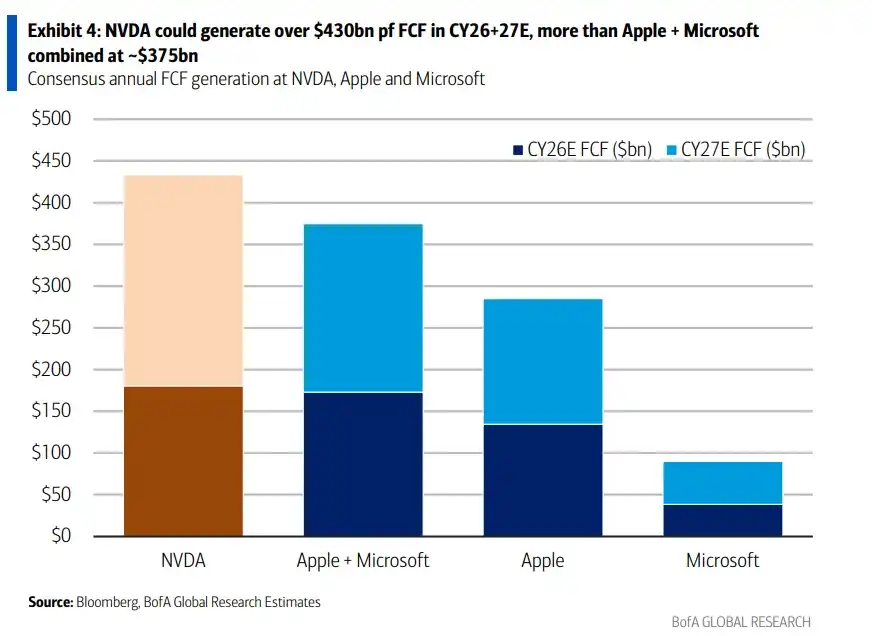
A more specific comparison: analysts predict NVIDIA's combined free cash flow for 2026+2027 will exceed $430 billion, higher than the combined ~$375 billion for Apple and Microsoft. However, NVIDIA's market cap is approximately $5.46 trillion, about 28% lower than the combined $7.5 trillion for Apple and Microsoft.
Analysts believe that if NVIDIA increases its dividend and buyback efforts, it could attract more long-term funds that prefer income, narrowing the valuation discount while also dispelling concerns about "round-trip financing." They list this change as a "potential catalyst for the second half of the year."

Vera Rubin: When Will the Next-Generation Chip Arrive?

NVIDIA's current main products are the Blackwell series. The market is concerned: when will the next-generation Vera Rubin platform officially ramp up?

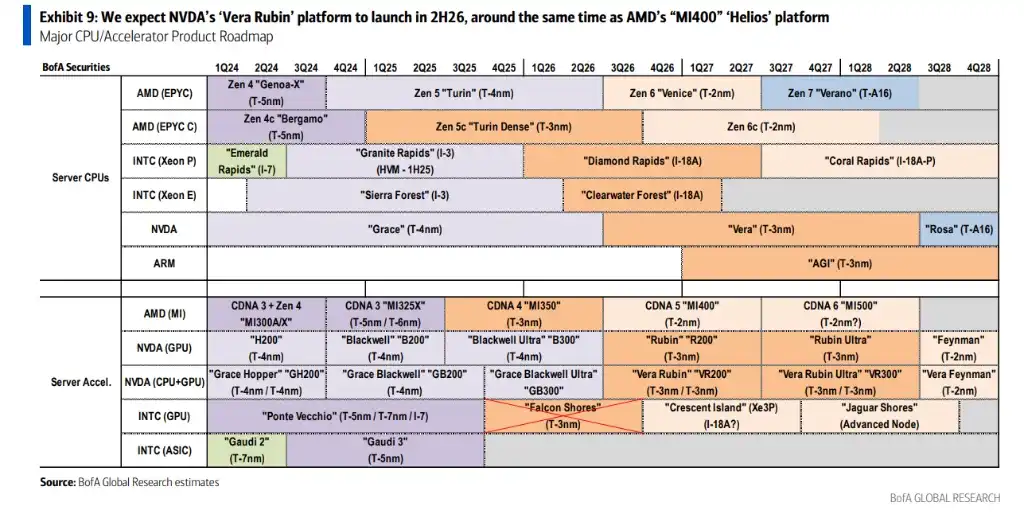
The bank's judgment is the second half of 2026. Vera Rubin (codenamed R200) uses TSMC's 3nm process and shares the "Oberon" rack architecture with Blackwell Ultra, making the product transition relatively smooth, with limited expected impact on gross margins.

Looking further ahead, Vera Rubin Ultra (codenamed VR300) will be launched in the second half of 2027, featuring a completely new "Kyber" rack architecture, while the cost proportion of High Bandwidth Memory (HBM) will also further increase.
The market also wants to hear NVIDIA's latest stance on the "trillion-dollar revenue forecast" during the earnings call—NVIDIA previously gave an outlook for cumulative revenue of $1 trillion from 2025 to 2027, but contributions from LPU (Language Processing Unit) racks, CPUs, and Vera Rubin Ultra have not yet been included. Will this be updated this time?

Gross Margin: Can the 75% Defense Line Hold?

Gross margin is one of the core supports of NVIDIA's valuation.

Analysts judge: in the short term, because Vera Rubin reuses Blackwell's rack architecture, gross margins are relatively stable during the product transition period. However, in the medium to long term, the rising proportion of HBM memory costs is a persistent pressure source.
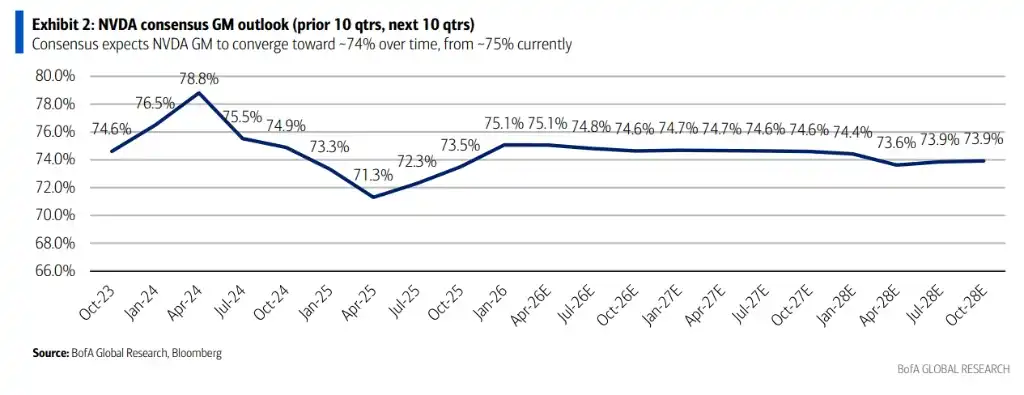
Market consensus shows NVIDIA's gross margin fluctuating within the 74% to 75% range. The bank has no disagreement with this but emphasizes that any better-than-expected gross margin performance will be a positive catalyst.

How Will the AI Accelerator Market Size Forecast Be Updated?

Bank of America previously provided NVIDIA's "trillion-dollar" prediction framework for the AI market from 2025 to 2027. This earnings report, the market is focused on whether NVIDIA will update this forecast, especially by incorporating three new growth drivers previously not counted:

  1. LPU (Language Processing Unit) racks
  2. Vera CPU (NVIDIA's self-developed server CPU)
  3. Vera Rubin Ultra

The bank expects that by 2030, the overall AI accelerator market size will reach approximately $1.17 trillion, with NVIDIA maintaining about 68% to 70% market share.
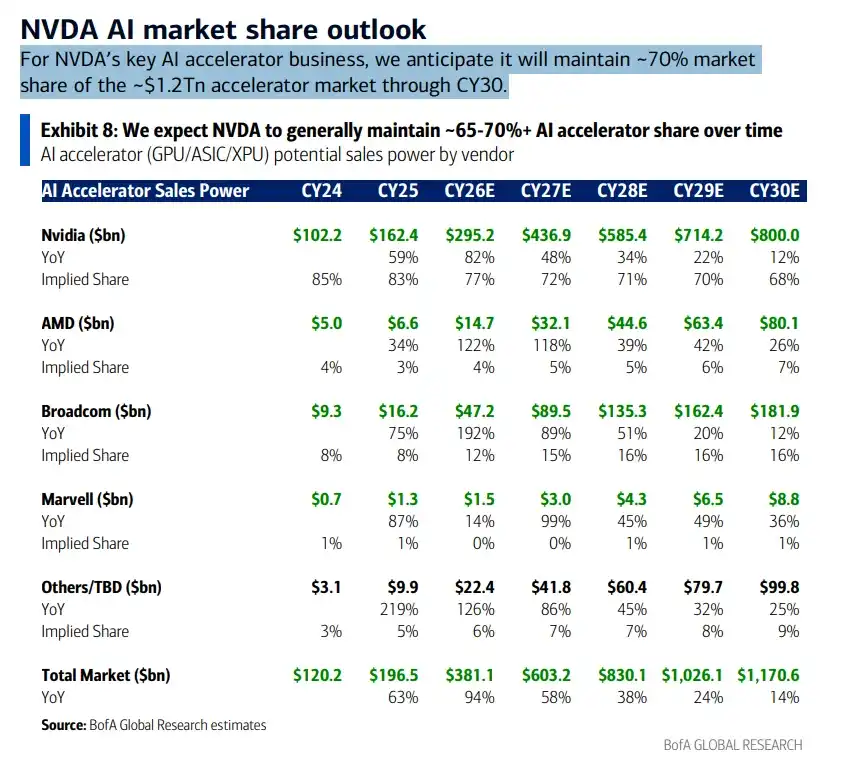
Specifically, NVIDIA's AI accelerator revenue is expected to grow from $102.2 billion in 2024 to $800 billion in 2030, AMD from $5 billion to $80.1 billion over the same period, and Broadcom from $9.3 billion to $181.9 billion.

Is the Competitive Threat from Google TPU and CPU Exaggerated?

A narrative has been circulating in the market recently: as AI enters the "Agentic AI" era, the importance of CPUs will surpass that of GPUs, thus threatening NVIDIA's moat.

The bank clearly disagrees with this, providing two reasons:

First, NVIDIA's self-developed "Vera CPU" will have new progress disclosed at the upcoming Computex conference, and its competitiveness in the standalone CPU market should not be underestimated.

Second, in already large-scale deployments of Blackwell and TPU clusters, the CPU-to-GPU ratio is already 1:2, which does not align with the narrative that "Agentic AI requires more CPUs."

The conclusion is: while the CPU market is large, there are many competitors (with strong contenders in both x86 and ARM architectures). NVIDIA's dominant position in the GPU/AI accelerator field is difficult to shake in the short term. It is estimated that by 2030, NVIDIA will maintain approximately 70% revenue share in a total addressable AI market exceeding $1.7 trillion.

Valuation: A 'Tech Leader' at a 50% Discount

Finally, back to valuation. The report uses a set of data to directly highlight NVIDIA's current valuation paradox.

Based on CY26/27 forward P/E ratios, NVIDIA is at 26x/19x, while the "Magnificent Seven" (Mag-7) average is 49x/42x—NVIDIA is at a nearly 50% discount.

Based on EV/FCF (Enterprise Value/Free Cash Flow), NVIDIA is at 28x/20x, while the Mag-7 average is 83x/59x—a discount exceeding 66%.

Based on PEG (Price/Earnings to Growth ratio), NVIDIA is at 0.41x, while the Mag-7 average is 2.61x, and the S&P 500 overall is above 1.3x.
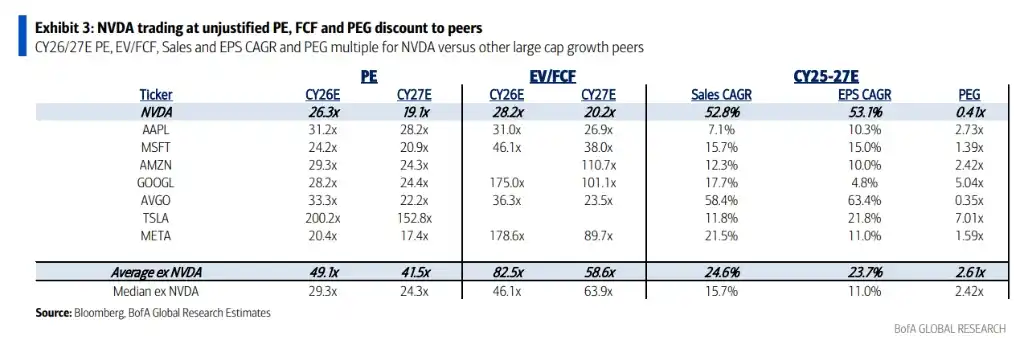
Bank of America maintains a "Buy" rating with a price target of $320, based on a CY27 forward P/E ratio of 28x (excluding cash), which is at the mid-to-low end of NVIDIA's historical valuation range of 25x to 56x.

Связанные с этим вопросы

QAccording to the report, what is the core reason for NVIDIA's valuation discount relative to its 'Magnificent 7' peers?

AThe core reason is NVIDIA's relatively low shareholder return rate (dividends + buybacks). Its average free cash flow return rate from 2022-2025 is only 47%, compared to an industry average and its own ten-year historical average of 80%. Its low dividend yield of 0.02% (vs. peer avg. 0.89%) means fewer income-focused funds hold its stock, contributing to the valuation gap.

QWhen does Bank of America's analyst team expect NVIDIA's next-generation Vera Rubin platform to ramp up in volume?

AThe analyst team expects the Vera Rubin platform (code R200) to ramp up in volume in the second half of 2026.

QWhat are the three new growth areas that could be included in an update to NVIDIA's 'trillion-dollar revenue' forecast?

AThe three new growth areas are: 1) LPU (Language Processing Unit) racks, 2) Vera CPU (NVIDIA's self-developed server CPU), and 3) Vera Rubin Ultra.

QWhat two reasons does the report give for downplaying the competitive threat from CPUs (like Google's TPU) to NVIDIA?

A1) NVIDIA's self-developed 'Vera CPU' is a competitive contender in the standalone CPU market, with new details expected at Computex. 2) In already deployed large-scale Blackwell and TPU clusters, the CPU-to-GPU ratio is already 1:2, which doesn't support the narrative that 'Agentic AI' requires significantly more CPUs.

QWhat is Bank of America's price target for NVIDIA and what is the valuation metric used to derive it?

ABank of America maintains a 'Buy' rating with a $320 price target. This target is based on a CY27 estimated P/E of 28x (excluding cash), which is at the low-to-mid range of NVIDIA's historical valuation range of 25x to 56x.

Похожее

Apple Also Has to Pay Rent Now

Apple Pays Rent Too: The Two-Way Flow of "Traffic Tax" and "AI Capability Rent" Between Tech Giants For over two decades, Google has paid Apple an estimated $20 billion annually to remain the default search engine on Safari, a "traffic tax" for a critical user entry point. However, in 2026, the direction of this cash flow partially reversed. Apple agreed to pay Google roughly $1 billion per year to license its Gemini AI models, as Apple's own models reportedly struggled with complex tasks. This creates a unique dynamic: Apple acts as the "landlord" in the established search ecosystem, collecting rent from Google for access. Simultaneously, in the emerging AI arena, Apple becomes the "tenant," paying Google for access to cutting-edge AI capabilities it cannot currently match internally. While Apple claims its new models are "distilled" from Gemini outputs and contain "not a drop" of Google's original code, core dependencies remain. Its knowledge base is refined using Gemini's outputs, and its most powerful cloud model runs on Google's infrastructure. Apple has structured the deal as non-exclusive, allowing it to theoretically switch AI suppliers—a hedge against over-reliance. The future hinges on whether advanced AI models become a commodity (cheap and abundant) or remain a concentrated, scarce resource (expensive and controlled by few). Apple is betting on the former, leveraging its massive device ecosystem to be a powerful, choosy customer. If the latter proves true, its bargaining power could erode. This power dynamic is extending to developers. Apple, Google, and WeChat are all pushing for apps to expose their core functions as standardized "actions" or "intents" that their respective AI assistants (Siri, Gemini, WeChat AI) can directly call. The new scarce resource is no longer just app store visibility, but "being selected by the AI." The currency of "rent" has changed from a 30% revenue share to ceding control over how users interact with an app's functions.

marsbit1 ч. назад

Apple Also Has to Pay Rent Now

marsbit1 ч. назад

Missed the SpaceX IPO? WEEX's "First Trade Protection" Lets You Experience US Stock Trading Risk-Free.

With the excitement around SpaceX's recent public listing reigniting interest in the US stock market, Chinese investors face significant challenges accessing compliant and convenient trading channels following regulatory actions against major online brokers. This article explores the available options, highlighting their risks and limitations. Traditional paths for US stock investments remain problematic. Qualified Domestic Institutional Investor (QDII) and Listed Open-Ended Fund (LOF) products, while compliant, suffer from high fees, significant purchase premiums, and a very limited selection of assets. Small, unregulated offshore brokers pose substantial risks, including potential insolvency. While secure, VIP accounts at banks in Hong Kong or Singapore require high minimum deposits (often 1-2 million RMB) and in-person visits, placing them out of reach for most retail investors. The article positions cryptocurrency exchanges, specifically their TradFi (traditional finance on-chain) offerings, as a compelling alternative. Platforms like WEEX are noted for providing access to a wide range of US stocks and ETFs, including SpaceX (SPCXON), through tokenized assets. This method offers advantages such as a single account for both crypto and traditional assets, USDT-based settlement avoiding fiat complexities, flexible leverage, and robust risk management. To attract users, WEEX is promoting a "First Trade Guarantee" campaign. Running from June 15 to July 8 (UTC+8), it features a $30,000 prize pool. Users who trade $500 worth of US stock contracts can qualify for a guarantee on their first eligible trade: 100% loss coverage up to $30 or a 20% bonus on profits up to $30. The campaign is presented as a low-risk opportunity for both crypto natives and traditional investors to experience US stock trading.

marsbit1 ч. назад

Missed the SpaceX IPO? WEEX's "First Trade Protection" Lets You Experience US Stock Trading Risk-Free.

marsbit1 ч. назад

How Difficult is Chip Making? A Division Error Costs 475 Million Dollars

How Hard Is It to Make a Chip? A Division Error Cost $475 Million Chip expert Shi Kan, a researcher at the Chinese Academy of Sciences and a popular tech creator, explains the immense challenges of chip development. Chips are foundational to modern technology, but their creation is extraordinarily difficult. The journey from sand to a functional chip involves complex design and manufacturing, but a critical bottleneck is verification—ensuring the design works flawlessly before costly production. A single, undetected bug can have catastrophic consequences, as illustrated by the infamous 1994 Intel Pentium FDIV bug. A flaw in the floating-point division unit forced a recall costing $475 million. Unlike software, chips cannot be easily patched after manufacture, making "first-time success" paramount. However, industry surveys show only 24% of chip projects achieve this; over three-quarters require at least one costly re-spin due to design flaws. Verification has thus become the dominant phase, consuming up to 70% of the design cycle. The core challenge is a "verification impossible triangle" between high performance, good debuggability, and low cost. Exhaustively verifying a modern CPU core could take 15,000 years with software simulation, or 30 years with advanced hardware emulation—timeframes utterly impractical for development. Despite being essential, verification is often seen as unglamorous "dirty work," receiving less academic attention than fields like AI. Shi and his team are tackling this by developing an agile verification research framework called ENCORE, based on FPGA technology, to improve verification efficiency and debug capability. Beyond research, Shi engages in public science communication through long-form video content, aiming to demystify chip technology, AI, and computer science. He argues for the value of pursuing "hard and long-term" endeavors, whether in the meticulous world of chip verification or in creating substantive educational content, believing such sustained effort is likely the right path forward.

marsbit1 ч. назад

How Difficult is Chip Making? A Division Error Costs 475 Million Dollars

marsbit1 ч. назад

Торговля

Спот
Фьючерсы
活动图片