NEAR Doubles: 3 Major Trends Become the 'Engine' for Token Price Surge

marsbitОпубликовано 2026-05-25Обновлено 2026-05-25

Введение

NEAR token price surged from around $1.24 in early May to over $2.5, with its market cap returning above $3 billion. This significant growth, occurring amidst broader market volatility, is attributed to three key factors. First, the AI narrative has been a major driver. NEAR co-founder Illia Polosukhin is a co-author of the seminal Transformer paper, the foundation of modern AI models like ChatGPT. NEAR has integrated AI capabilities into its ecosystem, notably through the Near.com super-app, positioning itself as a key decentralized AI infrastructure project. Endorsements from figures like Arthur Hayes further boosted market sentiment. Second, NEAR is enhancing its utility as a privacy-focused blockchain. With the launch of NEAR Intents for cross-chain transactions, privacy features like Confidential Payments and Confidential Intents have become critical to protect users from MEV attacks. These functionalities allow private transfers of assets like ETH and BTC across more than 35 chains, balancing privacy with usability and appealing to institutional and enterprise users. Third, a new tokenomics mechanism is providing buy-side pressure. Following the full unlocking of its initial supply in late 2025, NEAR now employs a fee-burn model. All protocol fees generated by the NEAR Intents layer are used to buy back and effectively remove NEAR tokens from circulation. With NEAR Intents TVL exceeding $80 million, this creates consistent monthly buybacks estimated around $3 million...

On May 25th, the price of the public blockchain NEAR's token stands at $2.37. Since early May, NEAR has surged from a low of $1.24 to a high of $2.5, with its market capitalization reclaiming a position above $3 billion.

While mainstream crypto assets like Bitcoin are fluctuating, NEAR has charted an independent course, standing out as one of the best-performing tokens alongside others like ZEC, ONDO, and HYPE. What is the underlying reason for this breakout?

AI Narrative

NEAR co-founder Illia Polosukhin is a veteran in the AI field. Illia is one of the eight co-authors of the Transformer paper, which includes other authors like Ashish Vaswani and Noam Shazeer, all from Google Brain/Google Research.

This paper proposed the Transformer architecture, which relies entirely on the attention mechanism, greatly improving parallel training efficiency and model scale. This is the origin of the framework for all mainstream large language models today, such as ChatGPT, Claude, and Gemini.

NEAR has made AI a core strategy from the early days. In February this year, NEAR officially launched the Near.com super app, integrating cross-chain swapping, privacy tools, and smart contract management into one platform with built-in AI capabilities, supporting autonomous agent application scenarios. In November 2023, Illia also officially assumed the role of CEO at the NEAR Foundation, focusing primarily on the core AI narrative.

In May, Nvidia's earnings report spurred a general recovery in the AI sector. NEAR is seen as a representative of decentralized AI infrastructure, alongside others like TAO.
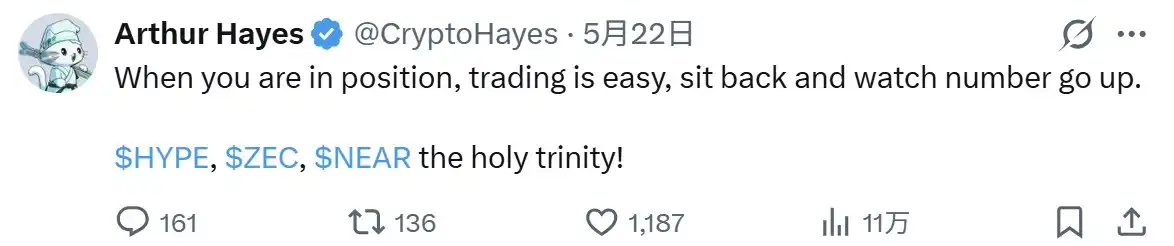
On May 22nd, BitMEX co-founder Arthur Hayes mentioned NEAR alongside HYPE and ZEC in an article, directly igniting market sentiment.

Privacy-Focused Public Chain

The blockchain industry has long faced the privacy dilemma of "transparency equals publicity." The surge of privacy coins like ZEC and XMR has refocused industry attention on the privacy track, with various protocols, including public chains, beginning to add privacy features.

NEAR was founded in 2018. Its initial core positioning was not AI, but scalability. Its earliest developments also focused on continuously optimizing sharding technology, making it one of the popular "Ethereum killer" public chains at the time.
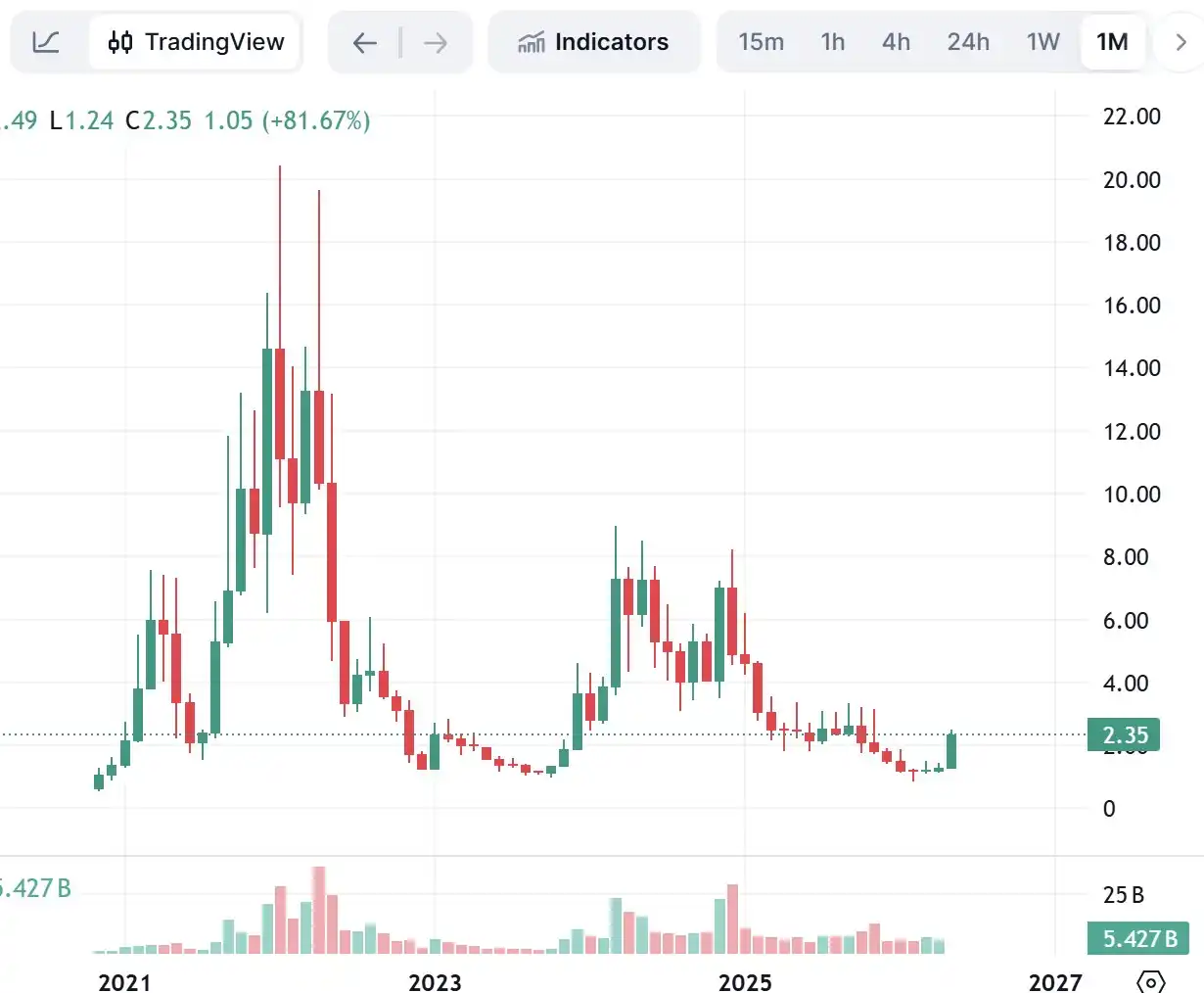
Because of this, NEAR's public sale on CoinList once caused the latter's website to crash. During the 2020-2021 bull market cycle, NEAR surged from $0.5 to a high of $20.59, becoming one of the most eye-catching star tokens of that era.

However, fast-forwarding to the current cycle, the vast majority of older tokens and new VC tokens have been largely abandoned by the market. Therefore, even in this bull cycle, NEAR only briefly reached a high of $9 in 2024 before declining, hitting a low of $0.84 in 2026.

After the official launch of NEAR Intents, privacy needs began to become very important. Intents are the core of cross-chain transactions, where users express their intent for execution. However, publicly conducting large transactions on-chain is vulnerable to MEV (Maximum Extractable Value) attacks. This drawback poses a significant obstacle for institutions, large holders, and ordinary DeFi users alike.

The NEAR team began planning privacy as an important complement to Intents. In late May this year, the NEAR Intents team launched the Confidential Payments and Confidential Intents features, supporting private cross-chain transfers of assets like ETH, BTC, SOL, and USDC across 35+ chains. The sender, amount, and path are all hidden, with only the result displayed on the target chain. The underlying technology uses a private shard + TEE (Trusted Execution Environment) bridge.
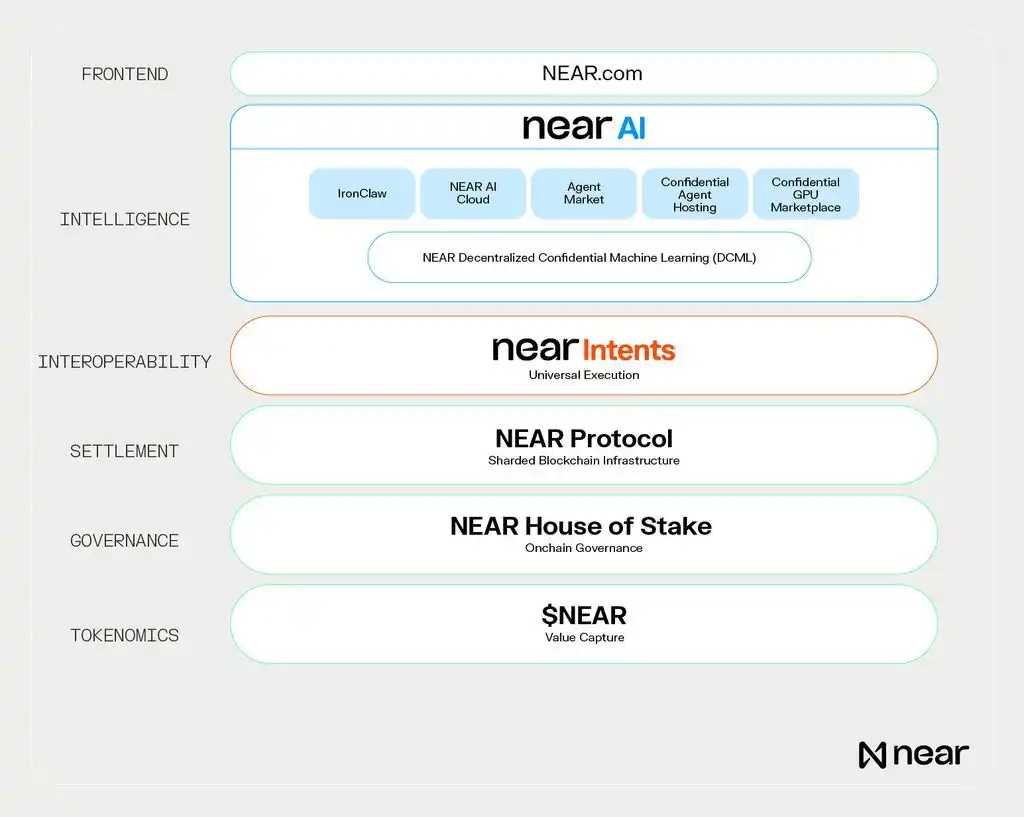
NEAR also opened a privacy mode, where user balances, transfers, and transaction activities are private by default. This prevents data leaks for ordinary users, enterprise users, and AI agents executing complex strategies. The Confidential Treasuries (Trezu) launched during the same period further supports private multi-signature, payroll, and cross-chain payments, having already processed $68 million in confidential transactions cumulatively.

Compared to pure privacy coins like Zcash, NEAR's balance between privacy and usability, as well as cross-chain functionality, is more practical. It also directly targets enterprise-level demands, driving a recovery in TVL and developer activity.

NEAR Intents Fee Buyback

In October 2025, NEAR completed the final batch of its initial supply unlock, with the circulation rate approaching 100%.
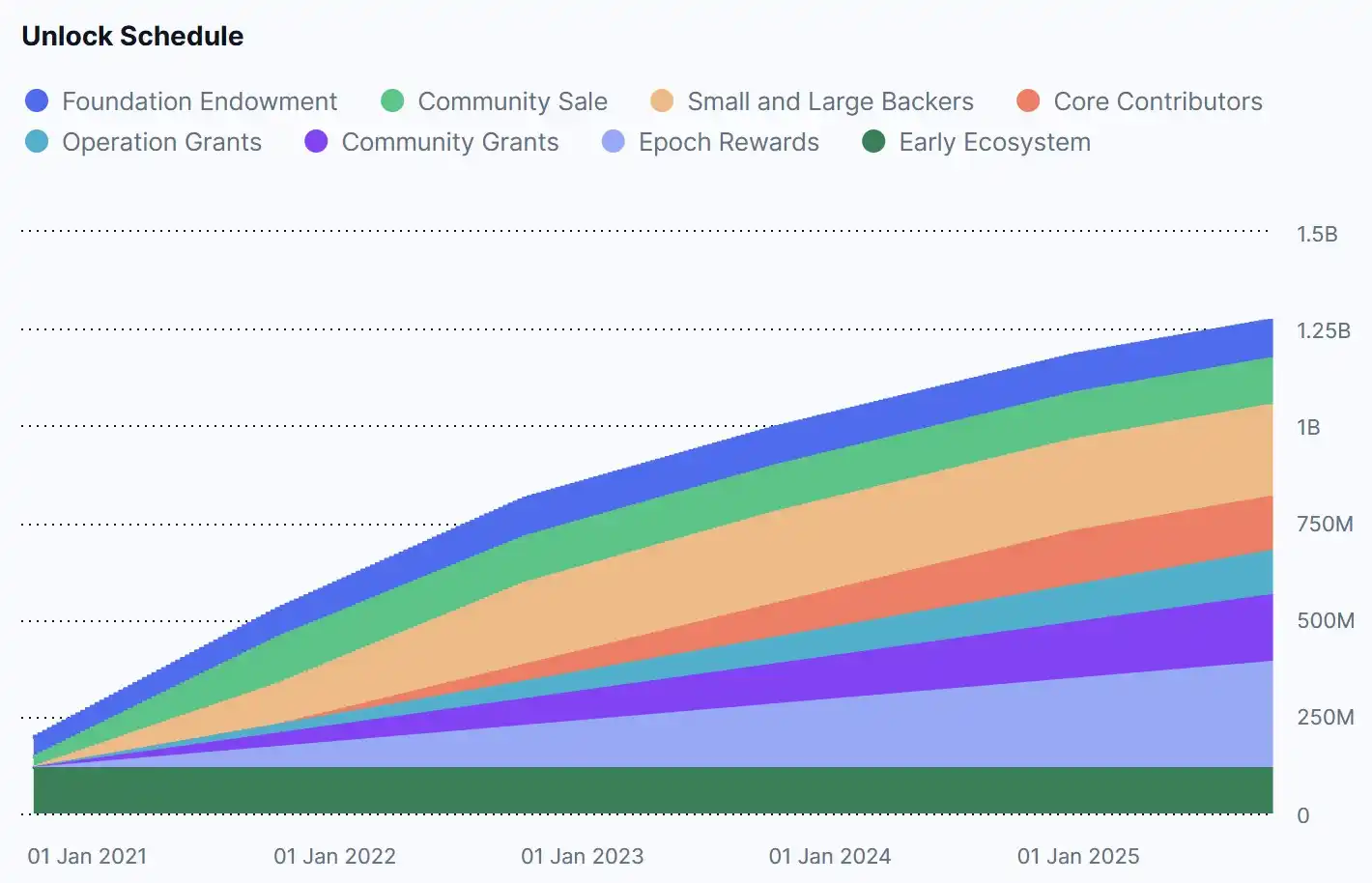
NEAR designed a dual mechanism of inflation + burning from the early days of its mainnet: a maximum annual inflation of 5% (permanently halved to 2.5% via an upgrade in October 2025), with 90% going to validators as rewards and 10% entering the protocol treasury. Entering 2026, the project has no major unlocks or linear unlock events, only regular epoch reward emissions (approximately 5.4 million NEAR released in the last 30 days, accounting for 0.4% of the total supply).

In addition, the fee revenue generated by NEAR Intents is used to directly buy back NEAR tokens on the market, also providing significant buying pressure.

NEAR's intent-driven cross-chain transaction layer on its protocol allows users to simply express the desired outcome (e.g., swapping BTC for SOL), and the system provides the optimal execution path, supporting multi-chain transactions without the need for bridging/wrapped assets and with low fees.

NEAR Intents previously had two fee components: protocol fees and distribution fees (shared with third-party integrators). However, protocol fees now entirely go towards the buyback path. The repurchased NEAR is not necessarily burned immediately but is instead staked, locked, or removed from liquidity. It still counts towards the total supply, reducing circulating supply pressure while also earning staking rewards.
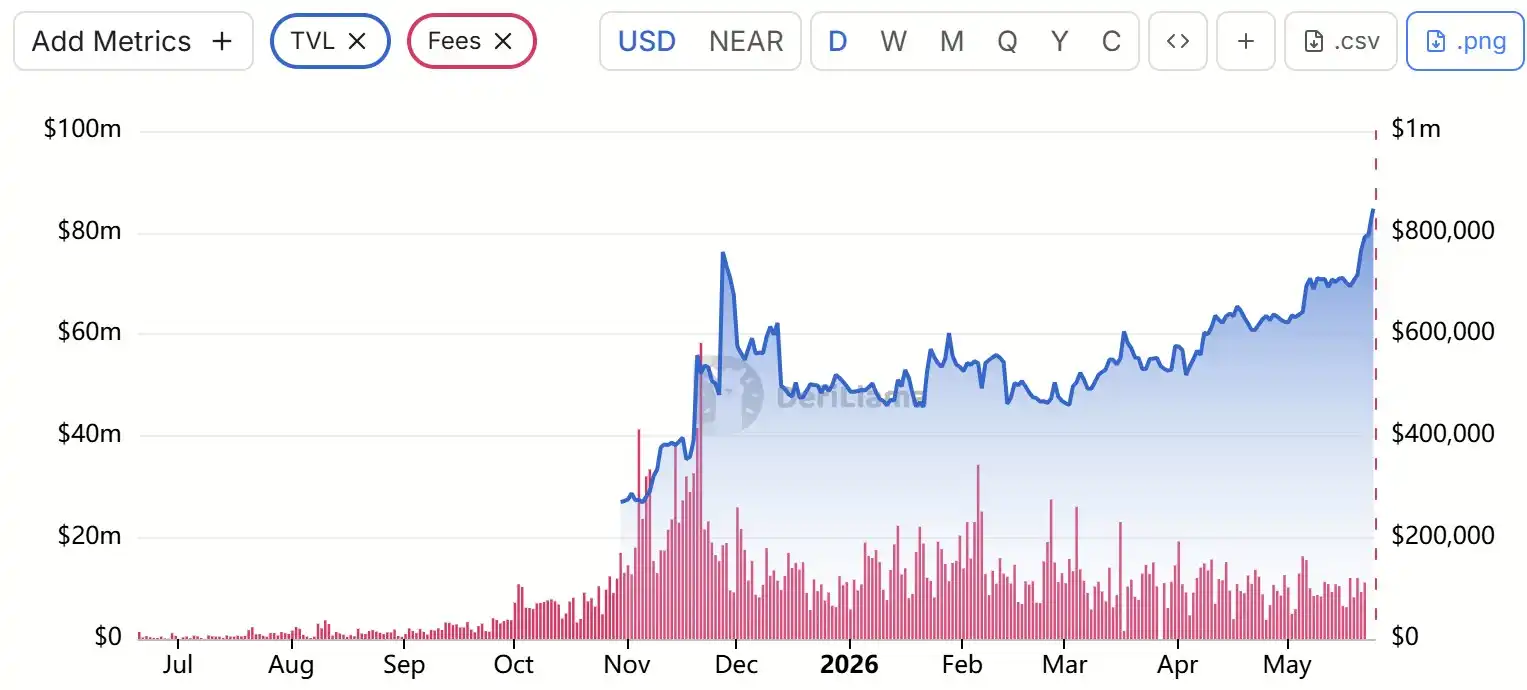
According to the latest data from defiLlama, the TVL of NEAR Intents has exceeded $80 million. Its daily generated fees fluctuate around $100,000, meaning the monthly buyback amount is approximately $3 million.

At the end of this month, its core development team, Near One, also announced the latest technological progress. The team will release dynamic resharding by the end of Q2 2026, significantly improving scalability. Additionally, the team will introduce NEAR's post-quantum secure signature scheme and related upgrades in June this year to enhance its resistance to quantum computing.


Связанные с этим вопросы

QWhat are the three main factors driving NEAR's recent price surge according to the article?

AAccording to the article, the three main factors driving NEAR's recent price surge are: 1) The strong AI narrative due to its co-founder's background and strategic focus. 2) Its evolution into a privacy-focused blockchain with features like Confidential Payments and Confidential Intents. 3) The token buyback mechanism fueled by fees generated from the NEAR Intents protocol.

QWhat significant event occurred in May 2026 that contributed to NEAR's price movement in the AI context?

AIn May 2026, BitMEX co-founder Arthur Hayes published an article that listed NEAR alongside tokens like HYPE and ZEC, which directly ignited market sentiment and contributed to its price movement.

QHow has NEAR's token supply situation evolved by 2026, and what is a key ongoing mechanism affecting its circulation?

ABy 2026, NEAR had completed the final unlock of its initial token supply, achieving a circulation rate close to 100%. A key ongoing mechanism is the permanent reduction of its annual inflation rate to 2.5% and, more importantly, the buyback of NEAR tokens using the fee revenue generated by the NEAR Intents protocol, which reduces selling pressure on the circulating supply.

QWhat are NEAR Intents, and what key privacy features were recently launched for them?

ANEAR Intents is an intent-driven cross-chain transaction layer on the NEAR protocol. Recently, the NEAR Intents team launched 'Confidential Payments' and 'Confidential Intents' features. These enable private cross-chain transfers of assets like ETH, BTC, and USDC across over 35 chains by hiding the sender, amount, and transfer path, only revealing the result on the target chain. This privacy is achieved using private shards and TEE (Trusted Execution Environment) bridges.

QWhat role did NEAR co-founder Illia Polosukhin play in the AI field before NEAR?

ABefore co-founding NEAR, Illia Polosukhin was one of the eight co-authors of the seminal 'Attention Is All You Need' paper that introduced the Transformer architecture. This architecture, which relies entirely on attention mechanisms, became the foundation for all major large language models like ChatGPT, Claude, and Gemini. He and his co-authors were from Google Brain/Google Research.

Похожее

CPU, Quietly Returning to the Center of the AI Computing Power Stage

Over the past three years, AI computing power narratives have been dominated by GPUs. However, starting in 2026, this story began to shift. While training large models remains GPU-intensive, the rapid growth of inference and AI agent workloads, which require high levels of task orchestration, concurrency, and data flow management, has highlighted a renewed critical role for CPUs. These are tasks GPUs are not designed to handle. Intel's recent launch of the Xeon 6+ processor, built on its Intel 18A process and featuring up to 288 efficiency cores (E-cores), exemplifies this strategic pivot. It is positioned not as a mere companion to GPUs but as the essential "control plane" for AI infrastructure, optimized for high-density, energy-efficient, and high-throughput workloads characteristic of AI agents and inference. This "CPU resurgence" is not about CPUs outperforming GPUs in raw computation. It reflects a systemic bottleneck: as AI scales from training single models to deploying countless intelligent agents, the demand for coordination and data handling surges. Major cloud providers are also developing their own high-density ARM-based server CPUs for similar workloads. However, Intel's success with this strategy faces significant challenges. Competition includes NVIDIA's integrated CPU-GPU solutions, the expanding adoption of cloud vendors' in-house ARM CPUs, and the crucial market test of Intel's 18A manufacturing process against rivals like TSMC's N2. In conclusion, CPUs are indeed reclaiming a central, though redefined, role in AI compute—managing the complex orchestration that enables massive-scale AI deployment. While the trend is clear, which company will ultimately lead this CPU resurgence remains an open question to be decided in the data centers of 2027 and beyond.

marsbit9 мин. назад

CPU, Quietly Returning to the Center of the AI Computing Power Stage

marsbit9 мин. назад

After Collaborating with 35+ DeFi Projects, Pink Brains Discovers the New 2026 KOL Marketing Rules

After collaborating with over 35 leading DeFi projects on marketing over three years, Pink Brains identifies a key shift for effective marketing in 2026: prioritizing the user journey over traditional campaign tactics. The most effective marketing mirrors how users actually behave—starting with discovery on social platforms like X (formerly Twitter), followed by data-driven verification on sites like DefiLlama, and finally, participation with small test funds. Success hinges on genuine, verifiable mechanisms, not just marketing hype. Current user interest centers on several key themes: new DeFi trends (RWA, perps, crypto x AI), meaningful airdrops requiring real contributions, real yield from protocol revenue, and tokens with value capture mechanisms directly tied to product usage. Case studies like Hyperliquid's HYPE (with its aggressive buyback program) and Venice's VVV (linking demand to AI compute) exemplify how strong tokenomics foster user retention. New trading venues like prediction markets, collectibles platforms, and GambleFi are also gaining traction, driven by verifiable activity. The article outlines common mistakes in DeFi KOL marketing, such as using creators unfamiliar with the product, generic messaging, or relying on a few top-tier KOLs. Instead, effective strategies align with different KOL types—educators, content creators, airdrop hunters, and niche experts—for various stages of the user journey. Ultimately, long-term user retention depends on a combination of a genuinely useful product, responsive support, community-aligned tokenomics, and strategic community building. The core takeaway is that sustainable growth stems from products whose value is validated by data and real-world utility, not just promotional efforts.

marsbit27 мин. назад

After Collaborating with 35+ DeFi Projects, Pink Brains Discovers the New 2026 KOL Marketing Rules

marsbit27 мин. назад

Торговля

Спот
Фьючерсы

Популярные статьи

Как купить S

Добро пожаловать на HTX.com! Мы сделали приобретение Sonic (S) простым и удобным. Следуйте нашему пошаговому руководству и отправляйтесь в свое крипто-путешествие.Шаг 1: Создайте аккаунт на HTXИспользуйте свой адрес электронной почты или номер телефона, чтобы зарегистрироваться и бесплатно создать аккаунт на HTX. Пройдите удобную регистрацию и откройте для себя весь функционал.Создать аккаунтШаг 2: Перейдите в Купить криптовалюту и выберите свой способ оплатыКредитная/Дебетовая Карта: Используйте свою карту Visa или Mastercard для мгновенной покупки Sonic (S).Баланс: Используйте средства с баланса вашего аккаунта HTX для простой торговли.Третьи Лица: Мы добавили популярные способы оплаты, такие как Google Pay и Apple Pay, для повышения удобства.P2P: Торгуйте напрямую с другими пользователями на HTX.Внебиржевая Торговля (OTC): Мы предлагаем индивидуальные услуги и конкурентоспособные обменные курсы для трейдеров.Шаг 3: Хранение Sonic (S)После приобретения вами Sonic (S) храните их в своем аккаунте на HTX. В качестве альтернативы вы можете отправить их куда-либо с помощью перевода в блокчейне или использовать для торговли с другими криптовалютами.Шаг 4: Торговля Sonic (S)С легкостью торгуйте Sonic (S) на спотовом рынке HTX. Просто зайдите в свой аккаунт, выберите торговую пару, совершайте сделки и следите за ними в режиме реального времени. Мы предлагаем удобный интерфейс как для начинающих, так и для опытных трейдеров.

1.4k просмотров всегоОпубликовано 2025.01.15Обновлено 2026.06.02

Как купить S

Sonic: Обновления под руководством Андре Кронье – новая звезда Layer-1 на фоне спада рынка

Он решает проблемы масштабируемости, совместимости между блокчейнами и стимулов для разработчиков с помощью технологических инноваций.

2.3k просмотров всегоОпубликовано 2025.04.09Обновлено 2025.04.09

Sonic: Обновления под руководством Андре Кронье – новая звезда Layer-1 на фоне спада рынка

HTX Learn: Пройдите обучение по "Sonic" и разделите 1000 USDT

HTX Learn — ваш проводник в мир перспективных проектов, и мы запускаем специальное мероприятие "Учитесь и Зарабатывайте", посвящённое этим проектам. Наше новое направление .

1.8k просмотров всегоОпубликовано 2025.04.10Обновлено 2025.04.10

HTX Learn: Пройдите обучение по "Sonic" и разделите 1000 USDT

Обсуждения

Добро пожаловать в Сообщество HTX. Здесь вы сможете быть в курсе последних новостей о развитии платформы и получить доступ к профессиональной аналитической информации о рынке. Мнения пользователей о цене на S (S) представлены ниже.

活动图片