Interpreting Polymarket's Major Updates Last Night: Expanded Fees, Self-Regulation, and New Incentives

Odaily星球日报Опубликовано 2026-03-24Обновлено 2026-03-24

Введение

Polymarket, a prediction market platform, announced a series of major updates focused on self-regulation, fee expansion, and new incentive mechanisms. Key updates include enhanced market integrity rules explicitly prohibiting insider trading, market manipulation, and trading by entities capable of influencing event results. This aims to increase transparency and build regulatory trust. A new dynamic fee structure will be implemented starting March 30, 2026, expanding beyond Crypto and Sports to include Finance, Politics, Economics, Culture, and Weather. Fees peak when contract prices are near 50% probability. The platform also opened its referral program to all users with over $10k in trading volume, offering a 30% fee rebate for direct referrals and 10% for secondary ones. Additionally, a market maker rebate program was launched, redistributing a portion of taker fees to liquidity providers daily in USDC, with rebate rates varying by market. While the community anticipated a token airdrop, the announced updates are seen as long-term operational improvements, with overall positive sentiment.

Original | Odaily Planet Daily (@OdailyChina)

Author | Asher (@Asher_ 0210)
Last Saturday, Mustafa, a member of the Polymarket official team, posted on X platform that major news would be announced on Monday.
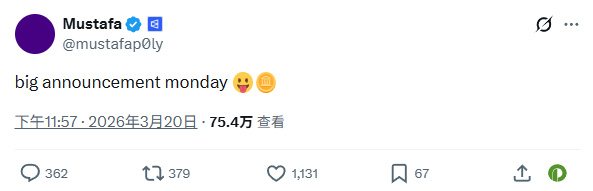
Activity of Polymarket official team member last weekend

As expected, Polymarket official released multiple major updates from last night to today. Next, Odaily Planet Daily will break them down for you one by one.

Updated Market Integrity Rules: Anti-Insider Trading, Anti-Manipulation

Last night, Polymarket announced updates to its market integrity rules for both its DeFi platform and its CFTC-regulated US exchange, further clarifying regulatory requirements regarding insider trading and market manipulation. Neal Kumar, Chief Legal Officer of Polymarket, stated: "Market prosperity relies on transparency. The refinement of these rules makes our expectations for all participants on both platforms clear and highlights the compliance infrastructure we have established. As Polymarket continues to grow, we will continue to solidify our foundation, ensuring our markets achieve their greatest strength—revealing the truth—through clear communication with users."

The new rules detail three types of prohibited behaviors, specifically including:

  • Trading using non-public information: If a participant possesses confidential information about the outcome or potential outcome of the subject event, and using this information would violate a pre-existing duty of trust or confidence owed to another person or entity, the participant must not trade any contracts.
  • Building positions based on illegal information sources: Participants must not trade using confidential information provided to them by others if the information was provided by someone who owes a pre-existing duty of trust or confidence to another, and the participant knows or has reason to know that the person providing the information would themselves be prohibited from using it for trading;
  • Entities with the ability to influence event outcomes participating in trading: If a participant has sufficient authority or influence to affect the outcome of the subject event, they must not participate in trading any contracts.

Simultaneously, the platform explicitly prohibits behaviors such as wash trading, matched orders, and price manipulation, and has launched a dedicated page to explain the rules and provide a channel for reporting anomalous behavior. Furthermore, Polymarket stated that its DeFi platform identifies risks through on-chain transparency mechanisms and a multi-layer monitoring system, while its US platform combines technical monitoring with collaboration from industry regulators to investigate and penalize violations.

This round of rule updates essentially redefines the market boundaries of Polymarket: which information can be traded, and which behaviors are directly excluded. Surrounding insider information, information sources, and the ability to influence event outcomes, the platform has turned previously ambiguous gray areas into clear "no-go" red lines, while simultaneously introducing monitoring and reporting mechanisms to bring trading behavior into a more traceable framework.

More importantly, this points to a change in the platform's positioning. Polymarket is shifting from the external perception of a "high-risk gambling arena" towards emphasizing information pricing and transparency as market infrastructure. By proactively strengthening compliance and rule expression, it aims to gain trust at the regulatory and public levels, laying the groundwork for subsequent broader expansion.

The Era of "Big Fees" Arrives: Fees Applied to All Except Geopolitical Events

According to the latest official Polymarket documentation, the platform will adjust its fee mechanism starting March 30, 2026. Building on the current Crypto and Sports categories, it will add multiple market categories such as Finance, Politics, Economics, Culture, Weather, etc., into the scope of taker fee charges.

The new fee rate is calculated using a dynamic formula directly related to price intervals. Overall, the new fee structure shows a distribution of "high in the middle, low at the ends": when the price is close to a 50% probability, the effective rate peaks, while in extreme intervals near 0% or 100%, the fee significantly decreases, potentially even being rounded down to 0 for very small trades.

Under the current fee system, the peak effective rate for Crypto markets is about 1.56%, and for Sports about 0.44%. In the new fee structure about to take effect, the differences between categories are further widened. For example, Crypto peaks at about 1.80%, Finance and Politics at about 1.00%, and Economics can reach 1.50%. Simultaneously, the corresponding maker rebate ratios for various categories are also set, e.g., Finance is as high as 50%, with most other categories around 25%.

The fee calculation is based on a unified formula, dynamically calculated by combining trade shares, price, and different market parameters. Fees are denominated in USDC but are charged in "share form" for buy orders and deducted in USDC for sell orders.
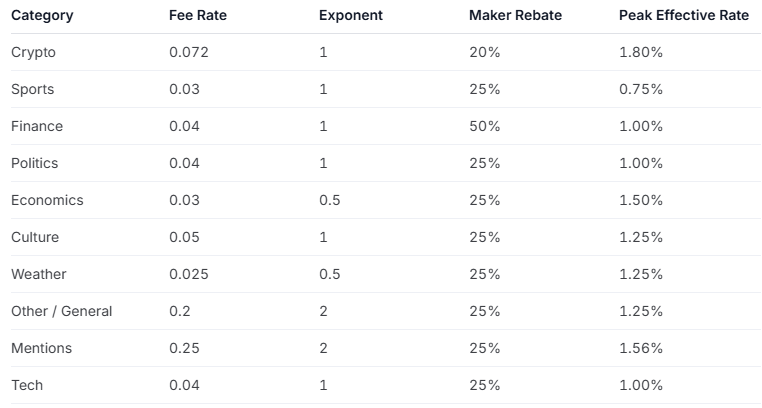
New fee charging standards for various markets

Not News Related to Financing or Token Airdrops, But Opening a Referral Program

This morning, Polymarket posted on X platform announcing that the referral program has been expanded from the internal testing phase to all traders with a trading volume exceeding $10, 000. Eligible users can receive rewards proportional to the trading volume of the new users they refer. Specific invitation details are as follows:

  • 30% fee rebate from direct referrals, 10% fee rebate from secondary referrals (rewards will be valid for the first 180 days after the user registers with Polymarket, this period may be subject to change without notice);
  • Fee rebate rewards are distributed daily (UTC);
  • Rewards are uncapped; the more your referred users trade on the platform, the more you earn.
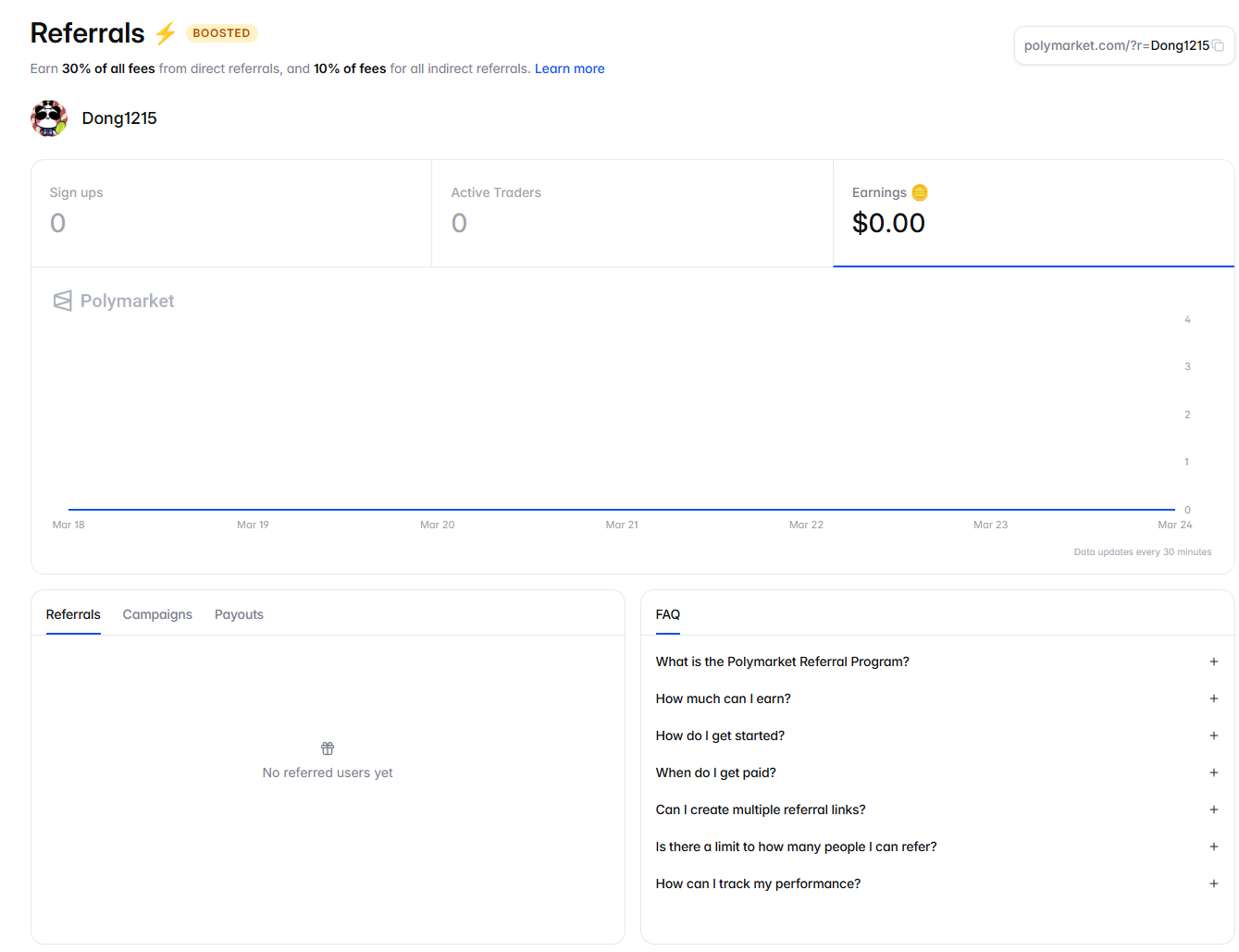
Polymarket invitation interface

Launch of Market Maker Rebate Program

In addition to opening the referral program, to incentivize continuous and competitive quoting, thereby providing a better trading experience for all traders, Polymarket has launched a market maker rebate program. Specifically, this mechanism redistributes a portion of the taker fees to liquidity providers (market makers), effectively redistributing trading costs among market participants.

Rebates are settled and distributed daily in USDC. Only successfully placed orders that are executed contribute to the allocation. The overall profit is not a fixed value but is calculated based on the proportion of liquidity contribution in the actual executed trades. The more trades executed and the higher the contribution, the corresponding rebate received is greater.

In terms of allocation logic, the system calculates the "fee equivalent value" for each executed trade, synthesizing the executed quantity, price, and fee parameters of different markets, and aggregates this within the same market. The final rebate is allocated according to each market maker's contribution share, meaning competition exists not only in whether the quote is executed but also in the price range of the quote and the fee contribution it brings. Overall, this rebate comes from the taker-paid fees, with varying rebate ratios across different markets, e.g., Crypto is 20%, Finance can be 50%, and most categories are around 25%.
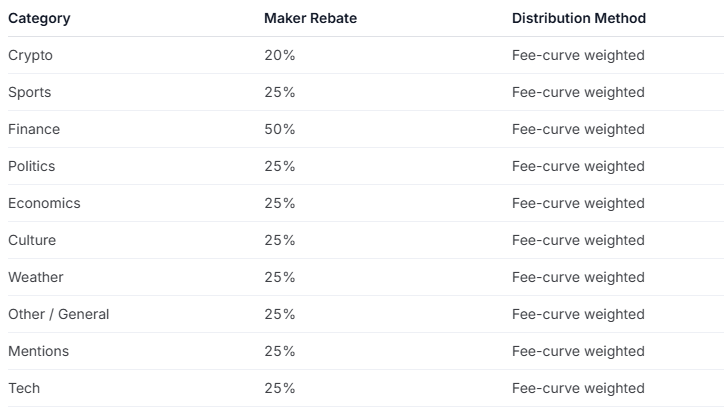
Rebate ratio situation across markets

No Information on Token Airdrops, But Overall Community Sentiment is Optimistic

Although the community previously anticipated that the "major news" might point to a token or airdrop, what ultimately materialized was a combination of updates to fees, rebates, and the referral system. Looking at the outcome, this mechanism leans more towards long-term incentive design rather than a one-time release of expectations. However, sentiment did not cool down because of this; instead, with clear, actionable paths for participation, the overall feedback from the trading community has been positive.

Many users already see the referral program as a "de facto airdrop entry," especially KOLs with their own traffic or community resources, who have noticeably increased their sharing efforts, with some even treating it as a long-term income stream; after the market maker rebate went live, feedback from the LP side was also direct, with more people reassessing their market making strategies, showing a clear increase in willingness to participate.

In contrast, arbitrage traders and those scanning for end-of-market opportunities are calmer. With the arrival of the new fee rules, some previously viable arbitrage spaces will be compressed, strategies need recalculation, and trading rhythms consequently tend to收敛 (converge, become more conservative), relying more on precise execution and cost control.

However, after Polymarket and Kalshi came under regulatory scrutiny, their valuations in the coming period will likely be worn down by policy tensions. (Related news:US lawmakers to propose bipartisan bill banning sports predictions on prediction markets like Polymarket)

Связанные с этим вопросы

QWhat are the three main types of prohibited behaviors under Polymarket's updated market integrity rules?

AThe three main types of prohibited behaviors are: 1. Trading using non-public information that violates a pre-existing duty of trust. 2. Trading based on illegal information sources, if the participant knows the provider of the information was themselves prohibited from using it. 3. Participating in any contract if the participant has the authority or influence to affect the outcome of the event.

QWhen will Polymarket's new fee mechanism take effect, and what is the major change?

AThe new fee mechanism will take effect on March 30, 2026. The major change is the expansion of the taker fee to cover multiple new market categories beyond just Crypto and Sports, including Finance, Politics, Economics, Culture, and Weather.

QWhat is the purpose of Polymarket's newly launched Market Maker Rebate Program?

AThe purpose of the Market Maker Rebate Program is to incentivize continuous and competitive quoting by redistributing a portion of the taker fees back to the market makers who provide liquidity, thereby improving the overall trading experience for all participants.

QWho is eligible to participate in Polymarket's newly expanded Referral Program?

AThe Referral Program has been expanded to all traders with a trading volume exceeding $10,000.

QHow does the new dynamic fee structure work in terms of the relationship between price and the fee rate?

AThe new fee structure features a 'middle high, ends low' distribution. The effective fee rate peaks when the price is near a 50% probability and decreases significantly as the price approaches 0% or 100%, with very small trades potentially being rounded down to a fee of 0.

Похожее

Fu Peng's First Public Speech in 2026: What Exactly Are Crypto Assets? Why Did I Join the Crypto Asset Industry?

Fu Peng, a renowned macroeconomist and now Chief Economist at New火 Group, delivered his first public speech of 2026 at the Hong Kong Web3 Festival. He explained his perspective on crypto assets and why he joined the industry, framing it within the context of macroeconomic trends and financial evolution. Fu emphasized that crypto assets are transitioning from an early, belief-driven phase to a mature, institutionally integrated asset class. He drew parallels to the 1970s-80s, when technological advances (like computing) revolutionized traditional finance, leading to the rise of FICC (Fixed Income, Currencies, and Commodities). Similarly, current advancements in AI, data, and blockchain are reshaping finance, with crypto assets becoming part of a new "FICC + C" (C for Crypto) framework. He noted that institutional capital, including traditional hedge funds, avoided early crypto due to its speculative nature but are now engaging as regulatory clarity emerges (e.g., stablecoin laws, CFTC classifying crypto as a commodity). Fu predicted that 2025-2026 marks a turning point where crypto becomes a standardized, financially viable asset for diversified portfolios, akin to commodities or derivatives in traditional finance. Fu defined Bitcoin not as "digital gold" in a simplistic sense but as a value-preserving, financially tradable asset. He highlighted that crypto's future lies in regulated, institutional adoption, moving away from retail-dominated trading. His entry into crypto signals this maturation, where traditional finance integrates crypto into mainstream asset management.

marsbit8 мин. назад

Fu Peng's First Public Speech in 2026: What Exactly Are Crypto Assets? Why Did I Join the Crypto Asset Industry?

marsbit8 мин. назад

Justin Sun Sues Trump Family: What $75 Million Bought Was Only a Blacklist

Justin Sun, founder of Tron, has filed a lawsuit in federal court against World Liberty Financial (WLF), alleging he was made the "primary target of a fraudulent scheme" after investing $75 million. Sun claims the investment secured him an advisor title and WLFI tokens, which were later frozen by WLF, causing "hundreds of millions in losses." The dispute began in late 2024 when Sun's investment helped revive WLF's struggling token sale, which ultimately raised $550 million. Shortly after, the SEC dropped its lawsuit against Sun following Donald Trump's inauguration. However, relations soured when Sun refused WLF's demands for additional funding. In August 2025, WLF added a "blacklist" function to its smart contract, allowing it to unilaterally freeze tokens. Sun's holdings, worth approximately $107 million, were frozen, and he was threatened with token destruction. The lawsuit highlights WLF's structure, which directs 75% of token sale profits to the Trump family, who had earned $1 billion by December 2025. WLF's CEO is Zach Witkoff, son of U.S. Middle East envoy Steve Witkoff. The project faces scrutiny for opaque operations, including a controversial loan arrangement on the Dolomite platform, co-founded by a WLF advisor. Despite Sun's history with the SEC, the case underscores centralization risks within DeFi, as WLF controls governance and holds powers to freeze assets arbitrarily. Sun's tokens remain frozen as legal proceedings begin.

marsbit16 мин. назад

Justin Sun Sues Trump Family: What $75 Million Bought Was Only a Blacklist

marsbit16 мин. назад

$500 to Buy OpenAI Stock: Silicon Valley's Most Respectable Liquidity Invitation

Silicon Valley's largest venture capital platform, AngelList, has launched a new fund called USVC, allowing U.S. retail investors to buy into high-profile AI companies like OpenAI, Anthropic, and xAI with a minimum investment of $500—no accredited investor status required. Promoted by AngelList co-founder Naval Ravikant, the fund is framed as an opportunity for ordinary people to access high-growth private tech investments traditionally reserved for VCs. However, critics argue it functions more like an exit vehicle for early insiders. USVC acquires shares not through primary rounds but largely via secondary transactions—purchasing stakes from early investors, VC funds, and employees looking to cash out at peak valuations. With companies like xAI heavily weighted in the portfolio, the fund effectively channels retail money into providing liquidity for insiders who entered at much lower valuations. The fund’s structure raises concerns: shares are illiquid, with no secondary market, and buybacks are limited and discretionary. The actual annual fee reaches 3.61%, far above the advertised 1% management fee. This model parallels the "low float, high fully diluted valuation" strategy seen in crypto, where early investors profit by selling to latecomers at inflated prices. The timing—alongside similar moves by platforms like Robinhood—suggests that Silicon Valley’s sudden interest in retail inclusion may be less about democratizing access and more about securing exits for insiders.

marsbit47 мин. назад

$500 to Buy OpenAI Stock: Silicon Valley's Most Respectable Liquidity Invitation

marsbit47 мин. назад

Торговля

Спот
Фьючерсы

Популярные статьи

Как купить S

Добро пожаловать на HTX.com! Мы сделали приобретение Sonic (S) простым и удобным. Следуйте нашему пошаговому руководству и отправляйтесь в свое крипто-путешествие.Шаг 1: Создайте аккаунт на HTXИспользуйте свой адрес электронной почты или номер телефона, чтобы зарегистрироваться и бесплатно создать аккаунт на HTX. Пройдите удобную регистрацию и откройте для себя весь функционал.Создать аккаунтШаг 2: Перейдите в Купить криптовалюту и выберите свой способ оплатыКредитная/Дебетовая Карта: Используйте свою карту Visa или Mastercard для мгновенной покупки Sonic (S).Баланс: Используйте средства с баланса вашего аккаунта HTX для простой торговли.Третьи Лица: Мы добавили популярные способы оплаты, такие как Google Pay и Apple Pay, для повышения удобства.P2P: Торгуйте напрямую с другими пользователями на HTX.Внебиржевая Торговля (OTC): Мы предлагаем индивидуальные услуги и конкурентоспособные обменные курсы для трейдеров.Шаг 3: Хранение Sonic (S)После приобретения вами Sonic (S) храните их в своем аккаунте на HTX. В качестве альтернативы вы можете отправить их куда-либо с помощью перевода в блокчейне или использовать для торговли с другими криптовалютами.Шаг 4: Торговля Sonic (S)С легкостью торгуйте Sonic (S) на спотовом рынке HTX. Просто зайдите в свой аккаунт, выберите торговую пару, совершайте сделки и следите за ними в режиме реального времени. Мы предлагаем удобный интерфейс как для начинающих, так и для опытных трейдеров.

1.2k просмотров всегоОпубликовано 2025.01.15Обновлено 2025.03.21

Как купить S

Sonic: Обновления под руководством Андре Кронье – новая звезда Layer-1 на фоне спада рынка

Он решает проблемы масштабируемости, совместимости между блокчейнами и стимулов для разработчиков с помощью технологических инноваций.

2.2k просмотров всегоОпубликовано 2025.04.09Обновлено 2025.04.09

Sonic: Обновления под руководством Андре Кронье – новая звезда Layer-1 на фоне спада рынка

HTX Learn: Пройдите обучение по "Sonic" и разделите 1000 USDT

HTX Learn — ваш проводник в мир перспективных проектов, и мы запускаем специальное мероприятие "Учитесь и Зарабатывайте", посвящённое этим проектам. Наше новое направление .

1.8k просмотров всегоОпубликовано 2025.04.10Обновлено 2025.04.10

HTX Learn: Пройдите обучение по "Sonic" и разделите 1000 USDT

Обсуждения

Добро пожаловать в Сообщество HTX. Здесь вы сможете быть в курсе последних новостей о развитии платформы и получить доступ к профессиональной аналитической информации о рынке. Мнения пользователей о цене на S (S) представлены ниже.

活动图片