In a Losing Bear Market, Who Is Quietly Making a Fortune?

Odaily星球日报Опубликовано 2026-04-10Обновлено 2026-04-10

Введение

Amid a prolonged bear market where most crypto participants are losing money, a few projects continue to generate significant revenue. A closer look at Defillama’s revenue rankings reveals that profitable projects share simple and clear revenue models, primarily falling into two categories: spread income and transaction fees. Spread-based revenue models involve acting as capital intermediaries—absorbing funds at lower costs and deploying them at higher yields. Examples include stablecoin issuers like Tether and Circle, which earn from interest on reserve assets like U.S. Treasuries; lending protocols such as Aave, which profit from the spread between borrowing and deposit rates; and liquid staking services like Lido, which retain a portion of staking rewards as fees. Transaction fee models generate revenue by taxing activities like trading, token creation, or other on-chain actions. Platforms such as Hyperliquid and EdgeX (perpetual trading), Polymarket (event prediction), pump.fun and GMGN (meme trading), Aerodrome and Jupiter (spot trading), as well as Phantom (via swap fees) and NFT marketplaces like Courtyard and Fragment, all rely heavily on transaction fees. Notable exceptions include Grayscale (traditional asset management fees), Chainlink (oracle data service fees), and Titan Builder (which profited unusually from a large MEV capture incident). The key insight is that sustainable profitability in a bear market comes from straightforward revenue models combined with...

Original | Odaily Planet Daily (@OdailyChina)

Author | Azuma (@azuma_eth)

The market remains sluggish, with funds performing poorly, protocols shutting down, major holders staying silent, and retail investors bleeding... It seems like everyone from top to bottom in the industry is losing money. However, even in such a cold market environment, a very few projects are still running their money-printing machines at full throttle.

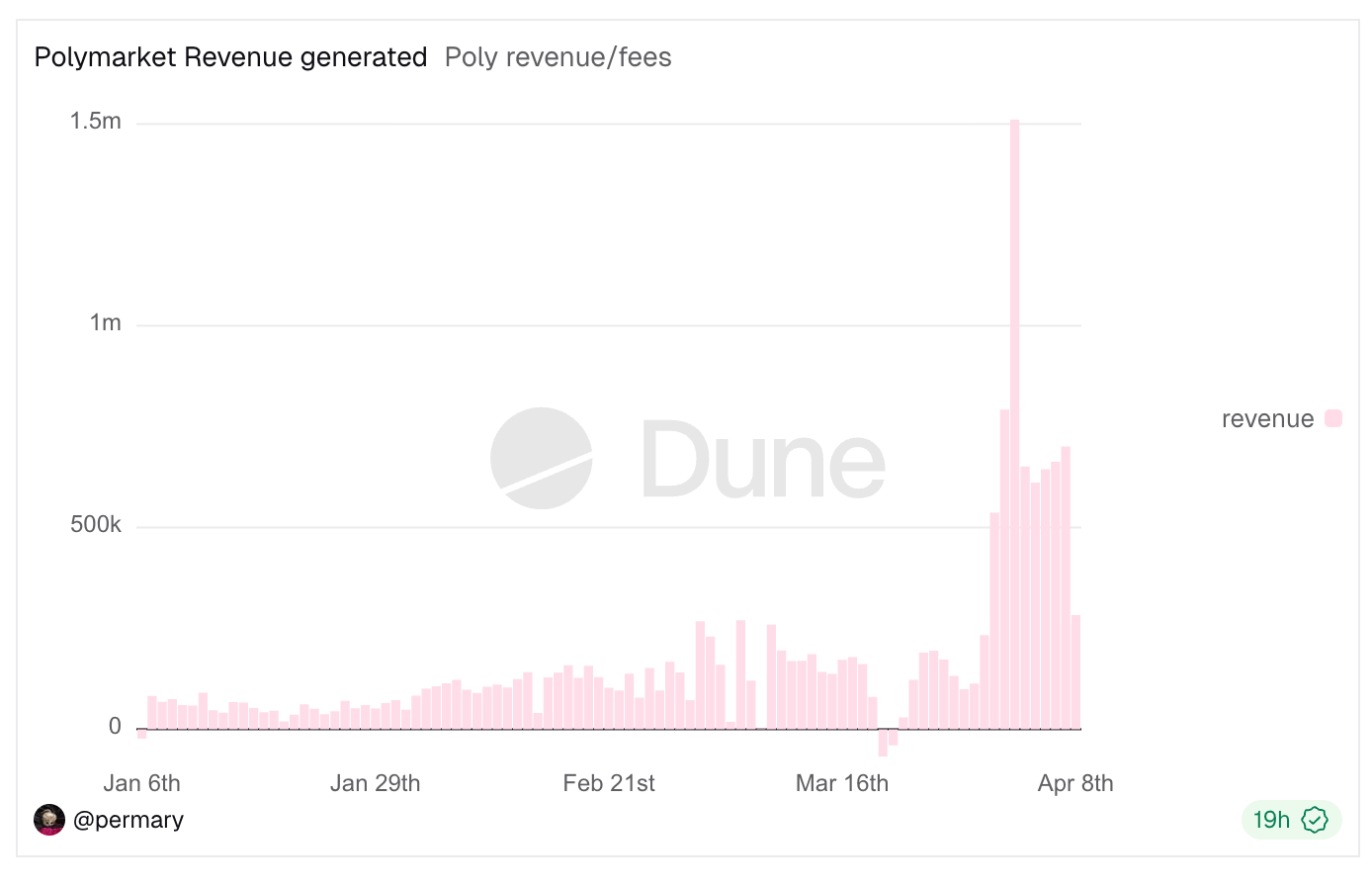
The latest example is Polymarket, which has fully opened its fee gates. Since recently broadening its fee scope and revising its fee formula (recommended reading: "Hardcore Analysis of Polymarket's Fee Formula: How Did Extreme Rates of 90+% Emerge?"), Polymarket's revenue-generating capacity has significantly surged; as of publication, Polymarket's total fee income has exceeded $24 million, with a single-day record of $1.5 million in revenue on April 2.
Taking this opportunity, I browsed the revenue rankings on Defillama to see which businesses are still consistently making money during the bear market, and the results were quite surprising: The core businesses and revenue sources of the listed projects are quite clear, even "simple."
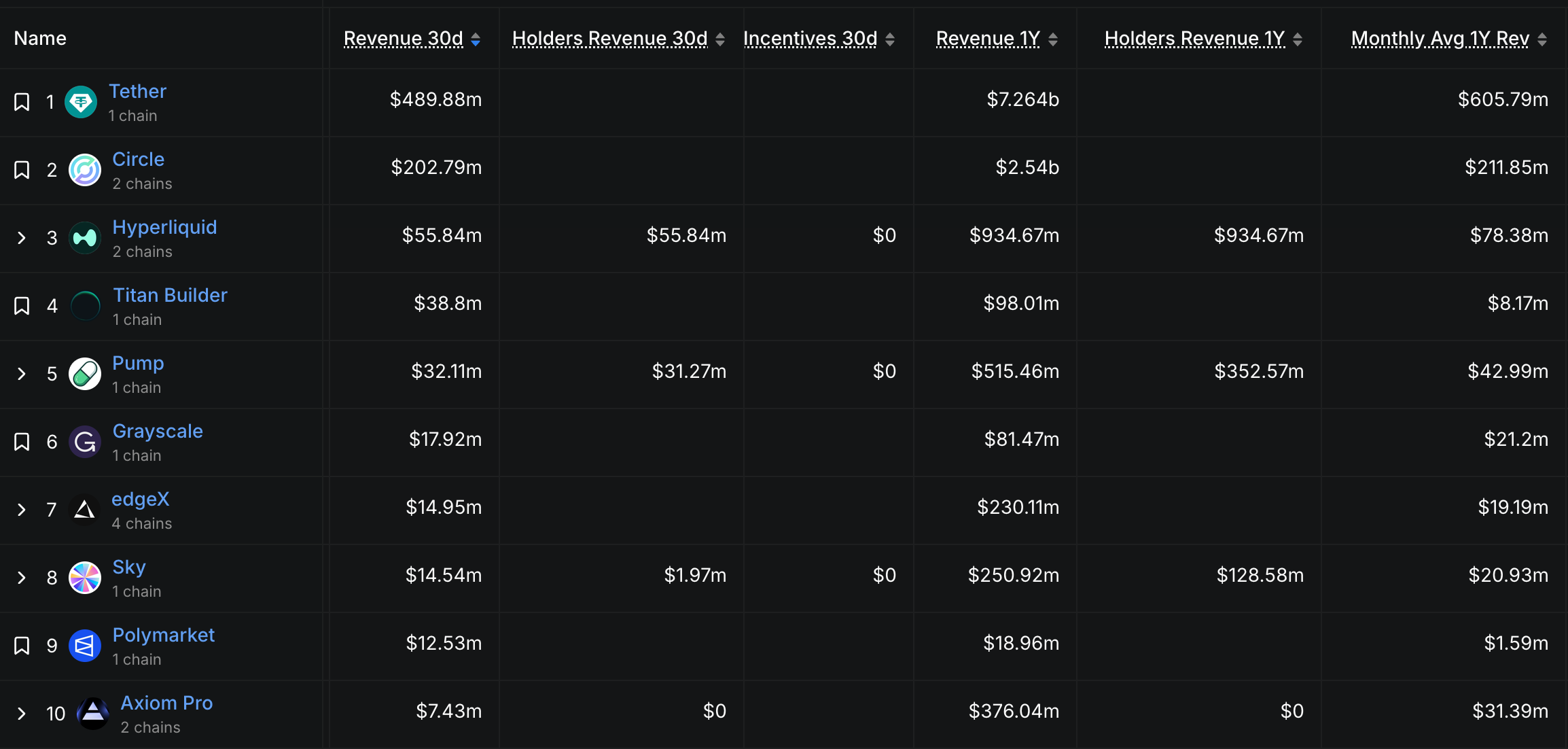
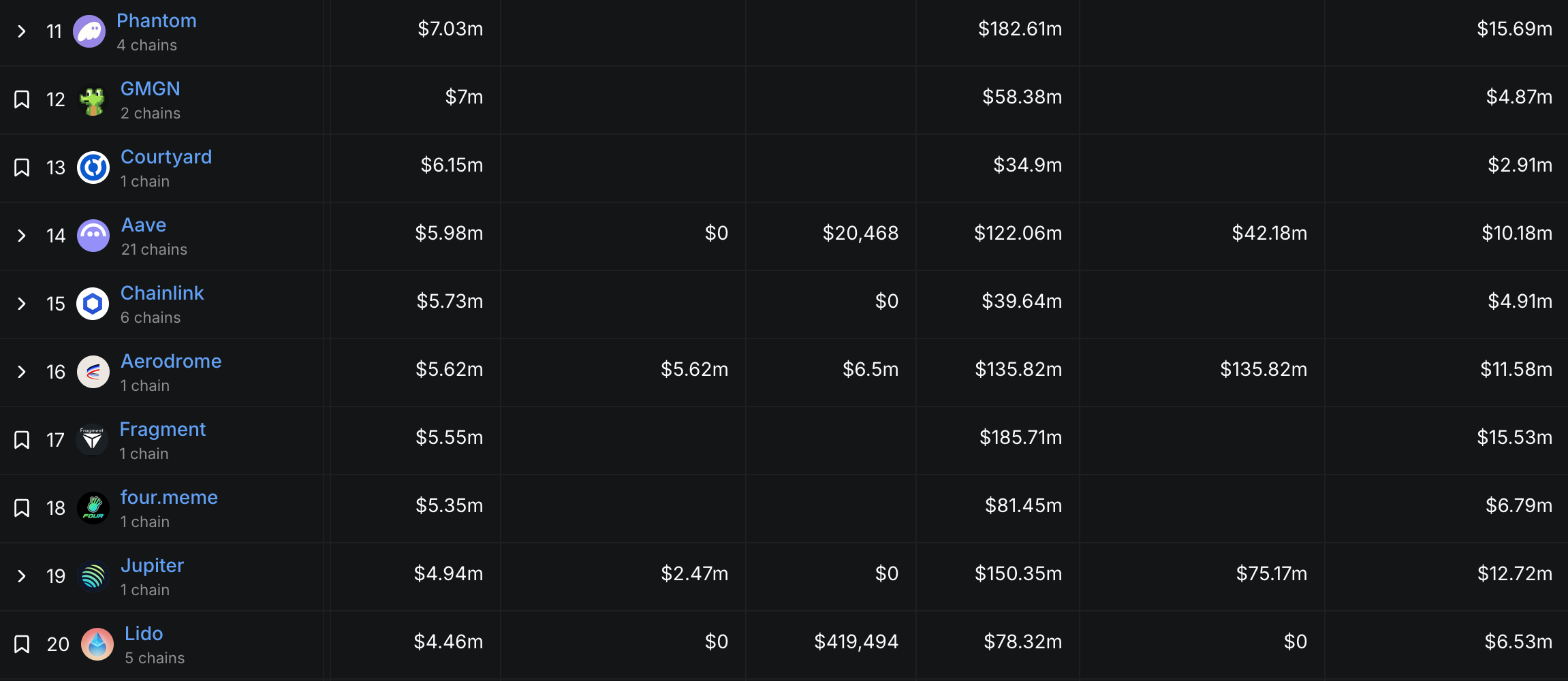
As shown above, I believe most players deeply involved in the crypto market could guess most of these names even without looking at the answers, and probably know exactly what they do. But when these names are neatly listed together, I suddenly realized that the main revenue sources of these profitable businesses are highly convergent, and can essentially be summarized into two broad categories: first, interest spreads, and second, transaction taxes (fees).

First, interest spreads: This is essentially acting as a "capital intermediary." The core logic is to absorb funds at relatively low costs and deploy them at relatively high returns, using time to gradually accumulate the difference between returns and costs — the profit of such businesses depends on the scale and duration of capital沉淀; the larger the scale and the longer the time, the higher the profit.

Tether, Circle, and other stablecoin issuers fall into this category. Their main income comes from the interest generated by deploying reserve funds into assets like U.S. Treasury bonds, while their costs mainly involve subsidies paid to partners and users. The difference between the two is the profit. Lending protocols like Aave also belong here, with the spread being the difference between the relatively higher borrowing rates and the relatively lower deposit rates. Liquid staking services (LST) like Lido are no exception; they withhold a certain percentage from ETH's native staking rewards as a service fee, which is also a form of interest spread.

Second, transaction taxes: This type of business is easier to understand. Whenever transaction-related activities (including token creation) occur, the business entity can "tax" the activity in the form of fees — the profit of such businesses depends on the transaction size per activity and the frequency of activities; the larger the size and the higher the frequency, the greater the profit.

Whether it's Hyperliquid and EdgeX focusing on contract trading, Polymarket focusing on event trading, pump.fun, GMGN, Axiom, and four.meme focusing on Meme trading, Aerodrome, Jupiter, and Phantom (whose main revenue comes from Swap fees on the wallet frontend) focusing on spot trading, or Courtyard and Fragment focusing on NFT trading (it's quite a surprise that this category even made the list), their primary revenue source is transaction taxes.

The only few special cases in the rankings are Grayscale, Chanilink, and Titan Builder. Grayscale is somewhat out of place here; its core revenue comes from ETF and fund management fees, essentially a traditional asset management business focused on the cryptocurrency market. Chanilink is definitely worth mentioning; its main revenue comes from data service fees paid by projects calling its oracle, making it more like a To B on-chain SaaS business. But as you can see, the Matthew effect in this path is more pronounced than in other sectors. Titan Builder is purely a sporadic phenomenon; it is a block-building service provider, not normally a particularly profitable business. The reason it made the list is because Titan Builder took the largest piece of the pie in last month's massive AAVE transaction sandwiching incident (details in "50 Million USDT for 35,000 AAVE: How Did the Disaster Happen?").
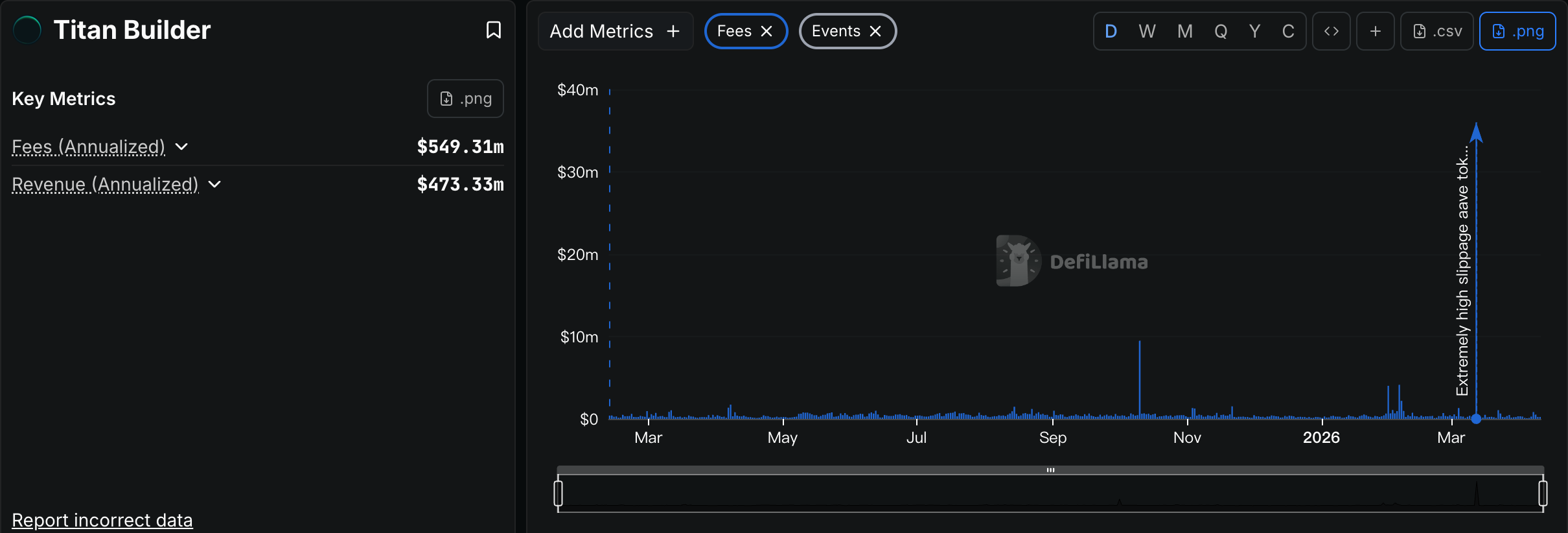
Odaily Note: See what it means to not open for business for three years, but eat for three years when you do.

So the conclusion is clear. Projects that continue to make money during the bear market are not those pursuing complex mechanisms and high-risk opportunities, but those that can operate consistently with simple, clear revenue models. In the still volatile cryptocurrency market, simpler revenue models have demonstrated greater resilience and better withstand the test of market fluctuations.

However, a simpler revenue model absolutely does not mean these businesses are "easier to run." On the contrary, behind the simple revenue models often lie more complex product services and meticulous operational management. This is where the leading players on the list have truly "differentiated" themselves through intense competition. From interaction design, to liquidity accumulation, to risk management, to user communication and feedback... To stand out in the fierce competition of the存量 market, one must invest more effort into product and service.

The crypto winter is not over yet. The projects that can truly survive and even profit are often those that flexibly combine simple revenue models with complex product services. Perhaps, this is the long-term code to navigate through bull and bear markets.


Связанные с этим вопросы

QWhat are the two main categories of revenue sources for profitable projects in the crypto bear market, as mentioned in the article?

AThe two main categories are spread (acting as a capital intermediary) and transaction tax (fees).

QWhich project set a single-day revenue record of $1.5 million on April 2nd, according to the article?

APolymarket set a single-day revenue record of $1.5 million on April 2nd.

QWhat is the core revenue source for stablecoin issuers like Tether and Circle, as explained in the article?

ATheir core revenue comes from the interest earned by deploying reserve funds into assets like U.S. Treasury bonds, minus the costs of subsidies to partners and users.

QName one project whose primary revenue comes from data service fees paid for oracle services, as highlighted in the article.

AChanilink's primary revenue comes from data service fees paid by projects for using its oracle services.

QWhat does the article suggest is the 'long-term password' to survive and profit through market cycles in crypto?

AThe 'long-term password' is combining simple revenue models with complex product services and sophisticated operational management.

Похожее

In-Depth Report on the On-Chain Lending Market: When Off-Chain Credit Meets On-Chain Liquidation

The on-chain lending market has evolved from a peripheral DeFi niche into core financial infrastructure. As of early 2026, total value locked (TVL) in on-chain lending protocols has reached $64.3 billion, accounting for 53.54% of total DeFi TVL, making it the largest and most mature vertical within decentralized finance. Aave dominates the sector with approximately $32.9 billion in TVL, commanding nearly half of the market—a leadership position that is unlikely to be challenged in the foreseeable future. However, the path of on-chain lending forward is not without risk. Liquidation cascades, credit defaults, and cross-chain vulnerabilities remain systemic threats hanging over the industry. At the same time, a deeper structural transformation is underway: on-chain lending is shifting from a “leverage tool for crypto-native users” to a “compliant gateway for institutional capital”. The scale of RWA (Real World Asset) lending has surpassed $18.5 billion, with U.S. Treasuries and government securities increasingly serving as core collateral. Institutional capital inflows are reshaping both the user base and risk appetite of the sector. This report systematically analyzes the evolution of on-chain lending definitions, competitive dynamics, core risks, and future trends, providing a comprehensive industry outlook for investors and trade practitioners. Key findings suggest that the “one dominant player with several strong challengers” structure will persist in the short term, while fixed-rate lending, compliant collateral, and institutional credit underwriting will define the next phase of competition. For investors focused on DeFi infrastructure, three key opportunity tracks stand out, namely, the Aave ecosystem (Morpho, Spark), RWA lending protocols (Ondo, Maple) and fixed-rate innovation (Notional, Pendle).

HTX Learn33 мин. назад

In-Depth Report on the On-Chain Lending Market: When Off-Chain Credit Meets On-Chain Liquidation

HTX Learn33 мин. назад

Fu Peng's First Public Speech in 2026: What Exactly Are Crypto Assets? Why Did I Join the Crypto Asset Industry?

Fu Peng, a renowned macroeconomist and now Chief Economist at New火 Group, delivered his first public speech of 2026 at the Hong Kong Web3 Festival. He explained his perspective on crypto assets and why he joined the industry, framing it within the context of macroeconomic trends and financial evolution. Fu emphasized that crypto assets are transitioning from an early, belief-driven phase to a mature, institutionally integrated asset class. He drew parallels to the 1970s-80s, when technological advances (like computing) revolutionized traditional finance, leading to the rise of FICC (Fixed Income, Currencies, and Commodities). Similarly, current advancements in AI, data, and blockchain are reshaping finance, with crypto assets becoming part of a new "FICC + C" (C for Crypto) framework. He noted that institutional capital, including traditional hedge funds, avoided early crypto due to its speculative nature but are now engaging as regulatory clarity emerges (e.g., stablecoin laws, CFTC classifying crypto as a commodity). Fu predicted that 2025-2026 marks a turning point where crypto becomes a standardized, financially viable asset for diversified portfolios, akin to commodities or derivatives in traditional finance. Fu defined Bitcoin not as "digital gold" in a simplistic sense but as a value-preserving, financially tradable asset. He highlighted that crypto's future lies in regulated, institutional adoption, moving away from retail-dominated trading. His entry into crypto signals this maturation, where traditional finance integrates crypto into mainstream asset management.

marsbit1 ч. назад

Fu Peng's First Public Speech in 2026: What Exactly Are Crypto Assets? Why Did I Join the Crypto Asset Industry?

marsbit1 ч. назад

Justin Sun Sues Trump Family: What $75 Million Bought Was Only a Blacklist

Justin Sun, founder of Tron, has filed a lawsuit in federal court against World Liberty Financial (WLF), alleging he was made the "primary target of a fraudulent scheme" after investing $75 million. Sun claims the investment secured him an advisor title and WLFI tokens, which were later frozen by WLF, causing "hundreds of millions in losses." The dispute began in late 2024 when Sun's investment helped revive WLF's struggling token sale, which ultimately raised $550 million. Shortly after, the SEC dropped its lawsuit against Sun following Donald Trump's inauguration. However, relations soured when Sun refused WLF's demands for additional funding. In August 2025, WLF added a "blacklist" function to its smart contract, allowing it to unilaterally freeze tokens. Sun's holdings, worth approximately $107 million, were frozen, and he was threatened with token destruction. The lawsuit highlights WLF's structure, which directs 75% of token sale profits to the Trump family, who had earned $1 billion by December 2025. WLF's CEO is Zach Witkoff, son of U.S. Middle East envoy Steve Witkoff. The project faces scrutiny for opaque operations, including a controversial loan arrangement on the Dolomite platform, co-founded by a WLF advisor. Despite Sun's history with the SEC, the case underscores centralization risks within DeFi, as WLF controls governance and holds powers to freeze assets arbitrarily. Sun's tokens remain frozen as legal proceedings begin.

marsbit1 ч. назад

Justin Sun Sues Trump Family: What $75 Million Bought Was Only a Blacklist

marsbit1 ч. назад

Торговля

Спот
Фьючерсы
活动图片