How a Silicon Valley Startup Became Venezuela's Cryptocurrency Lifeline

marsbitОпубликовано 2026-02-03Обновлено 2026-02-03

Введение

In the face of U.S. sanctions and Venezuela's economic crisis, Silicon Valley startup Kontigo positioned itself as a crypto-powered financial lifeline for Venezuelans. Founded by Jesus Castillo, the company raised over $20 million from investors like Coinbase Ventures and joined Y Combinator, promoting a vision of banking the unbanked in Latin America. However, Kontigo’s operations also facilitated the flow of funds into Venezuela’s sanctioned economy. Leaked presentations revealed that nearly 80% of Venezuela’s oil revenue was processed through stablecoins, with Kontigo acting as a government-authorized exchange. The company enabled users to transfer funds via U.S. bank accounts—until partners like JPMorgan Chase and Stripe severed ties following increased scrutiny. After a U.S. military intervention ousted President Maduro, Kontigo faced allegations of undisclosed government ties, which it denied. The company later reported a hack resulting in $341,000 in user losses, which it reimbursed. With key banking relationships terminated and its Venezuelan license expired, Kontigo’s transaction activity dwindled significantly, casting doubt on its future operations.

Written by: Ben Foldy

Compiled by: Luffy, Foresight News

The founders of fintech startup Kontigo embraced Silicon Valley's playbook: moving the company into a San Francisco house, hosting hackathons tailored for TikTok virality; peppering pitch decks with buzzwords, proclaiming the goal of building a "new Latin American bank"; even boasting about pioneering the Martian economy.

This approach helped the small, brash crypto startup secure a spot in the elite Y Combinator incubator and raise over $20 million in December last year from prominent Silicon Valley investors like Coinbase Ventures.

But recent U.S. military action in Venezuela has thrust a highly contentious aspect of Kontigo's business into the spotlight: it has become a major channel for moving funds into and out of Venezuela's heavily sanctioned economy.

Kontigo is now facing service disruptions from banks and payment networks, including JPMorgan Chase, Stripe, and Bridge, while also contending with allegations of undisclosed ties to the ousted Maduro regime, which Kontigo denies.

A Kontigo spokesperson declined to answer questions about business specifics but said in a statement that the company is reviewing its operating model.

"Kontigo is committed to expanding financial access for underserved communities," the spokesperson said. "We are conducting an internal review and will provide updates at the appropriate time. We adhere to U.S. laws, including U.S. sanctions regulations, and are evaluating our existing sanctions compliance processes and mechanisms, making improvements where necessary."

Kontigo was co-founded in 2023 by Venezuelan Jesus Castillo, who cast himself as a "David" about to slay the Goliaths of mainstream banking. The company says its 1.2 million users across Latin and South America have moved over $1 billion through the platform. The app allows users to convert hard currency into dollar-pegged stablecoins, enabling payments and access to the traditional banking system.

Outside Venezuela, the company portrayed itself to investors as a platform helping ordinary Latin Americans facing hyperinflation. But inside Venezuela, it became a channel to circumvent U.S. sanctions designed to cut off key sectors of the Maduro regime from the international financial system.

According to a presentation by an economist invited by Kontigo at an invite-only partner meeting in Caracas last December, the company's technology was described as helping the Maduro regime evade U.S. sanctions on the country's oil exports and repatriate oil sales revenue into the domestic economy in the form of cryptocurrency.

As sanctions severed Venezuela's traditional financial channels, the government increasingly relied on stablecoins for oil sales. The economist presented that in the second half of last year, nearly 80% of the country's oil revenue was received as stablecoin payments. These funds were then converted into bolivars through banks, informal exchange counters, and government-authorized crypto exchanges like Kontigo.

One slide read: "The crypto market to the rescue."

For months, Kontigo provided users, through intermediaries, with the ability to transfer funds between U.S. bank accounts at JPMorgan Chase, transactions largely prohibited by sanctions.

Late last year, JPMorgan Chase abruptly moved to cut off this channel. According to people familiar with the matter, Stripe, which had handled payments and transactions for Kontigo, has also terminated its relationship with the company.

When Kontigo struck a deal with another U.S. partner financial institution, company executives told them it had no physical operations within Venezuela, said people familiar with the matter. That partner has recently taken steps to end its relationship with Kontigo.

Venezuela turns to stablecoins for oil sales under U.S. sanctions

In the U.S.: A High-Profile, Brash Startup

Castillo co-founded Kontigo with the aim of using blockchain technology to solve Venezuela's everyday financial struggles, where hyperinflation and a lack of credit make it difficult for people to preserve savings. The platform allows users to convert bolivars into more stable, dollar-pegged stablecoins.

To U.S. investors, Castillo packaged his startup as a team of immigrants with big dreams fighting against the odds. Early investors said they were drawn to the vision of helping people in genuine need.

In promotional materials, the company said Castillo and colleagues took turns driving Uber on night shifts to make ends meet while building the company, dedicated to creating a financial system fit for a "multi-planetary age of abundance" and avoiding "exporting Earth's monetary and economic failures to Mars."

Around mid-2025, according to a promotional video posted on LinkedIn, Kontigo began offering users free "virtual" U.S. bank accounts with JPMorgan Chase. People familiar with the matter said these accounts were provided through another fintech startup, Checkbook, and that JPMorgan had no direct banking relationship with Kontigo. Nonetheless, Kontigo used the Chase bank brand logo in its advertisements.

In December, just weeks before the U.S. raid that ousted the Maduro regime, Kontigo announced it had raised $20 million from investors including Coinbase Ventures, Alumni Ventures, and DST Capital. Coinbase, Alumni, and DST did not respond to requests for comment.

Following the funding round, Castillo posted a video on LinkedIn boasting about what he called a "$23 million" Silicon Valley mansion where he and his 7-person team would live, free from distractions, aiming to increase annual revenue to $100 million within 60 days.

"If you're not willing to move the whole team to San Francisco, lock yourselves in a house until the goal is achieved, then you're not serious enough, you don't want success as badly as we do, you're destined to fail," Castillo said.

According to a promotional video, the funding coincided with a rebranding of the service, with Kontigo claiming to allow any user globally to buy and sell dollar-pegged cryptocurrencies without providing identification documents.

"Jamie Dimon, we're coming," Castillo posted on LinkedIn, calling out the JPMorgan Chase CEO and again boasting about building the "world's largest bank."
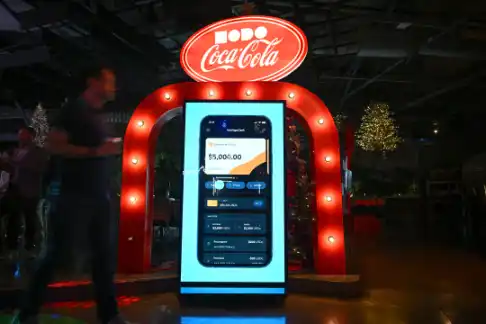
A large screen displaying the Kontigo cryptocurrency app interface, showing a balance of $5000 and transaction history

Inside Venezuela: A Different Story

In Venezuela, Kontigo operates under a license issued by the country's crypto regulator, Sunacrip, granting government permission to conduct crypto business. The license was awarded to a Venezuelan company named Oha Technology, signed by the Venezuelan finance minister.

Kontigo has since seemed to try to distance itself from Oha, saying it works with local institutions in all its markets. But until recently, Kontigo's website still showed it held an operating license issued by Sunacrip and listed Oha as its Venezuelan subsidiary. Castillo's personal webpage showed he had served as Chief Operating Officer of Oha AI. And in private group chat messages seen by The Wall Street Journal, Castillo celebrated obtaining the Sunacrip license in January 2025 and shared the license document.

At that invite-only presentation in Caracas, the company spokesperson emphasized the growing role of cryptocurrency in the Venezuelan economy. Economist Asdrúbal Oliveros told the audience that revenue from sanctioned oil sales was received in stablecoins and then flowed into licensed crypto platforms like Kontigo and its competitor Crixto.

Venezuelan Kontigo users can use the app to transfer money to their Venezuelan bank accounts, even if that bank is sanctioned by the U.S. Treasury.

A Turn of Fortune

Just weeks after announcing its successful funding, Kontigo's situation began to deteriorate rapidly.

In late December, an article in The Information exposed the news that Kontigo had been cut off by JPMorgan Chase.

Days later, U.S. military action ousted President Maduro. Shortly after, influential independent fintech journalist Jason Mikula wrote about the company, alleging secret links between Kontigo and a son of Maduro.

Kontigo quickly fought back.

When Klarna CEO Sebastian Siemiatkowski shared Mikula's article on platform X, the official Kontigo account replied that the company "will hold those spreading this false information accountable for the damage caused to the company's commercial reputation."

Subsequently, Kontigo informed users that the platform had suffered a hack, with 1,005 users losing a total of approximately $341,000. The company said it had fully compensated users for their losses.

In a 9-minute video posted on social media on January 12th, Castillo, speaking in Spanish, said the platform was under attack from both hackers and critics and denied any connection between Kontigo and the Maduro regime.

"The truth is, Kontigo's success is the result of years of effort, resilience, and persistence. We are not anyone's son-in-law, nephew, or cousin," he said.

Nevertheless, as problems mounted, the company's operations seemed to struggle. According to people familiar with the matter, Stripe and Bridge have terminated their partnerships with Kontigo, and users reported that PayPal no longer processes payments for the app. The Venezuelan crypto regulatory license held by Oha Technology expired on January 8th.

Kontigo's main public crypto wallet, listed on its website, has seen almost no transaction activity in recent days. For months prior, the wallet handled weekly transaction volumes in the hundreds of thousands of dollars, but since January 19th, only a few transactions of around $1 each have moved in and out.


Связанные с этим вопросы

QWhat is Kontigo and how did it position itself in Silicon Valley?

AKontigo is a fintech startup that presented itself in Silicon Valley as a 'neobank for Latin America' with ambitious goals, including expanding into the Martian economy. It used strategies like moving into a San Francisco house, hosting TikTok-friendly hackathons, and employing buzzword-heavy pitches to secure funding from notable investors like Coinbase Ventures and join Y Combinator.

QHow did Kontigo become a financial conduit for Venezuela despite US sanctions?

AKontigo became a key channel for moving funds in and out of Venezuela's sanctioned economy by allowing users to convert bolivars into dollar-pegged stablecoins. It operated with a license from Venezuela's crypto regulator, Sunacrip, and facilitated transactions that helped the Maduro regime bypass sanctions, including processing oil revenues converted into stablecoins.

QWhat challenges did Kontigo face following US military action in Venezuela?

AAfter the military action that ousted Maduro, Kontigo faced service disruptions from banks and payment networks like JPMorgan Chase, Stripe, and Bridge. It also dealt with allegations of undisclosed ties to the Maduro regime, which it denied, and conducted an internal review of its compliance with US sanctions.

QWhat was Kontigo's role in Venezuela's oil sales and financial system?

AKontigo helped the Venezuelan government circumvent US sanctions on oil sales by enabling the conversion of oil revenues into stablecoins. Nearly 80% of Venezuela's oil income in late 2024 was received in stablecoins, which were then exchanged into bolivars through authorized platforms like Kontigo.

QHow did Kontigo's founder, Jesus Castillo, describe the company's journey and response to criticism?

AJesus Castillo portrayed Kontigo as a result of years of hard work and resilience, denying any familial or political connections to the Maduro regime. He emphasized the company's mission to serve underserved populations and responded to critics by alleging hacking attacks and defending Kontigo's reputation amid growing operational challenges.

Похожее

North Korean Hackers Loot $500 Million in a Single Month, Becoming the Top Threat to Crypto Security

North Korean hackers, particularly the notorious Lazarus Group and its subgroup TraderTraitor, have stolen over $500 million from cryptocurrency DeFi platforms in less than three weeks, bringing their total theft for the year to over $700 million. Recent major attacks on Drift Protocol and KelpDAO, resulting in losses of approximately $286 million and $290 million respectively, highlight a strategic shift: instead of targeting core smart contracts, attackers are now exploiting vulnerabilities in peripheral infrastructure. For instance, the KelpDAO attack involved compromising downstream RPC infrastructure used by LayerZero's decentralized validation network (DVN), allowing manipulation without breaching core cryptography. This sophisticated approach mirrors advanced corporate cyber-espionage. Additionally, North Korea has systematically infiltrated the global crypto workforce, with an estimated 100 operatives using fake identities to gain employment at blockchain companies, enabling long-term access to sensitive systems and facilitating large-scale thefts. According to Chainalysis, North Korean-linked hackers stole a record $2 billion in 2025, accounting for 60% of all global crypto theft that year. Their total historical crypto theft has reached $6.75 billion. Post-theft, they employ specialized money laundering methods, heavily relying on Chinese OTC brokers and cross-chain mixing services rather than standard decentralized exchanges. Security experts, while acknowledging the increased sophistication, emphasize that many attacks still exploit fundamental weaknesses like poor access controls and centralized operational risks. Strengthening private key management, limiting privileged access, and enhancing coordination among exchanges, analysts, and law enforcement immediately after an attack are critical to improving defense and fund recovery chances. The industry's challenge now extends beyond secure smart contracts to safeguarding operational security at the infrastructure level.

marsbit55 мин. назад

North Korean Hackers Loot $500 Million in a Single Month, Becoming the Top Threat to Crypto Security

marsbit55 мин. назад

Circle CEO's Seoul Visit: No Korean Won Stablecoin Issuance, But Met All Major Korean Banks

Circle CEO Jeremy Allaire's recent activities in Seoul indicate a strategic shift for the company, moving away from issuing a Korean won-backed stablecoin and instead focusing on embedding itself as a key infrastructure provider within Korea’s financial and crypto ecosystem. Despite Korea accounting for nearly 30% of global crypto trading volume—with a market characterized by high retail participation and altcoin dominance—Circle has chosen not to compete for the role of stablecoin issuer. Instead, Allaire met with major Korean banks (including Shinhan, KB, and Woori), financial groups, leading exchanges (Upbit, Bithumb, Coinone), and tech firms like Kakao. This approach reflects a broader industry transition: the core of stablecoin competition is shifting from issuance rights to systemic positioning. With Korean regulators still debating whether banks or tech companies should issue stablecoins, Circle is avoiding regulatory uncertainty by strengthening its role as a service and technology partner. The company is deepening integration with trading platforms, building connections, and promoting stablecoin infrastructure. This positions Circle to benefit regardless of which entity eventually issues a won stablecoin. Allaire also noted the potential for a Chinese yuan stablecoin in the next 3–5 years, underscoring a regional trend of stablecoins becoming more regulated and integrated with traditional finance. Ultimately, Circle’s strategy highlights that future influence in the stablecoin market will belong not necessarily to the issuers, but to the foundational infrastructure layers that enable cross-system transactions.

marsbit1 ч. назад

Circle CEO's Seoul Visit: No Korean Won Stablecoin Issuance, But Met All Major Korean Banks

marsbit1 ч. назад

SpaceX Ties Up with Cursor: A High-Stakes AI Gambit of 'Lock First, Acquire Later'

SpaceX has secured an option to acquire AI programming company Cursor for $60 billion, with an alternative clause requiring a $10 billion collaboration fee if the acquisition does not proceed. This structure is not merely a potential acquisition but a strategic move to control core access points in the AI era. The deal is designed as a flexible, dual-path arrangement, allowing SpaceX to either fully acquire Cursor or maintain a binding partnership through high-cost collaboration. This "option-style" approach minimizes immediate regulatory and integration risks while ensuring long-term alignment between the two companies. At its core, the transaction exchanges critical AI-era resources: SpaceX provides its Colossus supercomputing cluster—one of the world’s most powerful AI training infrastructures—while Cursor contributes its AI-native developer environment and strong product adoption. This synergy connects compute power, models, and application layers, forming a closed-loop AI capability stack. Cursor, founded in 2022, has achieved rapid growth with over $1 billion in annual revenue and widespread enterprise adoption. Its value lies in transforming software development through AI agents capable of coding, debugging, and system design—positioning it as a gateway to future software production. For SpaceX, this move is part of a broader strategy to evolve from a aerospace company into an AI infrastructure empire, integrating xAI, supercomputing, and chip manufacturing. Controlling Cursor fills a gap in its developer tooling layer, strengthening its AI narrative ahead of a potential IPO. The deal reflects a shift in AI competition from model superiority to ecosystem and entry-point control. With programming tools as a key battleground, securing developer loyalty becomes crucial for dominating the software production landscape. Risks include questions around Cursor’s valuation, technical integration challenges, and potential regulatory scrutiny. Nevertheless, the deal underscores a strategic bet: controlling both compute and software development access may redefine power dynamics in the AI-driven future.

marsbit2 ч. назад

SpaceX Ties Up with Cursor: A High-Stakes AI Gambit of 'Lock First, Acquire Later'

marsbit2 ч. назад

Торговля

Спот
Фьючерсы

Популярные статьи

Как купить S

Добро пожаловать на HTX.com! Мы сделали приобретение Sonic (S) простым и удобным. Следуйте нашему пошаговому руководству и отправляйтесь в свое крипто-путешествие.Шаг 1: Создайте аккаунт на HTXИспользуйте свой адрес электронной почты или номер телефона, чтобы зарегистрироваться и бесплатно создать аккаунт на HTX. Пройдите удобную регистрацию и откройте для себя весь функционал.Создать аккаунтШаг 2: Перейдите в Купить криптовалюту и выберите свой способ оплатыКредитная/Дебетовая Карта: Используйте свою карту Visa или Mastercard для мгновенной покупки Sonic (S).Баланс: Используйте средства с баланса вашего аккаунта HTX для простой торговли.Третьи Лица: Мы добавили популярные способы оплаты, такие как Google Pay и Apple Pay, для повышения удобства.P2P: Торгуйте напрямую с другими пользователями на HTX.Внебиржевая Торговля (OTC): Мы предлагаем индивидуальные услуги и конкурентоспособные обменные курсы для трейдеров.Шаг 3: Хранение Sonic (S)После приобретения вами Sonic (S) храните их в своем аккаунте на HTX. В качестве альтернативы вы можете отправить их куда-либо с помощью перевода в блокчейне или использовать для торговли с другими криптовалютами.Шаг 4: Торговля Sonic (S)С легкостью торгуйте Sonic (S) на спотовом рынке HTX. Просто зайдите в свой аккаунт, выберите торговую пару, совершайте сделки и следите за ними в режиме реального времени. Мы предлагаем удобный интерфейс как для начинающих, так и для опытных трейдеров.

1.2k просмотров всегоОпубликовано 2025.01.15Обновлено 2025.03.21

Как купить S

Sonic: Обновления под руководством Андре Кронье – новая звезда Layer-1 на фоне спада рынка

Он решает проблемы масштабируемости, совместимости между блокчейнами и стимулов для разработчиков с помощью технологических инноваций.

2.2k просмотров всегоОпубликовано 2025.04.09Обновлено 2025.04.09

Sonic: Обновления под руководством Андре Кронье – новая звезда Layer-1 на фоне спада рынка

HTX Learn: Пройдите обучение по "Sonic" и разделите 1000 USDT

HTX Learn — ваш проводник в мир перспективных проектов, и мы запускаем специальное мероприятие "Учитесь и Зарабатывайте", посвящённое этим проектам. Наше новое направление .

1.8k просмотров всегоОпубликовано 2025.04.10Обновлено 2025.04.10

HTX Learn: Пройдите обучение по "Sonic" и разделите 1000 USDT

Обсуждения

Добро пожаловать в Сообщество HTX. Здесь вы сможете быть в курсе последних новостей о развитии платформы и получить доступ к профессиональной аналитической информации о рынке. Мнения пользователей о цене на S (S) представлены ниже.

活动图片