Has the Era of Easy Money for Crypto VCs Come to an End?

比推Опубликовано 2025-12-18Обновлено 2025-12-18

Введение

The era of easy profits for crypto VCs appears to be over, marked by a necessary market correction and a shift toward more sustainable investment practices. The recent collapse of Shima Capital, following SEC charges against its founder for fraudulent fundraising and mismanagement, symbolizes a broader industry-wide reckoning. Once-revered VCs are now facing scrutiny as inflated valuations, poor returns, and failed exit strategies expose systemic flaws. Market dynamics have shifted significantly: liquidity has dried up,散户 investors have retreated, and many VC portfolios are underwater. Data shows only 2% of altcoins are currently profitable, underscoring the severity of the downturn. VCs are adapting by focusing on later-stage investments, prioritizing projects with real traction and data over speculative narratives. Funding is increasingly concentrated in infrastructure—such as payment rails and privacy tools—rather than premature application-layer projects like NFTs or metaverse platforms. This period of "creative destruction" is pushing the industry toward maturity. VCs are becoming more disciplined, seeking genuine value and long-term viability rather than quick returns. While the transition is painful, it may ultimately lead to a healthier, more transparent, and more resilient crypto ecosystem.

Author: Nancy, PANews

Original Title: Farewell to Building Castles in the Sand: The Transformation Moment for Crypto VCs


From the former "investment风向标" to the current "fear of VCs," crypto venture capital is undergoing a necessary demystification and clearing out.

The darkest moment is also the moment of rebirth. This brutal process of defoaming is forcing the crypto market to establish a healthier and more sustainable valuation logic, while also driving the industry back to rational development and maturity.

The Fall of Star VCs: The Demystification of Elite Glory

Another crypto venture capital firm has fallen. On December 17, Shima Capital was exposed to be quietly shutting down.

In this brutal crypto cycle, the exit of VCs is not uncommon, but Shima Capital's departure is far from graceful. Unlike other VCs that died from liquidity drying up or were dragged down by poor investment portfolios, Shima Capital's downfall stemmed more from internal moral hazards and management chaos.

The direct trigger for this decision was the lawsuit filed by the U.S. SEC against the institution and its founder, Yida Gao, three weeks ago. The charges alleged that they violated multiple securities laws and illegally raised over $169.9 million from investors through fraudulent means.

Under regulatory pressure, Yida Gao quickly chose to settle with the SEC and the U.S. Department of Justice. While paying a fine of about $4 million, he decided to close the fund and announced his resignation from all positions, expressing deep regret for his "misleading decisions." The foundation will enter a liquidation process, gradually liquidating assets to repay investors when the market allows.

As a once high-frequency star venture capital firm in the crypto space, Shima Capital's rise relied more on the founder's elite光环. American-Chinese Yida Gao was a Wall Street top student with a background from MIT. He even took over former SEC Chairman Gary Gensler's role in teaching crypto courses at MIT, and his resume included prestigious institutions like Morgan Stanley and New Enterprise Associates.

With this background, Shima easily raised $200 million for its first fund, with backers including Dragonfly, hedge fund billionaire Bill Ackman, Animoca, OKX, Republic Capital, Digital Currency Group, and Mirana Ventures.

Armed with huge funds, Shima became one of the most active hunters in the last cycle, betting on over 200 crypto projects, including hot projects like Monad, Puddy Penguins, Solv, Berachain, 1inch, and Coin98. Despite its vast investment portfolio, Shima and its team were evaluated by investors as young and lacking experience, not truly understanding the industry, and merely riding the speculative wave of cryptocurrency.

More seriously, all this was built on lies. According to the SEC's lawsuit, when raising $158 million for Shima Capital Fund I, he fabricated past performance, claiming that one of his investments had achieved a 90x return, while the actual data was only 2.8x. When faced with the risk of exposure, he even tried to brush it off as a "笔误" to investors.

Not only that, Yida Gao raised funds from investors through an SPV to purchase BitClout tokens, promising discounts and principal protection. However, in reality, although he purchased the tokens at low prices, he did not offer them to investors at the original price but instead resold them to his own SPV at a markup, secretly profiting $1.9 million without disclosure.

From a long-term perspective, Shima's exit also sends a positive signal to the market: crypto wrongdoing is no longer outside the law, and the industry's transparency and ethical standards will be better improved.

Related reading: Unveiling the Founder of Shima Capital, Accused of Misappropriating Assets: From Fujian Immigrant to Wall Street Financial Elite

The Era of Easy Money Is Over, VCs Enter an Evolutionary Period

The so-called failure of the VC model is essentially the market forcing the industry to evolve.

Currently, the assembly-line model of "VCs assembling the game, retail investors taking over" has been broken, and funds are rapidly withdrawing from air projects. For example, not long ago, Monad, with its豪华 investment lineup, still couldn't escape price difficulties after its launch, which also broke the defenses of a group of VCs, sparking fierce debates around value valuation among风投 like Dragonfly.

The industry's rules of the game have changed. Whether it's the success of projects without VC funding (like Hyperliquid) or the community's resistance to high-valuation projects, they are actually pushing venture capital institutions out of their arrogant ivory towers. Only when the path of making quick money simply by "issuing and selling tokens" is blocked will VCs truly settle down to find projects with造血能力 that can solve real problems.

This阵痛 is obvious. As retail investors withdraw导致流动性枯竭, the traditional exit channels for VCs are blocked. Valuation callbacks not only延长了回报周期 but also leave a large number of investments facing serious paper losses.

Not long ago, Akshat Vaidya, co-founder of Arthur Hayes' family office Maelstrom, publicly complained that the principal of his investment in a certain Pantera fund four years ago had nearly halved, while Bitcoin had risen about twofold during the same period.

Another VC confessed to PANews that they were焦头烂额 with exits. Even though they participated in the seed round, the current token price they hold is lower than the cost price. Projects that managed to list on top exchanges like Binance only recovered one-fifth of the principal after many years. Many projects choose to随便上个小交易所 to give investors an交代, but there is simply no liquidity to exit. Some projects even choose to lie flat, and when asked, the answer is always "wait for the right time."

Glassnode data shows that currently only about 2% of altcoin supply is in a state of profit, showing an unprecedented分化 in the market. Historically, it has been uncommon for altcoins to consistently underperform during a Bitcoin bull market.
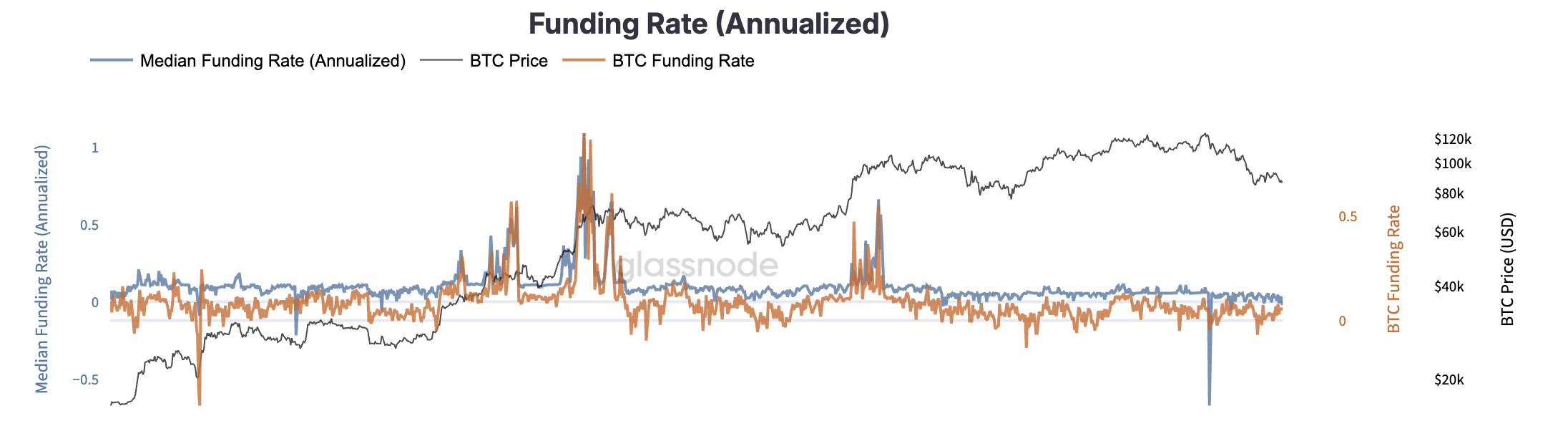
The data confirms that the era of making money with eyes closed is彻底结束了.

The end of one era means the beginning of another. Rui from HashKey Ventures pointed out on social media that VCs are not afraid of熬, they are afraid of快, which is why bear markets are actually more suitable for VCs. To truly succeed, one must survive until the next dead period. Unlike project parties, VCs are quite good at enduring. At the same time, most crypto VCs essentially arbitrage information asymmetry, coupled with some path dependence, earning some辛苦钱 and渠道费. More importantly, many of these people have now turned into market agents or market makers, which is essentially not much different.

Build Roads Before Building Towers, Seeking Certain Opportunities

Facing the receding hot money, VCs are not all "fleeing" but are making strategic contractions and adjustments to their battle lines.

"If a project doesn't have a data dashboard, we won't invest in it." Recent attendees of Dubai crypto events revealed that VCs now pay more attention to actual business data rather than单纯的故事. Faced with the bleak reality, VCs have significantly raised investment thresholds or even completely abandoned new investments.

Dovey Wan, founder of Primitive Ventures,坦言 that for investors, the ratio at which strength and luck can be exchanged (currently) is becoming increasingly苛刻, especially in the post-GPT era. This is true for all industries: choice is more important than effort, but choice is much harder than effort.

Pantera Capital revealed a positive trend in a recent video. According to its disclosure, although the total financing amount in the crypto field reached $34 billion this year, exceeding the records of 2021 and 2022, the number of transactions decreased by nearly 50%. Several main reasons are behind this phenomenon: First, the investor structure has changed. Family offices and individual investors active during 2021-2022 have become more cautious after experiencing bear market losses, with some even choosing to exit the market. Second, surviving VCs' investment strategies have become more concentrated. These风投 prefer to put funds into a few high-quality projects rather than casting a wide net as before, because the capital, time, and resource costs required to launch new projects are higher now. On the other hand, some funds have shifted to relatively safer assets, which also explains why大量资金 is highly concentrated in Bitcoin and a few mainline assets in this cycle. Third, funds are ample but deployment节奏放缓. Many venture capital funds raised large amounts of money in 2021 and 2022 and are currently holding ample "ammunition," mainly used to support existing investment portfolios and are in no hurry to invest in new projects. From a longer-term perspective, this change is not a negative signal but rather a sign of the market maturing.

Galaxy Research's recent analysis of Q3 investment reports also pointed out that crypto VC investment volume increased in the quarter but was relatively concentrated. Meanwhile, nearly 60% of investment capital flowed to late-stage companies, the second-highest level since Q1 2021. Compared to 2022, venture capital fundraising data also shows a significant decline in investor interest. This data also shows that VCs are more willing to heavily bet on certain opportunities.
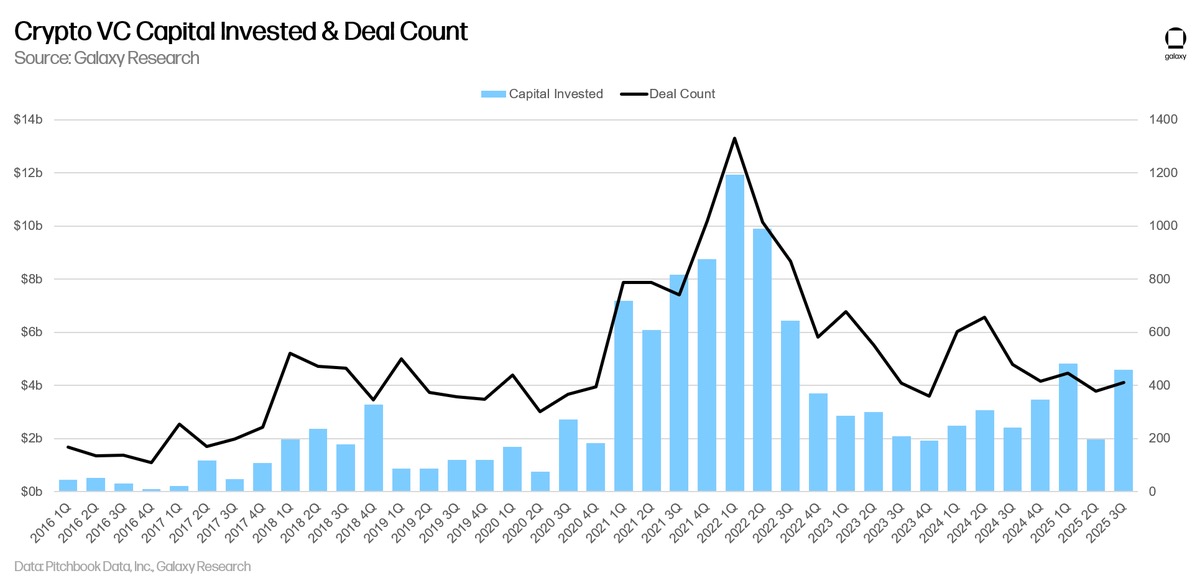
To hedge against the single-market risk, some crypto VCs have started "slacking off," targeting markets outside crypto-native ones. For example, the recent investment list of YZi Labs shows that its gaze has turned to biotech, robotics, and other outside tracks. Some crypto-native funds have long started investing in AI projects. Although they don't have a big pricing advantage compared to tech funds, it's an attempt at transformation.

Pantera also reflected on the investments of the last cycle. "In the last cycle, a large amount of capital poured into speculative areas like NFTs and the metaverse. These projects tried to skip infrastructure and directly build the 'cultural top layer.' But it was like building a castle on sand: the underlying infrastructure wasn't ready, payment rails were immature, the regulatory environment was unclear, and the user experience was far from mainstream level. The industry was too eager to seek killer apps and poured resources into the application layer where there was no soil yet."

Pantera believes this crypto cycle is undergoing a necessary "correction." Now more funds are flowing into infrastructure construction, such as more efficient payment chains, more mature privacy tools, and stablecoin systems. This path is the correct sequence, enabling the applications of the next cycle to truly explode.

Lay the foundation first, then build the tower.

The残酷出清 of crypto VCs today is both a阵痛 and a重塑.


Twitter:https://twitter.com/BitpushNewsCN

Bitpush TG Communication Group:https://t.me/BitPushCommunity

Bitpush TG Subscription: https://t.me/bitpush

Original link:https://www.bitpush.news/articles/7596797

Связанные с этим вопросы

QWhat led to the shutdown of Shima Capital, and what were the specific allegations by the SEC?

AShima Capital shut down after the SEC sued the firm and its founder, Yida Gao, for violating securities laws. The SEC alleged that Gao fraudulently raised over $169.9 million from investors by misrepresenting past investment returns and secretly profiting from undisclosed markups on token sales.

QHow has the investment strategy of crypto VCs changed in the current market cycle?

ACrypto VCs have become more selective, focusing on fewer high-quality projects with actual business data and traction. They are prioritizing infrastructure investments over speculative applications and are more concentrated on later-stage companies, reflecting a shift towards确定性机会 (certain opportunities) and risk mitigation.

QWhat does the case of Shima Capital indicate about the current state of crypto venture capital?

AThe Shima Capital case signifies a necessary cleansing and maturation of the crypto VC industry. It shows that unethical practices are no longer tolerated, and the market is demanding higher transparency and accountability, moving away from reliance on elite光环 (elite光环) and towards substantive value creation.

QWhy are some crypto VCs investing in non-crypto sectors like biotech and AI?

ASome crypto VCs are diversifying into non-crypto sectors like biotech and AI to hedge against the high risks and volatility in the cryptocurrency market. This strategy allows them to explore new growth areas while mitigating exposure to the cyclical and often speculative nature of crypto investments.

QAccording to Pantera Capital, what was the flaw in the previous crypto cycle's investment approach?

APantera Capital noted that the previous cycle saw excessive funding directed towards speculative areas like NFTs and metaverse projects without adequate underlying infrastructure. This was likened to building castles on sand, as the foundational elements—such as payment rails, regulatory clarity, and user experience—were not yet mature enough to support sustainable application growth.

Похожее

The Value Distribution of Stablecoins

**Summary: The Value Distribution of Stablecoins** The article argues that stablecoins are evolving from mere trading tools into broader channels for dollar access. It divides the stablecoin ecosystem into four layers to analyze how value is distributed: 1. **Issuance Layer:** Mints stablecoins, holds reserve assets, and captures the spread between reserve yield and user costs (e.g., Tether, Circle). This layer currently earns the largest profit margin. 2. **Infrastructure Layer:** Connects stablecoins to the traditional financial system, handling fiat on/off-ramps, banking integration, compliance (KYC/AML), and asset management (e.g., Bridge, BVNK). This is the "unglamorous" but critical work, building the essential bridges between crypto and real-world finance. 3. **Acquiring/Distribution Layer:** Integrates stablecoins into merchant systems, manages payment flows, and provides enterprise financial software (e.g., Stripe, Coinbase). They act as the access point for businesses. 4. **Application Layer:** The end-users and businesses that ultimately use stablecoins for payments, settlements, or as a store of value. They benefit from convenience but have little pricing power. The core thesis is that while the issuance layer currently dominates profits, the often-overlooked **infrastructure layer holds significant long-term potential**. The real challenge and barrier to mass adoption is not the on-chain transfer of stablecoins (which is simple), but the complex "last mile" integration into existing business workflows, banking systems, and regulatory frameworks across different countries. Companies in this layer are currently in a "land grab" phase, investing heavily to build networks, secure bank partnerships, and establish compliance pathways. While their position is currently pressured by the profitable issuers above and distribution platforms below, the article suggests that if stablecoins become a default financial rail for businesses, the infrastructure providers who have done the hard work of integration will ultimately gain strong pricing power and become entrenched, essential players.

marsbit4 ч. назад

The Value Distribution of Stablecoins

marsbit4 ч. назад

The Value Distribution of Stablecoins

The Value Distribution of Stablecoins The article argues that stablecoins are evolving from a mere trading tool into a broad "dollar channel." It analyzes the industry's value chain through four layers: 1. **Issuance Layer (e.g., Tether, Circle):** The top layer that mints stablecoins, holds reserve assets, and captures the thickest interest rate spread. 2. **Infrastructure Layer (e.g., Bridge, BVNK):** Connects stablecoins to the traditional financial system, handling critical but complex "dirty work" like fiat on/off-ramps, banking integration, compliance (KYC/AML), and cross-border settlement. 3. **Acquiring/Distribution Layer (e.g., Stripe, Coinbase):** Embeds stablecoins into merchant systems, manages payment flows, and integrates with enterprise software. 4. **Application Layer:** End-users and businesses that ultimately use stablecoins for payments, settlement, or storing value. The author posits that while the issuance layer currently captures the most profit, the most overlooked and potentially critical layer is infrastructure. The core challenge for stablecoin adoption isn't the on-chain transfer (which is simple), but bridging the gap between blockchain and the real-world financial system. This involves solving practical problems for businesses: fiat conversion, reconciliation, tax handling, and user onboarding. Infrastructure companies are currently in a difficult "land-grab" phase—building networks, securing banking relationships, and achieving compliance country-by-country. They face pressure from both the profitable issuance layer above and distribution platforms below. However, the author suggests this layer is building a crucial moat. Once stablecoins become a default business rail, the infrastructure players who have done the hard work of integration may gain significant, durable value and pricing power.

链捕手4 ч. назад

The Value Distribution of Stablecoins

链捕手4 ч. назад

How to Do Research Well: Deliberately Practice the Real Skills That Matter

No one truly teaches you how to do research. You're often given a desk, a pre-selected problem, and vague instructions to "create something new." Consequently, many people reverse-engineer the job based on visible outputs—papers, posts, announcements—learning only how to *appear* like a researcher rather than how to *become* one. True research capability is built from stacking small, trainable skills, nearly all of which can be developed through deliberate practice. **Pick Your Own Problem:** Most researchers absorb problems from advisors or trends, lacking the underlying reasoning. Choosing a problem you genuinely care about, as John Schulman advises, leads to original work. Develop "taste" like a muscle: predict experiment outcomes, guess paper results from methods, and track which findings remain important over time. **Upgrade Your Inputs:** Relying on shared reading lists (arXiv hot lists, filtered group chats) leads to unoriginal conclusions. Undervalued old literature often holds crucial insights (e.g., MoE, LSTM, backpropagation). Richard Sutton's "The Bitter Lesson" or Claude Shannon's 1952 talk on creative thinking are more predictive than lengthy modern surveys. Breadth matters as much as depth: draw from neuroscience, mechanism design, hardware knowledge, and honest statistics. Read papers directly, especially appendices and limitations sections. **Write Everything Down:** As Paul Graham noted, writing exposes flaws in seemingly mature ideas. Writing is the cheapest defense against self-deception. Following Feynman's principle, Darwin programmatically wrote down facts contradicting his theory to combat memory bias. Maintain a detailed log of hypotheses, setups, predictions, results, and updated understandings. Reviewing past logs fosters essential humility.

marsbit6 ч. назад

How to Do Research Well: Deliberately Practice the Real Skills That Matter

marsbit6 ч. назад

Торговля

Спот
Фьючерсы

Популярные статьи

Как купить ERA

Добро пожаловать на HTX.com! Мы сделали приобретение Caldera (ERA) простым и удобным. Следуйте нашему пошаговому руководству и отправляйтесь в свое крипто-путешествие.Шаг 1: Создайте аккаунт на HTXИспользуйте свой адрес электронной почты или номер телефона, чтобы зарегистрироваться и бесплатно создать аккаунт на HTX. Пройдите удобную регистрацию и откройте для себя весь функционал.Создать аккаунтШаг 2: Перейдите в Купить криптовалюту и выберите свой способ оплатыКредитная/Дебетовая Карта: Используйте свою карту Visa или Mastercard для мгновенной покупки Caldera (ERA).Баланс: Используйте средства с баланса вашего аккаунта HTX для простой торговли.Третьи Лица: Мы добавили популярные способы оплаты, такие как Google Pay и Apple Pay, для повышения удобства.P2P: Торгуйте напрямую с другими пользователями на HTX.Внебиржевая Торговля (OTC): Мы предлагаем индивидуальные услуги и конкурентоспособные обменные курсы для трейдеров.Шаг 3: Хранение Caldera (ERA)После приобретения вами Caldera (ERA) храните их в своем аккаунте на HTX. В качестве альтернативы вы можете отправить их куда-либо с помощью перевода в блокчейне или использовать для торговли с другими криптовалютами.Шаг 4: Торговля Caldera (ERA)С легкостью торгуйте Caldera (ERA) на спотовом рынке HTX. Просто зайдите в свой аккаунт, выберите торговую пару, совершайте сделки и следите за ними в режиме реального времени. Мы предлагаем удобный интерфейс как для начинающих, так и для опытных трейдеров.

742 просмотров всегоОпубликовано 2025.07.17Обновлено 2026.06.02

Как купить ERA

Обсуждения

Добро пожаловать в Сообщество HTX. Здесь вы сможете быть в курсе последних новостей о развитии платформы и получить доступ к профессиональной аналитической информации о рынке. Мнения пользователей о цене на ERA (ERA) представлены ниже.

活动图片