From the 'Babson Break' to AI and Meme Coins: A Global Bubble Driven by FOMO Is Taking Shape

marsbitОпубликовано 2025-12-18Обновлено 2025-12-18

Введение

The article draws a parallel between the 1929 "Babson Break" and current warnings about an AI bubble, suggesting a global FOMO-driven speculative mania is forming across multiple asset classes. It highlights concerns over unsustainable valuations in AI tech companies, where massive data center investments (projected near $1.6 trillion annually by 2030) are fueled by hype around unproven AGI capabilities. Beyond AI, bubbles are identified in gold, government bonds, private credit (dubbed "crap loans"), and particularly meme coins like TRUMP and MELANIA, which saw values plummet over 88%. The author argues speculative frenzy is amplified by social media, creating a global "attention economy" where collective obsession—from AI to pop culture trends—drives synchronized global market movements. While tech giants may withstand the AI investment rush, risky leverage by newer players and opaque financing structures (like SPVs buying Nvidia chips) raise systemic concerns. Experts warn that a collapse in AI or crypto could trigger a global crisis, emphasizing that productive eras historically follow only after speculative excesses are disciplined by regulation.

Two months before the stock market crash of "Black Monday" that triggered the Great Depression, an economist from Massachusetts named Roger Babson was deeply concerned about the frenzy of retail investors borrowing money to speculate in stocks. In a speech, he declared, "Sooner or later, a crash is coming, and it may be terrific." The market immediately fell by 3%, a drop that became known as the "Babson Break." But as Andrew Ross Sorkin writes in his captivating new book, "1929: The Inside Story of Wall Street's Worst Crash and How It Destroyed a Nation," in the following weeks, "the market shook off Babson's ominous prediction," partly due to optimistic expectations for new mass consumer goods like radios and cars. "Imaginative' investors once again gained the upper hand."

Today, there are many such "prophets of doom" like Babson warning of risks in the artificial intelligence (AI) sector, particularly regarding the valuations of public and private tech companies and their blind pursuit of the elusive goal of Artificial General Intelligence (AGI) — systems that can perform almost all human tasks, even surpassing human capabilities. Data from analytics firm Omdia shows that by 2030, tech companies will be spending nearly $1.6 trillion annually on data centers. The hype surrounding AI is immense, but its prospects as a profit-generating tool remain entirely hypothetical, leaving many clear-headed investors perplexed. Yet, just like a century ago, a "fear of missing out on the next big thing" mindset is driving many companies to ignore these "doomsday prophecies." Advait Arun, an analyst for climate finance and energy infrastructure at the Center for Public Enterprise, stated: "These companies are playing a game of 'Mad Libs,' believing these bold technologies can solve all existing problems." He recently published a report in the vein of Babson's views titled "It's a Bubble or It's Nothing," questioning the financing schemes behind data center projects and noting, "We are undoubtedly still in a phase of irrational exuberance."

Tech stocks have been soaring:
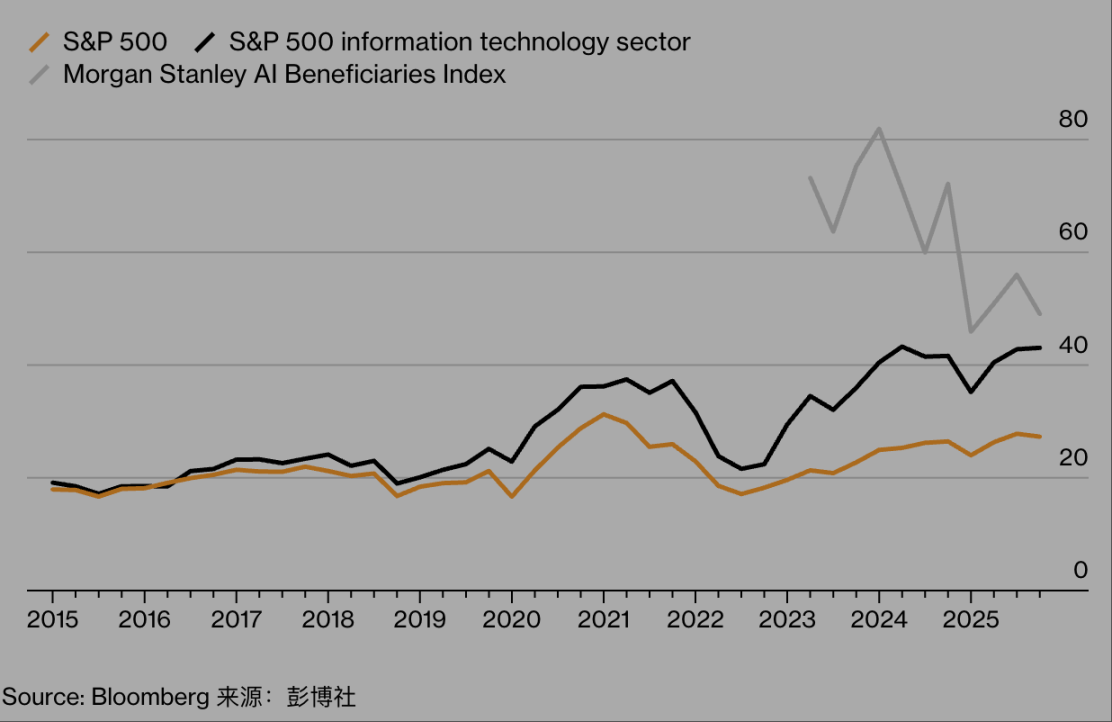
Source: Bloomberg

(This chart uses three index lines (S&P 500, S&P 500 Information Technology Sector, Morgan Stanley AI Beneficiaries Index) to show the process in US stocks from 2015 to 2025 where AI-related concept stocks first surged significantly on hype, then fell back as the bubble receded, diverging from the trends of the broader market and traditional tech sectors, reflecting the speculative frenzy and retreat risks in the AI field.)

Journalists should generally avoid arguing whether a particular resource or technology is overvalued. I don't have a strong stance on whether we are in an "AI bubble," but I suspect the question itself might be too narrow. If we define a "speculative bubble" as "an unsustainable rise in the value of an asset detached from its determinable fundamentals," then looking around, bubbles seem to be almost everywhere, and they appear to be inflating and contracting in sync.

World Economic Forum CEO Børge Brende pointed out that bubbles may exist in gold and government bonds. He recently stated that overall national debt levels haven't been this severe since World War II; and as of December 12th, gold prices had surged nearly 64% in a year. Many financial practitioners believe a bubble also exists in the private credit sector. This market, worth $3 trillion, involves large investment institutions providing loans (many for building AI data centers) and operates outside the constraints of the strictly regulated commercial banking system. Jeffrey Gundlach, founder and CEO of asset management firm DoubleLine Capital, recently called this opaque, unregulated, chaotic lending phenomenon "junk loans" on Bloomberg's "Odd Lots" podcast; JPMorgan Chase CEO Jamie Dimon referred to it as a "fuse for a financial crisis."

The most absurd phenomena occur in areas where "intrinsic value is difficult to judge." For example, from the beginning of the year to October 6th, the total market capitalization of BTC increased by $636 billion, but by December 12th, not only had all those gains been erased, but it had fallen even further. According to data from cryptocurrency media company Blockworks, the trading volume of "Meme coins," virtual currencies commemorating internet trends, peaked at $170 billion in January but plummeted to $19 billion by September. Leading the decline were TRUMP and MELANIA — coins launched by the US First Family two days before the presidential inauguration, which have fallen 88% and 99% in value since January 19th, respectively.

Many investors evaluating these cryptocurrencies do not focus on their potential to create intrinsic value for shareholders and society (as one would when assessing a traditional company's stock that reports profits), but rather solely attracted by the opportunity to "quickly make a lot of money." Their attitude towards cryptocurrencies is purely speculative, like joining a craps table during a trip to Las Vegas.

There might be demographic reasons behind investors (especially those attracted to cryptocurrencies, sports betting, and online prediction markets) trying to "manipulate" financial markets like a casino. A recent survey by Harris Poll showed that 60% of Americans today desire to amass huge wealth; among Gen Z and Millennial respondents, 70% said they want to be billionaires, compared to only 51% among Gen X and Baby Boomers. A study last year by financial firm Empower found that Gen Z believes "financial success" requires an annual salary of nearly $600,000 and a net worth of $10 million.

Thanks to TikTok videos, group chats, Reddit, and the "instant and unavoidable" nature of the internet, people around the world can now learn about money-making opportunities simultaneously. In principle, this seems fine, but in practice, it triggers imitation frenzies, fierce competition, and "groupthink" — a phenomenon that makes the new Apple TV+ series "Pluribus" particularly timely. The traditional economy, with its complex and diverse dimensions, has been replaced by the "attention economy": what is collectively obsessed over by everyone globally at any given moment.

In the business world, the focus of this "collective obsession" is AI; in pop culture, following "Pedro Pascal fever," there's "Sydney Sweeney fever," and "6-7 fever" (if you don't have teenagers at home, try Googling it). Over the past year, thanks to celebrities like BLACKPINK member Lisa, the "cute but practically worthless animal-shaped plush toys" launched by Chinese toymaker Pop Mart International Group have become a global craze, which we might call "Labubble" (referring to Labubu fever).

There's also a clear "protein bubble" in the food sector: from popcorn makers to breakfast cereal producers, everyone is promoting the "protein content" of their products to attract health-conscious consumers and GLP-1 (a blood sugar-lowering drug often used for weight loss) users. In the media sector, there might be bubbles in Substack newsletters, podcasts hosted by celebrities (like Amy Poehler's "Say More" and Meghan Markle's "Archetypes"), and the almost weekly release of "authorized celebrity documentary biopics" (Netflix's latest include: "Being Eddie" about Eddie Murphy and a biopic about Victoria Beckham). W. David Marx, author of "Status and Culture: How Our Desire for Social Rank Creates Taste, Identity, Art, Fashion, and Constant Change," said: "Today, everyone's 'reference group' is global, far beyond their immediate surroundings and surpassing their actual class and status. In these markets, 'globally synchronized movements' that were absolutely impossible in the past can occur."

Of course, the risks in the AI field are far higher than those related to "Labubu fever" products. No company wants to fall behind, so all industry giants are pushing forward, building computing infrastructure through "complex financing arrangements." In some cases, this involves "special purpose vehicles" (remember those from the 2008 financial crisis?) — entities that take on debt to purchase graphics processing units (AI chips) from Nvidia, which some observers believe could depreciate faster than expected.

Tech giants have the capacity to withstand any consequences of this "FOMO-induced frenzy": they primarily rely on strong balance sheets to pay for data centers, and can handle it even if white-collar workers widely believe "the current version of ChatGPT is sufficient for writing annual self-evaluations." But other companies are taking riskier moves. Oracle — a conservative database provider unlikely to be a challenger in the AI boom — is raising $38 billion in debt to build data centers in Texas and Wisconsin.

Other so-called "new cloud providers" (like relatively young companies such as CoreWeave and Fluidstack) are building specialized data centers for AI, Bitcoin mining, and other uses, and they are also borrowing heavily. At this point, the "cumulative impact" of the AI bubble begins to look increasingly severe. Gil Luria, Managing Director at investment firm D.A. Davidson & Co., echoing Roger Babson from a century ago, said: "When some institutions borrow money to build multi-billion dollar data centers without even having real customers, I start to worry. Lending for speculative investments has never been wise."

Carlota Perez, a British-Venezuelan researcher who has studied economic boom and bust cycles for decades, is also concerned. She points out that technological innovation is being transformed into high-risk speculation within a "over-leveraged, fragile, casino-like economy where bubbles burst once doubts spread." She wrote in an email: "If the AI and cryptocurrency sectors crash, it could trigger a global crisis of unimaginable scale. Historically, truly productive golden ages only arrive when the financial sector pays for its own actions (rather than being consistently bailed out) and society constrains it through proper regulation." Until then, hold tight to your Labubu plush toy.

Связанные с этим вопросы

QWhat historical event and figure does the article use as a parallel to the current AI investment frenzy, and what was the initial market reaction?

AThe article uses the 1929 stock market crash and the economist Roger Babson as a parallel. Babson warned of an impending crash, which initially caused a 3% market drop, an event known as the 'Babson Break.' However, the market soon recovered as optimistic investors took over.

QAccording to the article, what is the primary driver causing companies to ignore warnings about an AI bubble?

AThe primary driver is the 'Fear Of Missing Out' (FOMO) on the next big opportunity. This mindset, similar to a century ago, pushes companies to invest heavily despite the risks and unproven profitability of AI as a tool.

QBeyond AI, what other areas does the article identify as potential speculative bubbles?

AThe article identifies several other potential bubbles, including gold and government bonds (due to high global debt), the $3 trillion private credit market (called 'crap loans'), and the extreme volatility in cryptocurrencies and meme coins like TRUMP and MELANIA.

QWhat demographic trend does the article suggest is fueling the desire to treat financial markets like a casino?

AThe article cites a demographic trend where a significant majority of younger generations (70% of Gen Z and Millennials) aspire to become billionaires, compared to 51% of Gen X and Baby Boomers. This desire for immense wealth fuels speculative behavior in crypto, sports betting, and online prediction markets.

QWhat is the 'cumulative impact' of the AI bubble that the article suggests is becoming increasingly severe?

AThe 'cumulative impact' is the massive, and often risky, debt being taken on by companies to build AI infrastructure. This includes established giants and new 'cloud providers' borrowing billions, sometimes without confirmed customers, creating a fragile, over-leveraged system that could lead to a severe crisis if the bubble bursts.

Похожее

Торговля

Спот
Фьючерсы

Популярные статьи

Как купить MEME

Добро пожаловать на HTX.com! Мы сделали приобретение memecoin (MEME) простым и удобным. Следуйте нашему пошаговому руководству и отправляйтесь в свое крипто-путешествие.Шаг 1: Создайте аккаунт на HTXИспользуйте свой адрес электронной почты или номер телефона, чтобы зарегистрироваться и бесплатно создать аккаунт на HTX. Пройдите удобную регистрацию и откройте для себя весь функционал.Создать аккаунтШаг 2: Перейдите в Купить криптовалюту и выберите свой способ оплатыКредитная/Дебетовая Карта: Используйте свою карту Visa или Mastercard для мгновенной покупки memecoin (MEME).Баланс: Используйте средства с баланса вашего аккаунта HTX для простой торговли.Третьи Лица: Мы добавили популярные способы оплаты, такие как Google Pay и Apple Pay, для повышения удобства.P2P: Торгуйте напрямую с другими пользователями на HTX.Внебиржевая Торговля (OTC): Мы предлагаем индивидуальные услуги и конкурентоспособные обменные курсы для трейдеров.Шаг 3: Хранение memecoin (MEME)После приобретения вами memecoin (MEME) храните их в своем аккаунте на HTX. В качестве альтернативы вы можете отправить их куда-либо с помощью перевода в блокчейне или использовать для торговли с другими криптовалютами.Шаг 4: Торговля memecoin (MEME)С легкостью торгуйте memecoin (MEME) на спотовом рынке HTX. Просто зайдите в свой аккаунт, выберите торговую пару, совершайте сделки и следите за ними в режиме реального времени. Мы предлагаем удобный интерфейс как для начинающих, так и для опытных трейдеров.

741 просмотров всегоОпубликовано 2024.03.29Обновлено 2025.03.21

Как купить MEME

Что такое MEME 2.0

Memecoin 2.0: Восход $MEME 2.0 в мире криптовалют Введение В постоянно меняющемся ландшафте криптовалют появилось новое соперничество. Memecoin 2.0, символизируемый как $MEME 2.0, поднимает концепцию мем-коинов на захватывающий новый уровень. Являясь побочным продуктом оригинального Memecoin, этот проект привлек внимание крипто-сообщества, смещая акцент с типичных финансовых стимулов на вовлекающий и развлекательный опыт. Работающий на блокчейне Ethereum, Memecoin 2.0 смело переопределяет взаимодействие сообщества в криптосфере. Что такое Memecoin 2.0, $MEME 2.0? По сути, Memecoin 2.0 — это криптовалютный проект, который ставит на первое место дух сообщества и веселье, связанное с культурой мемов. В отличие от традиционных криптовалют, которые сосредоточены на практических случаях использования и ощутимых преимуществах, Memecoin 2.0 выделяется тем, что принимает легкую сторону цифровой валюты. Проект существует без обещаний полезности, структурированной дорожной карты или финансовых возвратов, сосредоточившись вместо этого на создании яркого сообщества вокруг мемов и совместного наслаждения. Таким образом, он использует растущую тенденцию мем-культуры в онлайн-пространстве, становясь уникальным игроком в мире цифровых активов. Создатель Memecoin 2.0, $MEME 2.0 Несмотря на обширные исследования происхождения Memecoin 2.0, явная идентичность его создателя остается неизвестной. Эта анонимность не является чем-то необычным в крипто-сообществе, где многие проекты возглавляют отдельные лица или группы, предпочитающие оставаться в тени. Отсутствие общедоступной информации о создателе можно рассматривать как стратегический ход, ставящий акцент на взаимодействие сообщества, а не на индивидуальную известность в этой сфере. Инвесторы Memecoin 2.0, $MEME 2.0 Информация о инвесторах или финансовой поддержке Memecoin 2.0 является скудной. Это отсутствие деталей может указывать на то, что проект либо финансируется самим собой, либо его внимание к сообществу, а не к традиционным инвестиционным структурам, привлекает другой тип сторонников. Поскольку мир мем-коинов обычно включает большее участие grassroots, чем институциональные инвестиции, этот подход соответствует философии проектов, управляемых сообществом. Как работает Memecoin 2.0, $MEME 2.0? Memecoin 2.0 полностью работает на блокчейне Ethereum, используя его надежные функции безопасности и масштабируемость. Используя преимущества Ethereum, Memecoin 2.0 может предложить безопасную среду для взаимодействия пользователей, обеспечивая при этом, чтобы транзакции были эффективными и экономичными. Одной из уникальных черт Memecoin 2.0 является его структура, ориентированная на сообщество. Ценность и популярность токена $MEME 2.0 вытекают из активного участия его пользователей, а не из внутренней полезности. Этот дизайн усиливает фокус проекта на развлекательной стороне криптовалюты, подразумевая, что смех и вовлеченность сообщества — это настоящие валюты, определяющие его успех. Более того, проект вписывается в более широкую экосистему мем-коинов, где ценность каждого мем-коина колеблется на основе культуры, трендов и вовлеченности сообщества, а не традиционных экономических принципов. Хронология Memecoin 2.0, $MEME 2.0 Чтобы лучше понять эволюцию и ключевые моменты Memecoin 2.0, вот хронология, подчеркивающая значимые события в его истории: 2024: Создание Memecoin 2.0 признается как ответвление от оригинального Memecoin, утвердившее себя в процветающем контексте мем-коинов, работая на блокчейне Ethereum. 13 июля 2024: Memecoin 2.0 официально позиционирует себя как мем-коин, ориентированный на сообщество, в сети Ethereum, подчеркивая свой развлекательный подход, который приглашает пользователей участвовать и способствовать его росту. Ключевые моменты о Memecoin 2.0, $MEME 2.0 Несколько критических характеристик определяют Memecoin 2.0: Подход, ориентированный на сообщество: Главная миссия Memecoin 2.0 — создать веселый и увлекательный опыт взаимодействия в сообществе, используя общее наслаждение, полученное от меметической культуры. Построен на Ethereum: Работа на блокчейне Ethereum предоставляет проекту необходимую инфраструктуру, которая обеспечивает безопасность и масштабируемость. Отсутствие полезности или дорожной карты: В резком отличии от традиционных криптовалют, Memecoin 2.0 не обещает никаких утилитарных функций или финансовых возвратов, подтверждая свою приверженность к вовлеченности сообщества и социальному взаимодействию. Фокус на меметической культуре: Принимая юмористические и культурные аспекты мем-феномена, Memecoin 2.0 предоставляет платформу для пользователей взаимодействовать с криптовалютой как офлайн, так и онлайн. Дополнительный контекст: Значение мем-коинов Мем-коины стали отдельным классом криптовалют, часто движимыми юмором и легкомысленным подходом к торговле. Эти монеты, как правило, не имеют значительной полезности или дорожных карт разработки, привлекая пользователей обещанием веселья, взаимодействия в сообществе и культурной значимости. В ландшафте более широкой криптоэкосистемы мем-коины восстанавливают важность вовлеченности сообщества, противодействуя исключительно ориентированным на прибыль подходам. Проекты, такие как Memecoin 2.0, открывают эру, где развлечение может гармонировать с финансовыми устремлениями, превращая блокчейн в игровую площадку для творчества и социального взаимодействия. Заключение Memecoin 2.0, или $MEME 2.0, олицетворяет новую волну криптовалют, которая ставит вовлеченность сообщества выше жестких финансовых структур. С акцентом на юмор и социальное взаимодействие, он использует увлечение, окружающее мем-культуру. Работая на блокчейне Ethereum, Memecoin 2.0 использует возможности технологии, оставаясь верным своему обязательству к развлекательной ценности цифровой валюты. Поскольку пространство вокруг криптовалют продолжает развиваться, Memecoin 2.0 служит свидетельством той мысли, что будущее цифровых активов может хорошо зависеть от общих опытов, смеха и крепких связей в сообществе. В непредсказуемом мире крипты, возможно, радость может быть столь же ценна, как и традиционная финансовая прибыль.

128 просмотров всегоОпубликовано 2024.04.04Обновлено 2024.12.03

Что такое MEME 2.0

Обсуждения

Добро пожаловать в Сообщество HTX. Здесь вы сможете быть в курсе последних новостей о развитии платформы и получить доступ к профессиональной аналитической информации о рынке. Мнения пользователей о цене на MEME (MEME) представлены ниже.

活动图片