From Bitcoin Core to Trump's Cabinet: Uncovering Epstein, Peter Thiel, and Putin's Crypto Power Network

marsbitОпубликовано 2026-02-09Обновлено 2026-02-09

Введение

From Bitcoin Core to Trump's Cabinet: Uncovering Epstein, Peter Thiel, and Putin's Crypto Power Network This investigation reveals how Jeffrey Epstein leveraged his international connections to position cryptocurrency at the center of geopolitics. Through recently disclosed emails, the article traces the complex ties between Epstein, Silicon Valley billionaire Peter Thiel, former Trump strategist Steve Bannon, and high-ranking Russian officials. Epstein advised Russia to use Bitcoin to achieve a "leapfrog" reshaping of the global financial system, provided critical funding to Blockstream to sustain Bitcoin Core development, and was deeply involved in Thiel's venture capital firm. These early crypto-political maneuvers, now influencing global elections and state power through figures like J.D. Vance, represent Epstein's most隐秘 and damaging legacy. The network connected Kremlin interests, far-right populist movements, and Silicon Valley's anti-regulatory ideology, using cryptocurrency as a tool for political disruption and unaccountable financial influence.

Author: Byline Times

Translated by: Deep Tide TechFlow

Original Link:In Putin’s Orbit: The Crypto Politics of Jeffrey Epstein and Peter Thiel

Deep Tide Introduction: This article reveals how Jeffrey Epstein used his complex international network to push cryptocurrency to the center stage of geopolitics. Through recently disclosed emails, the article traces the intricate connections between Epstein, Silicon Valley magnate Peter Thiel, former Trump strategist Steve Bannon, and high-level Russian officials. Epstein not only advised Russia to use Bitcoin to 'leapfrog' and reshape the financial system but also injected capital into Blockstream at a critical moment to sustain Bitcoin Core development, and was deeply involved in Thiel's venture capital firm. These early crypto-political maneuvers are now, through the rise of figures like J.D. Vance, profoundly influencing global democratic elections and the contest for national power, becoming Epstein's most hidden and destructive legacy.

In 1957, when the Soviet Union launched the first artificial satellite, 'Sputnik,' into space, the Western world was caught off guard by a technological and cultural revolution that had been brewing for almost a decade.

In a 2013 email, Jeffrey Epstein invoked the 'Sputnik' analogy to a senior Russian official, stating that 'Russia taking the lead in finance, the same thing could happen now.' He argued that instead of merely imitating Silicon Valley and catching up with Microsoft, Apple, and Google, Russia could achieve a 'leapfrog development over global society by reinventing the 21st-century financial system' through a new type of currency and securitization.

This Russian official was Sergey Belyakov. After graduating from the FSB (Federal Security Service) spy academy, Belyakov served as a senior advisor to Oleg Deripaska, one of Vladimir Putin's most devoted oligarchs and international agents—Deripaska himself was a close associate of Epstein and Labour Party colleague Peter Mandelson. By 2013, he had become Deputy Minister of Economic Development of Russia.

Epstein reminded Belyakov that he had helped establish the US derivatives market in the 1970s, which was a precursor to the 'more advanced, disruptive securitization plans now made feasible by technology.'

Epstein insisted that Russia had a unique advantage in executing this 'grand vision of establishing a new global currency... which is larger than any single project conceived by any government, and its core is actually not difficult to achieve.'

He had reason to believe his words would be heard at the highest levels.

In a letter dated May 22, 2013, Epstein revealed: 'Putin asked me to be present at the economic conference in St. Petersburg. I refused him. If he wants to meet, he needs to set aside real, dedicated time and privacy.'
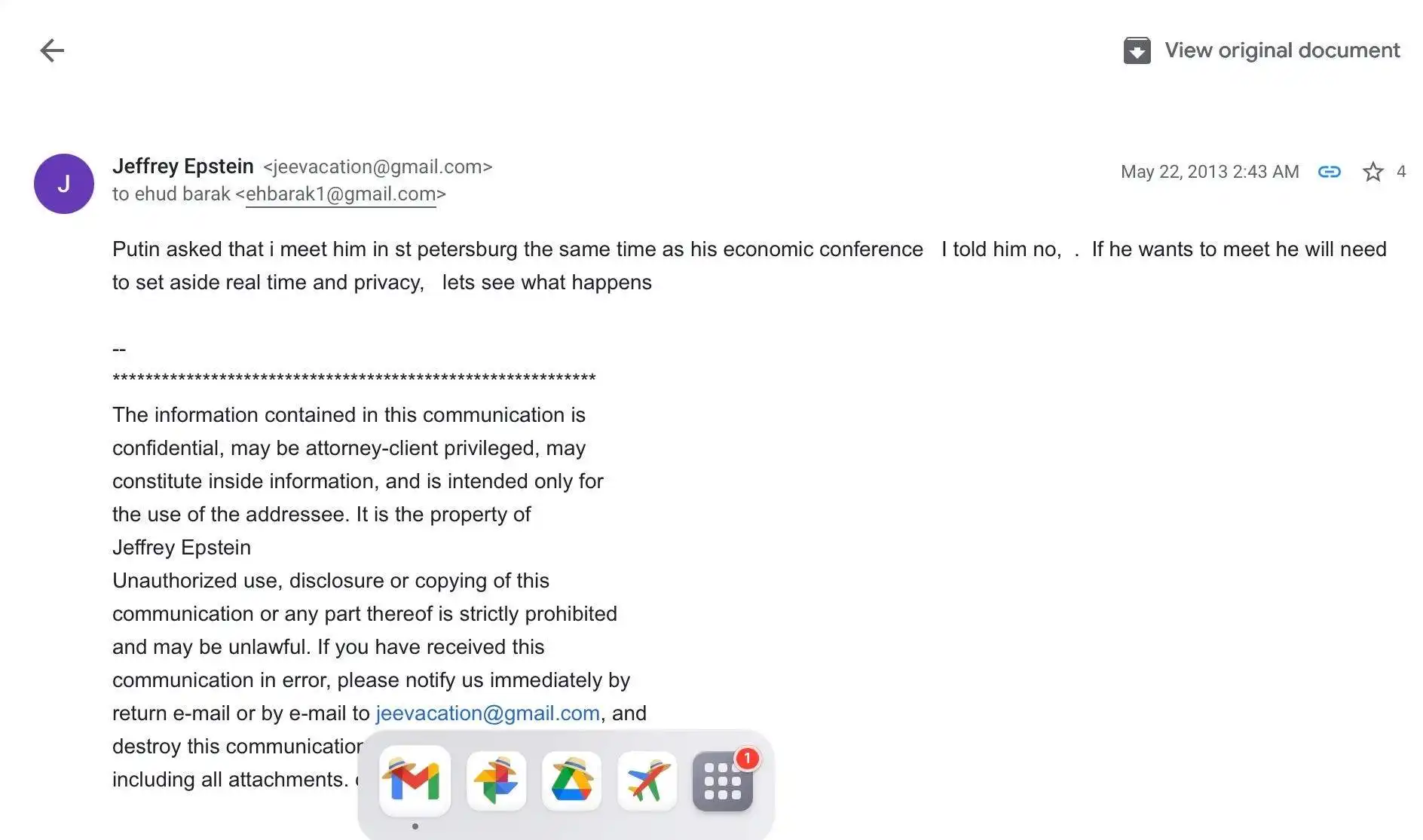
Caption: Clues to Epstein's relationship with the Kremlin

This was not baseless chatter. Epstein shared this information with former Israeli Prime Minister Ehud Barak, who was to meet Putin in person a few weeks later and could easily verify this claim through Kremlin channels.

In January 2014, Thorbjørn Jagland (then Secretary General of the Council of Europe) wrote to Epstein, stating he was planning to meet the Russian president in Sochi. Epstein told Jagland to 'explain to Putin that there should be a sophisticated Russian version of Bitcoin,' calling it 'the most advanced financial instrument globally.'

This is the prism through which to understand the rest of the crypto network built around Epstein, Vladimir Putin, Peter Thiel, and Steve Bannon.

Social Capital

Peter Thiel, co-founder of Palantir and a core member of the so-called 'PayPal Mafia' alongside Elon Musk, is an avid follower of cryptocurrency, valuing its ability to provide an alternative to government-controlled fiat currency. He once declared: 'Bitcoin is what PayPal should have been.'

He had long been a target of Epstein.

As early as 2012, Epstein received an email from fintech entrepreneur Ian Osborne suggesting they 'have a drink with Peter Thiel,' calling Thiel 'the best person to study currency,' and linking him to Abu Dhabi's sovereign wealth fund.

In 2013, Epstein urged former Israeli minister Ehud Barak to 'spend some real time with Peter Thiel.'

By July 2014, Thiel and Epstein were exchanging emails about Bitcoin regulation at the New York Stock Exchange. In September of the same year, Epstein hosted consecutive meetings with Thiel and William Burns, who was then Deputy Secretary of State in the Obama administration and is now the Director of the CIA (Central Intelligence Agency).

By 2015, Epstein proposed Thiel as one of the people Belyakov should meet. Following Epstein's advice, Belyakov contacted Thiel directly, and Thiel asked his executive assistant to schedule a face-to-face meeting for July 2015.

Epstein had multiple interests here. First was cryptocurrency. Emails from MIT (Massachusetts Institute of Technology) show that Joi Ito solicited and accepted donations from Epstein, which helped pay the salaries of Bitcoin Core developers after the Bitcoin Foundation collapsed. Another email thread shows Epstein was involved in the seed round financing of Bitcoin infrastructure development company Blockstream in 2014, increasing his allocation from $50,000 to $500,000 after Ito requested more shares in the oversubscribed deal.

But just as Thiel was interested in blockchain currency, surveillance, and data systems like Palantir, Epstein joined in, investing $40 million in Thiel's Valar Ventures. According to Ehud Barak, Thiel and Epstein 'co-owned' the firm and used it to take a share in the Israeli surveillance technology company Carbyne.

(A spokesperson for Peter Thiel later denied this, stating that Epstein was merely a 'limited partner (LP).')

As Epstein and Thiel aligned financially, their political inclinations also converged. Both were unusually important early supporters of Donald Trump's first presidential term. A brief exchange in the emails captures the tone of this relationship. Epstein wrote to Peter Thiel: 'I like your exaggeration about Trump, it's not a lie,' then suggested Thiel 'come see me in the Caribbean.'

Thiel broke with most of Silicon Valley, publicly supported Trump, and injected millions of dollars into pro-Trump super PACs. Epstein's communications show he closely followed Trump's polls against Hillary, campaign staff, and appointments related to Bitcoin and fintech.

In his speech at the 2016 Republican National Convention, Thiel used the platform of Trump's coronation to attack 'financial bubbles' and praise 'new forms of money,' later telling audiences that Bitcoin could be 'China's financial weapon' or a hedge against the dollar's reserve status.

As Russia's interference activities around the US election escalated through massive social media offensives and hacking of the Hillary campaign's emails, Epstein also arranged a luncheon at his New York townhouse, attended by Trump supporters Thiel, Tom Barrack, and Russia's Permanent Representative to the UN, Vitaly Churkin—a seasoned Kremlin operator.

After Churkin's sudden death in 2017, Epstein emailed Thiel: 'My Russian ambassador friend died. Life is short, eat dessert first.'

"Brexit is Just the Beginning"

Epstein was a frequent visitor to the UK, even beyond his connections to Ghislaine Maxwell and Andrew Mountbatten, and he closely watched British finance and politics.

In recently disclosed information and emails, he saw the UK's decision to leave the EU in the June 2016 vote as a political reshuffling and trading opportunity—something that could be shorted financially and leveraged politically. As he wrote to Peter Thiel about the chaos triggered by the referendum: 'Brexit is just the beginning.'

To achieve broader goals, beyond his maneuvers in Silicon Valley and Russia, Epstein invested significant time and intellectual capital in a major project led by former Trump campaign manager, White House Chief of Staff, Breitbart publisher, and Cambridge Analytica co-founder Steve Bannon, who had just lost his position as White House Chief of Staff and was looking for a new role.

He initially found opportunity in the pan-European populist 'Movement' (The Movement), founded in 2017 by allies like Nigel Farage's partner Laure Ferrari and People's Party leader Mischaël Modrikamen, initially led by Bannon's friend Nigel Farage himself.

Registered in Brussels, the organization's mission was to unite 'populist and conservative movements in Europe,' defending 'national sovereignty' and 'effective national borders.'

Behind the scenes, Jeffrey Epstein became a funder and strategist for Bannon's Movement, providing financial advice on how to circumvent financial regulations, offering transportation and accommodation, and introducing key figures in Europe.

During the turbulent Brexit transition, as Theresa May's government struggled to find a solution acceptable to the Brexit right wing, Bannon was flying to the UK to organize opposition.

In 2018, Bannon told Epstein he was meeting with Boris Johnson, Nigel Farage, and Jacob Rees-Mogg to organize them to overthrow Theresa May. Writer Michael Wolff wrote to Epstein, claiming to be an intermediary with leadership challenger Boris Johnson.

However, the UK was just one stop in Bannon's international populist plan. He soon texted Epstein about his broader European ambitions, claiming: 'My advisory role now covers Front National, Salvini's League, Germany's AfD, the Swiss People's Party, Orban, Land and Freedom Party, Farage—next May is the European Parliament election—we can increase from 92 seats to 200—block any crypto legislation or anything we want.'

By the time Theresa May was replaced by Boris Johnson in 2019, Bannon was ecstatic: 'May is gone... we really crushed them... we are on a roll.'

Even then, cryptocurrency never left the agenda, with Bannon agreeing: 'Crypto is currency, blockchain is equivalent to Internet 2.0.'

The Legacy of Crypto Politics

The UK left the EU in 2020. Epstein was arrested and subsequently died in prison. Farage's UKIP was replaced by his more domestically focused Reform UK. However, the lessons about fintech and its ability to reshape or disrupt democracy did not disappear.

When Farage's confidant, former UKIP MEP and Reform UK Wales leader Nathan Gill, was arrested in September 2021 on suspicion of accepting pro-Russian bribes, he was actually on his way to attend a Kremlin-backed forum on Russia's DEG electronic voting system.

He was scheduled to give a speech titled 'The Same Technology That Gives Us Crypto Will Also Change How We Vote,' explicitly linking blockchain to election infrastructure.

Subsequently, Farage's Reform UK became the first UK political party to solicit cryptocurrency donations through an overseas processor not fully regulated by the FCA (Financial Conduct Authority)—precisely the kind of opaque funding channel anti-corruption experts had warned about.

Meanwhile, Vice President J.D. Vance—whose Ohio Senate campaign was heavily funded by Thiel and who echoes Thiel's grievances against the 'Deep State' and globalism—is now at the core of Trump's plans as Vice President and the clearest advocate of national conservatism within the government.

Vance's rise implants Thiel's worldview into the executive branch: a politics that sees technology (from surveillance companies like Palantir to Bitcoin and other cryptocurrencies) as tools of national power and civilizational competition, rather than neutral infrastructure.

Against the backdrop of Epstein's 2013 Sputnik email to Moscow—urging Russia to 'reinvent the 21st-century financial system' by creating 'a new type of currency on a global scale'—the layers of the crypto-political project are exposed through Epstein's documents.

Although Epstein is no longer alive, the cryptocurrency infrastructure he helped save, Silicon Valley's ideological resistance to regulation, and the dark, unaccountable influence of crypto politics in democratic elections remain some of his most destructive legacies.

Updated on February 5, 2026, to include comments from Thiel's representative regarding Epstein's role in Valar Ventures.


Связанные с этим вопросы

QWhat was Jeffrey Epstein's proposal to Russian officials regarding the financial system in 2013?

AEpstein proposed that Russia should not just imitate Silicon Valley but instead achieve a 'leapfrog development' over global society by reinventing the 21st-century financial system through a new type of currency and securitization, suggesting that Russia had a unique advantage in creating a 'global new currency'.

QHow did Jeffrey Epstein influence the development of Bitcoin Core according to the disclosed emails?

AEpstein provided donations that helped pay the salaries of Bitcoin Core developers after the Bitcoin Foundation collapsed. He was also involved in the seed round financing of Blockstream in 2014, increasing his allocation from $50,000 to $500,000 upon request.

QWhat role did Peter Thiel play in the relationship between Epstein and Russian officials?

AEpstein recommended Peter Thiel as a key contact for Russian Deputy Minister Sergey Belyakov. Thiel subsequently arranged a face-to-face meeting with Belyakov in July 2015, facilitated by Epstein's influence and network.

QHow did Steve Bannon and Jeffrey Epstein collaborate in the context of European populist movements?

AEpstein became a funder and strategist for Bannon's 'The Movement,' a pan-European populist initiative. He provided financial advice on circumventing regulations, offered travel and accommodation support, and introduced key European figures to advance their political goals, including influencing elections and crypto legislation.

QWhat is the connection between Nigel Farage's Reform UK and cryptocurrency, as mentioned in the article?

AReform UK became the first UK political party to solicit cryptocurrency donations through an overseas processor not fully regulated by the UK's Financial Conduct Authority (FCA), creating an opaque channel for funds that raised concerns among anti-corruption experts.

Похожее

North Korean Hackers Loot $500 Million in a Single Month, Becoming the Top Threat to Crypto Security

North Korean hackers, particularly the notorious Lazarus Group and its subgroup TraderTraitor, have stolen over $500 million from cryptocurrency DeFi platforms in less than three weeks, bringing their total theft for the year to over $700 million. Recent major attacks on Drift Protocol and KelpDAO, resulting in losses of approximately $286 million and $290 million respectively, highlight a strategic shift: instead of targeting core smart contracts, attackers are now exploiting vulnerabilities in peripheral infrastructure. For instance, the KelpDAO attack involved compromising downstream RPC infrastructure used by LayerZero's decentralized validation network (DVN), allowing manipulation without breaching core cryptography. This sophisticated approach mirrors advanced corporate cyber-espionage. Additionally, North Korea has systematically infiltrated the global crypto workforce, with an estimated 100 operatives using fake identities to gain employment at blockchain companies, enabling long-term access to sensitive systems and facilitating large-scale thefts. According to Chainalysis, North Korean-linked hackers stole a record $2 billion in 2025, accounting for 60% of all global crypto theft that year. Their total historical crypto theft has reached $6.75 billion. Post-theft, they employ specialized money laundering methods, heavily relying on Chinese OTC brokers and cross-chain mixing services rather than standard decentralized exchanges. Security experts, while acknowledging the increased sophistication, emphasize that many attacks still exploit fundamental weaknesses like poor access controls and centralized operational risks. Strengthening private key management, limiting privileged access, and enhancing coordination among exchanges, analysts, and law enforcement immediately after an attack are critical to improving defense and fund recovery chances. The industry's challenge now extends beyond secure smart contracts to safeguarding operational security at the infrastructure level.

marsbit54 мин. назад

North Korean Hackers Loot $500 Million in a Single Month, Becoming the Top Threat to Crypto Security

marsbit54 мин. назад

Circle CEO's Seoul Visit: No Korean Won Stablecoin Issuance, But Met All Major Korean Banks

Circle CEO Jeremy Allaire's recent activities in Seoul indicate a strategic shift for the company, moving away from issuing a Korean won-backed stablecoin and instead focusing on embedding itself as a key infrastructure provider within Korea’s financial and crypto ecosystem. Despite Korea accounting for nearly 30% of global crypto trading volume—with a market characterized by high retail participation and altcoin dominance—Circle has chosen not to compete for the role of stablecoin issuer. Instead, Allaire met with major Korean banks (including Shinhan, KB, and Woori), financial groups, leading exchanges (Upbit, Bithumb, Coinone), and tech firms like Kakao. This approach reflects a broader industry transition: the core of stablecoin competition is shifting from issuance rights to systemic positioning. With Korean regulators still debating whether banks or tech companies should issue stablecoins, Circle is avoiding regulatory uncertainty by strengthening its role as a service and technology partner. The company is deepening integration with trading platforms, building connections, and promoting stablecoin infrastructure. This positions Circle to benefit regardless of which entity eventually issues a won stablecoin. Allaire also noted the potential for a Chinese yuan stablecoin in the next 3–5 years, underscoring a regional trend of stablecoins becoming more regulated and integrated with traditional finance. Ultimately, Circle’s strategy highlights that future influence in the stablecoin market will belong not necessarily to the issuers, but to the foundational infrastructure layers that enable cross-system transactions.

marsbit1 ч. назад

Circle CEO's Seoul Visit: No Korean Won Stablecoin Issuance, But Met All Major Korean Banks

marsbit1 ч. назад

SpaceX Ties Up with Cursor: A High-Stakes AI Gambit of 'Lock First, Acquire Later'

SpaceX has secured an option to acquire AI programming company Cursor for $60 billion, with an alternative clause requiring a $10 billion collaboration fee if the acquisition does not proceed. This structure is not merely a potential acquisition but a strategic move to control core access points in the AI era. The deal is designed as a flexible, dual-path arrangement, allowing SpaceX to either fully acquire Cursor or maintain a binding partnership through high-cost collaboration. This "option-style" approach minimizes immediate regulatory and integration risks while ensuring long-term alignment between the two companies. At its core, the transaction exchanges critical AI-era resources: SpaceX provides its Colossus supercomputing cluster—one of the world’s most powerful AI training infrastructures—while Cursor contributes its AI-native developer environment and strong product adoption. This synergy connects compute power, models, and application layers, forming a closed-loop AI capability stack. Cursor, founded in 2022, has achieved rapid growth with over $1 billion in annual revenue and widespread enterprise adoption. Its value lies in transforming software development through AI agents capable of coding, debugging, and system design—positioning it as a gateway to future software production. For SpaceX, this move is part of a broader strategy to evolve from a aerospace company into an AI infrastructure empire, integrating xAI, supercomputing, and chip manufacturing. Controlling Cursor fills a gap in its developer tooling layer, strengthening its AI narrative ahead of a potential IPO. The deal reflects a shift in AI competition from model superiority to ecosystem and entry-point control. With programming tools as a key battleground, securing developer loyalty becomes crucial for dominating the software production landscape. Risks include questions around Cursor’s valuation, technical integration challenges, and potential regulatory scrutiny. Nevertheless, the deal underscores a strategic bet: controlling both compute and software development access may redefine power dynamics in the AI-driven future.

marsbit2 ч. назад

SpaceX Ties Up with Cursor: A High-Stakes AI Gambit of 'Lock First, Acquire Later'

marsbit2 ч. назад

Торговля

Спот
Фьючерсы

Популярные статьи

Как купить S

Добро пожаловать на HTX.com! Мы сделали приобретение Sonic (S) простым и удобным. Следуйте нашему пошаговому руководству и отправляйтесь в свое крипто-путешествие.Шаг 1: Создайте аккаунт на HTXИспользуйте свой адрес электронной почты или номер телефона, чтобы зарегистрироваться и бесплатно создать аккаунт на HTX. Пройдите удобную регистрацию и откройте для себя весь функционал.Создать аккаунтШаг 2: Перейдите в Купить криптовалюту и выберите свой способ оплатыКредитная/Дебетовая Карта: Используйте свою карту Visa или Mastercard для мгновенной покупки Sonic (S).Баланс: Используйте средства с баланса вашего аккаунта HTX для простой торговли.Третьи Лица: Мы добавили популярные способы оплаты, такие как Google Pay и Apple Pay, для повышения удобства.P2P: Торгуйте напрямую с другими пользователями на HTX.Внебиржевая Торговля (OTC): Мы предлагаем индивидуальные услуги и конкурентоспособные обменные курсы для трейдеров.Шаг 3: Хранение Sonic (S)После приобретения вами Sonic (S) храните их в своем аккаунте на HTX. В качестве альтернативы вы можете отправить их куда-либо с помощью перевода в блокчейне или использовать для торговли с другими криптовалютами.Шаг 4: Торговля Sonic (S)С легкостью торгуйте Sonic (S) на спотовом рынке HTX. Просто зайдите в свой аккаунт, выберите торговую пару, совершайте сделки и следите за ними в режиме реального времени. Мы предлагаем удобный интерфейс как для начинающих, так и для опытных трейдеров.

1.2k просмотров всегоОпубликовано 2025.01.15Обновлено 2025.03.21

Как купить S

Sonic: Обновления под руководством Андре Кронье – новая звезда Layer-1 на фоне спада рынка

Он решает проблемы масштабируемости, совместимости между блокчейнами и стимулов для разработчиков с помощью технологических инноваций.

2.2k просмотров всегоОпубликовано 2025.04.09Обновлено 2025.04.09

Sonic: Обновления под руководством Андре Кронье – новая звезда Layer-1 на фоне спада рынка

HTX Learn: Пройдите обучение по "Sonic" и разделите 1000 USDT

HTX Learn — ваш проводник в мир перспективных проектов, и мы запускаем специальное мероприятие "Учитесь и Зарабатывайте", посвящённое этим проектам. Наше новое направление .

1.8k просмотров всегоОпубликовано 2025.04.10Обновлено 2025.04.10

HTX Learn: Пройдите обучение по "Sonic" и разделите 1000 USDT

Обсуждения

Добро пожаловать в Сообщество HTX. Здесь вы сможете быть в курсе последних новостей о развитии платформы и получить доступ к профессиональной аналитической информации о рынке. Мнения пользователей о цене на S (S) представлены ниже.

活动图片