Examining if SKY crypto can target $0.10 after 15-week bull run

ambcryptoОпубликовано 2026-03-05Обновлено 2026-03-05

Введение

SKY, the native token of an on-chain decentralized protocol, posted significant gains driven by strong momentum in the perpetual market. Over the past day, its market capitalization increased by approximately 10%, adding around $178 million. Trading volume also rose by 12%, reaching $27 million, while the Taker Buy/Sell Ratio remained above 1, indicating stronger buying pressure. Open interest and funding rates reflected growing long positions. The token has been in a 15-week bullish trend, forming higher highs and higher lows. With limited overhead resistance, SKY may attempt to surpass its previous high of $0.095 and target $0.10, representing a potential 30% gain. The Money Flow Index supports continued capital inflow. However, spot traders have recently begun profit-taking, resulting in outflows of about $5.8 million. Despite this, the selling pressure remains relatively small compared to the overall market cap growth and is not yet a significant threat to the upward trend.

Sky [SKY], the native token of the on-chain decentralized protocol, posted a double-digit gain over the past day as investor sentiment continues to strengthen.

Capital from the spot side of the market has gradually pulled back, yet the broader sentiment on the chart shows that momentum continues to build.

SKY rallies on perpetual market momentum

The major push for SKY came primarily from its perpetual market, where investors anticipate further upside on the chart.

Over the past day, SKY’s market capitalization surged roughly 10%, at press time, adding about $178 million and pushing the asset’s valuation to around $1.78 billion.

Support from the perpetual market followed a rise in trading capital, which climbed to $27 million, marking a 12% increase during the same period. At the same time, the Taker Buy/Sell Ratio has remained above 1.

When the Taker Buy/Sell Ratio moves above 1, it confirms that buying volume in the perpetual market exceeds selling volume within a specific time frame. In this case, the data reflects activity over the past 24 hours.

The inflow of capital and the surge in buying volume were not the only factors driving the move. According to the latest readings, the new capital and trading activity have also translated into more long contracts in the market, with traders increasingly opening long positions.

This trend appears in the positive Open Interest Weighted Funding Rate. For context, roughly 1.4 million contracts have remained open on SKY perpetual markets over the past day as the market rebounds.

Market structure shows sustained strength

The market structure continues to print a clearly bullish candle pattern, although the move has drawn less attention since SKY’s gains have not been as explosive as those recorded by some other tokens.

On the one-week timeframe, the broader market liquidation that began during the week ending on the 6th of October lasted just six weeks, or roughly 47 days, for SKY. The correction ended during the week, closing on the 17th of November.

Since then, SKY has spent the next 15 weeks, roughly 103 days, forming a sequence of higher highs and higher lows, a decisively bullish structure.

During this period alone, about 5.1 billion SKY in trading volume has changed hands.

Based on the chart structure, SKY could attempt another rebound. With limited resistance overhead, the asset may push beyond its previous high of $0.095 and move toward $0.10, which would represent a potential 30% gain.

The Money Flow Index also confirms continued capital inflows that have supported the recent price advance. At press time, the MFI was holding above 50, suggesting that market momentum remains on the bullish side.

Spot traders add selling pressure

Spot traders, however, appear to have shifted to the bearish side of the market as they begin selling to lock in profits. The move likely reflects profit-taking after SKY’s 15-week bullish run.

The sell-off began around the 24th of February and has continued since then. During this period, total spot outflows have reached roughly $5.8 million, marking a notable withdrawal of liquidity from the market.

For now, the scale of this outflow remains relatively small compared with the $178 million added to SKY’s market capitalization over the past day.

Unless the spot sell-off grows significantly, especially during a period of declining prices, it is unlikely to pose an immediate threat to SKY’s broader upward trajectory.


Final Summary

  • SKY gains momentum in the perpetual market, adding to its recent advance.
  • Spot sell-off emerges but does not yet alter the broader price trajectory.

Связанные с этим вопросы

QWhat is the primary market driving SKY's recent price surge according to the article?

AThe perpetual market is the primary driver of SKY's recent price surge, with increased trading capital and a Taker Buy/Sell Ratio above 1 indicating strong buying pressure.

QHow long has SKY been in a bull run, and what is the key characteristic of its market structure during this period?

ASKY has been in a bull run for 15 weeks (approximately 103 days), forming a sequence of higher highs and higher lows, which is a decisively bullish market structure.

QWhat is the potential price target for SKY mentioned in the article, and what would that gain represent?

AThe potential price target for SKY is $0.10. Reaching this level from its previous high of $0.095 would represent a potential gain of approximately 30%.

QDespite the overall bullish momentum, what bearish activity is occurring from a specific group of traders?

ASpot traders have shifted to selling to lock in profits, creating a sell-off that began around February 24th, resulting in total spot outflows of roughly $5.8 million.

QWhat does a Taker Buy/Sell Ratio above 1 indicate for the SKY market?

AA Taker Buy/Sell Ratio above 1 confirms that the volume of buy orders (taker buys) has exceeded the volume of sell orders (taker sells) in the perpetual market over the specified time frame, indicating dominant buying pressure.

Похожее

Circle CEO's Seoul Visit: No Korean Won Stablecoin Issuance, But Met All Major Korean Banks

Circle CEO Jeremy Allaire's recent activities in Seoul indicate a strategic shift for the company, moving away from issuing a Korean won-backed stablecoin and instead focusing on embedding itself as a key infrastructure provider within Korea’s financial and crypto ecosystem. Despite Korea accounting for nearly 30% of global crypto trading volume—with a market characterized by high retail participation and altcoin dominance—Circle has chosen not to compete for the role of stablecoin issuer. Instead, Allaire met with major Korean banks (including Shinhan, KB, and Woori), financial groups, leading exchanges (Upbit, Bithumb, Coinone), and tech firms like Kakao. This approach reflects a broader industry transition: the core of stablecoin competition is shifting from issuance rights to systemic positioning. With Korean regulators still debating whether banks or tech companies should issue stablecoins, Circle is avoiding regulatory uncertainty by strengthening its role as a service and technology partner. The company is deepening integration with trading platforms, building connections, and promoting stablecoin infrastructure. This positions Circle to benefit regardless of which entity eventually issues a won stablecoin. Allaire also noted the potential for a Chinese yuan stablecoin in the next 3–5 years, underscoring a regional trend of stablecoins becoming more regulated and integrated with traditional finance. Ultimately, Circle’s strategy highlights that future influence in the stablecoin market will belong not necessarily to the issuers, but to the foundational infrastructure layers that enable cross-system transactions.

marsbit6 мин. назад

Circle CEO's Seoul Visit: No Korean Won Stablecoin Issuance, But Met All Major Korean Banks

marsbit6 мин. назад

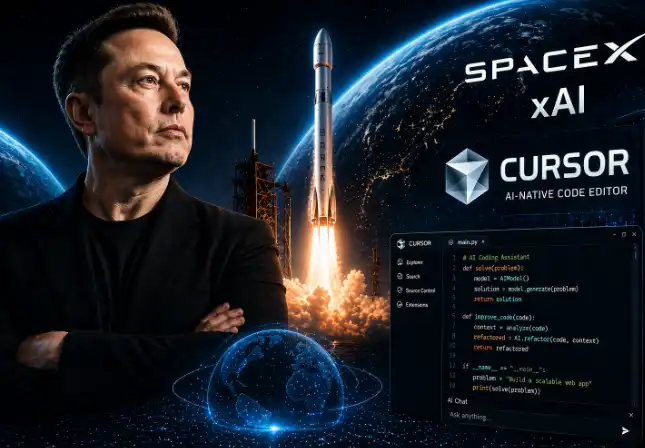
SpaceX Ties Up with Cursor: A High-Stakes AI Gambit of 'Lock First, Acquire Later'

SpaceX has secured an option to acquire AI programming company Cursor for $60 billion, with an alternative clause requiring a $10 billion collaboration fee if the acquisition does not proceed. This structure is not merely a potential acquisition but a strategic move to control core access points in the AI era. The deal is designed as a flexible, dual-path arrangement, allowing SpaceX to either fully acquire Cursor or maintain a binding partnership through high-cost collaboration. This "option-style" approach minimizes immediate regulatory and integration risks while ensuring long-term alignment between the two companies. At its core, the transaction exchanges critical AI-era resources: SpaceX provides its Colossus supercomputing cluster—one of the world’s most powerful AI training infrastructures—while Cursor contributes its AI-native developer environment and strong product adoption. This synergy connects compute power, models, and application layers, forming a closed-loop AI capability stack. Cursor, founded in 2022, has achieved rapid growth with over $1 billion in annual revenue and widespread enterprise adoption. Its value lies in transforming software development through AI agents capable of coding, debugging, and system design—positioning it as a gateway to future software production. For SpaceX, this move is part of a broader strategy to evolve from a aerospace company into an AI infrastructure empire, integrating xAI, supercomputing, and chip manufacturing. Controlling Cursor fills a gap in its developer tooling layer, strengthening its AI narrative ahead of a potential IPO. The deal reflects a shift in AI competition from model superiority to ecosystem and entry-point control. With programming tools as a key battleground, securing developer loyalty becomes crucial for dominating the software production landscape. Risks include questions around Cursor’s valuation, technical integration challenges, and potential regulatory scrutiny. Nevertheless, the deal underscores a strategic bet: controlling both compute and software development access may redefine power dynamics in the AI-driven future.

marsbit46 мин. назад

SpaceX Ties Up with Cursor: A High-Stakes AI Gambit of 'Lock First, Acquire Later'

marsbit46 мин. назад

Торговля

Спот
Фьючерсы

Популярные статьи

Как купить SKY

Добро пожаловать на HTX.com! Мы сделали приобретение sky (SKY) простым и удобным. Следуйте нашему пошаговому руководству и отправляйтесь в свое крипто-путешествие.Шаг 1: Создайте аккаунт на HTXИспользуйте свой адрес электронной почты или номер телефона, чтобы зарегистрироваться и бесплатно создать аккаунт на HTX. Пройдите удобную регистрацию и откройте для себя весь функционал.Создать аккаунтШаг 2: Перейдите в Купить криптовалюту и выберите свой способ оплатыКредитная/Дебетовая Карта: Используйте свою карту Visa или Mastercard для мгновенной покупки sky (SKY).Баланс: Используйте средства с баланса вашего аккаунта HTX для простой торговли.Третьи Лица: Мы добавили популярные способы оплаты, такие как Google Pay и Apple Pay, для повышения удобства.P2P: Торгуйте напрямую с другими пользователями на HTX.Внебиржевая Торговля (OTC): Мы предлагаем индивидуальные услуги и конкурентоспособные обменные курсы для трейдеров.Шаг 3: Хранение sky (SKY)После приобретения вами sky (SKY) храните их в своем аккаунте на HTX. В качестве альтернативы вы можете отправить их куда-либо с помощью перевода в блокчейне или использовать для торговли с другими криптовалютами.Шаг 4: Торговля sky (SKY)С легкостью торгуйте sky (SKY) на спотовом рынке HTX. Просто зайдите в свой аккаунт, выберите торговую пару, совершайте сделки и следите за ними в режиме реального времени. Мы предлагаем удобный интерфейс как для начинающих, так и для опытных трейдеров.

486 просмотров всегоОпубликовано 2025.09.17Обновлено 2025.09.17

Как купить SKY

Обсуждения

Добро пожаловать в Сообщество HTX. Здесь вы сможете быть в курсе последних новостей о развитии платформы и получить доступ к профессиональной аналитической информации о рынке. Мнения пользователей о цене на SKY (SKY) представлены ниже.

活动图片