Even Facing Gunshots and Jail, Why Do Small-Town Americans Still Oppose AI Data Centers?

marsbitОпубликовано 2026-04-14Обновлено 2026-04-14

Введение

Residents in small American towns are fiercely opposing AI data center projects, even resorting to extreme measures like shooting at officials' homes. The backlash is driven by concerns over massive resource consumption, lack of transparency, and disproportionate economic impact. For instance, Festus, Missouri, voted to recall half its city council after approving a $6 billion project without public hearings. A single data center can consume 3.6 times more electricity and significant water compared to a small city’s residential use, threatening local resources. Organized opposition groups have grown from 142 to 188 in a year, halting or delaying projects worth $162 billion. The bottleneck for AI expansion is shifting from power contracts to local politics, where grassroots resistance is intensifying.

On April 7, voters in Festus, Missouri, ousted four out of eight city council members in a single recall election. The trigger was the council's approval of a $6 billion AI data center project in late March by a 6-2 vote. The project, led by CRG, the data center development arm of Clayco, spans 360 acres, with the end customer being an undisclosed Fortune 100 company (codenamed Project Cumulus).

The council approved it without holding public hearings. Subsequently, the local resident group Wake Up JeffCo sued the city government and CRG in St. Louis County Court, and a petition to recall the mayor has also been initiated. According to a summary by Tom's Hardware, around the same time, the home of Indianapolis city councilor Ron Gibson was shot at with over a dozen bullets at the end of 2025, with a note left at the doorstep saying, "No Data Centers."

Festus is not an isolated case. Not long ago, Indianapolis city councilor Ron Gibson's home was hit by 13 shots in the middle of the night, waking his 8-year-old son. A handwritten note was left at the door: "No data centers." The FBI has launched an investigation. Jordyn Abrams, a researcher at George Washington University's Program on Extremism, pointed out that data centers are becoming targets for anti-tech, anti-government extremists.

Advocacy group Data Center Watch, in its Q2 2025 report, updated the number of organized opposition groups from 142 (across 24 states) a year ago to 188 (across 40 states). The value of projects halted or delayed increased from $64 billion to $162 billion. On April 1, 2026, Port Washington, Wisconsin, passed the nation's first referendum explicitly targeting data centers, with 66% of voters approving a mandatory referendum threshold for TIF subsidies exceeding $10 million.

These events collectively answer the same question: Could the real bottleneck in AI capacity expansion be stuck at the county and city ballot box?

Widespread Backlash

Plotting events from the past 23 months on a U.S. map reveals two levels of backlash. One is at the state level, where eight states have submitted or passed data center moratorium bills, including Maine (passed the House 82-62, lasting until 2027), Vermont (paused until July 2030), Virginia (submitted by Democratic Representative Irene Shin, paused until 2028), Georgia, Maryland, South Dakota, Wisconsin, and Minnesota. This layer involves legislative action, with the broadest impact but the slowest progress.
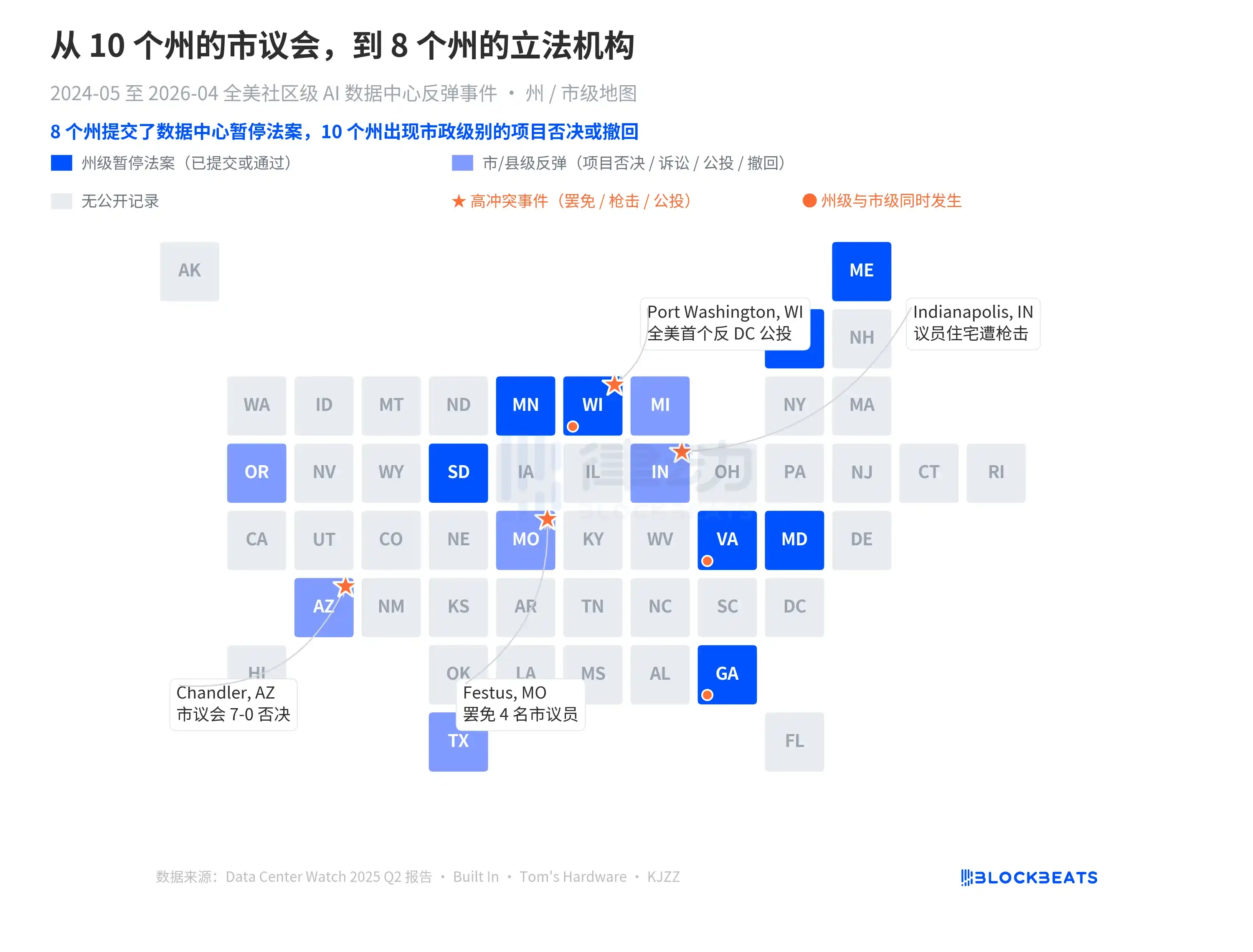
The other is at the city and county level, where backlash is denser and more intense. The Chandler, Arizona city council unanimously rejected Active Infrastructure's $2.5 billion project in December 2025 (lobbied by former federal senator Kyrsten Sinema). The Tucson city council is currently reviewing data center zoning restrictions in April 2026, with public comment open until the end of the month. Hays County / San Marcos, Texas, rejected a $1.5 billion project by a 5-2 vote. Oregon's Cascade Locks, Indiana's Chesterton, Virginia's Catlett Station, Missouri's Peculiar, Michigan's Lansing. According to Data Center Watch, at least 10 states have seen direct municipal rejections or developer withdrawals.

More than half of the high-conflict incidents are concentrated in the Midwest and Midsouth. This region has relatively ample grid capacity over the past decade and was a hotspot for the previous wave of data center expansion. The backlash now focused in the same area, from another perspective, is the supply side spreading from "states with power surplus" and hitting the most sensitive layer of local politics.

$6 Billion Is Not on the Same Scale

Festus's fiscal scale means the $6 billion figure simply cannot be processed normally by the city council. According to local newspaper myleaderpaper citing municipal budget documents, Festus's FY2025 general fund plus public safety operating budget is $17.64 million, FY2024 total municipal expenditure was $37.41 million, and reserve funds at the end of FY2025 are projected at $28.09 million.

The data center project's $6 billion is about 340 times the annual operating budget, or $450,000 per resident for the city's 13,200 people. In relative terms, this is not a local development project to be discussed, but a small town being plugged into a capital pipeline completely unrelated to itself.
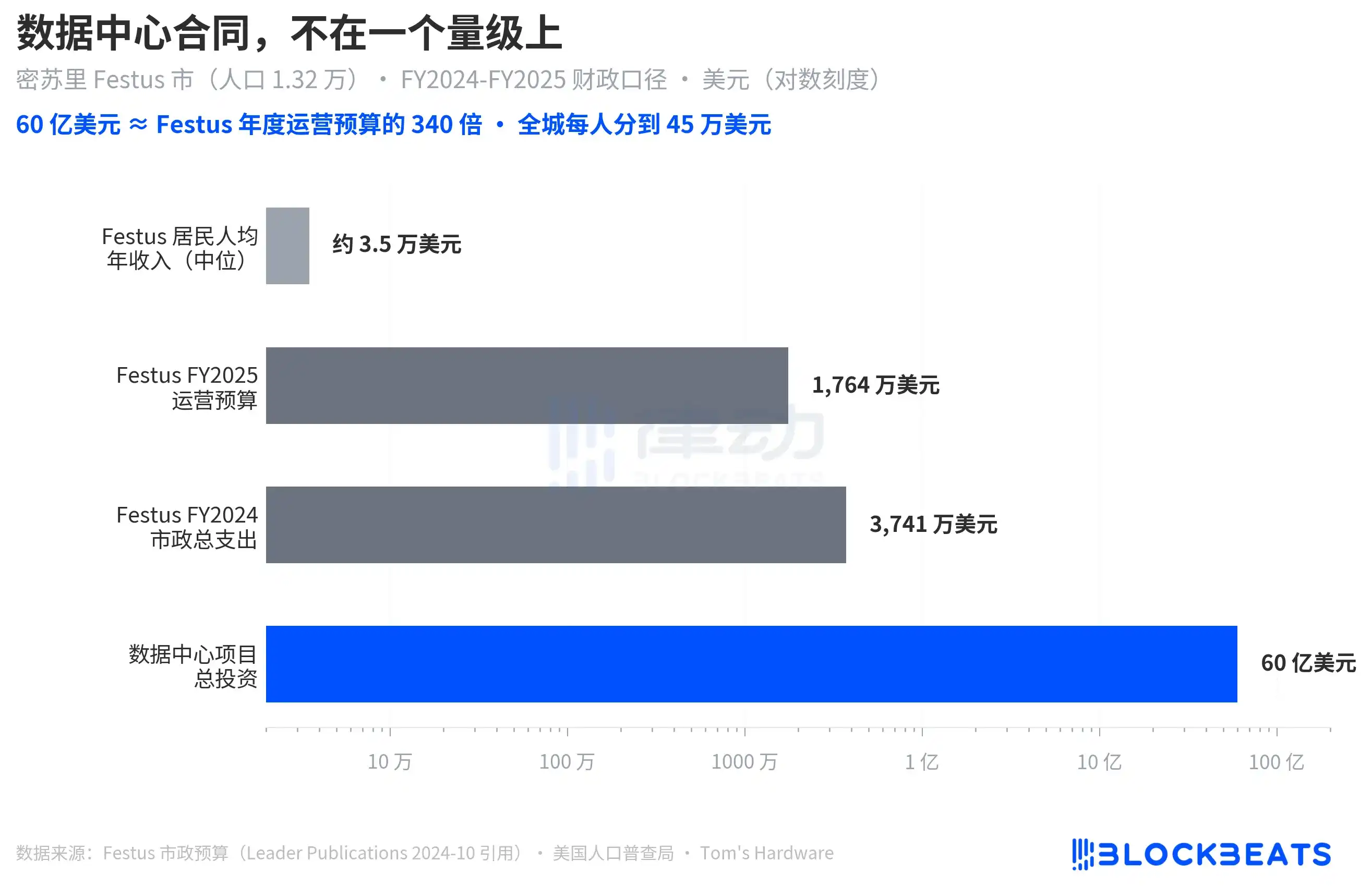
Comparing it to Festus residents' median annual income—about $35,000 in Missouri non-metro areas—makes the issue clearer. Any decimal point in the data center contract is larger than the entire community's lifetime per capita disposable income. Local officials lack experience in balancing such numbers procedurally. The Festus council resolution was criticized for "not holding public hearings" technically because such projects typically operate under commercial confidentiality clauses (developer and end customer identities undisclosed), making normal council procedures unable to review confidential contracts. This is a structural loophole, not negligence by individual council members.

Precisely because of the scale gap, breaking down the data center contract into manageable pieces for local councils is inherently unworkable. This is why, over the past 12 months, the backlash path hasn't been internal resolution but external weapons: recall, litigation, and referendum. Festus's recall of four council members, simultaneous lawsuit by residents in St. Louis County Court, and initiation of a mayor recall petition are a rare case of all three paths triggering at once.

One Data Center, Consuming a Small Town

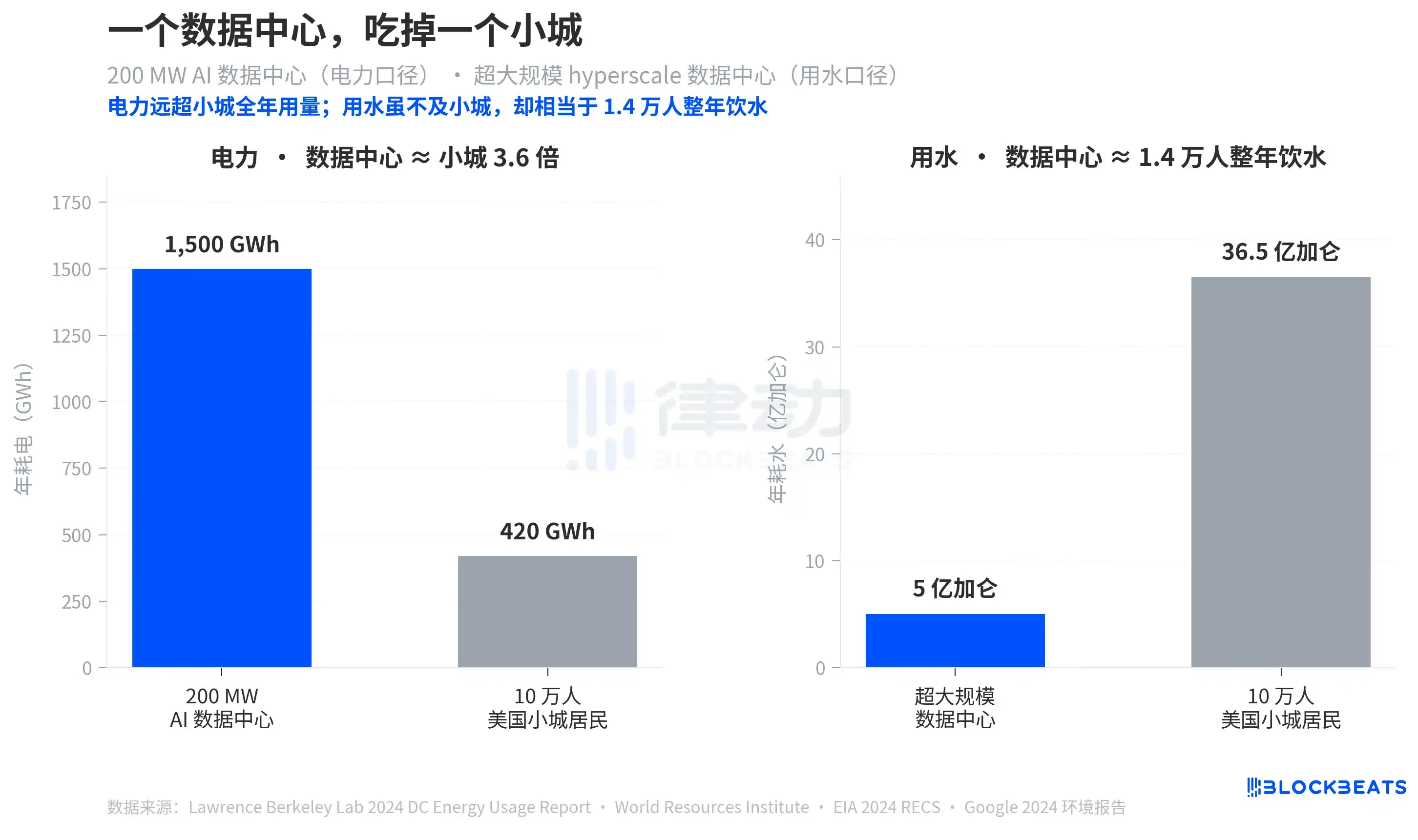
The power consumption of an AI data center is best felt using a small U.S. town for comparison. A fully loaded 200 MW AI data center, at 86% load factor, consumes about 1,500 GWh annually. A 100,000-person small U.S. town's residential electricity consumption is about 420 GWh per year (based on EIA's average residential electricity use of 10.5 MWh per household, 2.5 persons per household). The data center uses 3.6 times the electricity of the town's residents. And this is just electricity, not counting cooling and ancillary water use.

The water comparison is reversed but even more直观. According to USGS typical residential water use (100 gallons per person per day), a 100,000-person town uses about 3.65 billion gallons annually. A hyperscale AI data center, per Google's Council Bluffs (the largest Google data center in the U.S.), uses 500 million gallons per year. In absolute terms, the data center uses 13.7% of the town's water, but on another scale, it's equivalent to the annual drinking water for 14,000 people. For a town with 10,000 to 50,000 residents, it means ceding a substantial portion of the city's water supply to one user. According to Lawrence Berkeley Lab's 2024 data center energy report, U.S. data centers used 17 billion gallons directly for cooling in 2023, and 211 billion gallons indirectly (for power generation), with direct water use expected to double or quadruple by 2028.
The most common protest cry is "our wells will run dry." Numerically, this is not an emotional expression. In Loudoun County, Virginia (the most data center-dense county in the U.S.), potential data center water use in 2023 was 899 million gallons, about 10% of the county's total water use, according to local water data cited by Sierra Club and Grist. If this is the case at the county level, the numbers for towns will only be more extreme.

Planned Capacity Entering the Backlash Window

Actually operational U.S. data center capacity, per FERC and Wood Mackenzie Q4 2025 data, is about 50 GW. The planned pipeline totals 241 GW, with 33% (about 80 GW) in active development and the remaining 67% (about 161 GW) not yet started. BloombergNEF predicts the U.S. will add 97 GW from 2025 to 2030, with data center electricity peak reaching 106 GW by 2035. All these numbers point to one fact: the vast majority of capacity is still on drawing boards, not yet落地.
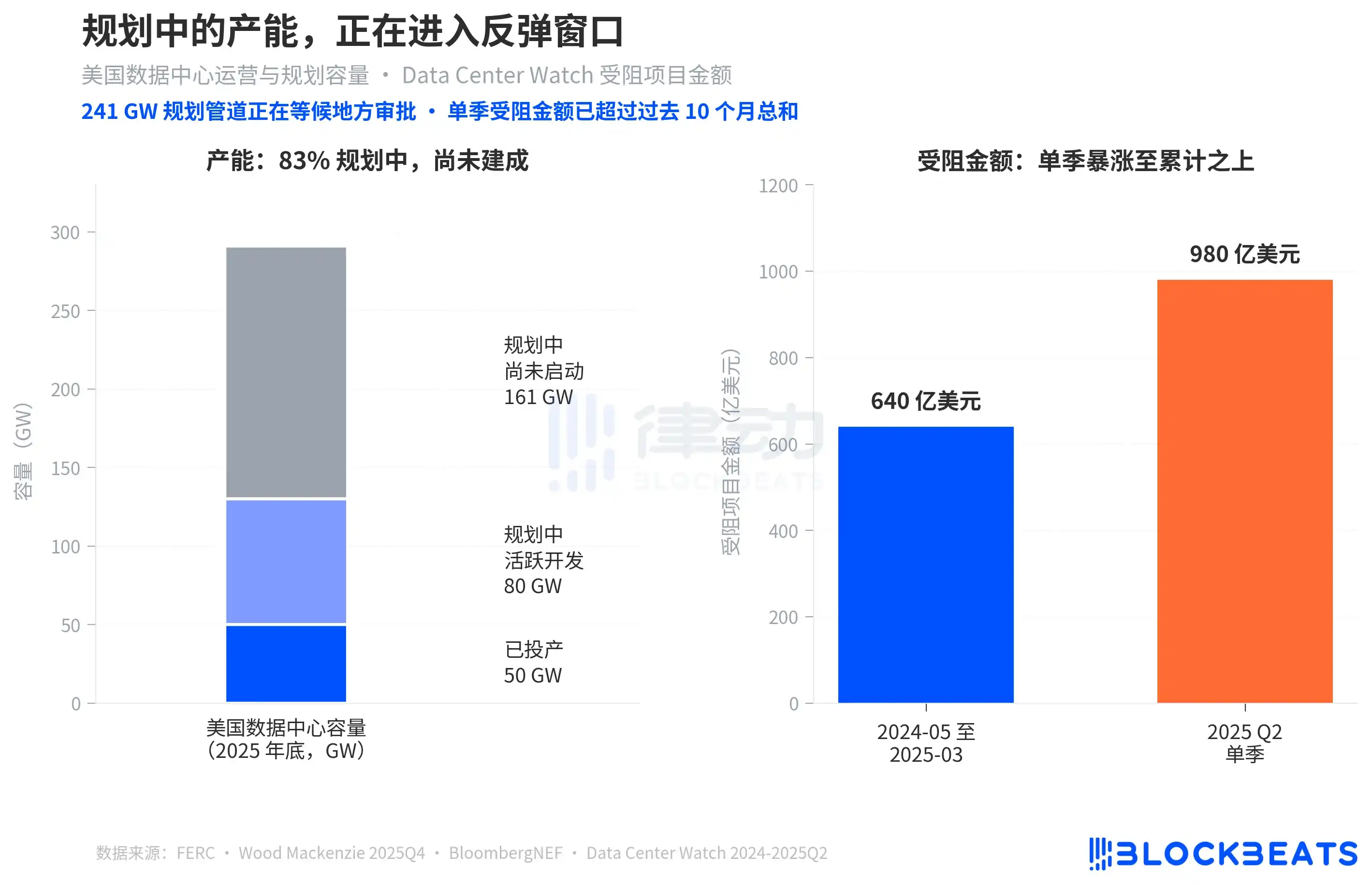
According to data disclosed by Sightline Climate via TechRadar, 30% to 50% of the 16 GW originally planned for 2026 commissioning is expected to be canceled or delayed. Meanwhile, Data Center Watch data shows that from May 2024 to March 2025, organized opposition blocked or delayed $64 billion in data center projects. In Q2 2025 alone, this figure was $98 billion, corresponding to 20 projects. The quarterly受阻 amount already exceeds the cumulative total of the previous 10 months.

This creates a timing mismatch. Capital has committed to multiplying U.S. data center capacity several times over the next five years, but新增 capacity must pass through county and city approvals one by one. The more planned capacity, the larger the surface area vulnerable to backlash. Cases like Festus escalating from council vote to recall and lawsuit in a month are not because it's special, but because the number of opposition groups increased by 46 in a year (per Data Center Watch Q2 2025 report), and they share templated legal tools跨州, including TIF subsidy referendums, zoning lawsuits, and councilor recall petitions. Whether the long-term power contracts signed by frontier labs will be fulfilled depends on which counties they land in and what kind of residents are watching those counties' councils.

The bottleneck in AI capacity expansion has, for the first time, jumped outside the power contract negotiation table and appeared on the recall ballots of 13,200 people.


Связанные с этим вопросы

QWhy did the residents of Festus, Missouri, vote to recall four city council members?

AThe residents voted to recall four city council members because the council approved a $6 billion AI data center project without holding a public hearing, which was seen as a lack of transparency and disregard for community input.

QWhat are the primary concerns driving the organized opposition to AI data centers in small towns?

AThe primary concerns include the massive consumption of local resources, such as electricity and water, which can dwarf the usage of entire small towns, potential environmental impacts like drying up wells, and the lack of democratic process in approving these large-scale projects.

QHow does the scale of a typical AI data center project compare to the budget of a small town like Festus?

AThe $6 billion AI data center project in Festus is approximately 340 times the city's annual operating budget of $17.64 million, highlighting a massive financial disparity that makes it difficult for local governments to manage or negotiate such projects effectively.

QWhat legislative actions have been taken at the state level in response to data center expansion?

AEight states have submitted or passed data center moratorium bills, including Maine (passed by the House until 2027), Vermont (paused until July 2030), Virginia (submitted by a Democratic representative until 2028), Georgia, Maryland, South Dakota, Wisconsin, and Minnesota, aiming to temporarily halt new data center developments.

QWhat is the projected impact of organized opposition on planned data center capacity in the United States?

AOrganized opposition has led to $640 billion in data center projects being blocked or delayed from May 2024 to March 2025, with an additional $980 billion受阻 in Q2 2025 alone. It is estimated that 30% to 50% of the 16 GW of capacity planned for 2026 may be canceled or postponed due to these protests.

Похожее

Почему цена биткоина осталась устойчивой и не упала, несмотря на недавний крупный хакерский взлом? Вот в чем секрет

В интервью на канале «Волк со всех улиц» эксперты обсудили устойчивость биткоина после хакерской атаки на холодные кошельки на $100 млн. Аналитик Bitwise Райан Расмуссен отметил, что рынок созрел: теперь доминируют институциональные инвесторы, использующие ETF и регулируемые сервисы (Coinbase, Anchorage), поэтому инциденты с частными кошельками почти не влияют на общую ситуацию. Инвестдиректор Bitwise Мэтт Хоуган добавил, что рынок стал более устойчивым к негативным новостям благодаря институциональному капиталу, а оставшиеся инвесторы держат активы твердо. Гендиректор Arch Public Тиллман Холлоуэй констатировал «смену караула»: если раньше цену определяли майнеры и криптобиржи, теперь контроль у Уолл-стрит. Хоуган также указал на разрыв между пессимизмом в соцсетях и долгосрочными стратегиями крупных банков (Morgan Stanley, Wells Fargo, UBS), рассматривающих коррекции как возможность для покупки. Расмуссен отметил, что управляющие портфелями всё чаще включают криптоактивы, рекомендуя выделять на биткоин 1–6%, так как его интеграция в традиционные индексы снизила воспринимаемые риски.

cryptonews.ru19 мин. назад

Почему цена биткоина осталась устойчивой и не упала, несмотря на недавний крупный хакерский взлом? Вот в чем секрет

cryptonews.ru19 мин. назад

Основатель Aave решительно выступает против запланированных изменений в Ethereum: «Это может нанести значительный ущерб»

Основатель и CEO Aave Стани Кулечов выступил против предложения в сообществе Ethereum (EIP), направленного на ограничение доходов от стейкинга. Предложение предусматривает снижение доходности до 0%, если доля стейкингованных ETH превысит 50% от общего предложения. Кулечов утверждает, что это сделает доход непредсказуемым и нерентабельным, особенно для институциональных инвесторов, которые ценят стабильные денежные потоки. Это может привести к их уходу в альтернативные сети, нанеся ущерб внедрению Ethereum. Он также предупреждает, что такие изменения подорвут стратегии кредитования и получения дохода на основе ETH, сократят соответствующие рынки и ослабят привлекательность ETH как актива. Кулечов призвал тщательно оценивать влияние на DeFi, стейкинг и институциональное принятие, надеясь, что предложение не будет реализовано.

cryptonews.ru59 мин. назад

Основатель Aave решительно выступает против запланированных изменений в Ethereum: «Это может нанести значительный ущерб»

cryptonews.ru59 мин. назад

Акции майнера Bitdeer подскочили на более чем 12% на фоне соглашения на $4,7 млрд

Компания Bitdeer заключила 16-летнее соглашение об аренде оборудования на своем объекте в Норвегии с компанией Volta Tydal AS на сумму 4,7 млрд долларов. Речь идет о площадке в муниципалитете Тюдал общей мощностью 180 МВт, которую переоборудуют из майнинга криптоактивов для нужд сектора искусственного интеллекта. В рамках сделки дочерняя структура Bitdeer, Tydal Data Center AS, предоставит 121 МВт вычислительных мощностей, сконфигурированных с графическими процессорами Nvidia. Эти мощности предназначены для «ведущей ИИ-лаборатории», которой, по данным Bloomberg, является компания Anthropic. Соглашение предусматривает возможность продления еще на 8 лет, что в перспективе может принести Bitdeer общий доход около 8 млрд долларов за 24 года. На фоне этой новости курс акций Bitdeer вырос более чем на 12%. Как и другие крупные майнинговые компании, Bitdeer активно диверсифицирует бизнес в сферу ИИ, где использование электроэнергии для вычислений в настоящее время считается более выгодным.

cryptonews.ru1 ч. назад

Акции майнера Bitdeer подскочили на более чем 12% на фоне соглашения на $4,7 млрд

cryptonews.ru1 ч. назад

Французская компания Sequans продолжает сокращать свои позиции в BTC, вновь инвестируя в интернет вещей

Французский производитель микросхем Sequans Communications (NYSE: SQNS) продолжил сокращать свои вложения в Bitcoin (BTC), продав 1200 монет во втором квартале 2026 года. В результате объем ее BTC-резервов уменьшился с 1514 до 314 монет, стоимость которых на конец июня оценивалась в $18,4 млн. По словам генерального директора Жоржа Карама, продажа активов была частью оптимизации структуры капитала. Компания полностью погасила конвертируемый долг, завершила квартал с $21 млн денежных средств (против $10,6 млн тремя месяцами ранее) и не имеет долгов. Основной стратегией теперь является развитие основного бизнеса — производства полупроводников для Интернета вещей (IoT). Продажа BTC во втором квартале принесла компании чистую прибыль в размере $5,3 млн, что резко контрастирует с убытком в $11,7 млн от аналогичных продаж в первом квартале. При этом нереализованные убытки от BTC-активов во втором квартале составили $3 млн против $29,3 млн в предыдущем квартале. Бизнес по производству микросхем показал рост: выручка от продаж продукции увеличилась более чем на 80% в годовом исчислении, достигнув $7,5 млн. Компания сосредоточена на более чем 40 проектах, находящихся в серийном производстве. Акции Sequans отреагировали на новости ростом на предрыночных торгах. Sequans начала инвестировать в BTC в июле 2025 года, достигнув пика в более чем 3300 монет, но с ноября 2025 года последовательно сокращает позиции. Компания входит в число ряда публичных фирм (наряду с MARA, Riot Platforms и другими), которые недавно сократили свои BTC-холдинги.

cryptonews.ru1 ч. назад

Французская компания Sequans продолжает сокращать свои позиции в BTC, вновь инвестируя в интернет вещей

cryptonews.ru1 ч. назад

Компания Coldcard опубликовала новое заявление по поводу масштабного взлома биткоинов!

Компания Coldcard, производитель аппаратных биткоин-кошельков, выпустила срочное предупреждение о безопасности. Угроза, связанная с уязвимостью в процессе генерации ключей, привела к убыткам около 40 миллионов долларов и еще не устранена полностью. Компания настоятельно рекомендует всем пользователям немедленно перевести свои средства на новые кошельки и создать совершенно новые сид-фразы для восстановления. Также необходимо обновить прошивку и перестать использовать адреса, созданные устаревшими методами. Coldcard опровергла слухи о том, что новейшее обновление навсегда выводит устройства из строя. В случае временной ошибки генератора случайных чисел (TRNG) проблема решается полным отключением устройства от питания и его перезапуском. Разработчики заявили, что нет доказательств необратимого повреждения устройств текущим патчем. В настоящее время команда работает над новым обновлением, которое сделает восстановление системы генерации случайных чисел более безопасным. Оно будет включать ограничение попыток, обнаружение ошибок и очистку старых данных. Поддержка модели Mk3 будет реализована в отдельном обновлении программного обеспечения.

cryptonews.ru1 ч. назад

Компания Coldcard опубликовала новое заявление по поводу масштабного взлома биткоинов!

cryptonews.ru1 ч. назад

Торговля

Спот
活动图片