Crypto Under Fire: Why South Korea’s Bithumb Penalty Is A Warning Shot To Exchanges Worldwide

bitcoinistОпубликовано 2026-03-16Обновлено 2026-03-16

Введение

South Korea's Financial Intelligence Unit (FIU) has imposed a six-month partial business suspension and a fine of 36.8 billion won (approximately $24–26 million) on Bithumb, one of the country's largest cryptocurrency exchanges. The penalties are due to serious breaches of Anti-Money Laundering (AML) and Know Your Customer (KYC) regulations, including dealings with unregistered overseas virtual asset service providers and inadequate customer due diligence. The exchange’s CEO received a reprimand, and its reporting officer faces a six-month suspension. This action is part of a broader regulatory crackdown following a system error at Bithumb in February that miscredited Bitcoin holdings. The move aligns with South Korea's efforts to strengthen crypto oversight in line with FATF standards. Similar enforcement trends are emerging globally, as seen in major penalties against exchanges like Binance in the U.S. and regulatory actions in Canada, Australia, and France. The case underscores increasing regulatory scrutiny on crypto exchanges worldwide and highlights the growing importance of robust compliance to mitigate counterparty risks.

South Korea’s Financial Intelligence Unit (FIU) has imposed a 6-month partial business suspension and 36.8 billion won fine on one the biggest Korean crypto exchanges, Bithumb.

A New Governance Hit On A Crypto Exchange

According to Korean outlet News1, the FIU has finalized heavy sanctions against Bithumb for serious Anti‐Money Laundering (AML) and Know Your Costumer (KYC) breaches, including dealings with unregistered overseas virtual asset service providers and weak customer due diligence under the Specific Financial Information Act.

The measures include a six‐month partial business suspension, focused on restricting certain virtual asset transfers, especially to external wallets for new users, and an administrative fine in the tens of billions of won (around $24–26 million). Alongside this, the CEO was issued a reprimand warning and the exchange’s reporting officer faces a six-month suspension.

This decision follows a wider supervisory campaign launched after Bithumb’s “ghost Bitcoin” system error this past February, which saw hundreds of thousands of BTC briefly mis‐credited and triggered full‐scale inspections across Korean exchanges. As reported by Bitcoinist, the FIU preliminarily notified Bithumb of the suspension on March 9.

Bithumb’s case mirrors previous Korean penalties against rivals like Upbit and Korbit, which have already faced multi‐million‐dollar fines and partial suspensions over widespread KYC and AML failures.

A Worldwide Trend

Recently, South Korea has been moving at a rapid speed to align its crypto oversight with the Financial Action Task Force (FATF) standards, expanding its Travel Rule implementation and treating major exchanges more and more like systemically important financial institutions, as seen by the recent proposal of the Digital Assets Basic Act, an umbrella bill that packages a wide range of crypto policy measures, from stablecoin rules to crypto exchange‐traded funds.

Globally, the pattern is no different. From Binance’s record multi‐billion‐dollar AML and sanctions settlement in the US to Canada’s nine‐figure fine against Cryptomus and targeted audits in Australia and France, regulators worldwide seem to be converging on a “no more excuses” approach to crypto AML.

For traders, the actionable takeaway is that jurisdiction and compliance profile now directly affect counterparty risk: platforms with weak AML controls risk sudden suspensions, tightened withdrawal rules, or liquidity shocks that can spill over into prices and funding conditions. In today’s climate, trading on exchanges that cut corners on AML rules might mean an extra hidden risk of being suddenly hit by regulators.
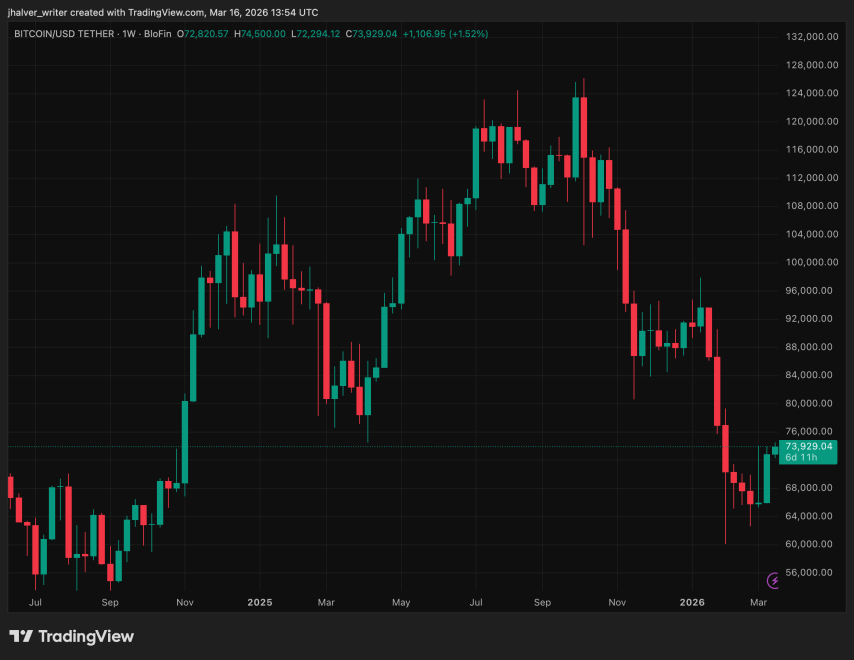
BTC’s price almost reaches $74K on the daily chart. Source: BTCUSDT on Tradingview

Cover image from Perplexity, BTCUSDT chart from Tradingview

Связанные с этим вопросы

QWhat penalties did South Korea's FIU impose on Bithumb and for what reasons?

ASouth Korea's FIU imposed a 6-month partial business suspension and a 36.8 billion won (approximately $24-26 million) fine on Bithumb due to serious Anti-Money Laundering (AML) and Know Your Customer (KYC) breaches, including dealings with unregistered overseas virtual asset service providers and weak customer due diligence under the Specific Financial Information Act.

QWhat triggered the wider supervisory campaign that led to Bithumb's penalties?

AThe wider supervisory campaign was triggered by Bithumb's 'ghost Bitcoin' system error in February, where hundreds of thousands of BTC were briefly mis-credited, which prompted full-scale inspections across Korean exchanges.

QHow does South Korea's recent regulatory approach align with global standards?

ASouth Korea is rapidly aligning its crypto oversight with the Financial Action Task Force (FATF) standards, expanding its Travel Rule implementation and treating major exchanges more like systemically important financial institutions, as seen in the proposed Digital Assets Basic Act.

QWhat are the global examples of similar regulatory actions against crypto exchanges mentioned in the article?

AGlobal examples include Binance's record multi-billion-dollar AML and sanctions settlement in the US, Canada's nine-figure fine against Cryptomus, and targeted audits in Australia and France.

QWhy is trading on exchanges with weak AML controls considered risky for traders according to the article?

ATrading on exchanges with weak AML controls is risky because platforms risk sudden suspensions, tightened withdrawal rules, or liquidity shocks that can spill over into prices and funding conditions, adding an extra hidden risk of regulatory action.

Похожее

Interview with Jeff Hoffman: How Web3 and AI Are Reshaping the Trillion-Dollar Social Travel Market

Interview with Jeff Hoffman: Web3 and AI Reshaping the Trillion-Dollar Social Travel Market Jeff Hoffman, co-founder of Priceline, discusses how Web3 and AI are transforming the social travel industry. He highlights that the current travel market is fragmented and inefficient, dominated by traditional online travel agencies (OTAs) that act as intermediaries with opaque models. Web3 introduces direct connections, transparency, and faster settlements, shifting value back to travelers. Key trends driving this change include demand for flexible rewards, digital payments, and trust in communities over ads. Hoffman joined Staynex not for its Web3 label, but because it addresses industry inefficiencies by integrating booking, payments, AI-driven itineraries, and rewards into a single ecosystem. This Web2.5 model combines Web2 scale with Web3 incentives. He emphasizes the team’s focus on execution over hype as a key reason for his involvement. Looking ahead, blockchain will enable transparent rewards and seamless cross-border payments, while AI provides personalization. Together, they will turn travel into a continuous relationship rather than a transaction. Hoffman predicts traditional OTAs will persist, but value will shift to platforms that own payment, loyalty, and community networks. Social travel represents a significant, underestimated opportunity in Web3.

marsbit27 мин. назад

Interview with Jeff Hoffman: How Web3 and AI Are Reshaping the Trillion-Dollar Social Travel Market

marsbit27 мин. назад

Торговля

Спот
Фьючерсы

Популярные статьи

Как купить S

Добро пожаловать на HTX.com! Мы сделали приобретение Sonic (S) простым и удобным. Следуйте нашему пошаговому руководству и отправляйтесь в свое крипто-путешествие.Шаг 1: Создайте аккаунт на HTXИспользуйте свой адрес электронной почты или номер телефона, чтобы зарегистрироваться и бесплатно создать аккаунт на HTX. Пройдите удобную регистрацию и откройте для себя весь функционал.Создать аккаунтШаг 2: Перейдите в Купить криптовалюту и выберите свой способ оплатыКредитная/Дебетовая Карта: Используйте свою карту Visa или Mastercard для мгновенной покупки Sonic (S).Баланс: Используйте средства с баланса вашего аккаунта HTX для простой торговли.Третьи Лица: Мы добавили популярные способы оплаты, такие как Google Pay и Apple Pay, для повышения удобства.P2P: Торгуйте напрямую с другими пользователями на HTX.Внебиржевая Торговля (OTC): Мы предлагаем индивидуальные услуги и конкурентоспособные обменные курсы для трейдеров.Шаг 3: Хранение Sonic (S)После приобретения вами Sonic (S) храните их в своем аккаунте на HTX. В качестве альтернативы вы можете отправить их куда-либо с помощью перевода в блокчейне или использовать для торговли с другими криптовалютами.Шаг 4: Торговля Sonic (S)С легкостью торгуйте Sonic (S) на спотовом рынке HTX. Просто зайдите в свой аккаунт, выберите торговую пару, совершайте сделки и следите за ними в режиме реального времени. Мы предлагаем удобный интерфейс как для начинающих, так и для опытных трейдеров.

1.1k просмотров всегоОпубликовано 2025.01.15Обновлено 2025.03.21

Как купить S

Sonic: Обновления под руководством Андре Кронье – новая звезда Layer-1 на фоне спада рынка

Он решает проблемы масштабируемости, совместимости между блокчейнами и стимулов для разработчиков с помощью технологических инноваций.

2.2k просмотров всегоОпубликовано 2025.04.09Обновлено 2025.04.09

Sonic: Обновления под руководством Андре Кронье – новая звезда Layer-1 на фоне спада рынка

HTX Learn: Пройдите обучение по "Sonic" и разделите 1000 USDT

HTX Learn — ваш проводник в мир перспективных проектов, и мы запускаем специальное мероприятие "Учитесь и Зарабатывайте", посвящённое этим проектам. Наше новое направление .

1.8k просмотров всегоОпубликовано 2025.04.10Обновлено 2025.04.10

HTX Learn: Пройдите обучение по "Sonic" и разделите 1000 USDT

Обсуждения

Добро пожаловать в Сообщество HTX. Здесь вы сможете быть в курсе последних новостей о развитии платформы и получить доступ к профессиональной аналитической информации о рынке. Мнения пользователей о цене на S (S) представлены ниже.

活动图片