Code Is Getting Cheaper, Licenses Are Getting More Valuable: The Real Moat of Fintech in the AI Era

marsbitОпубликовано 2026-03-16Обновлено 2026-03-16

Введение

"The article argues that in the AI era, code is becoming cheaper, but true competitive advantages in Fintech come from hard-to-replicate elements like banking licenses, underwriting data from credit losses, and proprietary risk models trained on real transaction volumes. While traditional software companies face compressed margins as AI lowers both development and distribution costs, Fintech's real moats lie in regulatory compliance, risk management, and data accumulation—areas where AI actually strengthens incumbents. Companies that own the "fin" side (licenses, risk-bearing, proprietary data) will benefit from AI, while those relying solely on "tech" (software interfaces built atop others' infrastructure) will suffer from eroding differentiation. The new arbitrage is no longer about applying software valuations to financial economics, but about owning the foundational elements of finance itself."

Author: Matt Brown

Compiled by: Deep Tide TechFlow

Deep Tide Introduction: Matrix VC partner Matt Brown presents a counterintuitive argument: AI is making code increasingly cheaper, but it's making the truly hard-to-replicate elements in Fintech—banking licenses, underwriting data accumulated from credit losses, risk control models fed by real transaction volumes—more valuable than ever before.

"You can't vibe-code your way into a banking charter," a phrase that captures the core of the entire article.

This is not just a Fintech analysis; it's a map of "what moats are stronger" in the AI era.

Full Text Below:

The term "Fintech" has long relied on ambiguity arbitrage within its name.

"Fin" implies a flood of emails from .gov domains, months-long audits, compliance officers who know your SAR filing history better than you do, and weekday trips to Charlotte or Washington D.C. "Tech" implies a sleek mobile app, a 10x user experience, and discussing investments over coffee at Blue Bottle.

"Fin" and "tech" have always existed on a spectrum, but the market has typically rewarded those Fintech companies that act as much like "tech" and as little like "fin" as possible.

This is understandable. In 2021, the gross profit pool for software was about $0.7 trillion, commanding high premium valuations. The gross profit pool for financial services was an order of magnitude larger, yet valued much more conservatively. Fintech allowed you to arbitrage both sides: the economics of financial services, paired with the valuation multiples of software companies.

The size of this profit pool also tells you where the real money is. Financial services generate the most gross profit among global industries. The "fin" side of Fintech is not only more defensive; it's a vastly larger market.
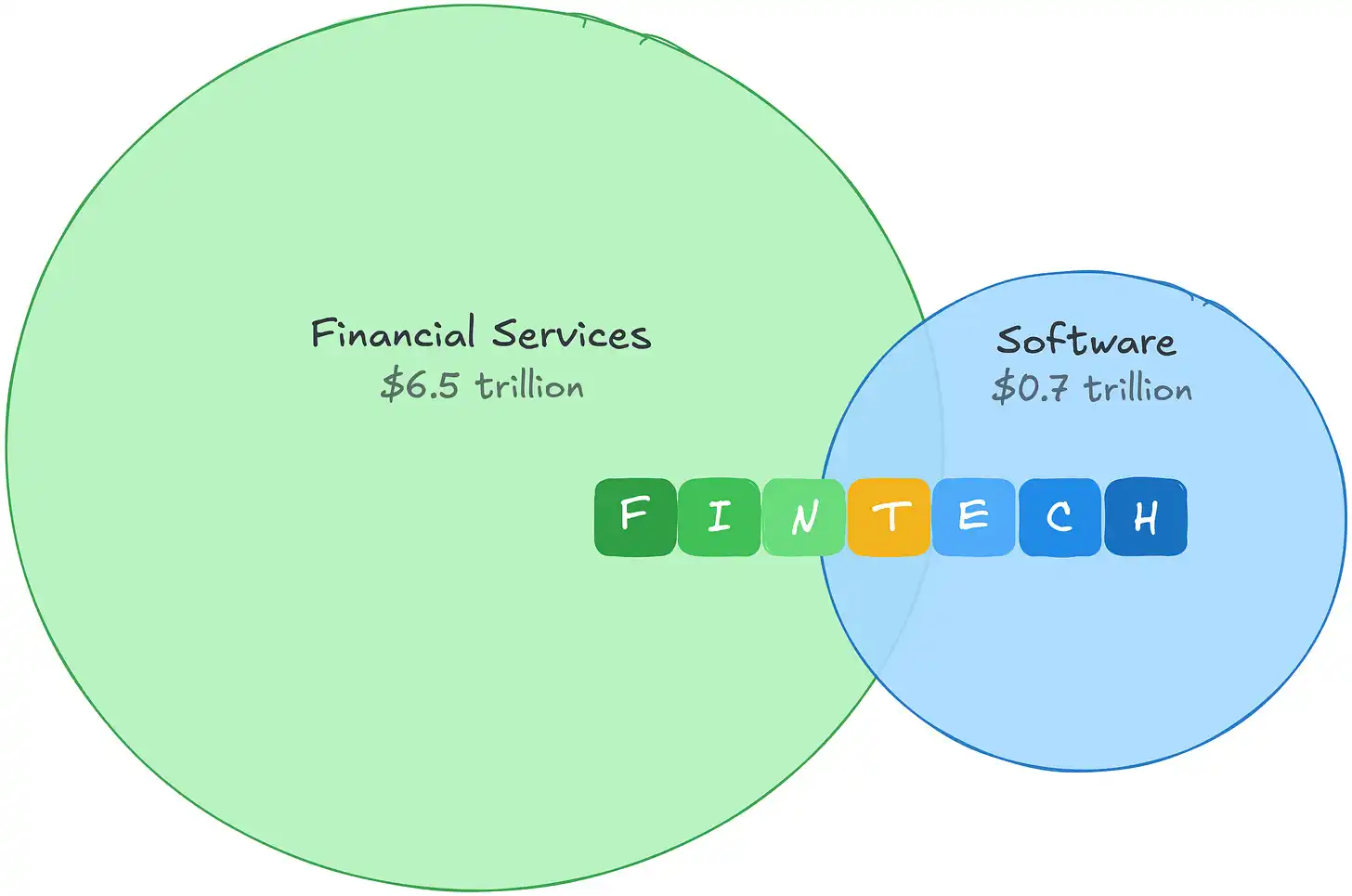
Then AI, and the arbitrage space vanished. As investors repriced "what code is worth in a world where code is getting cheaper," software valuations compressed. Fintech companies, being categorized by the market as software companies, were caught in the crossfire.

But the market got the categorization wrong. Fintech's costs, and its moats, were never in the code, and in the face of AI-driven cost compression, they look increasingly anti-fragile.

A Tale of Two Cost Structures

Software once had one of the best business models in history: code was expensive to produce, but once written, distribution was nearly free. The gap between "expensive to build" and "free to distribute" was the margin. If you were a SaaS company spending 22 to 25% of revenue on R&D, that expenditure was also your barrier to entry. Competitors couldn't easily replicate something that took years and tens of millions of dollars to build.

AI compresses this gap from the top. If code is both cheap to build *and* cheap to distribute, margins narrow. The wall keeping competitors out gets lower, more players enter, and pricing power erodes.

If your business *is* software, this is a real problem. But Fintech's spend isn't engineering spend. Follow the money, and the difference becomes obvious quickly.

PayPal spends 9% of revenue on R&D; Block spends 12%. This isn't because Fintech engineering isn't important—Stripe's engineering capability is world-class and a real competitive advantage. It's that most of the money doesn't flow to engineering.

The money flows to the "fin". Unlike R&D spend, these costs don't just produce the product; they produce the moat:

Credit Losses Buy Underwriting Data

Affirm spends 35% of its revenue on credit losses and funding costs *before* it pays a single engineer. Every dollar lost to a bad loan is repayment data a competitor doesn't get. A new entrant training a model on synthetic data has no real benchmark. You cannot build a reliable loss history on synthetic data alone.

Compliance Spend Buys Regulatory Permission

Wise dedicates a third of its employees to compliance and financial crime prevention across 65+ regulatory licenses. Money transmitter licenses in 50 states, BSA/AML compliance programs, bank charter requirements. These aren't advantages you build; they're permissions you continually earn. You can't vibe-code your way into a banking charter.

Volume Buys Proprietary Data

Toast's Payments segment has gross margins around 22%, far below its 70% SaaS margins, but generates nearly twice the gross profit dollars. Those costs buy merchant-level transaction data, which in turn feeds Toast Capital, which has originated over $1 billion in loans. Adyen's risk models are trained on transaction patterns across 30+ markets.

Fintech Margins Were Never High, and That's the Point

Payment companies have gross margins of 20 to 50%, not 80%. But low margins don't equal a weak business. Fintech margins are low because a huge portion of the costs are generating compounding advantages. And even the costs that don't generate advantages are outside the reach of AI-driven cost compression.

AI makes every one of these moats stronger. Better models push down loss rates, better fraud detection reduces chargebacks, better compliance tools let smaller teams hold more licenses. AI doesn't replace the moat; it rewards the companies that chose to build in the hardest parts of Fintech: money movement, risk-taking, proprietary data, and regulation.

So the real argument isn't just "AI helps Fintech," but that AI is shifting value away from product surface area and towards proprietary data, risk-taking capacity, regulatory permission, and distribution embedded in real money movement. If you're building in these areas, AI is compounding in your direction. If your differentiation is in the code, AI is compounding in the opposite direction.

Demand-side growth continues, too. Every vibe-coded checkout flow is a new fraud vector, every autonomously transacting AI agent is a chargeback risk. The more that gets built on top of Fintech infrastructure, the more indispensable that infrastructure itself becomes.

"Fin" is Where You Win

This realization is already forcing smart Fintech founders to rethink their place on the "fin" vs. "tech" spectrum:

Do we take and price risk ourselves, or pass it to a counterparty and let them take the profit?

Do we own the regulatory relationship, or rent it from someone who does?

Is every transaction making our own risk model sharper, or training someone else's?

Is our ledger the source of truth for data, or an incomplete mirror of someone else's ledger?

This distinction splits the Fintech landscape in two. Companies that own the regulatory relationships, take their own credit losses, and accumulate transaction data are building moats that AI will deepen. Companies that rent the "fin"—slapping a better interface on a partner bank's charter, a BaaS provider's ledger, someone else's risk model—face the exact same problem as SaaS companies. Their differentiation was in the code, and the code just got cheaper.
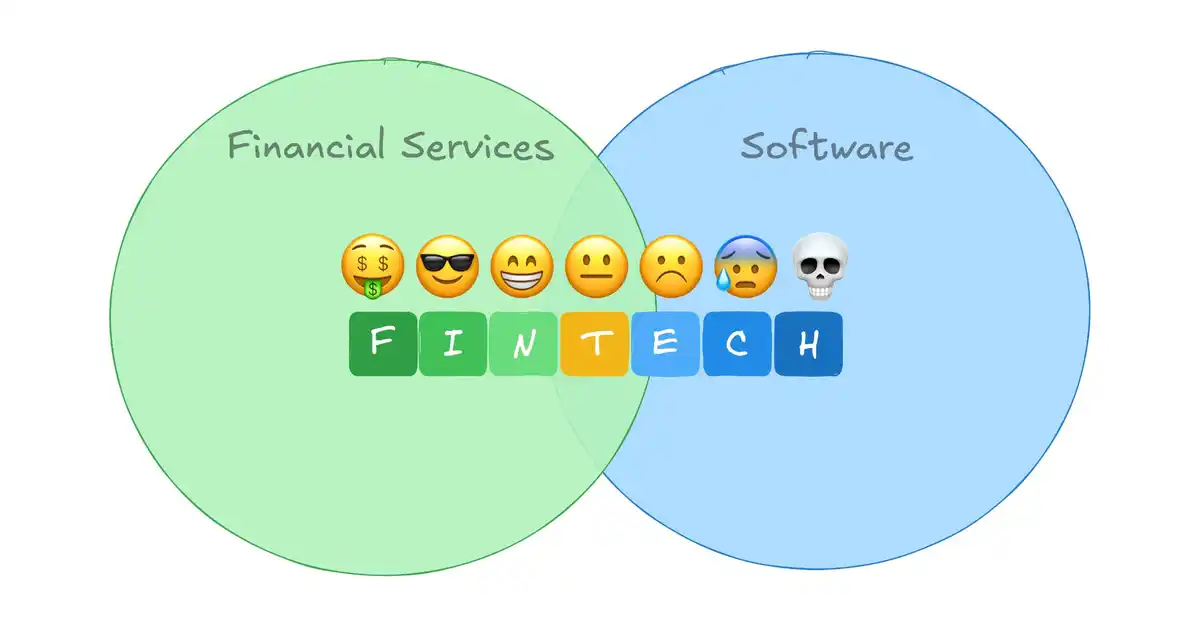
The old arbitrage of applying software multiples to financial services economics is dead. The new arbitrage is simpler: own the "fin".


Связанные с этим вопросы

QAccording to the article, why are banking licenses and underwriting data becoming more valuable in the AI era?

ABecause AI makes code cheaper to produce and distribute, but it cannot replicate hard-to-obtain assets like banking licenses (which require regulatory approval and compliance) or real underwriting data (built from actual credit losses and transaction histories). These elements form defensible moats that AI actually strengthens.

QHow does AI impact the cost structure and moats of traditional software companies versus Fintech companies?

AAI compresses the profit margins of traditional software companies by making code cheaper to build and distribute, lowering entry barriers and eroding pricing power. In contrast, Fintech companies' moats—built on regulatory licenses, proprietary data from transactions, and credit risk experience—are not only resistant to AI-driven cost compression but are actually enhanced by AI through better models for risk and compliance.

QWhat are some examples of Fintech companies investing in 'fin' moats rather than 'tech' differentiation?

AExamples include: Affirm spending 35% of revenue on credit losses and funding costs to build underwriting data; Wise investing heavily in compliance across 65+ regulatory licenses; and Toast using low-margin payment processing to gather proprietary transaction data that fuels its lending business (Toast Capital).

QWhat key questions should Fintech founders ask to determine if they are building a durable AI-era moat?

AFounders should ask: Do we take and price risk ourselves or pass it to partners? Do we own regulatory relationships or rent them? Does each transaction improve our own risk models or train someone else's? Is our ledger a source of truth or an incomplete copy of another ledger?

QHow does the article characterize the shift in valuation dynamics for Fintech companies in the age of AI?

AThe old arbitrage of applying software valuation multiples to Fintech businesses is disappearing. The new arbitrage is owning the 'fin' elements—regulatory licenses, risk-bearing capabilities, and proprietary data—which AI makes more valuable, rather than relying solely on 'tech' (code and user experience) which is becoming commoditized.

Похожее

North Korean Hackers Loot $500 Million in a Single Month, Becoming the Top Threat to Crypto Security

North Korean hackers, particularly the notorious Lazarus Group and its subgroup TraderTraitor, have stolen over $500 million from cryptocurrency DeFi platforms in less than three weeks, bringing their total theft for the year to over $700 million. Recent major attacks on Drift Protocol and KelpDAO, resulting in losses of approximately $286 million and $290 million respectively, highlight a strategic shift: instead of targeting core smart contracts, attackers are now exploiting vulnerabilities in peripheral infrastructure. For instance, the KelpDAO attack involved compromising downstream RPC infrastructure used by LayerZero's decentralized validation network (DVN), allowing manipulation without breaching core cryptography. This sophisticated approach mirrors advanced corporate cyber-espionage. Additionally, North Korea has systematically infiltrated the global crypto workforce, with an estimated 100 operatives using fake identities to gain employment at blockchain companies, enabling long-term access to sensitive systems and facilitating large-scale thefts. According to Chainalysis, North Korean-linked hackers stole a record $2 billion in 2025, accounting for 60% of all global crypto theft that year. Their total historical crypto theft has reached $6.75 billion. Post-theft, they employ specialized money laundering methods, heavily relying on Chinese OTC brokers and cross-chain mixing services rather than standard decentralized exchanges. Security experts, while acknowledging the increased sophistication, emphasize that many attacks still exploit fundamental weaknesses like poor access controls and centralized operational risks. Strengthening private key management, limiting privileged access, and enhancing coordination among exchanges, analysts, and law enforcement immediately after an attack are critical to improving defense and fund recovery chances. The industry's challenge now extends beyond secure smart contracts to safeguarding operational security at the infrastructure level.

marsbit53 мин. назад

North Korean Hackers Loot $500 Million in a Single Month, Becoming the Top Threat to Crypto Security

marsbit53 мин. назад

Circle CEO's Seoul Visit: No Korean Won Stablecoin Issuance, But Met All Major Korean Banks

Circle CEO Jeremy Allaire's recent activities in Seoul indicate a strategic shift for the company, moving away from issuing a Korean won-backed stablecoin and instead focusing on embedding itself as a key infrastructure provider within Korea’s financial and crypto ecosystem. Despite Korea accounting for nearly 30% of global crypto trading volume—with a market characterized by high retail participation and altcoin dominance—Circle has chosen not to compete for the role of stablecoin issuer. Instead, Allaire met with major Korean banks (including Shinhan, KB, and Woori), financial groups, leading exchanges (Upbit, Bithumb, Coinone), and tech firms like Kakao. This approach reflects a broader industry transition: the core of stablecoin competition is shifting from issuance rights to systemic positioning. With Korean regulators still debating whether banks or tech companies should issue stablecoins, Circle is avoiding regulatory uncertainty by strengthening its role as a service and technology partner. The company is deepening integration with trading platforms, building connections, and promoting stablecoin infrastructure. This positions Circle to benefit regardless of which entity eventually issues a won stablecoin. Allaire also noted the potential for a Chinese yuan stablecoin in the next 3–5 years, underscoring a regional trend of stablecoins becoming more regulated and integrated with traditional finance. Ultimately, Circle’s strategy highlights that future influence in the stablecoin market will belong not necessarily to the issuers, but to the foundational infrastructure layers that enable cross-system transactions.

marsbit1 ч. назад

Circle CEO's Seoul Visit: No Korean Won Stablecoin Issuance, But Met All Major Korean Banks

marsbit1 ч. назад

SpaceX Ties Up with Cursor: A High-Stakes AI Gambit of 'Lock First, Acquire Later'

SpaceX has secured an option to acquire AI programming company Cursor for $60 billion, with an alternative clause requiring a $10 billion collaboration fee if the acquisition does not proceed. This structure is not merely a potential acquisition but a strategic move to control core access points in the AI era. The deal is designed as a flexible, dual-path arrangement, allowing SpaceX to either fully acquire Cursor or maintain a binding partnership through high-cost collaboration. This "option-style" approach minimizes immediate regulatory and integration risks while ensuring long-term alignment between the two companies. At its core, the transaction exchanges critical AI-era resources: SpaceX provides its Colossus supercomputing cluster—one of the world’s most powerful AI training infrastructures—while Cursor contributes its AI-native developer environment and strong product adoption. This synergy connects compute power, models, and application layers, forming a closed-loop AI capability stack. Cursor, founded in 2022, has achieved rapid growth with over $1 billion in annual revenue and widespread enterprise adoption. Its value lies in transforming software development through AI agents capable of coding, debugging, and system design—positioning it as a gateway to future software production. For SpaceX, this move is part of a broader strategy to evolve from a aerospace company into an AI infrastructure empire, integrating xAI, supercomputing, and chip manufacturing. Controlling Cursor fills a gap in its developer tooling layer, strengthening its AI narrative ahead of a potential IPO. The deal reflects a shift in AI competition from model superiority to ecosystem and entry-point control. With programming tools as a key battleground, securing developer loyalty becomes crucial for dominating the software production landscape. Risks include questions around Cursor’s valuation, technical integration challenges, and potential regulatory scrutiny. Nevertheless, the deal underscores a strategic bet: controlling both compute and software development access may redefine power dynamics in the AI-driven future.

marsbit2 ч. назад

SpaceX Ties Up with Cursor: A High-Stakes AI Gambit of 'Lock First, Acquire Later'

marsbit2 ч. назад

Торговля

Спот
Фьючерсы

Популярные статьи

Как купить ERA

Добро пожаловать на HTX.com! Мы сделали приобретение Caldera (ERA) простым и удобным. Следуйте нашему пошаговому руководству и отправляйтесь в свое крипто-путешествие.Шаг 1: Создайте аккаунт на HTXИспользуйте свой адрес электронной почты или номер телефона, чтобы зарегистрироваться и бесплатно создать аккаунт на HTX. Пройдите удобную регистрацию и откройте для себя весь функционал.Создать аккаунтШаг 2: Перейдите в Купить криптовалюту и выберите свой способ оплатыКредитная/Дебетовая Карта: Используйте свою карту Visa или Mastercard для мгновенной покупки Caldera (ERA).Баланс: Используйте средства с баланса вашего аккаунта HTX для простой торговли.Третьи Лица: Мы добавили популярные способы оплаты, такие как Google Pay и Apple Pay, для повышения удобства.P2P: Торгуйте напрямую с другими пользователями на HTX.Внебиржевая Торговля (OTC): Мы предлагаем индивидуальные услуги и конкурентоспособные обменные курсы для трейдеров.Шаг 3: Хранение Caldera (ERA)После приобретения вами Caldera (ERA) храните их в своем аккаунте на HTX. В качестве альтернативы вы можете отправить их куда-либо с помощью перевода в блокчейне или использовать для торговли с другими криптовалютами.Шаг 4: Торговля Caldera (ERA)С легкостью торгуйте Caldera (ERA) на спотовом рынке HTX. Просто зайдите в свой аккаунт, выберите торговую пару, совершайте сделки и следите за ними в режиме реального времени. Мы предлагаем удобный интерфейс как для начинающих, так и для опытных трейдеров.

579 просмотров всегоОпубликовано 2025.07.17Обновлено 2025.07.17

Как купить ERA

Обсуждения

Добро пожаловать в Сообщество HTX. Здесь вы сможете быть в курсе последних новостей о развитии платформы и получить доступ к профессиональной аналитической информации о рынке. Мнения пользователей о цене на ERA (ERA) представлены ниже.

活动图片