Cardano Founder Sounds Alarm Over New US Crypto Bill

bitcoinistОпубликовано 2026-03-03Обновлено 2026-03-03

Введение

Cardano founder Charles Hoskinson strongly opposes the new U.S. crypto market structure bill, H.R. 3633, arguing it would harm innovation by classifying new digital assets as securities by default. He warns that the bill would force projects to undergo a difficult process to prove decentralization and potentially never escape securities classification. Hoskinson claims the SEC could exploit vague language to delay or block projects indefinitely, stifling new development in the U.S. and protecting older networks. He calls for a principles-based rewrite that modernizes securities laws and limits regulatory overreach, instead of a bill he believes enshrines the SEC's aggressive enforcement approach.

Cardano founder Charles Hoskinson is urging the crypto industry to take a harder look at H.R. 3633, arguing that the market structure bill could lock future US token projects into securities status rather than provide the regulatory clarity its backers promise. His criticism goes beyond process: Hoskinson says the bill, as written, could protect legacy networks while making it far harder for new crypto projects to launch and grow inside the United States.

Cardano Founder Issues A Stark Warning

In a video published March 2, the Cardano founder framed the dispute partly as a direct response to Ripple CEO Brad Garlinghouse’s view that a flawed bill is still preferable to no bill. Hoskinson rejected that outright. “A bad bill is not better than no bill,” he said. “You start from a principles-based approach. You don’t make everything a security by default, and you upgrade modernized securities laws so that’s not so bad.”

His core objection is that the Clarity Act would treat newly launched digital assets as securities first, then require them to convince the SEC they qualify to “graduate” into commodity status once their networks are sufficiently decentralized. In Hoskinson’s reading, that framework would have captured XRP, Cardano and Ethereum at launch. The difference, he argued, is that older networks may ultimately be grandfathered in, while future projects would face a regulatory maze from day one.

Hoskinson repeatedly returned to the same question: what, in practice, stops the SEC from keeping a token classified as a security indefinitely? “If it starts as a security, what stops them from keeping it as a security forever?” he asked. “And are we really sure that we can trust that to rulemaking that has yet to happen by people who have yet to be appointed by agencies that spent the last four [expletive] years suing everybody and throwing everybody in prison?”

From there, he laid out a series of what he called “attack vectors” that an adversarial SEC could use in rulemaking. One involved procedural delays around filing completeness, where the agency could keep resetting the clock with deficiency notices. Another focused on the bill’s undefined treatment of “common control,” which he said could let regulators interpret open-source coordination itself as evidence of centralized management.

He also argued that proving decentralization could become impossible if issuers were required to identify beneficial owners across pseudonymous wallet systems or rely on compliance categories the SEC has not even created.

The broad point was that the bill may look workable in statute but become punitive in implementation. “A bad bill enshrines into law every single thing Gary Gensler was trying to do to the industry,” Hoskinson said. “A bad bill through rulemaking allows the SEC to arbitrarily and capriciously kill every new project in the United States. A bad bill exposes all DeFi developers to personal liability.”

He also argued the current political fight in Washington is not really about the bill’s structure at all. According to Hoskinson, the real holdup is stablecoin yield, not developer protections, DeFi coverage or the SEC-CFTC split. In his telling, that leaves the industry in a strange place: a bill marketed as market structure reform, but one that “doesn’t cover the core of what’s going on in the industry right now.”

Hoskinson’s preferred alternative is a principles-based rewrite that modernizes securities law itself, builds blockchain-native disclosure rails, explicitly protects developers and DeFi, and limits how much discretion regulators can exercise in later rulemaking. Otherwise, he warned, the practical result may be simple: established networks survive, while the next generation of US crypto projects builds offshore first and only tries to enter the American market years later.

At press time, Cardano traded at $0.2692.
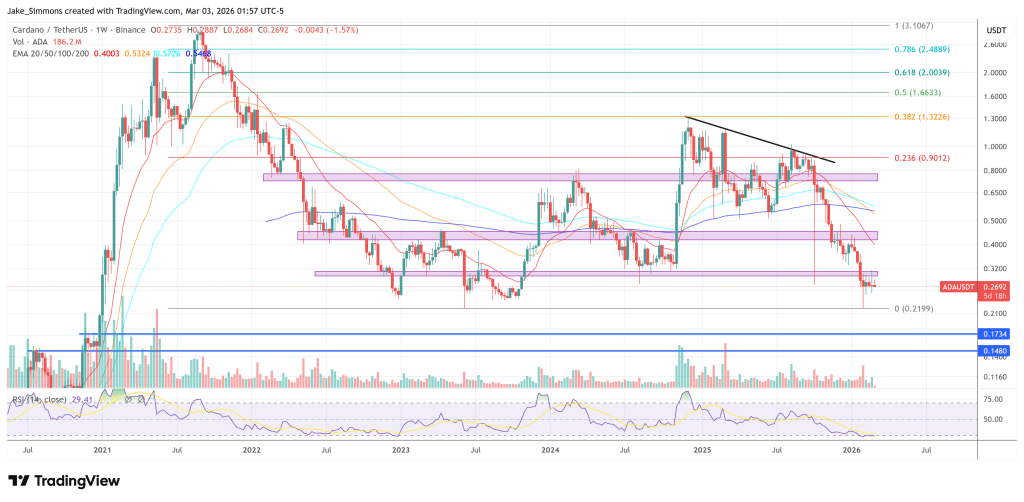
ADA hovers below key resistance, 1-week chart | Source: ADAUSDT on TradingView.com

Связанные с этим вопросы

QWhat is Charles Hoskinson's main criticism of the H.R. 3633 crypto bill?

AHis main criticism is that the bill would treat newly launched digital assets as securities by default, forcing them to prove to the SEC that they qualify to 'graduate' into commodity status. He argues this creates a punitive regulatory maze for new projects while potentially grandfathering in older networks.

QAccording to Hoskinson, what is the real political holdup in Washington regarding crypto legislation?

AHe argues that the real holdup is not about the bill's market structure, but specifically about the issue of stablecoin yield, rather than developer protections, DeFi coverage, or the SEC-CFTC jurisdictional split.

QWhat specific 'attack vectors' does Hoskinson suggest an adversarial SEC could use under the proposed bill?

AHe suggests the SEC could use procedural delays by resetting the clock with deficiency notices on filing completeness and could exploit the bill's undefined treatment of 'common control' to interpret open-source coordination as evidence of centralized management.

QWhat is Hoskinson's preferred alternative to the current H.R. 3633 bill?

AHis preferred alternative is a principles-based rewrite that modernizes securities law itself, builds blockchain-native disclosure systems, explicitly protects developers and DeFi, and limits the discretion regulators have in future rulemaking.

QWhat does Hoskinson warn will be the practical result for the US crypto industry if this 'bad bill' passes?

AHe warns that established networks may survive, but the next generation of US crypto projects will be forced to build offshore first and only attempt to enter the American market years later, stifling innovation within the country.

Похожее

Торговля

Спот
Фьючерсы

Популярные статьи

Как купить ADA

Добро пожаловать на HTX.com! Мы сделали приобретение Cardano (ADA) простым и удобным. Следуйте нашему пошаговому руководству и отправляйтесь в свое крипто-путешествие.Шаг 1: Создайте аккаунт на HTXИспользуйте свой адрес электронной почты или номер телефона, чтобы зарегистрироваться и бесплатно создать аккаунт на HTX. Пройдите удобную регистрацию и откройте для себя весь функционал.Создать аккаунтШаг 2: Перейдите в Купить криптовалюту и выберите свой способ оплатыКредитная/Дебетовая Карта: Используйте свою карту Visa или Mastercard для мгновенной покупки Cardano (ADA).Баланс: Используйте средства с баланса вашего аккаунта HTX для простой торговли.Третьи Лица: Мы добавили популярные способы оплаты, такие как Google Pay и Apple Pay, для повышения удобства.P2P: Торгуйте напрямую с другими пользователями на HTX.Внебиржевая Торговля (OTC): Мы предлагаем индивидуальные услуги и конкурентоспособные обменные курсы для трейдеров.Шаг 3: Хранение Cardano (ADA)После приобретения вами Cardano (ADA) храните их в своем аккаунте на HTX. В качестве альтернативы вы можете отправить их куда-либо с помощью перевода в блокчейне или использовать для торговли с другими криптовалютами.Шаг 4: Торговля Cardano (ADA)С легкостью торгуйте Cardano (ADA) на спотовом рынке HTX. Просто зайдите в свой аккаунт, выберите торговую пару, совершайте сделки и следите за ними в режиме реального времени. Мы предлагаем удобный интерфейс как для начинающих, так и для опытных трейдеров.

1.9k просмотров всегоОпубликовано 2024.03.29Обновлено 2025.07.02

Как купить ADA

SNEK: ведущий мемкоин на блокчейне Cardano, открывающий новую эпоху для экосистемы Cardano

SNEK - это дефляционный мемкоин, выпущенный на блокчейне Cardano. Он создаёт децентрализованную культурную и развлекательную ценность за счёт участия глобального сообщества.

2.0k просмотров всегоОпубликовано 2025.10.15Обновлено 2025.10.15

SNEK: ведущий мемкоин на блокчейне Cardano, открывающий новую эпоху для экосистемы Cardano

Неделя обучения по популярным токенам 8: запуск основной сети Ouroboros Leios для ADA ожидается в 2026 году

Основная сеть Ouroboros Leios для ADA, как ожидается, будет запущена в 2026 году, а хардфорк до версии протокола 11 запланирован на I квартал 2026 года.

1.9k просмотров всегоОпубликовано 2026.02.10Обновлено 2026.02.12

Неделя обучения по популярным токенам 8: запуск основной сети Ouroboros Leios для ADA ожидается в 2026 году

Обсуждения

Добро пожаловать в Сообщество HTX. Здесь вы сможете быть в курсе последних новостей о развитии платформы и получить доступ к профессиональной аналитической информации о рынке. Мнения пользователей о цене на ADA (ADA) представлены ниже.

活动图片