$BTC Needs to Drop to $8K for Holdings Not to Cover Debt, Says Strategy, as $HYPER’s Presale Soars

bitcoinistОпубликовано 2026-02-06Обновлено 2026-02-06

Введение

A recent analysis suggests Bitcoin would need to plummet to approximately $8,000—a 92% drop from current levels—for major institutional holdings to become insolvent and fail to cover debt obligations. This highlights the extreme resilience of corporate Bitcoin treasuries, which have effectively turned BTC into high-grade collateral. However, this stability has exposed a limitation: Bitcoin’s base layer lacks utility for yield generation or high-speed transactions. This has accelerated interest in Layer-2 solutions like Bitcoin Hyper ($HYPER), which integrates the Solana Virtual Machine (SVM) to bring high-speed smart contracts and DeFi capabilities to Bitcoin. The project has raised over $31.2 million in its presale, with significant whale activity indicating strong institutional interest. $HYPER aims to solve Bitcoin’s scalability issues by enabling fast, low-cost transactions while leveraging Bitcoin’s security.

Trusted Editorial content, reviewed by leading industry experts and seasoned editors. Ad Disclosure

Quick Facts:

  • ➡️ Institutional Bitcoin holdings are robust, with models suggesting prices would need to collapse to ~$8,000 to trigger debt insolvency for major treasuries.
  • ➡️ The resilience of Layer 1 is driving demand for Layer 2 utility, as investors seek yield and speed on top of their secure collateral.
  • ➡️ Bitcoin Hyper utilizes the Solana Virtual Machine (SVM) to bring high-speed smart contracts to Bitcoin, solving the network’s historic latency issues.
  • ➡️ Smart money interest is rising, with over $31M raised in the presale and significant whale accumulation recorded on-chain.

Corporate Bitcoin treasuries have hardened into the bedrock of the modern crypto economy. But analysts are now stress-testing exactly how far the market would need to bleed to break them.

According to recent strategic modeling regarding leverage and asset-backed debt, Bitcoin would need to catastrophically devalue to approximately $8,000 for major institutional holdings to fail in covering their debt obligations.
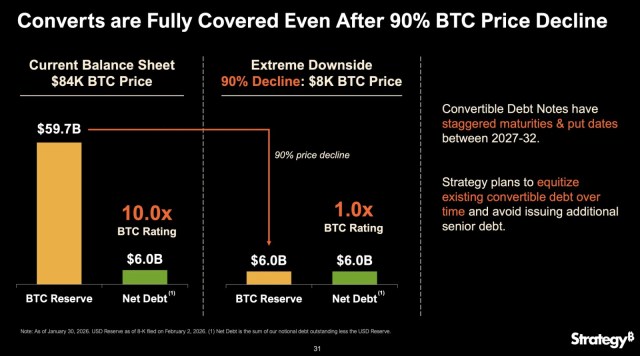
That is a staggering 92% drawdown from current levels. This figure is significant not because it’s likely, but because it highlights the extreme buffer institutional giants like MicroStrategy have built against volatility.

The data reveals a massive ‘invalidation zone.’ Critics often argue that leveraged institutional exposure poses a systemic risk of cascading liquidations. Well, sort of, but if the insolvency threshold is truly in the four-figure range, the current market structure is far more resilient than the bearish sentiment implies.

It shifts the narrative from ‘risk of collapse’ to ‘efficiency of capital.’ Institutions have effectively turned Bitcoin into a pristine collateral layer. Think of it as a digital Fort Knox.

Yet, a vault isn’t a payment rail. While the ‘Strategy’ of holding Bitcoin protects wealth, it doesn’t do much to generate yield or facilitate commerce. The base layer remains constrained by 10-minute block times and limited scriptability.

This disconnect, between Bitcoin as a passive asset and the market’s hunger for active capital, has triggered a migration of liquidity toward high-performance infrastructure.

As the base layer solidifies, capital is rotating into Layer 2 solutions capable of unlocking the trillion-dollar dormant value on the network. That trend is visibly accelerating the presale momentum of Bitcoin Hyper ($HYPER).

$HYPER is available here.

Bitcoin Hyper ($HYPER) Activates The SVM Liquidity Engine

The market is no longer satisfied with Bitcoin acting solely as a ‘pet rock.’ The demand is for programmable money. However, previous attempts to layer smart contracts atop Bitcoin have struggled with high latency and bridging risks.

Bitcoin Hyper ($HYPER) addresses this by integrating the Solana Virtual Machine (SVM) directly as a Bitcoin Layer 2. This isn’t merely an incremental upgrade; it’s a complete architectural shift. By using the SVM, Bitcoin Hyper enables transaction throughput that rivals traditional finance, bypassing the EVM limitations that hamstring many other L2s.

This integration solves the ‘velocity problem.’ On the main chain, Bitcoin is sluggish.

On Bitcoin Hyper, it becomes a high-frequency asset. The protocol features a Decentralized Canonical Bridge, allowing for trustless transfers of $BTC into a wrapped environment primed for DeFi, high-speed payments, and gaming.
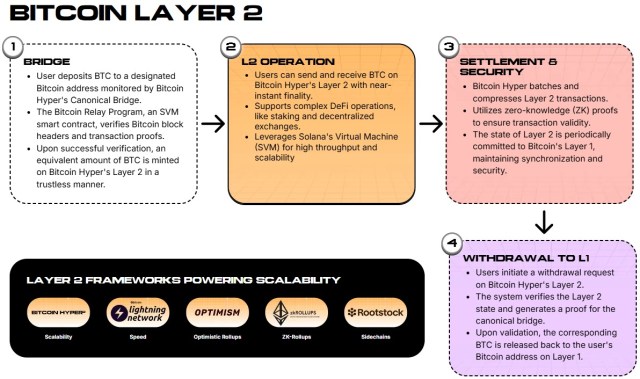
Plus, with support for Rust and a dedicated SDK, developers can deploy dApps that benefit from Bitcoin’s security guarantees without suffering from its execution bottlenecks.

The implication here is profound. If Bitcoin is the savings account, Bitcoin Hyper is the checking account and the investment bank combined. It enables users to stake, swap, and lend without leaving the Bitcoin ecosystem for less secure chains.

The technical architecture relies on a modular design: Bitcoin L1 handles final settlement (the anchor), while the SVM-powered L2 handles execution. This separation of duties allows for sub-second finality, a metric essential for modern DeFi applications but previously impossible on the Bitcoin network.

Check out Bitcoin Hyper here.

Whales Accumulate $HYPER As Presale Crosses $31M

While the base layer stabilizes, smart money is aggressively positioning itself in the infrastructure layer. Financial metrics from the Bitcoin Hyper presale indicate a decoupling from broader market sentiment, with capital flowing heavily into this new L2 narrative.

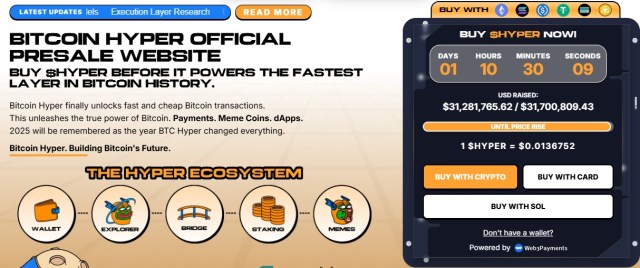
According to official data, the project has successfully raised over $31.2M and counting. That figure suggests high conviction among early adopters who view the SVM-on-Bitcoin thesis as the next logical cycle driver.

The token is currently priced at $0.0136752, but the volume of high-value transactions tells the clearer story.
On-chain data from Etherscan reveals that two whale wallets accumulated $500K and $380K respectively in recent transactions.

This specific activity suggests that sophisticated investors are looking past the short-term noise of Bitcoin’s price action and betting on the infrastructure that will service the network in the coming years.

Investors are likely drawn by the incentives structure. Bitcoin Hyper offers immediate staking after the Token Generation Event (TGE), with a 7-day vesting period for presale stakers. Unlike governance tokens with vague utility, $HYPER serves as the fuel for the L2 ecosystem, aligning holder interests with network activity.

When whales move $500K into a presale asset, it often signals an anticipation of a liquidity rotation, moving from the heavy, slow collateral of L1 into the high-velocity, yield-bearing potential of L2.

Join the Bitcoin Hyper presale.

This article is for informational purposes only and does not constitute financial advice. Cryptocurrencies are high-risk assets. The $8,000 figure cited regarding debt coverage is a theoretical model and not a price prediction. Always conduct independent due diligence before investing.

Editorial Process for bitcoinist is centered on delivering thoroughly researched, accurate, and unbiased content. We uphold strict sourcing standards, and each page undergoes diligent review by our team of top technology experts and seasoned editors. This process ensures the integrity, relevance, and value of our content for our readers.

patrubogdan

Follow

Full Profile

Related Posts

Bitcoin Teeters on Edge: Will $60K Hold or Is a V-Shape Recovery Imminent? $HYPER Keeps Pumping

Senator Lummis Urges Banks to Adopt Stablecoins Amidst CLARITY Act Delay, as Maxi Doge Turns Heads

Robinhood CEO Says Prediction Markets Will Soar as Bitcoin Hyper ($HYPER) Reaches $31.2M in Presale

Vitalik Buterin Cashes Out $6.6 Million In Ether After Early Signals

While Bitcoin And Ether Falter, XRP Optimism Stands Out: Analysts

$500M UAE Funds In Trump-Linked Project Draw Congressional Inquiry

Связанные с этим вопросы

QAccording to the article, what price would Bitcoin need to drop to for major institutional holdings to fail to cover their debt obligations?

AAccording to the strategic modeling mentioned in the article, Bitcoin would need to drop to approximately $8,000 for major institutional holdings to fail in covering their debt obligations.

QWhat is the core technological innovation that Bitcoin Hyper ($HYPER) brings to the Bitcoin network?

ABitcoin Hyper's core innovation is integrating the Solana Virtual Machine (SVM) as a Bitcoin Layer 2, which enables high-speed smart contracts and transaction throughput that rivals traditional finance.

QHow much capital has the Bitcoin Hyper ($HYPER) presale raised, as stated in the article?

AThe Bitcoin Hyper presale has raised over $31.2 million.

QWhat problem does the Bitcoin Hyper protocol aim to solve regarding Bitcoin's functionality?

ABitcoin Hyper aims to solve Bitcoin's historic latency issues and limited scriptability by turning it into a high-frequency asset capable of powering DeFi, high-speed payments, and gaming, moving it beyond just a passive store of value.

QWhat does the article suggest is driving the increased demand for Layer 2 solutions like Bitcoin Hyper?

AThe article suggests that the resilience and solidification of Bitcoin as a base collateral layer (Layer 1) is driving demand for Layer 2 utility, as investors seek yield and speed on top of their secure Bitcoin holdings.

Похожее

The Value Distribution of Stablecoins

**Summary: The Value Distribution of Stablecoins** The article argues that stablecoins are evolving from mere trading tools into broader channels for dollar access. It divides the stablecoin ecosystem into four layers to analyze how value is distributed: 1. **Issuance Layer:** Mints stablecoins, holds reserve assets, and captures the spread between reserve yield and user costs (e.g., Tether, Circle). This layer currently earns the largest profit margin. 2. **Infrastructure Layer:** Connects stablecoins to the traditional financial system, handling fiat on/off-ramps, banking integration, compliance (KYC/AML), and asset management (e.g., Bridge, BVNK). This is the "unglamorous" but critical work, building the essential bridges between crypto and real-world finance. 3. **Acquiring/Distribution Layer:** Integrates stablecoins into merchant systems, manages payment flows, and provides enterprise financial software (e.g., Stripe, Coinbase). They act as the access point for businesses. 4. **Application Layer:** The end-users and businesses that ultimately use stablecoins for payments, settlements, or as a store of value. They benefit from convenience but have little pricing power. The core thesis is that while the issuance layer currently dominates profits, the often-overlooked **infrastructure layer holds significant long-term potential**. The real challenge and barrier to mass adoption is not the on-chain transfer of stablecoins (which is simple), but the complex "last mile" integration into existing business workflows, banking systems, and regulatory frameworks across different countries. Companies in this layer are currently in a "land grab" phase, investing heavily to build networks, secure bank partnerships, and establish compliance pathways. While their position is currently pressured by the profitable issuers above and distribution platforms below, the article suggests that if stablecoins become a default financial rail for businesses, the infrastructure providers who have done the hard work of integration will ultimately gain strong pricing power and become entrenched, essential players.

marsbit3 ч. назад

The Value Distribution of Stablecoins

marsbit3 ч. назад

The Value Distribution of Stablecoins

The Value Distribution of Stablecoins The article argues that stablecoins are evolving from a mere trading tool into a broad "dollar channel." It analyzes the industry's value chain through four layers: 1. **Issuance Layer (e.g., Tether, Circle):** The top layer that mints stablecoins, holds reserve assets, and captures the thickest interest rate spread. 2. **Infrastructure Layer (e.g., Bridge, BVNK):** Connects stablecoins to the traditional financial system, handling critical but complex "dirty work" like fiat on/off-ramps, banking integration, compliance (KYC/AML), and cross-border settlement. 3. **Acquiring/Distribution Layer (e.g., Stripe, Coinbase):** Embeds stablecoins into merchant systems, manages payment flows, and integrates with enterprise software. 4. **Application Layer:** End-users and businesses that ultimately use stablecoins for payments, settlement, or storing value. The author posits that while the issuance layer currently captures the most profit, the most overlooked and potentially critical layer is infrastructure. The core challenge for stablecoin adoption isn't the on-chain transfer (which is simple), but bridging the gap between blockchain and the real-world financial system. This involves solving practical problems for businesses: fiat conversion, reconciliation, tax handling, and user onboarding. Infrastructure companies are currently in a difficult "land-grab" phase—building networks, securing banking relationships, and achieving compliance country-by-country. They face pressure from both the profitable issuance layer above and distribution platforms below. However, the author suggests this layer is building a crucial moat. Once stablecoins become a default business rail, the infrastructure players who have done the hard work of integration may gain significant, durable value and pricing power.

链捕手4 ч. назад

The Value Distribution of Stablecoins

链捕手4 ч. назад

How to Do Research Well: Deliberately Practice the Real Skills That Matter

No one truly teaches you how to do research. You're often given a desk, a pre-selected problem, and vague instructions to "create something new." Consequently, many people reverse-engineer the job based on visible outputs—papers, posts, announcements—learning only how to *appear* like a researcher rather than how to *become* one. True research capability is built from stacking small, trainable skills, nearly all of which can be developed through deliberate practice. **Pick Your Own Problem:** Most researchers absorb problems from advisors or trends, lacking the underlying reasoning. Choosing a problem you genuinely care about, as John Schulman advises, leads to original work. Develop "taste" like a muscle: predict experiment outcomes, guess paper results from methods, and track which findings remain important over time. **Upgrade Your Inputs:** Relying on shared reading lists (arXiv hot lists, filtered group chats) leads to unoriginal conclusions. Undervalued old literature often holds crucial insights (e.g., MoE, LSTM, backpropagation). Richard Sutton's "The Bitter Lesson" or Claude Shannon's 1952 talk on creative thinking are more predictive than lengthy modern surveys. Breadth matters as much as depth: draw from neuroscience, mechanism design, hardware knowledge, and honest statistics. Read papers directly, especially appendices and limitations sections. **Write Everything Down:** As Paul Graham noted, writing exposes flaws in seemingly mature ideas. Writing is the cheapest defense against self-deception. Following Feynman's principle, Darwin programmatically wrote down facts contradicting his theory to combat memory bias. Maintain a detailed log of hypotheses, setups, predictions, results, and updated understandings. Reviewing past logs fosters essential humility.

marsbit6 ч. назад

How to Do Research Well: Deliberately Practice the Real Skills That Matter

marsbit6 ч. назад

Торговля

Спот
Фьючерсы

Популярные статьи

Как купить S

Добро пожаловать на HTX.com! Мы сделали приобретение Sonic (S) простым и удобным. Следуйте нашему пошаговому руководству и отправляйтесь в свое крипто-путешествие.Шаг 1: Создайте аккаунт на HTXИспользуйте свой адрес электронной почты или номер телефона, чтобы зарегистрироваться и бесплатно создать аккаунт на HTX. Пройдите удобную регистрацию и откройте для себя весь функционал.Создать аккаунтШаг 2: Перейдите в Купить криптовалюту и выберите свой способ оплатыКредитная/Дебетовая Карта: Используйте свою карту Visa или Mastercard для мгновенной покупки Sonic (S).Баланс: Используйте средства с баланса вашего аккаунта HTX для простой торговли.Третьи Лица: Мы добавили популярные способы оплаты, такие как Google Pay и Apple Pay, для повышения удобства.P2P: Торгуйте напрямую с другими пользователями на HTX.Внебиржевая Торговля (OTC): Мы предлагаем индивидуальные услуги и конкурентоспособные обменные курсы для трейдеров.Шаг 3: Хранение Sonic (S)После приобретения вами Sonic (S) храните их в своем аккаунте на HTX. В качестве альтернативы вы можете отправить их куда-либо с помощью перевода в блокчейне или использовать для торговли с другими криптовалютами.Шаг 4: Торговля Sonic (S)С легкостью торгуйте Sonic (S) на спотовом рынке HTX. Просто зайдите в свой аккаунт, выберите торговую пару, совершайте сделки и следите за ними в режиме реального времени. Мы предлагаем удобный интерфейс как для начинающих, так и для опытных трейдеров.

1.5k просмотров всегоОпубликовано 2025.01.15Обновлено 2026.06.02

Как купить S

Sonic: Обновления под руководством Андре Кронье – новая звезда Layer-1 на фоне спада рынка

Он решает проблемы масштабируемости, совместимости между блокчейнами и стимулов для разработчиков с помощью технологических инноваций.

2.3k просмотров всегоОпубликовано 2025.04.09Обновлено 2025.04.09

Sonic: Обновления под руководством Андре Кронье – новая звезда Layer-1 на фоне спада рынка

HTX Learn: Пройдите обучение по "Sonic" и разделите 1000 USDT

HTX Learn — ваш проводник в мир перспективных проектов, и мы запускаем специальное мероприятие "Учитесь и Зарабатывайте", посвящённое этим проектам. Наше новое направление .

1.8k просмотров всегоОпубликовано 2025.04.10Обновлено 2025.04.10

HTX Learn: Пройдите обучение по "Sonic" и разделите 1000 USDT

Обсуждения

Добро пожаловать в Сообщество HTX. Здесь вы сможете быть в курсе последних новостей о развитии платформы и получить доступ к профессиональной аналитической информации о рынке. Мнения пользователей о цене на S (S) представлены ниже.

活动图片