Bridging Worlds, Integrating Traditional Finance and Crypto Markets - 2026 Crypto Finance Forum Set to Open

marsbitОпубликовано 2026-01-29Обновлено 2026-01-29

Введение

CryptoFi Forum 2026 is set to take place on February 12, 2026, at The University of Hong Kong, marking a significant moment in the convergence of cryptocurrency and traditional finance. Jointly organized by WLFI, Bakkt, HKU Business School's Executive Education, and ME Group, the forum aims to create a high-level dialogue platform connecting East and West, academic research with business practice, and traditional finance with the crypto industry. Under the vision of "Decoding Cryptocurrency, Reshaping the Future of Finance," the event will systematically explore the evolution of crypto finance. It will focus on institutional-grade opportunities and emerging technological paradigms within regulatory frameworks, offering forward-looking insights into the global financial system. The forum will feature strategic dialogues with speakers including Zak Folkman, Chase Herro, and Ryan Fang from WLFI; Nicholas Baes, COO of Bakkt; Dr. Xiao Feng of HashKey Group; Professor Yang Wang, Vice-President of HKU; Jack Kong, Director of Cyberport and CEO of Nano Labs; and Jessica Yang, CEO of ME Group. Discussions will center on three core themes: the current crypto industry landscape, latest institutional practices in traditional finance, and cutting-edge on-chain applications. The event is supported by strategic partners Nano Labs Ltd (Nasdaq: NA) and CoinFound, alongside media partners including Foresight News and Odaily.

At a time when cryptocurrencies and traditional finance are achieving deep integration, the Crypto Finance Forum will grandly open at the University of Hong Kong on February 12, 2026.
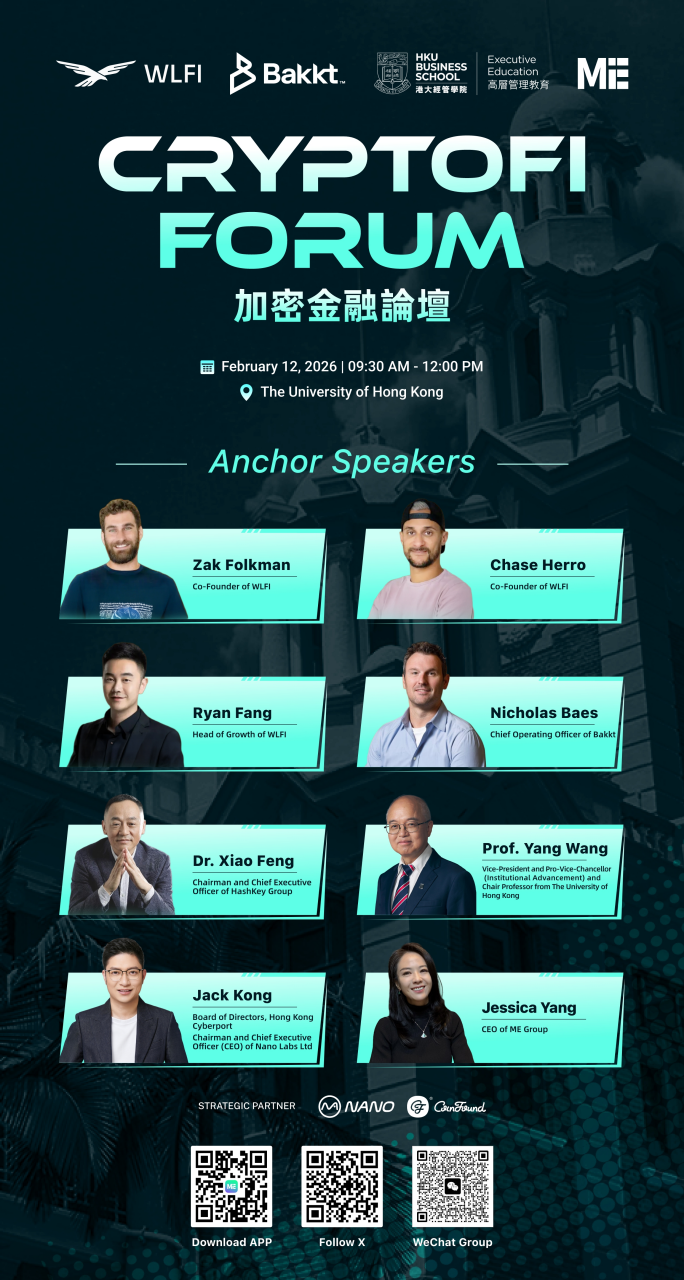
Co-hosted by WLFI, Bakkt, HKU Business School Executive Education, and ME Group, the CryptoFi Forum (Crypto Finance Forum) aims to create a high-level dialogue platform connecting East and West, academic research and business practice, traditional finance and the crypto industry. Guided by the vision of "Decoding Cryptocurrency, Reshaping the Future of Finance," this forum will systematically outline the evolution of crypto finance and, within a compliant framework, deeply explore institutional-grade opportunities and emerging technology paradigms to provide forward-looking insights for the future of the global financial system.

The forum will unfold through multiple strategic dialogues, featuring guests including Zak Folkman, Chase Herro, and Ryan Fang from the WLFI team; Nicholas Baes, Chief Operating Officer of Bakkt; Dr. Xiao Feng of HashKey Group; Professor Wang Yang, Vice-President (University Advancement) and Chair Professor at the University of Hong Kong; Jack Kong, Director of Hong Kong Cyberport and CEO of Nano Labs; and Ms. Jessica Yang, CEO of ME Group. The forum agenda will focus on three core themes: the current industry landscape of the crypto world, the latest institutional practices in traditional finance, and cutting-edge applications in the on-chain world.

Furthermore, thanks to the strong support of strategic partners: Nano Labs Ltd (Nasdaq: NA) and CoinFound; and media partners: Foresight News, Odaily, Jinse Finance, PANews, Bitpush, and Finet.

Event Information

Event Theme: Crypto Finance Forum

Event Time: February 12, 2026, 09:30 - 12:00 (HKT)

Event Location: University of Hong Kong

Hosts: WLFI, Bakkt, HKU Business School Executive Education, ME Group

Strategic Partners: Nano Labs Ltd (Nasdaq: NA), CoinFound

About CryptoFi Forum

The "Crypto Finance Forum" (CryptoFi Forum, CFF) is committed to building a dialogue and cooperation platform to promote the development of the global crypto finance industry.

Official Website: https://www.me.news/CryptoFi

About WLFI

WLFI is building the future of finance. USD1 is just the beginning, committed to serving individual users, institutions, and broader financial participants.

Official Website: https://worldlibertyfinancial.com/

About Bakkt

Bakkt focuses on building a new generation of institutional-grade digital asset infrastructure, reshaping the form of money, its flow, and market mechanisms.

Official Website: https://bakkt.com/

About HKU Business School Executive Education

HKU Business School Executive Education is dedicated to helping managers cope with the complex global market environment. Leveraging the University of Hong Kong's unique advantages in international perspective, integrative thinking, and academic excellence, it enhances managers' strategic vision.

Official Website: https://execed.hkubs.hku.hk/

About ME Group

ME Group is a globally leading financial information and technology platform. Headquartered in Hong Kong, with a North American office in New York. Core businesses include media services (ME News), branded events (ME Event), video services (BTV), and AI-driven media, marketing, and data services. Committed to providing global users with accurate information content, professional market services, and AI intelligent solutions.

Official Website: https://www.me.news/

More Details

Event Official Website: https://www.me.news/events/488

X Platform: https://x.com/CryptoFi_Forum

Связанные с этим вопросы

QWhat is the main purpose and vision of the CryptoFi Forum 2026?

AThe CryptoFi Forum 2026 aims to create a high-level dialogue platform connecting East and West, academic research with business practice, and traditional finance with the crypto industry. Its vision is to 'decode cryptocurrency and reshape the financial future,' systematically reviewing the evolution of crypto finance and exploring institutional-grade opportunities and new technological paradigms within a compliant framework.

QWhen and where will the CryptoFi Forum 2026 be held?

AThe CryptoFi Forum 2026 will be held on February 12, 2026, from 09:30 to 12:00 HKT at The University of Hong Kong.

QWhich organizations are the main organizers of this forum?

AThe forum is jointly organized by WLFI, Bakkt, HKU Business School's Executive Education, and ME Group.

QWho are some of the key speakers featured at the event?

AKey speakers include Zak Folkman, Chase Herro, and Ryan Fang from WLFI; Nicholas Baes, COO of Bakkt; Dr. Xiao Feng of HashKey Group; Professor Yang Wang, Vice-President (University Global Engagement) of HKU; Jack Kong, Director of Hong Kong Cyberport and CEO of Nano Labs; and Jessica Yang, CEO of ME Group.

QWhat are the three core themes that the forum agenda will focus on?

AThe forum agenda will focus on three core themes: the current industrial landscape of the crypto world, the latest institutional-grade practices in traditional finance, and cutting-edge applications in the on-chain world.

Похожее

TechFlow Intelligence Bureau: Chip Stocks Lose Trillions in a Single Day, Bitcoin Falls Below $60,000, US-Iran Conflict Escalates

**Daily Tech & Markets Roundup: AI Advances, Market Turmoil, and Geopolitical Tensions** **AI / LLMs**: Anthropic's internal report on AI self-improvement sparked serious discussions about Recursive Self-Improvement (RSI). Meanwhile, debate continues on AI coding tools after Claude was accused of introducing bugs into the rsync codebase. In positive news, DeepSeek V4 Flash impressed in local deployment tests, and GitHub Copilot now supports custom endpoints for local models. A surprising research turn suggests removing chain-of-thought prompting can sometimes improve LLM performance. **Crypto / Web3**: Bitcoin plunged below $60,000, with its RSI hitting levels last seen during the COVID-19 crash, driven by strong U.S. jobs data reviving interest rate hike fears. Discussions highlight Ethereum DeFi's continued lack of a smooth consumer payment layer. **Chips / Hardware**: Chip stocks suffered a massive sell-off, with the Philadelphia Semiconductor Index posting its worst single-day drop in six years, erasing over a trillion dollars in value. Marvell, Micron, AMD, and Intel were among the biggest losers. **Tech Companies**: A leaked Microsoft document revealing goals to make Copilot "addictive" drew criticism. LinkedIn founder Reid Hoffman left Microsoft's board to focus full-time on his AI agent startup, Manus. Google was revealed to be paying SpaceX $920 million monthly for AI training compute. **Markets & Macro**: A blowout U.S. jobs report (172k vs. 80k expected) crushed hopes for near-term rate cuts, sending Treasury yields soaring and triggering a broad market sell-off. CEOs from Kraft, McDonald's, and Whirlpool simultaneously warned U.S. consumers are exhausting their savings. **Geopolitics**: U.S.-Iran tensions escalated with missile/drone interceptions and U.S. strikes on Iranian radar sites, keeping the critical Strait of Hormuz largely closed since late February and posing ongoing oil supply risks. **The Bottom Line**: The strong jobs data acted as a single trigger for correlated sell-offs across equities, crypto, and chips. Underlying the volatility is a stark contradiction between robust employment data and warnings of consumer weakness, alongside geopolitical risks that could reignite inflation, leaving markets to price in a fraught macro outlook with no clear "soft landing" path.

marsbit16 мин. назад

TechFlow Intelligence Bureau: Chip Stocks Lose Trillions in a Single Day, Bitcoin Falls Below $60,000, US-Iran Conflict Escalates

marsbit16 мин. назад

It Took Me a Year to See the Bitter Truth About Agent Payments

After a year building infrastructure for the Agent economy, engaging with major players like Stripe, Visa, and Coinbase, the author shares a sobering analysis of the current state of Agent payments. The core finding is a stark lack of genuine, immediate demand across most envisioned use cases. The article breaks down four key market segments: 1. **Agent-to-Merchant (Consumer Shopping):** For most product categories (e.g., clothing, electronics), conversational AI shopping is a step backwards from visual e-commerce interfaces. While agents excel at understanding needs, they can't replace side-by-side product comparison. Real merchant interest is defensive "Agent Engine Optimization," not driven by current customer demand. Potential exists for high-frequency, low-decision purchases (like food delivery) or navigating complex store UIs, but these require massive B2C distribution channels dominated by giants like Amazon. 2. **Agent-to-API (Developer Services):** Developers already have subscriptions and billing relationships for APIs (compute, data). Prepaid balances solve micro-payment issues for low transaction volumes. A deeper structural problem is that major SaaS vendors' business models rely on enterprise contracts, resisting granular pay-per-call pricing. While protocols like MPP and x402 serve the long tail of niche services, this market is small and developers are historically low-willingness-to-pay. 3. **Agent-to-Agent:** This remains largely theoretical with minimal transaction volume. While it represents a long-term bet on a fundamentally new transaction infrastructure (sub-second, micro-penny to million-dollar, multi-party settlements), it does not constitute a present market. 4. **Agent-to-Finance:** This is the only category with existing, paying demand. Integrating AI into financial workflows (trading, portfolio management) is a natural evolution and enables new capabilities like autonomous rebalancing. However, competition favors established, regulated institutions. The "real problem" is not moving money between agents, but the broader challenge of **coordination**—orchestrating work between agents and humans, verifying outcomes, and settling results. Payment is just one component of settlement, which is itself part of coordination. Companies that solve the coordination layer will subsume payment, not the other way around. While well-funded incumbents build defensively for a long-term future, startups must find where the market is today—which, for the author's team, lies outside these four categories in an area of real, growing, and underserved activity.

marsbit59 мин. назад

It Took Me a Year to See the Bitter Truth About Agent Payments

marsbit59 мин. назад

It Took Me a Year to See the Hard Truth About Agent Payments

**Title: It Took Me a Year to See the Hard Truth About Agent Payments** Over the past year, I've worked on infrastructure for the Agent economy, engaging with major players like Stripe, Visa, Coinbase, and numerous startups. The findings reveal a stark reality: genuine, widespread demand for Agent-based payments does not yet exist. **Key Observations:** * **Agent-to-Merchant (Shopping):** The user experience for AI shopping often falls short, especially for visual product discovery. While AI excels at understanding needs, conversational interfaces can't yet replace browsing and comparing multiple products visually. Current merchant interest is largely defensive ("Agent Engine Optimization") for a future that hasn't arrived. High-frequency, low-friction purchases (like food delivery) are potential fits, but lack open APIs and face high AI inference costs. Simpler, more affordable, or cross-language interactions for complex UIs are a niche opportunity but require massive consumer distribution to scale. * **Agent-to-API (Developer Tools):** Developer payment needs for APIs (computing, data, models) are already met through subscriptions and prepaid credits. The core challenge is not payment friction but supplier economics: most large SaaS providers prefer enterprise contracts over micropayments for API calls. Protocols like MPP and x402 suit the long-tail of smaller services but cater to a developer market historically reluctant to pay for these tools. Major infrastructure needs at the top of the stack are already being addressed. * **Agent-to-Agent (Machine Commerce):** This is a long-term vision with almost no current transaction volume. While a future with high-speed, high-frequency, multi-party machine-to-machine transactions would require novel infrastructure, it remains theoretical. The market is not here yet. * **Agent-to-Finance:** This is the only category with clear, present demand. Financial professionals and DeFi users already pay for tools, and AI augmentation is a natural evolution. Autonomous AI agents can enable entirely new financial strategies. However, competition is fierce from established, regulated incumbents who can more easily layer AI onto their existing products. **The Core Insight:** Companies, especially giants with long time horizons, are building defensively for a potential future of mass machine commerce. For them, early investment is a low-cost hedge. For startups, the current market reality is different. The primary challenge isn't just moving money between agents (payments). The larger, unsolved problem is **orchestration** – coordinating work between agents and humans, verifying outcomes, and then settling. Payment is just a part of settlement, which is just a part of orchestration. Companies that solve the orchestration problem will subsume payments, not the other way around. After a year of building, we see the real, growing, and underserved market opportunity lies in this broader domain of orchestration.

链捕手1 ч. назад

It Took Me a Year to See the Hard Truth About Agent Payments

链捕手1 ч. назад

Claude Opus 4.8 Finds a $4.5 Billion Bug: The AI Era is Mass-Producing Hackers

A researcher discovered a critical "infinite mint" vulnerability in the Zcash cryptocurrency's Orchard protocol using Claude Opus 4.8, leading to a swift fix but also a 50% market drop, erasing billions in value. This incident highlights a new era where powerful, accessible AI models are dramatically lowering the barrier to finding software vulnerabilities. Previously, the security community feared specialized models like Claude Mythos Preview, capable of finding decades-old zero-day exploits. The Zcash case, however, involved a publicly available, general-purpose model. This shift makes advanced security auditing—and attack capabilities—accessible to far more people, not just experts. The mass democratization of vulnerability discovery brings a dual challenge: a flood of low-quality, AI-generated false reports that overwhelm maintainers, and the real, rapid uncovering of deep, dangerous bugs. Open-source projects, often understaffed and unfunded, are particularly vulnerable to this "attention DDoS." The article cites examples like curl shutting down its bug bounty program due to the unsustainable workload. Our perceived digital safety has often been luck, relying on the high cost and effort required to find deeply hidden flaws in complex systems, as seen with historical vulnerabilities like Heartbleed or Baron Samedit. AI changes this cost structure, effectively "mass-producing flashlights" to illuminate every corner of our codebase. While large companies operate extensive security chains involving external white-hat hackers and massive defensive operations, the global cybersecurity workforce faces a severe shortage, especially of experienced personnel capable of analyzing complex threats and coordinating fixes. The core dilemma emerges: AI makes *finding* bugs cheap and scalable, but *fixing* them remains a slow, expensive, and human-intensive process. The article concludes that AI won't destroy the internet but acts as a bright light, revealing that our digital existence is not inherently secure but is precariously maintained by ongoing human effort. The true cost in the AI era may not be discovery, but whether there will be enough people left willing and able to do the hard work of repair.

marsbit1 ч. назад

Claude Opus 4.8 Finds a $4.5 Billion Bug: The AI Era is Mass-Producing Hackers

marsbit1 ч. назад

Торговля

Спот
Фьючерсы
活动图片