Behind USDH's Acquisition by Coinbase: Hyperliquid's Interest-Driven Choice

marsbitОпубликовано 2026-05-15Обновлено 2026-05-15

Введение

Coinbase announces its integration with Hyperliquid, becoming the official USDC treasury deployer on the platform. The native stablecoin USDH, issued by Native Markets, will be gradually phased out as Coinbase acquires its brand assets. Users can convert USDH to USDC or fiat without fees during the transition. The move solidifies USDC as Hyperliquid's official stablecoin and pricing asset. The arrangement is framed as a three-way win: Coinbase deepens its ties to the Hyperliquid ecosystem; Hyperliquid gains the vast majority of future USDC reserve yield revenue (estimated at up to 90%); and Native Markets exits with compensation from the asset sale. However, some community members criticize the outcome, viewing USDH's shutdown as a retreat from decentralization and arguing that the original governance vote favored internal interests over users. The partnership also sees Circle and Coinbase staking HYPE tokens to support the network's AQAv2 upgrade. Ultimately, the article suggests the resolution underscores pragmatic economic interests over earlier community-centric rhetoric.

Original | Odaily Planet Daily (@OdailyChina)

Author | Wenser (@wenser 2010)
Last September, the battle over Hyperliquid's native stablecoin USDH once became an industry focus; now, this once highly anticipated stablecoin has suddenly reached its "exit moment."

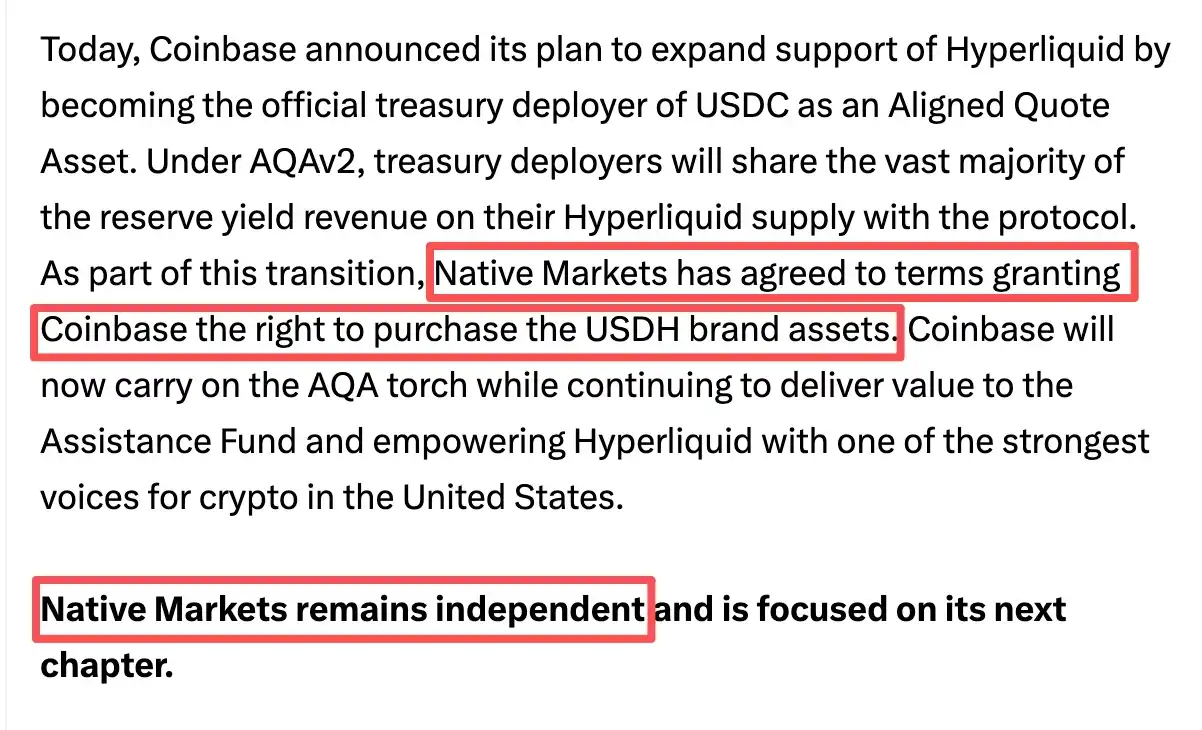
Last night, Coinbase announced it will become the official treasury deployer for USDC on Hyperliquid, while USDH issuer Native Markets granted Coinbase the rights to purchase USDH brand assets. Subsequently, the USDH market will be gradually phased out, during which users can still convert USDH to USDC or fiat currency without fees.

Thus, the once famous USDH has become an asset acquired by Coinbase, while USDC has been officially established as Hyperliquid's official stablecoin and pricing asset. Odaily Planet Daily will briefly analyze the details and subsequent impacts in this article.

USDH Exits, USDC Rises: The Economic Calculations Behind $5 Billion

The grand drama of the "Hyperliquid Ecosystem Stablecoin Battle" has concluded with a win-win-win outcome for Coinbase & Circle, Hyperliquid, and USDH issuer Native Markets.

Coinbase further deepens its ties with the Hyperliquid ecosystem; Hyperliquid gains the majority of the stablecoin reserve income from USDC within its ecosystem; Native Markets, as the ultimate winner of the past USDH era, receives its reward by "selling the USDH brand assets."

Coinbase & Circle: Deepening Integration with Hyperliquid's On-Chain Economy, Continuously Increasing HYPE Investment

Currently, the scale of USDC on Hyperliquid is approximately $5.164 billion, a two-fold year-on-year increase.

As the official partner and revenue-sharing party for USDC, Coinbase's move undoubtedly aims to deeply integrate with the Hyperliquid ecosystem.

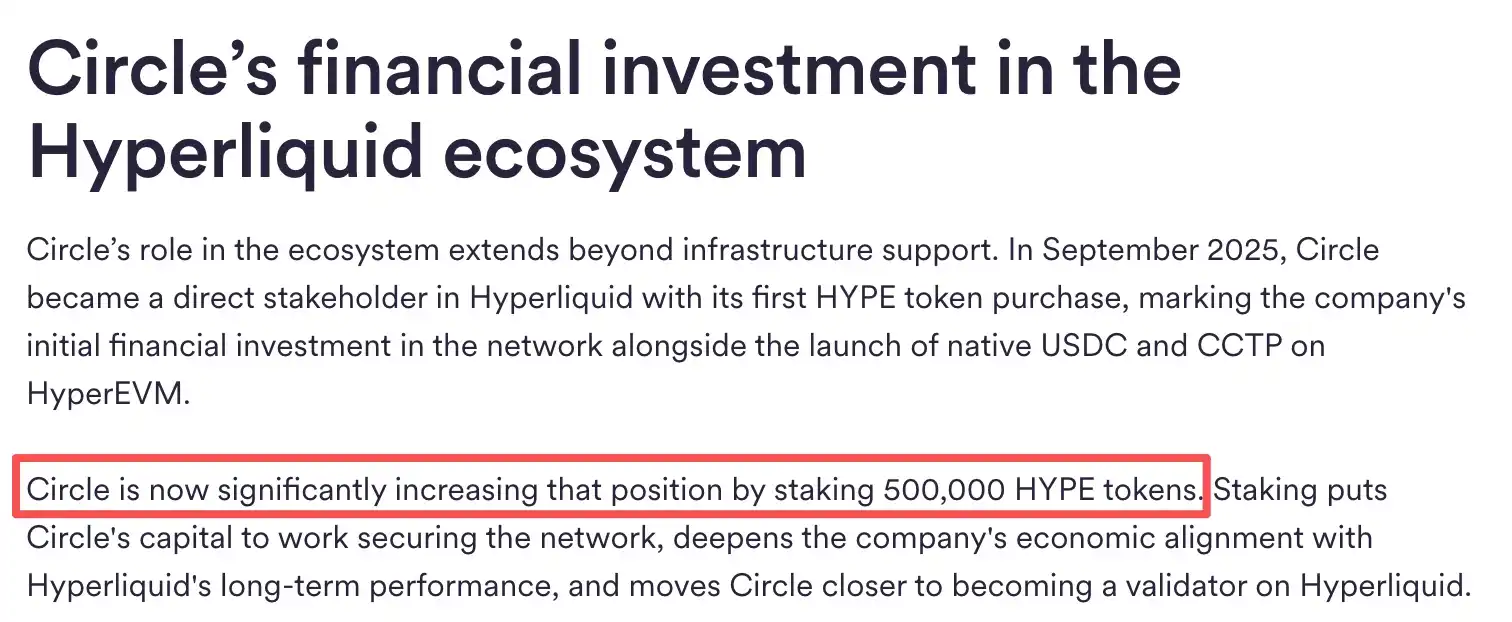
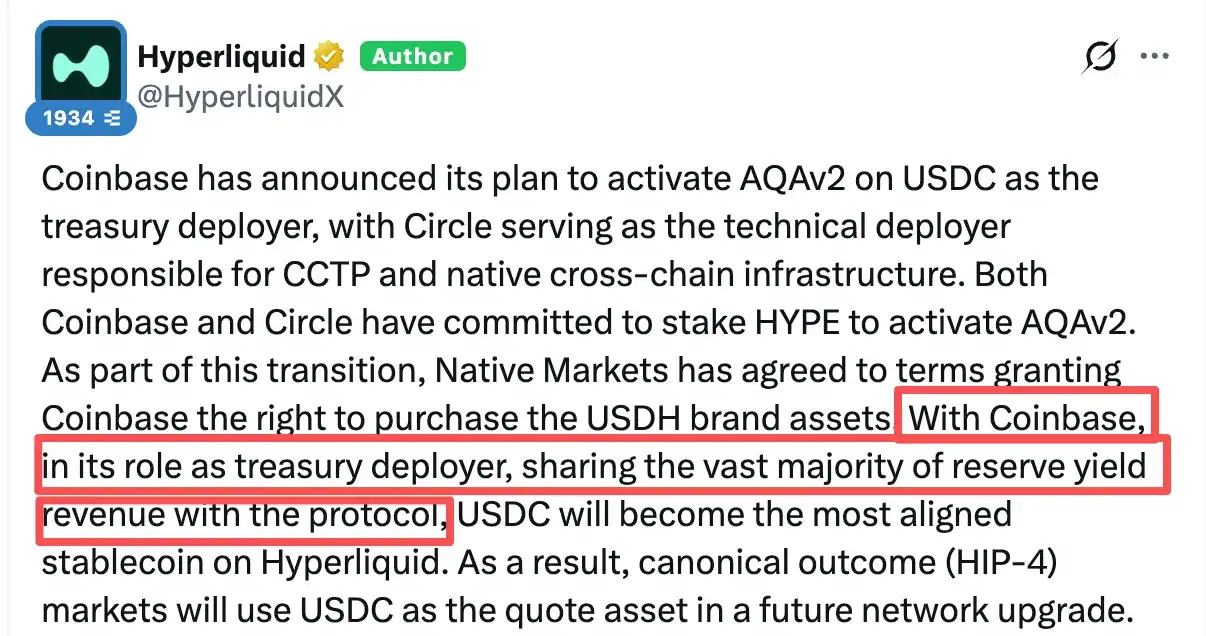
Furthermore, according to Hyperliquid's official announcement, both Coinbase (capital deployer) and Circle (responsible for technical deployment of CCTP and native cross-chain infrastructure) have committed to staking HYPE to activate AQAv2 (Aligned Quote Asset v2).

It is worth mentioning that in September last year, Circle already purchased HYPE tokens, and its current HYPE token staking scale has increased to around 500,000 tokens.
Hyperliquid: Receiving the Lion's Share of USDC Reserve Income, Benefiting from Coinbase Alliance

As for the biggest winner of this collaboration, it is undoubtedly Hyperliquid as the ecosystem foundation.

According to the official announcement, Coinbase will subsequently share the vast majority of reserve income revenue with the Hyperliquid protocol. Although the specific sharing ratio has not been disclosed, if based on the previous USDH revenue-sharing mechanism, Hyperliquid will actually receive approximately 90% of the reserve income.

Based on calculations by Hyperliquid community members, with a scale of $4.7 billion and an interest rate return of 3.8%, this corresponds to about $160 million in income; in other words, it equates to a daily $440,000 HYPE token buyback.

Moreover, with the CLARITY Act passing a vote in the US Senate Banking Committee, Hyperliquid's deep ties with Coinbase also imply that HYPE and Hyperliquid have gained a degree of support at the US regulatory level.
Native Markets: USDH's Historical Mission Accomplished

As the issuer of Hyperliquid's native stablecoin USDH, Native Markets appears to be the biggest loser in this "acquisition event," but judging from its official statement, its outcome can be considered a "successful retreat."

On one hand, USDH provided a model and template for the revenue-sharing agreement between Coinbase and the Hyperliquid protocol for USDC income; on the other hand, Coinbase likely directly acquired the USDH-related brand assets, meaning the USDH stablecoin issued by the Native Markets team was "acquired by Coinbase," thus providing the team with some economic return.

Subsequently, Native Markets also stated it would remain independent and seek development in other areas.
After USDH's Exit: In the Win-Win-Win Scenario, Only USDH Users Get Hurt

Of course, Native Markets' exit is not met with unanimous "praise." Hyperliquid community users also expressed criticism regarding its so-called "having a seat at the negotiation table" narrative.

Some believe that USDH's exit signifies a complete regression of the decentralization era;

Others pointed out that during the initial USDH stablecoin issuer vote, they should have chosen Paxos, as they at least considered users and stablecoin growth, while those who voted for Native Markets did so merely for alignment and internal interests. In the end, users gained nothing. These remarks also garnered considerable agreement and support.

Thus, the drama from a year ago, featuring "CEO romance" and "defying giants," has finally come to an end.

However, looking at the current scene of Hyperliquid "shaking hands and making peace" with Coinbase and Circle is somewhat sigh-inducing and even slightly ironic.

Everything, it turns out, was just about interest distribution, not the once-loudly chanted slogans of "for the community" or "for Hyperliquid."

Recommended Reading

Hyperliquid Stablecoin USDH Becomes "Industry Sweetheart," Giants Engage in Chaotic Distribution Rights Battle

USDH Vote in Progress: "Predetermined Script," "CEO Romance," "Retreating at the Height of Success" Take Turns on Stage


Связанные с этим вопросы

QWhat major change was announced regarding the native stablecoin USDH on Hyperliquid, and who was involved in the announcement?

ACoinbase announced it will become the official treasury deployer for USDC on Hyperliquid, and the USDH issuer Native Markets granted Coinbase the right to purchase the USDH brand assets. The USDH market will be gradually shut down.

QWhat is the primary reason for Coinbase's involvement in this deal according to the article, especially regarding its relationship with Hyperliquid and HYPE tokens?

ACoinbase aims to deepen its binding with the Hyperliquid ecosystem. Both Coinbase and Circle have committed to staking HYPE tokens to activate AQAv2. Circle has already purchased HYPE tokens, increasing its stake to around 500,000 HYPE.

QHow is the Hyperliquid protocol expected to benefit financially from this new arrangement with Coinbase and the shift to USDC?

AHyperliquid is set to receive the vast majority (estimated around 90%) of the reserve yield income from the USDC deposits on its platform. Based on community calculations using $47 billion in assets and a 3.8% yield, this could amount to approximately $44 million per year, used for daily HYPE buybacks.

QWhat was the outcome for Native Markets, the issuer of USDH, in this transition, and what are its future plans?

ANative Markets received economic compensation through the sale of the USDH brand assets to Coinbase. The company considers USDH's historical mission complete and stated it will remain independent and seek development in other areas.

QWhat criticism did some Hyperliquid community members express regarding the phasing out of USDH and the original vote for its issuer?

ASome community members criticized the move as a step back for decentralization. Others argued that voters should have chosen Paxos as the USDH issuer, as they were more focused on user and stablecoin growth, while those who voted for Native Markets were motivated by factionalism and internal interests, leaving end-users with nothing.

Похожее

How to Do Research Well: Deliberately Practice the Real Skills That Matter

No one truly teaches you how to do research. You're often given a desk, a pre-selected problem, and vague instructions to "create something new." Consequently, many people reverse-engineer the job based on visible outputs—papers, posts, announcements—learning only how to *appear* like a researcher rather than how to *become* one. True research capability is built from stacking small, trainable skills, nearly all of which can be developed through deliberate practice. **Pick Your Own Problem:** Most researchers absorb problems from advisors or trends, lacking the underlying reasoning. Choosing a problem you genuinely care about, as John Schulman advises, leads to original work. Develop "taste" like a muscle: predict experiment outcomes, guess paper results from methods, and track which findings remain important over time. **Upgrade Your Inputs:** Relying on shared reading lists (arXiv hot lists, filtered group chats) leads to unoriginal conclusions. Undervalued old literature often holds crucial insights (e.g., MoE, LSTM, backpropagation). Richard Sutton's "The Bitter Lesson" or Claude Shannon's 1952 talk on creative thinking are more predictive than lengthy modern surveys. Breadth matters as much as depth: draw from neuroscience, mechanism design, hardware knowledge, and honest statistics. Read papers directly, especially appendices and limitations sections. **Write Everything Down:** As Paul Graham noted, writing exposes flaws in seemingly mature ideas. Writing is the cheapest defense against self-deception. Following Feynman's principle, Darwin programmatically wrote down facts contradicting his theory to combat memory bias. Maintain a detailed log of hypotheses, setups, predictions, results, and updated understandings. Reviewing past logs fosters essential humility.

marsbit46 мин. назад

How to Do Research Well: Deliberately Practice the Real Skills That Matter

marsbit46 мин. назад

Following US Ban on Fable 5, Zhipu AI's Stock Soars 47%

On June 15th, shares of Zhipu AI surged dramatically on the Hong Kong stock market, peaking at a 47.6% gain before closing 32.82% higher. This sharp increase was directly triggered by two recent industry events. On June 12th, Anthropic announced it was suspending global access to its latest flagship models, Claude Fable 5 and Claude Mythos 5, to comply with a U.S. government export control order. The next day, Zhipu AI announced it would open access to its latest open-source flagship model, GLM-5.2, under the permissive MIT license. The Anthropic incident highlighted a critical issue beyond raw model capability: the risk of sudden, unpredictable loss of access to advanced AI models, especially for developers and enterprises deeply integrated with them. This has shifted industry and market focus toward factors like stability, sustainable access, and controllability. Zhipu's move, promoting "frontier intelligence for all," positions its openly available model as a reliable and accessible alternative. The GLM-5.2 model emphasizes "Long Horizon Task" capabilities with a 1M context window, targeting complex, multi-step coding and engineering workflows where maintaining context is crucial. Analysts note this event exposes the risk of dependency on closed-source models subject to single jurisdictional controls, potentially accelerating a shift toward domestic base models and localized deployments. The market's reaction signals a new valuation dimension in AI: providers who can offer stable, long-term, and sustainably accessible AI capabilities are gaining strategic importance.

marsbit1 ч. назад

Following US Ban on Fable 5, Zhipu AI's Stock Soars 47%

marsbit1 ч. назад

Fully Entering the AI Era: Alipay Bets on Conversation, WeChat Holds Fast to Social

In May 2026, Alipay announced over 300 million AI payment transactions. Shortly after, WeChat opened its mini-programs for AI integration, sparking controversy by requiring developer source code access. This highlights their diverging approaches to AI integration. Alipay is testing "Project Treasure," an optional AI-native interface replacing traditional app grids with a conversational window. Users can command complex tasks (e.g., "book a ride and order coffee") handled end-to-end by AI. This shift follows an abandoned standalone AI app, focusing instead on enhancing its existing user base. For unmodified mini-programs, Alipay's AI uses "screen-reading" to simulate user interactions, bypassing the need for developer overhaul. It also introduced "Token Pay" for micro-transactions and "AI Wallets" for autonomous agent spending. WeChat, prioritizing its core social function, is taking an embedded approach. Its AI agent will operate within existing contexts like group chats and official accounts, assisting without a separate interface. To enable this, WeChat offers developers two paths: granting source code access for direct AI control ("Automatic Mode") or manually encapsulating services into standardized "Skills." Both place significant burden on developers. Key differences emerge in handling legacy services: WeChat demands developer cooperation (code or labor), while Alipay's screen-reading offers immediate, if potentially less stable, compatibility. Alipay's 3 billion AI transactions demonstrate user acceptance of AI-driven commercial actions. The divergent strategies may reshape mini-program ecosystems—Alipay passively "AI-fying" services, WeChat potentially favoring resource-rich developers—and set competing technical standards. Ultimately, the competition centers on where users entrust the command to "help me get things done."

marsbit1 ч. назад

Fully Entering the AI Era: Alipay Bets on Conversation, WeChat Holds Fast to Social

marsbit1 ч. назад

Торговля

Спот
Фьючерсы

Популярные статьи

Как купить S

Добро пожаловать на HTX.com! Мы сделали приобретение Sonic (S) простым и удобным. Следуйте нашему пошаговому руководству и отправляйтесь в свое крипто-путешествие.Шаг 1: Создайте аккаунт на HTXИспользуйте свой адрес электронной почты или номер телефона, чтобы зарегистрироваться и бесплатно создать аккаунт на HTX. Пройдите удобную регистрацию и откройте для себя весь функционал.Создать аккаунтШаг 2: Перейдите в Купить криптовалюту и выберите свой способ оплатыКредитная/Дебетовая Карта: Используйте свою карту Visa или Mastercard для мгновенной покупки Sonic (S).Баланс: Используйте средства с баланса вашего аккаунта HTX для простой торговли.Третьи Лица: Мы добавили популярные способы оплаты, такие как Google Pay и Apple Pay, для повышения удобства.P2P: Торгуйте напрямую с другими пользователями на HTX.Внебиржевая Торговля (OTC): Мы предлагаем индивидуальные услуги и конкурентоспособные обменные курсы для трейдеров.Шаг 3: Хранение Sonic (S)После приобретения вами Sonic (S) храните их в своем аккаунте на HTX. В качестве альтернативы вы можете отправить их куда-либо с помощью перевода в блокчейне или использовать для торговли с другими криптовалютами.Шаг 4: Торговля Sonic (S)С легкостью торгуйте Sonic (S) на спотовом рынке HTX. Просто зайдите в свой аккаунт, выберите торговую пару, совершайте сделки и следите за ними в режиме реального времени. Мы предлагаем удобный интерфейс как для начинающих, так и для опытных трейдеров.

1.5k просмотров всегоОпубликовано 2025.01.15Обновлено 2026.06.02

Как купить S

Sonic: Обновления под руководством Андре Кронье – новая звезда Layer-1 на фоне спада рынка

Он решает проблемы масштабируемости, совместимости между блокчейнами и стимулов для разработчиков с помощью технологических инноваций.

2.3k просмотров всегоОпубликовано 2025.04.09Обновлено 2025.04.09

Sonic: Обновления под руководством Андре Кронье – новая звезда Layer-1 на фоне спада рынка

HTX Learn: Пройдите обучение по "Sonic" и разделите 1000 USDT

HTX Learn — ваш проводник в мир перспективных проектов, и мы запускаем специальное мероприятие "Учитесь и Зарабатывайте", посвящённое этим проектам. Наше новое направление .

1.8k просмотров всегоОпубликовано 2025.04.10Обновлено 2025.04.10

HTX Learn: Пройдите обучение по "Sonic" и разделите 1000 USDT

Обсуждения

Добро пожаловать в Сообщество HTX. Здесь вы сможете быть в курсе последних новостей о развитии платформы и получить доступ к профессиональной аналитической информации о рынке. Мнения пользователей о цене на S (S) представлены ниже.

活动图片