Anthropic Just Released an "AI Job Disruption Report": The Higher the Education, the More "Disrupted"

marsbitОпубликовано 2026-01-16Обновлено 2026-01-16

Введение

Anthropic's latest "Economic Index Report" reveals a counterintuitive finding: AI accelerates work most dramatically in complex, high-skill tasks. While AI boosts speed by 9x for high-school-level tasks, this jumps to 12x for college-level work, indicating that knowledge-intensive roles are most impacted. The report highlights a critical shift towards "deskilling," where AI handles the analytical core of jobs, potentially leaving humans with diminished, routine tasks. However, effective human-AI collaboration extends AI's effective task horizon from 2 hours to 19 hours, showcasing a 10x improvement in handling complex projects. Globally, a divide exists: wealthier nations use AI for productivity enhancement, while poorer regions primarily use it for education. Anthropic forecasts AI could drive 1.0-1.2% annual US productivity growth, echoing 1990s tech boom levels. The key takeaway is that the future belongs not to those replaced by AI, but to those who master defining problems and collaborating with it.

Original Author: Xinzhiyuan

The "gold content" of your job is being hollowed out by AI. Anthropic's latest report reveals a counterintuitive truth: the more complex a task is as measured by years of education required, the more dramatically AI accelerates it. More frightening than direct replacement is "deskilling"—AI takes away the joy of thinking, leaving you with only mundane chores. But the data also points to the only way out: mastering human-AI collaboration can increase your odds of success tenfold. In this era of computational surplus, this is a survival guide you must understand.

Anthropic just released its "Economic Index Report" on its official website yesterday.

The report not only focuses on what people are using AI for but also on the extent to which AI is truly replacing human thinking.
This time, they introduced a new dimension called "Economic Primitives" to quantify task complexity, required education level, and the degree of AI autonomy.

The future of the workplace reflected in the data is far more complex than simple "unemployment" or "utopian" theories.

The Harder the Task, the Faster AI Does It

In our traditional understanding, machines are usually good at repetitive, simple labor but appear clumsy in areas involving profound knowledge.

But Anthropic's data presents a completely opposite conclusion: the more complex the task, the more惊人 (stunning) the "acceleration" brought by AI.

The report shows that for tasks understandable with just a high school education, Claude can increase work speed by 9 times;

once the task difficulty rises to a level requiring a college degree, this acceleration multiplier soars to 12 times.

This means that the white-collar elite work that originally required humans to ponder for hours is currently the area where AI "harvests" most efficiently.

Even when considering the failure rate of AI occasionally producing hallucinations, the conclusion remains unchanged: the efficiency surge AI brings to complex tasks is enough to offset the cost of fixing its errors.

This explains why programmers and financial analysts are now more reliant on Claude than data entry clerks—because in these high-intelligence-density fields, the leverage effect demonstrated by AI is the strongest.

19 Hours: The "New Moore's Law" of Human-AI Collaboration

The most shocking data in this report comes from the test of AI's "endurance" (task horizons, measured by 50% success rate).

Standard benchmark tests like METR (Model Evaluation & Threat Research) suggest that current top models (like Claude Sonnet 4.5) see their success rate drop below 50% when handling tasks that would take a human 2 hours.
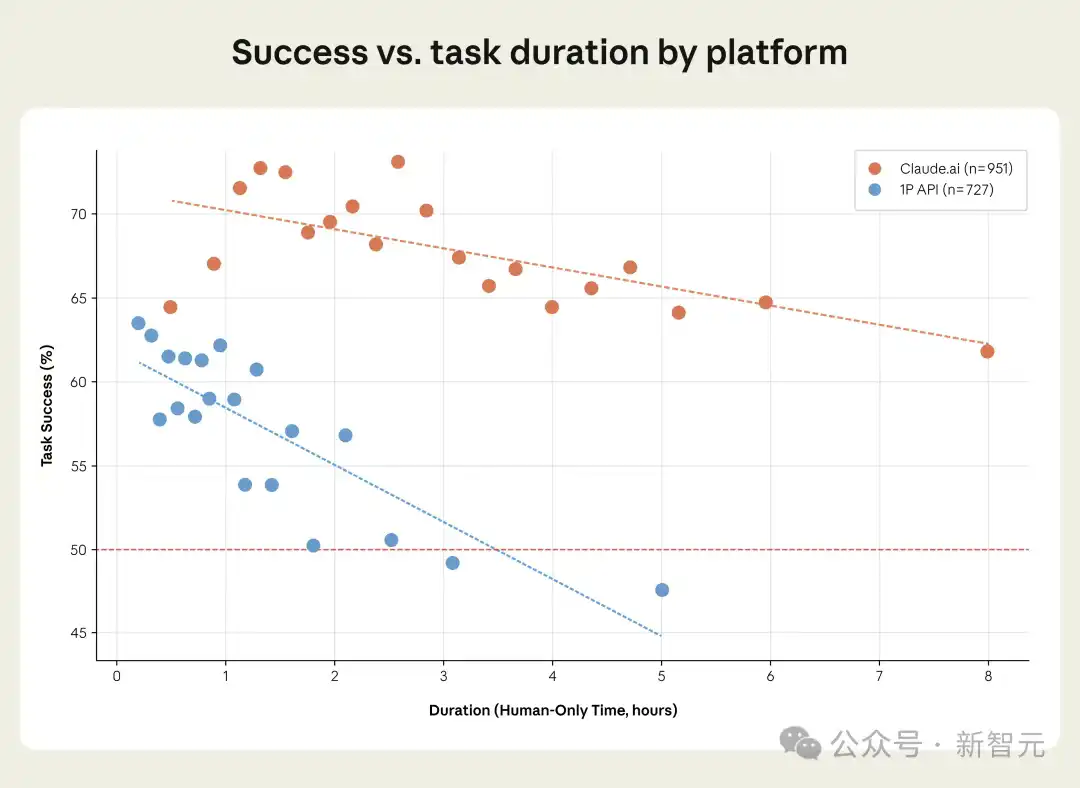
But in Anthropic's actual user data, this time limit is significantly extended.

In commercial scenarios using API calls, Claude can maintain a success rate of over 50% for tasks involving 3.5 hours of work.

And in the Claude.ai chat interface, this number is astonishingly pushed to 19 hours.

Why such a huge gap? The secret lies in human intervention.

Benchmark tests are AI facing the test alone, while real-world users break down a massive complex project into countless small steps, constantly correcting AI's course through feedback loops.

This human-AI collaborative workflow pushes the (50% success rate measured) task duration上限 (upper limit) from 2 hours to about 19 hours, nearly a 10-fold increase.

This might be the true shape of future work: not AI doing everything independently, but humans learning how to steer it through a marathon.

The Folded World Map: The Poor Learn Knowledge, the Rich Engage in Production

If we zoom out to a global perspective, we see a clear and slightly ironic "adoption curve".

In high per capita GDP developed countries, AI is already deeply embedded in productivity and personal life.

People use it to write code, create reports, and even plan travel itineraries.

But in countries with lower per capita GDP, Claude's primary role is "teacher," with大量 (a large number of) uses concentrated on coursework and educational tutoring.
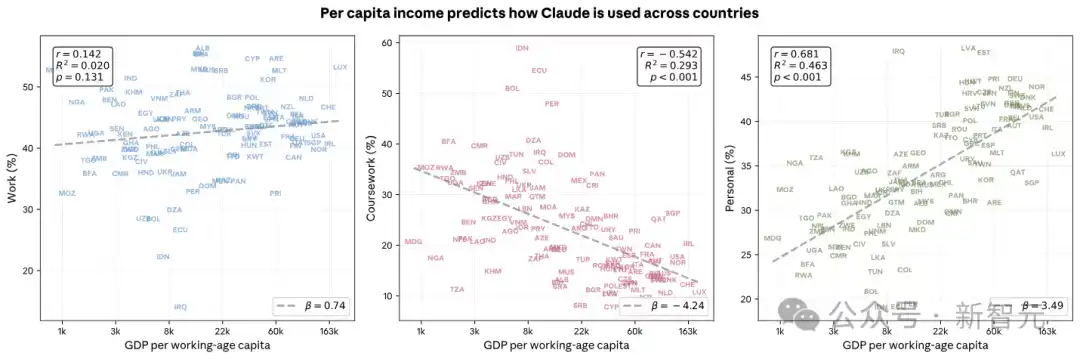
Beyond wealth disparity, this is also a manifestation of a technological gap.

Anthropic mentioned they are collaborating with the Rwandan government, trying to help people there leapfrog the mere "learning" phase and enter broader application layers.

Because without intervention, AI is likely to become a new barrier: people in wealthy regions use it to exponentially amplify output, while people in less developed regions are still using it to补习 (remedially learn) basic knowledge.

Workplace Concerns: The Specter of "Deskilling"

The most controversial and警惕 (warranting caution) part of the report is the discussion on "Deskilling".

Data indicates that the tasks currently covered by Claude require, on average, 14.4 years of educational background (equivalent to an associate degree), significantly higher than the 13.2 years required on average for overall economic activity.
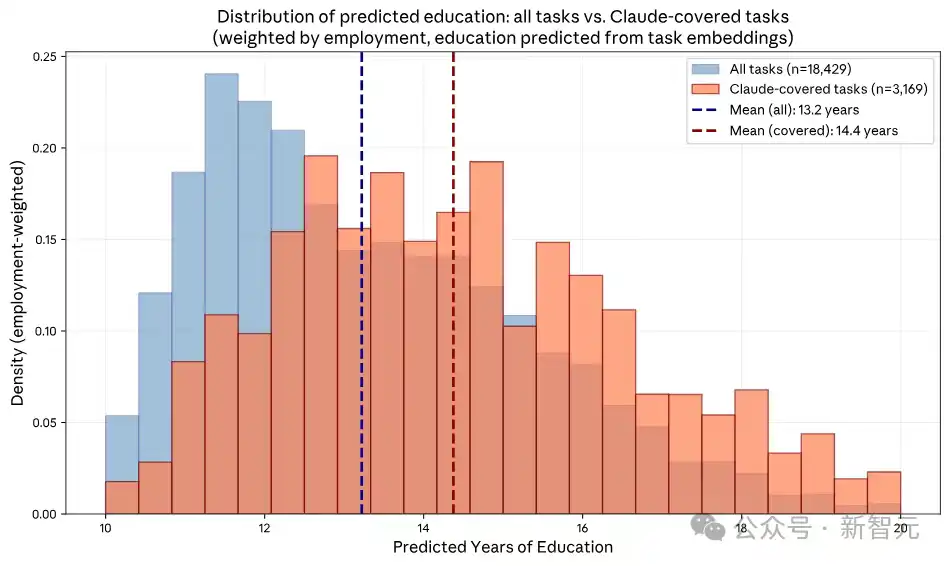
AI is systematically剔除 (removing) the "high-intelligence" parts of work.

For technical writers or travel agency agents, this could be disastrous.

AI takes over分析行业动态 (analyzing industry trends),规划复杂行程 (planning complex itineraries) — the tasks that require "brains" — leaving humans with only琐碎工作 (trivial tasks) like sketching or collecting invoices.

Your job remains, but the "gold content" of the job is hollowed out.

Of course, there are beneficiaries.

For example, real estate managers, when AI handles枯燥的行政工作 (tedious administrative work) like bookkeeping and contract comparison, can focus their energy on client negotiation and stakeholder management requiring high emotional intelligence—this is反而 (instead) a form of "Upskilling".

Anthropic cautiously states this is only an extrapolation based on the current situation, not an inevitable prophecy.

But the alarm it sounds is real.

If your core competitiveness is merely processing complex information, then you are at the eye of the storm.

A Return to the "Golden Age" of Productivity?

Finally, let's return to the macro perspective.

Anthropic revised its forecast for US labor productivity.

After剔除 (removing) possible AI errors and failures, they predict AI will drive productivity growth by 1.0% to 1.2% annually over the next decade.

This seems like a reduction of one-third compared to the previous optimistic estimate of 1.8%, but don't underestimate this 1 percentage point.

It is enough to bring US productivity growth back to the levels of the late 1990s internet boom.

Moreover, this is based solely on the model capabilities as of November 2025. With the entry of Claude Opus 4.5, and the gradual dominance of "augmented mode" (where people no longer try to dump all work on AI but collaborate with it more intelligently) in user behavior, this number has significant upside potential.

Conclusion

Reading through the entire report, what is most感慨 (striking) is not just how strong AI has become, but more how quickly humans are adapting.

We are undergoing a migration from "passive automation" to "active enhancement".

In this transformation, AI acts like a mirror; it takes over those tasks that require high education but can be completed through logical deduction, thereby forcing us to seek out value that cannot be quantified by algorithms.

In this era of computational surplus, humanity's scarcest ability is no longer finding answers, but defining problems.

References:

https://www.anthropic.com/research/economic-index-primitives

https://www.anthropic.com/research/anthropic-economic-index-january-2026-report

Связанные с этим вопросы

QAccording to Anthropic's report, which type of tasks does AI accelerate the most?

AAI accelerates complex tasks that require a higher level of education the most. Tasks requiring a college degree see a 12x speedup, compared to a 9x speedup for tasks requiring only a high school education.

QWhat is the key finding regarding human-AI collaboration in terms of task duration?

AThe key finding is that human-AI collaboration dramatically extends the viable task duration. While benchmarks suggest AI's 50% success rate drops at 2-hour tasks, real-world collaborative workflows push this limit to approximately 19 hours.

QHow does the primary use of AI differ between high-GDP and low-GDP countries, as per the report?

AIn high-GDP countries, AI is primarily used for productivity and personal life enhancement (e.g., coding, reports). In low-GDP countries, its main role is as an educational tool for coursework and tutoring.

QWhat is 'deskilling' and which professionals are most at risk from it?

A'Deskilling' is the process where AI systematically removes the high-intellect, analytical parts of a job, leaving humans with more mundane tasks. Professionals like technical writers and travel agents, whose core value is processing complex information, are most at risk.

QWhat is Anthropic's revised forecast for AI's annual impact on US productivity growth over the next decade?

AAnthropic's revised forecast estimates that AI will boost US labor productivity growth by 1.0% to 1.2% annually over the next decade, a figure comparable to the growth rates seen during the late 1990s internet boom.

Похожее

North Korean Hackers Loot $500 Million in a Single Month, Becoming the Top Threat to Crypto Security

North Korean hackers, particularly the notorious Lazarus Group and its subgroup TraderTraitor, have stolen over $500 million from cryptocurrency DeFi platforms in less than three weeks, bringing their total theft for the year to over $700 million. Recent major attacks on Drift Protocol and KelpDAO, resulting in losses of approximately $286 million and $290 million respectively, highlight a strategic shift: instead of targeting core smart contracts, attackers are now exploiting vulnerabilities in peripheral infrastructure. For instance, the KelpDAO attack involved compromising downstream RPC infrastructure used by LayerZero's decentralized validation network (DVN), allowing manipulation without breaching core cryptography. This sophisticated approach mirrors advanced corporate cyber-espionage. Additionally, North Korea has systematically infiltrated the global crypto workforce, with an estimated 100 operatives using fake identities to gain employment at blockchain companies, enabling long-term access to sensitive systems and facilitating large-scale thefts. According to Chainalysis, North Korean-linked hackers stole a record $2 billion in 2025, accounting for 60% of all global crypto theft that year. Their total historical crypto theft has reached $6.75 billion. Post-theft, they employ specialized money laundering methods, heavily relying on Chinese OTC brokers and cross-chain mixing services rather than standard decentralized exchanges. Security experts, while acknowledging the increased sophistication, emphasize that many attacks still exploit fundamental weaknesses like poor access controls and centralized operational risks. Strengthening private key management, limiting privileged access, and enhancing coordination among exchanges, analysts, and law enforcement immediately after an attack are critical to improving defense and fund recovery chances. The industry's challenge now extends beyond secure smart contracts to safeguarding operational security at the infrastructure level.

marsbit2 мин. назад

North Korean Hackers Loot $500 Million in a Single Month, Becoming the Top Threat to Crypto Security

marsbit2 мин. назад

Circle CEO's Seoul Visit: No Korean Won Stablecoin Issuance, But Met All Major Korean Banks

Circle CEO Jeremy Allaire's recent activities in Seoul indicate a strategic shift for the company, moving away from issuing a Korean won-backed stablecoin and instead focusing on embedding itself as a key infrastructure provider within Korea’s financial and crypto ecosystem. Despite Korea accounting for nearly 30% of global crypto trading volume—with a market characterized by high retail participation and altcoin dominance—Circle has chosen not to compete for the role of stablecoin issuer. Instead, Allaire met with major Korean banks (including Shinhan, KB, and Woori), financial groups, leading exchanges (Upbit, Bithumb, Coinone), and tech firms like Kakao. This approach reflects a broader industry transition: the core of stablecoin competition is shifting from issuance rights to systemic positioning. With Korean regulators still debating whether banks or tech companies should issue stablecoins, Circle is avoiding regulatory uncertainty by strengthening its role as a service and technology partner. The company is deepening integration with trading platforms, building connections, and promoting stablecoin infrastructure. This positions Circle to benefit regardless of which entity eventually issues a won stablecoin. Allaire also noted the potential for a Chinese yuan stablecoin in the next 3–5 years, underscoring a regional trend of stablecoins becoming more regulated and integrated with traditional finance. Ultimately, Circle’s strategy highlights that future influence in the stablecoin market will belong not necessarily to the issuers, but to the foundational infrastructure layers that enable cross-system transactions.

marsbit30 мин. назад

Circle CEO's Seoul Visit: No Korean Won Stablecoin Issuance, But Met All Major Korean Banks

marsbit30 мин. назад

SpaceX Ties Up with Cursor: A High-Stakes AI Gambit of 'Lock First, Acquire Later'

SpaceX has secured an option to acquire AI programming company Cursor for $60 billion, with an alternative clause requiring a $10 billion collaboration fee if the acquisition does not proceed. This structure is not merely a potential acquisition but a strategic move to control core access points in the AI era. The deal is designed as a flexible, dual-path arrangement, allowing SpaceX to either fully acquire Cursor or maintain a binding partnership through high-cost collaboration. This "option-style" approach minimizes immediate regulatory and integration risks while ensuring long-term alignment between the two companies. At its core, the transaction exchanges critical AI-era resources: SpaceX provides its Colossus supercomputing cluster—one of the world’s most powerful AI training infrastructures—while Cursor contributes its AI-native developer environment and strong product adoption. This synergy connects compute power, models, and application layers, forming a closed-loop AI capability stack. Cursor, founded in 2022, has achieved rapid growth with over $1 billion in annual revenue and widespread enterprise adoption. Its value lies in transforming software development through AI agents capable of coding, debugging, and system design—positioning it as a gateway to future software production. For SpaceX, this move is part of a broader strategy to evolve from a aerospace company into an AI infrastructure empire, integrating xAI, supercomputing, and chip manufacturing. Controlling Cursor fills a gap in its developer tooling layer, strengthening its AI narrative ahead of a potential IPO. The deal reflects a shift in AI competition from model superiority to ecosystem and entry-point control. With programming tools as a key battleground, securing developer loyalty becomes crucial for dominating the software production landscape. Risks include questions around Cursor’s valuation, technical integration challenges, and potential regulatory scrutiny. Nevertheless, the deal underscores a strategic bet: controlling both compute and software development access may redefine power dynamics in the AI-driven future.

marsbit1 ч. назад

SpaceX Ties Up with Cursor: A High-Stakes AI Gambit of 'Lock First, Acquire Later'

marsbit1 ч. назад

Торговля

Спот
Фьючерсы
活动图片