An App Made for 1000 RMB Now Valued at 10 Million

marsbitОпубликовано 2026-01-12Обновлено 2026-01-12

Введение

Three post-95s developers spent 1,000 RMB and less than a month to create an app called “Died Yet?” — now valued at 10 million RMB. The app allows users to check in daily to confirm they are alive. If a user misses two consecutive check-ins, the system automatically sends an email to their emergency contact. Launched on January 8, it quickly topped Apple’s paid app chart at 8 RMB per download. Paying users grew 200-fold in days. A capital offer followed: the founders are considering selling 10% equity for 1 million RMB, implying a 10 million RMB valuation. The app taps into a real anxiety: China has over 120 million people living alone, a number expected to reach 200 million by 2030. The app’s viral name, “Died Yet?”, originated from an online meme and was key to its success. A copycat app, “Alive Yet?”, emerged within 24 hours, but the founders argue the concept—not the tech—is the core value. The piece contrasts this with crypto valuations, citing Fuel Network—a project once valued at $1 billion with minimal users, now down 99%—to highlight different valuation models: one driven by real users and payments, the other by narrative and tokenomics. The author concludes that “Died Yet?” offers more tangible value than most speculative assets.

Written by: Curry, Shenchao TechFlow

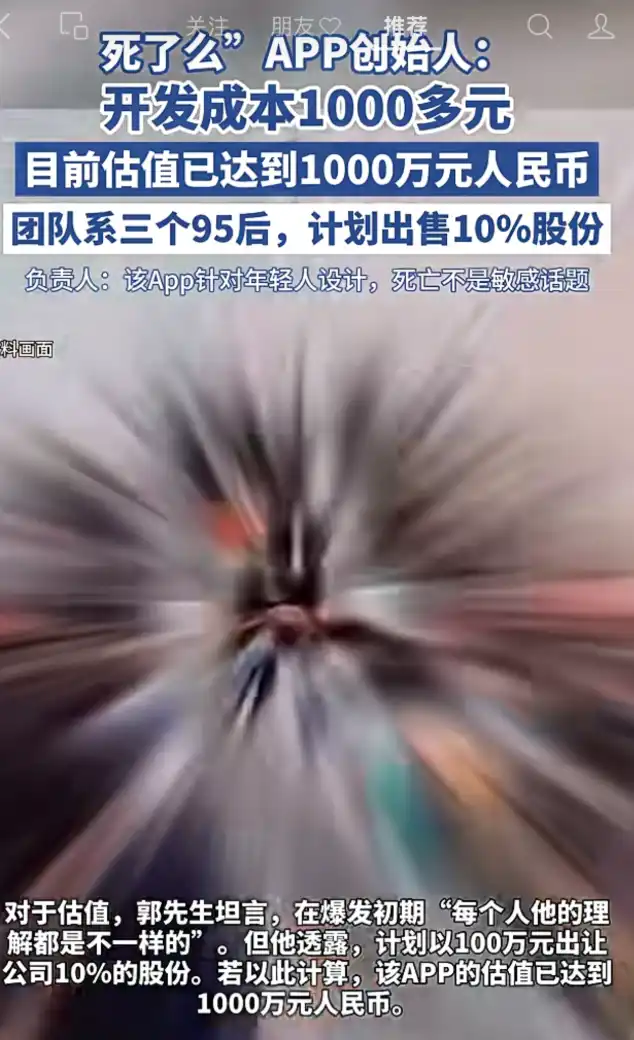
Three post-95s spent 1000 RMB and took less than a month to create an App.

Now it's valued at 10 million. A ten-thousand-fold increase.

This App is called "Is He Dead", and its function is ridiculously simple: open it every day and check in to prove you're still alive. If you don't check in for two consecutive days, the system automatically sends an email to your emergency contact.

That's it?

Yeah, that's it.

On January 8th, it topped the Apple paid charts, costing 8 RMB to download. Founder Mr. Guo said that the number of paying users has increased 200-fold in the past few days and is still rising.

Capital came knocking. Mr. Guo said he plans to sell 10% of the shares for 1 million RMB. Doing the math, that's a valuation of 10 million.
The name "Is He Dead" comes from a viral internet meme a few years ago.

Someone asked on a social platform: What App does everyone need and will definitely download?

A highly upvoted answer: Is He Dead.

Mr. Guo and his team saw this discussion and thought it had potential. They went to trademark the name and found that surprisingly, no one had registered it.

So they made it.

Why did something so simple become popular?

China's solo-living population exceeded 120 million in 2024. By 2030, it's projected to be 150 to 200 million. These people live in rental apartments in cities like Beijing, Shanghai, Guangzhou, and Shenzhen, sharing a common, very real anxiety:

If something happens to me at home one day, how long will it take for someone to find out? So, 8 RMB buys the confirmation that "someone knows I'm still alive."

Less than 24 hours after "Is He Dead" went viral, a copycat appeared.

An App called "Is He Alive" was listed on the Apple App Store, with exactly the same function, free to download.
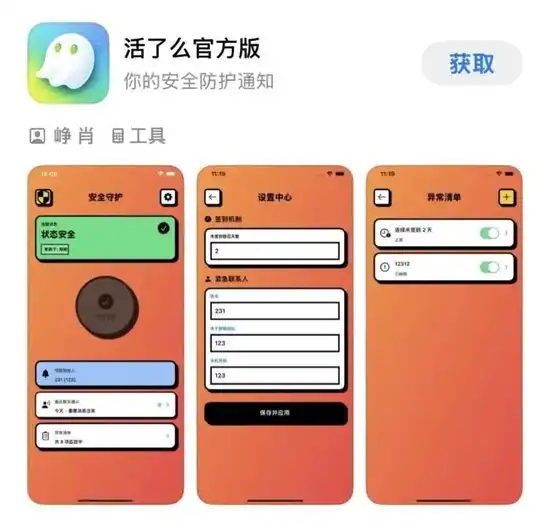
In response, Mr. Guo was very calm: The advantage of this product is not its technical barrier, but its discovery of user needs.

Translation: You can copy the function, but you can't copy my name.

Indeed. The three words "Is He Dead" are the most valuable part of this product. If it had been called "Solo Living Safety Guard," it would probably still be gathering dust in a corner of the App Store.

Looking back, an APP with no technical barrier, costing 1000 RMB, valued at 10 million, is that expensive?

Well, you might want to look at the valuation methods once used in the crypto industry?

In 2025, there was a crypto project called Fuel Network, working on a "modular blockchain execution layer." VCs gave it a valuation of 1 billion USD, roughly over 7 billion RMB.

700 times the valuation of "Is He Dead".

What does Fuel Network have?

A whitepaper, a roadmap, endorsements from a bunch of Tier1 institutions, videos of the founders speaking at major conferences.

But not many people actually using it.

What is Fuel Network's market cap now? Around 16 million USD. Down about 99% from its peak.
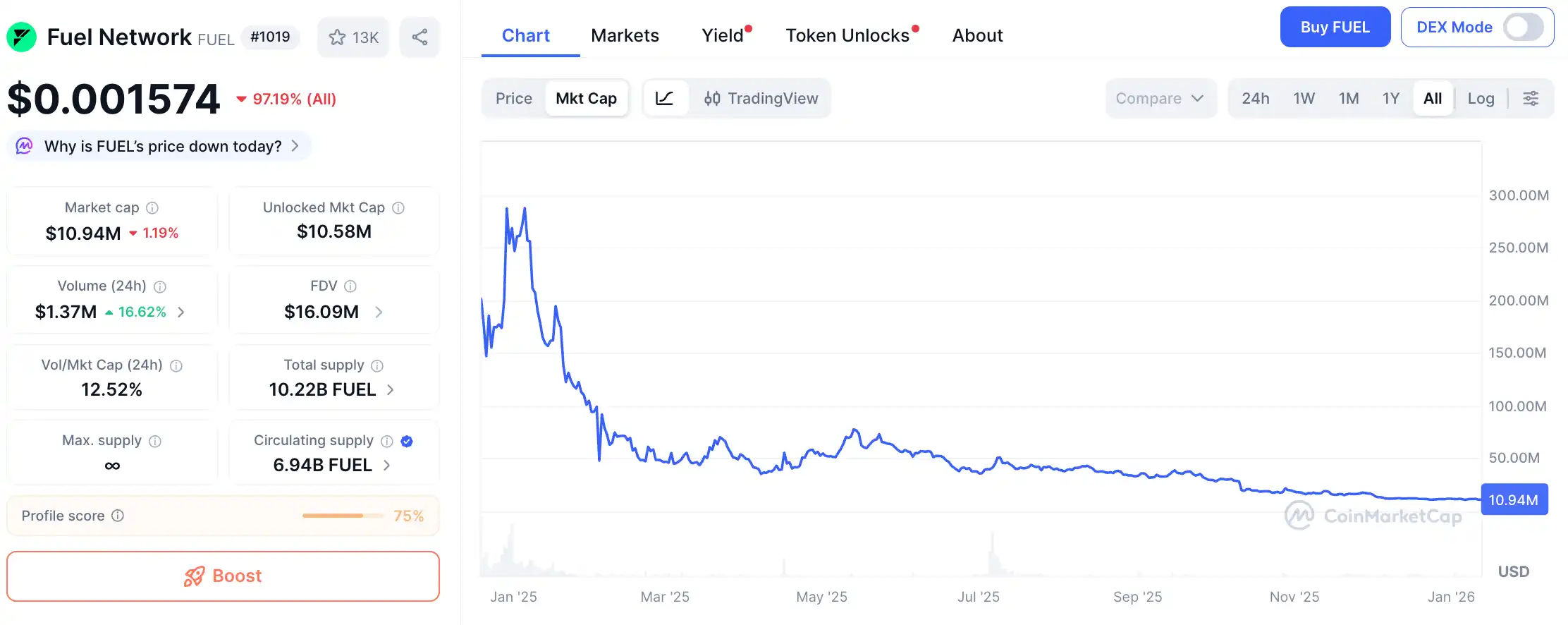
I'm not saying all crypto projects are scams.

I'm saying:

In the crypto world, a project can have no users, no revenue, no one actually using it, and still get a valuation of 1 billion USD.

In the world of "Is He Dead", you need people to actually pay 8 RMB to download it for it to count.

One gives a valuation first and then looks for users. The other has users first and then discusses valuation.

Which is more reasonable? I don't know.

What's more absurd is that the logic of "Is He Dead" is almost heresy in the crypto world.

You tell everyone: We have real users, real payments, solving a real need.

People will definitely ask: What's the narrative? The token economic model? What's the FDV?

You say: No token, just selling the App, 8 RMB each.

Everyone: Then why would I invest in you?

This isn't a joke. The crypto industry's valuation system operates like this.

Users aren't important, revenue isn't important; what's important is whether the story is sexy enough, whether the token can list on major exchanges, and whether the unlock schedule is long enough for early investors to have time to dump.

If "Is He Dead" issued a token, created a "Solo Living Chain", and painted a big picture of the "global loneliness economy", its valuation might really increase tenfold.

But then, it might not have real users anymore.

Perhaps the reason "Is He Dead" became popular is precisely because it serves people who have this anxiety but don't actually need it that badly.

The people who truly need it probably can't use it.

This is actually quite similar to the crypto industry:

Those who truly need "financial inclusion" are often the ones who can least use DeFi.

In the end, whether 10 million is expensive depends on what ruler you use.

Using the internet ruler: one month of development, a team of three, no funding, no burning cash, reaching number one on the paid charts, 10 million is not expensive.

Using the crypto ruler: no token, no narrative, no FDV, only 10 million? That's too cheap. How about issuing a token?

I think the most ironic point is the divide between Web2 and Web3:

In one world, "having users" is a prerequisite for valuation. In another world, "having users" is an accident of valuation.

After writing this, I actually downloaded "Is He Dead" and checked in.

8 RMB for peace of mind.

At least it's more reliable than most of the shitcoins I've bought.

Связанные с этим вопросы

QWhat is the name of the app developed by three post-95s with an initial cost of 1000 RMB, and what is its core function?

AThe app is called '死了么' (translated as 'Is It Dead'). Its core function is to allow users to sign in daily to prove they are alive. If a user fails to sign in for two consecutive days, the system automatically sends an email to their emergency contact.

QHow much did the app '死了么' cost to download, and what was its performance on the Apple paid charts?

AThe app cost 8 RMB to download. It reached number one on the Apple paid charts on January 8th.

QWhat is the estimated valuation of the '死了么' app, and how was this valuation determined?

AThe app has an estimated valuation of 10 million RMB. This was determined as the founder, Mr. Guo, plans to sell 10% of the company's shares for 1 million RMB.

QAccording to the article, what is the valuation approach in the crypto industry contrasted with that of the '死了么' app?

AIn the crypto industry, projects can receive high valuations based on narratives, token economic models, and backing from institutions, even without real users or revenue. In contrast, the '死了么' app's valuation is based on actual user downloads and payments, emphasizing real user demand.

QWhat ironic point does the article make about the target audience of the '死了么' app and its similarity to the crypto industry?

AThe article points out that the app likely serves people who have the anxiety of being found in case of an emergency but don't truly need it, while those who genuinely need it might not use it. This is similar to the crypto industry, where those who truly need 'financial inclusion' are often the least able to use DeFi.

Похожее

North Korean Hackers Loot $500 Million in a Single Month, Becoming the Top Threat to Crypto Security

North Korean hackers, particularly the notorious Lazarus Group and its subgroup TraderTraitor, have stolen over $500 million from cryptocurrency DeFi platforms in less than three weeks, bringing their total theft for the year to over $700 million. Recent major attacks on Drift Protocol and KelpDAO, resulting in losses of approximately $286 million and $290 million respectively, highlight a strategic shift: instead of targeting core smart contracts, attackers are now exploiting vulnerabilities in peripheral infrastructure. For instance, the KelpDAO attack involved compromising downstream RPC infrastructure used by LayerZero's decentralized validation network (DVN), allowing manipulation without breaching core cryptography. This sophisticated approach mirrors advanced corporate cyber-espionage. Additionally, North Korea has systematically infiltrated the global crypto workforce, with an estimated 100 operatives using fake identities to gain employment at blockchain companies, enabling long-term access to sensitive systems and facilitating large-scale thefts. According to Chainalysis, North Korean-linked hackers stole a record $2 billion in 2025, accounting for 60% of all global crypto theft that year. Their total historical crypto theft has reached $6.75 billion. Post-theft, they employ specialized money laundering methods, heavily relying on Chinese OTC brokers and cross-chain mixing services rather than standard decentralized exchanges. Security experts, while acknowledging the increased sophistication, emphasize that many attacks still exploit fundamental weaknesses like poor access controls and centralized operational risks. Strengthening private key management, limiting privileged access, and enhancing coordination among exchanges, analysts, and law enforcement immediately after an attack are critical to improving defense and fund recovery chances. The industry's challenge now extends beyond secure smart contracts to safeguarding operational security at the infrastructure level.

marsbit11 мин. назад

North Korean Hackers Loot $500 Million in a Single Month, Becoming the Top Threat to Crypto Security

marsbit11 мин. назад

Circle CEO's Seoul Visit: No Korean Won Stablecoin Issuance, But Met All Major Korean Banks

Circle CEO Jeremy Allaire's recent activities in Seoul indicate a strategic shift for the company, moving away from issuing a Korean won-backed stablecoin and instead focusing on embedding itself as a key infrastructure provider within Korea’s financial and crypto ecosystem. Despite Korea accounting for nearly 30% of global crypto trading volume—with a market characterized by high retail participation and altcoin dominance—Circle has chosen not to compete for the role of stablecoin issuer. Instead, Allaire met with major Korean banks (including Shinhan, KB, and Woori), financial groups, leading exchanges (Upbit, Bithumb, Coinone), and tech firms like Kakao. This approach reflects a broader industry transition: the core of stablecoin competition is shifting from issuance rights to systemic positioning. With Korean regulators still debating whether banks or tech companies should issue stablecoins, Circle is avoiding regulatory uncertainty by strengthening its role as a service and technology partner. The company is deepening integration with trading platforms, building connections, and promoting stablecoin infrastructure. This positions Circle to benefit regardless of which entity eventually issues a won stablecoin. Allaire also noted the potential for a Chinese yuan stablecoin in the next 3–5 years, underscoring a regional trend of stablecoins becoming more regulated and integrated with traditional finance. Ultimately, Circle’s strategy highlights that future influence in the stablecoin market will belong not necessarily to the issuers, but to the foundational infrastructure layers that enable cross-system transactions.

marsbit38 мин. назад

Circle CEO's Seoul Visit: No Korean Won Stablecoin Issuance, But Met All Major Korean Banks

marsbit38 мин. назад

SpaceX Ties Up with Cursor: A High-Stakes AI Gambit of 'Lock First, Acquire Later'

SpaceX has secured an option to acquire AI programming company Cursor for $60 billion, with an alternative clause requiring a $10 billion collaboration fee if the acquisition does not proceed. This structure is not merely a potential acquisition but a strategic move to control core access points in the AI era. The deal is designed as a flexible, dual-path arrangement, allowing SpaceX to either fully acquire Cursor or maintain a binding partnership through high-cost collaboration. This "option-style" approach minimizes immediate regulatory and integration risks while ensuring long-term alignment between the two companies. At its core, the transaction exchanges critical AI-era resources: SpaceX provides its Colossus supercomputing cluster—one of the world’s most powerful AI training infrastructures—while Cursor contributes its AI-native developer environment and strong product adoption. This synergy connects compute power, models, and application layers, forming a closed-loop AI capability stack. Cursor, founded in 2022, has achieved rapid growth with over $1 billion in annual revenue and widespread enterprise adoption. Its value lies in transforming software development through AI agents capable of coding, debugging, and system design—positioning it as a gateway to future software production. For SpaceX, this move is part of a broader strategy to evolve from a aerospace company into an AI infrastructure empire, integrating xAI, supercomputing, and chip manufacturing. Controlling Cursor fills a gap in its developer tooling layer, strengthening its AI narrative ahead of a potential IPO. The deal reflects a shift in AI competition from model superiority to ecosystem and entry-point control. With programming tools as a key battleground, securing developer loyalty becomes crucial for dominating the software production landscape. Risks include questions around Cursor’s valuation, technical integration challenges, and potential regulatory scrutiny. Nevertheless, the deal underscores a strategic bet: controlling both compute and software development access may redefine power dynamics in the AI-driven future.

marsbit1 ч. назад

SpaceX Ties Up with Cursor: A High-Stakes AI Gambit of 'Lock First, Acquire Later'

marsbit1 ч. назад

Торговля

Спот
Фьючерсы
活动图片