A New Crypto Predator Emerges: Google Exposes ‘Ghostblade’

bitcoinistОпубликовано 2026-03-21Обновлено 2026-03-21

Введение

A new iOS malware called "Ghostblade," part of the DarkSword tool suite, has been exposed by Google Threat Intelligence. Designed to steal sensitive data from Apple devices, it targets cryptocurrency private keys, messages from iMessage, WhatsApp, and Telegram, as well as SIM details, location data, and media files. Ghostblade operates once, extracts information, and then deletes crash logs to avoid detection, leaving no persistent trace. This makes it particularly effective and hard to identify. The emergence of Ghostblade reflects a broader shift in cyberattacks toward individual crypto users rather than institutions. Although overall crypto hack losses dropped to around $50 million in February—down from $385 million the previous month—this decline is due to attackers shifting from code exploits to social engineering, phishing, and wallet poisoning schemes. The report underscores that high-value individual holders are increasingly targeted through deceptive websites and malware designed to operate quickly and discreetly.

Private crypto holders took the heaviest losses from hacking, phishing, and digital theft attempts in February 2026, according to blockchain intelligence firm Nominis — and a newly identified strain of iOS malware may explain part of why individual users have become the preferred target.

Designed To Strike Fast And Disappear

Google Threat Intelligence has identified a JavaScript-based malicious tool called Ghostblade, built specifically to hit Apple iOS devices, extract sensitive data, and go quiet before anyone notices.

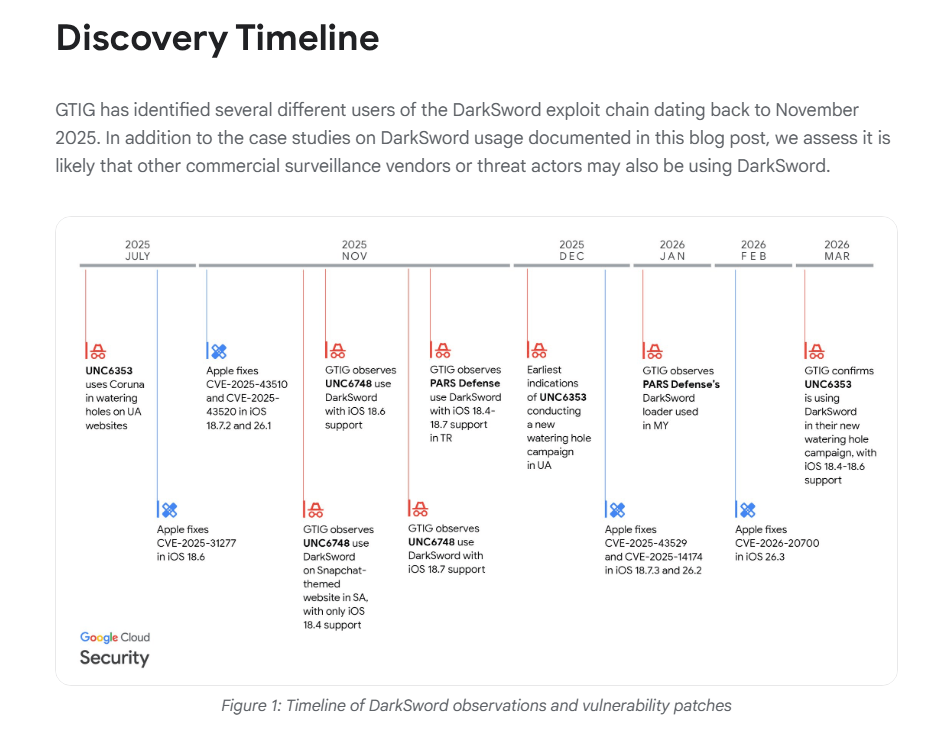
The software is one of six tools bundled inside a broader package researchers are calling DarkSword. Together, the tools are engineered to steal cryptocurrency private keys, messaging data, and personal information from infected devices.

Ghostblade runs once, takes what it needs, and stops. No persistent background activity. No extra software required to make it work. That design makes it far harder to catch than malware that keeps running after an infection.
Source: Google

The tool also covers its tracks in a specific way. After it finishes, it wipes crash logs from the compromised device. Those logs are what Apple normally collects to identify software problems and flag suspicious activity. Without them, Apple receives no signal that anything went wrong.

What Ghostblade Can Actually Access

The scope of what Ghostblade can pull from a device is wide. Based on Google’s report, the malware is capable of reaching messages from iMessage, WhatsApp, and Telegram.

It can also collect SIM card details, location data, multimedia files, and system-level settings. For crypto users, the most direct threat is private key exposure — the kind of access that gives an attacker full control over a digital wallet with no way to reverse transactions once funds are moved.

Bitcoin is currently trading at $70,572. Chart: TradingView

The DarkSword suite represents a new chapter in browser-based attacks aimed at the crypto space, with Ghostblade serving as one of its most technically refined components.

Hackers Shift Focus From Code To People

Total losses from crypto-related hacks dropped sharply in February, falling to close to $50 million from $385 million the month before, Nominis data shows. But that decline does not signal a safer environment.

Reports indicate the drop reflects a change in method, not ambition. Attackers moved away from exploiting code vulnerabilities and toward phishing schemes, wallet poisoning, and other approaches that rely on tricking users rather than breaking systems.

Fake websites built to mirror legitimate platforms are a common vehicle. Users who land on them and interact with any element can have credentials and keys lifted without realizing it.

The Ghostblade alert from Google arrives against that backdrop — a reminder that high-value individual users, not just exchanges or protocols, are firmly in the crosshairs.

Featured image from Unsplash, chart from TradingView

Связанные с этим вопросы

QWhat is the name of the newly identified iOS malware described in the article, and what is its primary function?

AThe malware is called Ghostblade. Its primary function is to extract sensitive data, such as cryptocurrency private keys, messaging data, and personal information, from infected Apple iOS devices and then go quiet to avoid detection.

QAccording to the article, what broader package is Ghostblade a part of, and what is the collective goal of its tools?

AGhostblade is one of six tools bundled inside a broader package called DarkSword. The collective goal of these tools is to steal cryptocurrency private keys, messaging data, and personal information from infected devices.

QHow does the Ghostblade malware avoid detection after it completes its task on a compromised device?

AGhostblade avoids detection by running only once, taking the data it needs, and then stopping with no persistent background activity. It also covers its tracks by wiping crash logs from the device, which prevents Apple from receiving signals that would normally flag suspicious activity.

QWhat specific types of data can the Ghostblade malware access on an infected device?

AGhostblade can access messages from iMessage, WhatsApp, and Telegram. It can also collect SIM card details, location data, multimedia files, system-level settings, and most critically for crypto users, private keys that control digital wallets.

QWhat trend in cyber attacks does the article highlight, as shown by the change in total crypto losses from January to February 2026?

AThe article highlights a trend where attackers are shifting their focus from exploiting code vulnerabilities to using methods that trick users, such as phishing schemes and wallet poisoning. This is evidenced by a sharp drop in total losses from $385 million in January to about $50 million in February, which reflects this change in method rather than a decrease in attacker ambition.

Похожее

Fu Peng's First Public Speech in 2026: What Exactly Are Crypto Assets? Why Did I Join the Crypto Asset Industry?

Fu Peng, a renowned macroeconomist and now Chief Economist at New火 Group, delivered his first public speech of 2026 at the Hong Kong Web3 Festival. He explained his perspective on crypto assets and why he joined the industry, framing it within the context of macroeconomic trends and financial evolution. Fu emphasized that crypto assets are transitioning from an early, belief-driven phase to a mature, institutionally integrated asset class. He drew parallels to the 1970s-80s, when technological advances (like computing) revolutionized traditional finance, leading to the rise of FICC (Fixed Income, Currencies, and Commodities). Similarly, current advancements in AI, data, and blockchain are reshaping finance, with crypto assets becoming part of a new "FICC + C" (C for Crypto) framework. He noted that institutional capital, including traditional hedge funds, avoided early crypto due to its speculative nature but are now engaging as regulatory clarity emerges (e.g., stablecoin laws, CFTC classifying crypto as a commodity). Fu predicted that 2025-2026 marks a turning point where crypto becomes a standardized, financially viable asset for diversified portfolios, akin to commodities or derivatives in traditional finance. Fu defined Bitcoin not as "digital gold" in a simplistic sense but as a value-preserving, financially tradable asset. He highlighted that crypto's future lies in regulated, institutional adoption, moving away from retail-dominated trading. His entry into crypto signals this maturation, where traditional finance integrates crypto into mainstream asset management.

marsbit52 мин. назад

Fu Peng's First Public Speech in 2026: What Exactly Are Crypto Assets? Why Did I Join the Crypto Asset Industry?

marsbit52 мин. назад

Justin Sun Sues Trump Family: What $75 Million Bought Was Only a Blacklist

Justin Sun, founder of Tron, has filed a lawsuit in federal court against World Liberty Financial (WLF), alleging he was made the "primary target of a fraudulent scheme" after investing $75 million. Sun claims the investment secured him an advisor title and WLFI tokens, which were later frozen by WLF, causing "hundreds of millions in losses." The dispute began in late 2024 when Sun's investment helped revive WLF's struggling token sale, which ultimately raised $550 million. Shortly after, the SEC dropped its lawsuit against Sun following Donald Trump's inauguration. However, relations soured when Sun refused WLF's demands for additional funding. In August 2025, WLF added a "blacklist" function to its smart contract, allowing it to unilaterally freeze tokens. Sun's holdings, worth approximately $107 million, were frozen, and he was threatened with token destruction. The lawsuit highlights WLF's structure, which directs 75% of token sale profits to the Trump family, who had earned $1 billion by December 2025. WLF's CEO is Zach Witkoff, son of U.S. Middle East envoy Steve Witkoff. The project faces scrutiny for opaque operations, including a controversial loan arrangement on the Dolomite platform, co-founded by a WLF advisor. Despite Sun's history with the SEC, the case underscores centralization risks within DeFi, as WLF controls governance and holds powers to freeze assets arbitrarily. Sun's tokens remain frozen as legal proceedings begin.

marsbit1 ч. назад

Justin Sun Sues Trump Family: What $75 Million Bought Was Only a Blacklist

marsbit1 ч. назад

$500 to Buy OpenAI Stock: Silicon Valley's Most Respectable Liquidity Invitation

Silicon Valley's largest venture capital platform, AngelList, has launched a new fund called USVC, allowing U.S. retail investors to buy into high-profile AI companies like OpenAI, Anthropic, and xAI with a minimum investment of $500—no accredited investor status required. Promoted by AngelList co-founder Naval Ravikant, the fund is framed as an opportunity for ordinary people to access high-growth private tech investments traditionally reserved for VCs. However, critics argue it functions more like an exit vehicle for early insiders. USVC acquires shares not through primary rounds but largely via secondary transactions—purchasing stakes from early investors, VC funds, and employees looking to cash out at peak valuations. With companies like xAI heavily weighted in the portfolio, the fund effectively channels retail money into providing liquidity for insiders who entered at much lower valuations. The fund’s structure raises concerns: shares are illiquid, with no secondary market, and buybacks are limited and discretionary. The actual annual fee reaches 3.61%, far above the advertised 1% management fee. This model parallels the "low float, high fully diluted valuation" strategy seen in crypto, where early investors profit by selling to latecomers at inflated prices. The timing—alongside similar moves by platforms like Robinhood—suggests that Silicon Valley’s sudden interest in retail inclusion may be less about democratizing access and more about securing exits for insiders.

marsbit1 ч. назад

$500 to Buy OpenAI Stock: Silicon Valley's Most Respectable Liquidity Invitation

marsbit1 ч. назад

Торговля

Спот
Фьючерсы
活动图片